

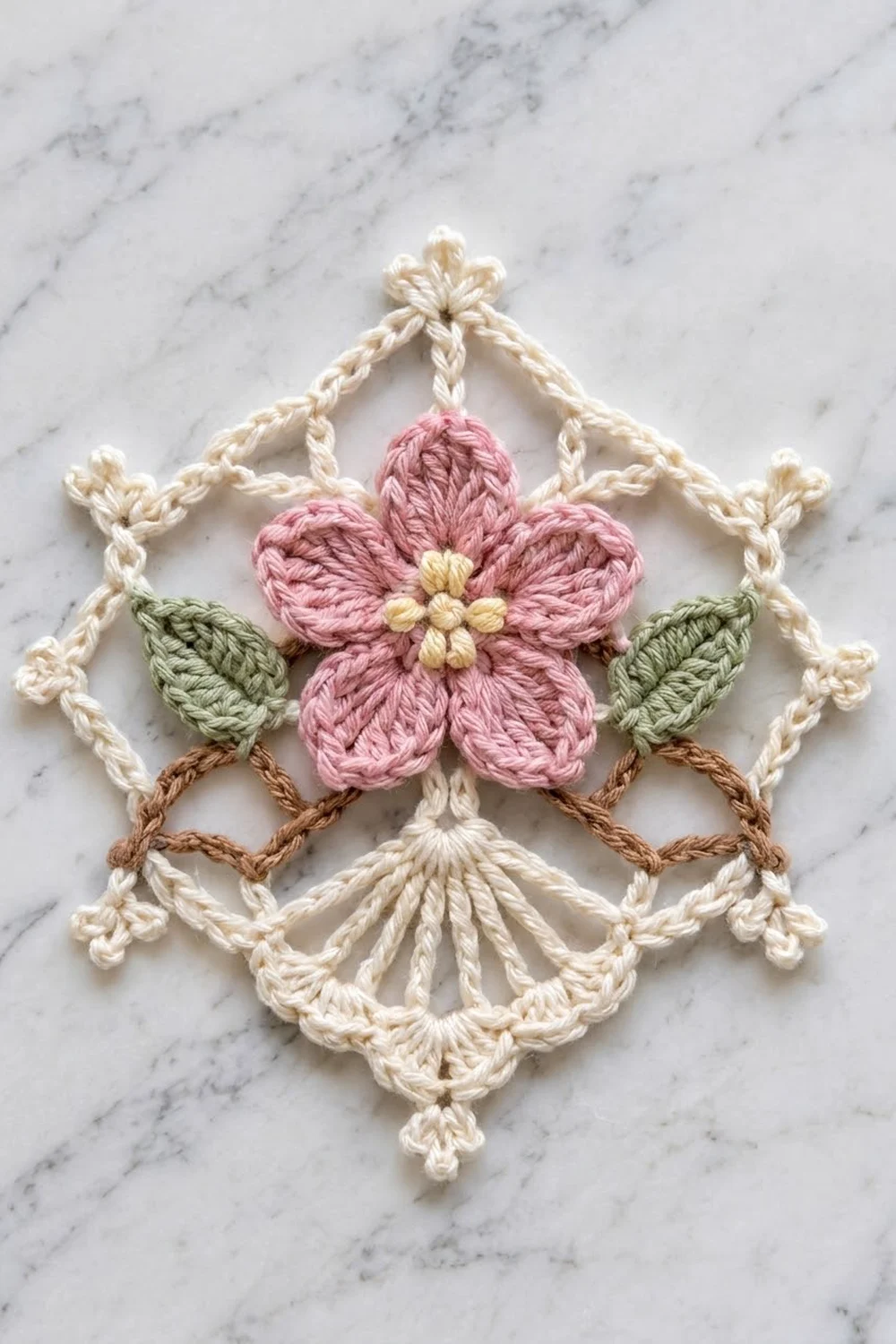
The Blossom Fan Lace Diamond is a single lace motif set on point. A cream chain-mesh frame surrounds a radiating fan, and a soft pink flower sits in the middle, framed by two sage leaves and a pair of brown branches. Small picots trim every edge, and a three-picot trefoil marks each of the four points.
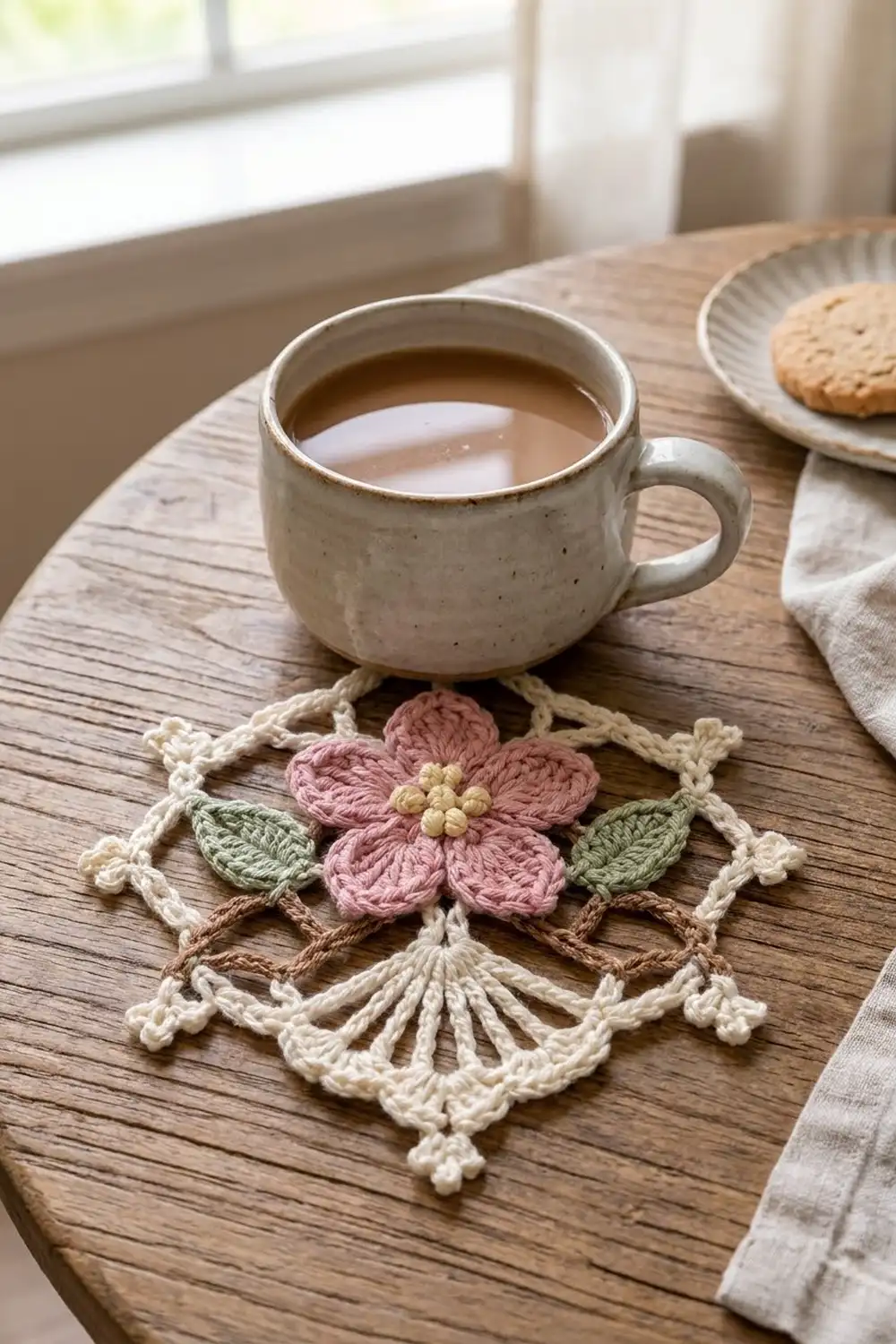
The palette is cream, dusty pink, sage green, warm brown, and pale butter yellow. The style is cottage-romantic and light, so the motif works on its own as a doily, a table accent, a sachet front, or a gift tag.
This pattern uses US crochet terms. The finished motif measures 6.5 in (16.5 cm) from point to point, both across and from top to bottom, after blocking.
You’ll work the cream base in five rounds from a center ring. One round is deliberately lopsided, with a fan in the lower half and chain loops in the upper half. Rounds 4 and 5 turn the circle into a diamond. The flower, leaves, and branches are made separately and sewn on in layers.
Finished Size and Construction
- Finished size: 6.5 in (16.5 cm) point to point, blocked
- Skill level: Intermediate
- Terminology: US crochet terms
- Yarn weight: DK (light, #3) cotton
- Hook: 3.5 mm (E-4)
- Number of pieces: 1 finished motif, made from 1 base and 5 appliqué parts (1 flower, 2 leaves, 2 branches)
- Layout: single motif set on point (diamond)
- Piece size: 6.5 in (16.5 cm) point to point
- Size before border: 5.75 in (14.6 cm) point to point after Round 4
- Border depth: 0.375 in (1.0 cm) on each side
Materials
Use a smooth mercerized or combed cotton in DK weight, about 125 m per 50 g. Cotton holds the picots crisp and blocks well. Choose a soft, slightly muted pink and a gray-leaning sage so the flower stays gentle against the cream.
- Cream (base): 12 g, 30 m
- Dusty pink (flower): 5 g, 13 m
- Sage green (leaves): 3 g, 8 m
- Warm brown (branches): 2 g, 5 m
- Pale butter yellow (flower center): 1 g, 3 m
Tools:
- 3.5 mm (E-4) crochet hook
- Tapestry needle
- Sharp embroidery needle for appliqué
- Rustproof pins
- Blocking mat or folded towel
- Spray bottle
- Ruler or tape measure
- Stitch marker
All quantities include a margin of about 20% for your gauge swatch, weaving in ends, and sewing tails.
Abbreviations (US Terms)
- ch – chain
- sl st – slip stitch
- sc – single crochet
- hdc – half double crochet
- dc – double crochet
- tr – treble crochet
- st(s) – stitch(es)
- sk – skip
- sp – space
- MR – magic ring
- BLO – back loop only
Special stitches:
- Picot: Ch 3, sl st in 3rd ch from hook.
- Trefoil picot (tp): Ch 3, sl st in 3rd ch from hook; ch 4, sl st in 4th ch from hook; ch 3, sl st in 3rd ch from hook. You get 3 picots side by side, with the longer one in the middle.
Gauge and Checkpoints
Base gauge: 20 sc and 22 rows = 4 in (10.2 cm) in DK cotton with a 3.5 mm hook.
Lace gauge is easier to check against the motif itself, so make one base and measure it at each stage. Measure flat, without stretching:
- After Round 1: 1.25 in (3.2 cm) across
- After Round 2: the fan is 3.5 in (8.9 cm) wide, measured from the first tr to the last tr
- After Round 3: 4.25 in (10.8 cm) wide
- After Round 4: 5.5 in (14.0 cm) unblocked, opening to 5.75 in (14.6 cm) blocked
- After Round 5: 6.5 in (16.5 cm) blocked
Each checkpoint allows ±0.25 in (0.6 cm).
If the motif is too big: If Round 3 is more than 0.5 in (1.3 cm) too wide, go down to a 3.25 mm hook. Also check that your chain loops aren’t loose.
If the motif is too small: Go up to a 3.75 mm hook, or relax your chains. Tight chains are the most common reason lace shrinks.
Base Motif (Cream)
Round 1
MR, ch 3 (counts as dc), 15 dc in ring. Pull the ring closed and sl st to the top of the beginning ch-3. (16 dc)
Number the stitches 1 to 16, with the beginning ch-3 as st 1. Stitches 1–8 become the lower half and stitches 9–16 the upper half.
Round 2 (Fan and Upper Loops)
Ch 4 (counts as tr), tr in st 1. Work 2 tr in each of sts 2–8. (16 tr fan)
Ch 4, sc in next st, 8 times, working in sts 9–16. Sl st to the top of the beginning ch-4. No chain is needed here, because st 16 sits right next to st 1.
Round 2 total: 16 tr, 8 sc, 8 ch-4 loops.
The 16 trebles spread into a half-circle fan across the lower half of the ring.
Round 3 (Fan Rim and Upper Mesh)
Ch 1, sc in the same st (tr 1).
Ch 3, sk next tr, sc in next tr, 7 times. Your last sc goes in tr 15.
Ch 3, sk tr 16, sc in the first ch-4 loop. This makes the 8th ch-3 sp.
Ch 5, sc in next ch-4 loop, 7 times. Ch 5, then sl st to the first sc.
Round 3 total: 16 sc, 8 ch-3 sps (fan rim), 8 ch-5 loops (upper mesh) = 16 sps.
Number the spaces 1–16, starting with the first ch-3 sp. The four points of the diamond fall at these sc:
- Left point: sc in tr 1, between sps 16 and 1
- Bottom point: sc in tr 9, between sps 4 and 5
- Right point: sc in the first ch-4 loop, between sps 8 and 9
- Top point: sc in the 5th ch-4 loop, between sps 12 and 13
Round 4 (Diamond Frame)
- Sl st into sp 1. Ch 1, sc in the same sp.
- Ch 6, sc in next sp, 3 times (sps 2–4).
- Ch 9, sc in sp 5. This is the bottom corner.
- Ch 6, sc in next sp, 3 times (sps 6–8).
- Ch 9, sc in sp 9. This is the right corner.
- Ch 6, sc in next sp, 3 times (sps 10–12).
- Ch 9, sc in sp 13. This is the top corner.
- Ch 6, sc in next sp, 3 times (sps 14–16).
- Ch 9, sl st to the first sc. This is the left corner.
Round 4 total: 16 sc, 12 ch-6 side loops, 4 ch-9 corner loops.
Each side of the diamond now has 3 ch-6 loops, with a ch-9 loop at each end. The longer corner chains pull the circle out into points. Don’t fasten off; carry straight on to the border.
Appliqué Pieces
Flower (Dusty Pink)
Rnd 1: MR, ch 1, 10 sc in ring, sl st to the first sc. (10 sc)
Rnd 2: Ch 1, sc in the same st, ch 3, sk 1. Sc in next st, ch 3, sk 1, 4 times. Sl st to the first sc. (5 sc, 5 ch-3 sps)
Rnd 3: In each ch-3 sp, work (sc, hdc, 2 dc, tr, 2 dc, hdc, sc). Sl st to the first sc. (5 petals of 9 sts = 45 sts)
Rnd 4 (ridge outline): Working loosely, sl st in BLO of each st around. (45 sl st)
This raised slip-stitch ridge gives each petal the rolled edge seen on the finished flower. Fasten off and leave a 12 in (30.5 cm) tail. The flower measures 2.75 in (7.0 cm) across.
Center: With butter yellow and an embroidery needle, work one French knot in the center of the ring. Add 5 more knots around it, one at the base of each petal, wrapping the yarn twice for each knot. (6 knots)
Leaves (Sage Green, Make 2)
- Ch 10.
- Working into chs 2–9 in turn: sc, hdc, dc in next 3 ch, hdc, sc, sl st. (8 sts)
- Work (sl st, ch 2, sl st) in the last ch. This forms the tip.
- Rotate and work along the free loops of chs 9–2, mirroring step 2: sl st, sc, hdc, dc in next 3 ch, hdc, sc. (8 sts)
- Sl st in the first sc, then ch 2 to make the stem nub.
Total per leaf: 16 sts plus the tip.
Each leaf is 1.75 in (4.4 cm) long and 0.75 in (1.9 cm) wide. Fasten off and leave a 10 in (25.4 cm) tail.
Branches (Brown, Make 2)
Ch 21. Sl st in the back bump of the 2nd ch from hook and of each ch across. (20 sl st)
Each branch measures 3.5 in (8.9 cm). Fasten off and leave a 10 in (25.4 cm) tail.
Border (Cream, Round 5)
Border gauge: About 26 sc per side over the side length of the blocked diamond, including the trefoil picots.
Round 5: You’re at the first sc of Round 4, and the next loop is a ch-6 loop.
Ch 1. (3 sc, picot, 3 sc) in each of the next 3 ch-6 loops, then (4 sc, tp, 4 sc) in the next ch-9 loop, 4 times. Sl st to the first sc and fasten off.
Counts per side: Measure each side from the middle of one trefoil to the middle of the next:
- 4 sc from the first corner loop
- 18 sc from the 3 side loops (3 × 6)
- 4 sc from the next corner loop
That gives 26 sc and 3 picots per side. The 8 sc in each corner loop are shared, 4 per side, so no corner stitch is counted twice.
Round 5 total: 104 sc, 12 picots, 4 trefoil picots.
Check: 12 loops × 6 sc = 72, plus 4 loops × 8 sc = 32, gives 104. Likewise, 4 sides × 26 = 104.
Why the math works: Each side spans 27 chains from Round 4: 3 × 6 side chains plus half of each ch-9 corner (4.5 + 4.5). Working 26 sc into 27 chains is almost one sc per chain, so the loops are filled without ruffling. The slightly lower count keeps the edge taut and straight between points. The extra sc in each corner loop gives the trefoil room to sit out at the point, which adds the 0.375 in (1.0 cm) border depth on each side: 5.75 in + 0.75 in = 6.5 in (16.5 cm).
Assembly of Layers
Pin the pieces in order, working from the bottom layer up:
- Branches: Lay one branch from the center of the motif toward the left point, in a shallow upward arc just above the fan rim. Lay the second branch as its mirror toward the right point. Sew them down with small stitches through the back bumps.
- Leaves: Place a leaf over the outer end of each branch, with the tip pointing toward the left or right point and the stem nub touching the branch. Whipstitch around the edge.
- Flower: Center the flower over Round 1 and the upper mesh, so the lower petals just overlap the top of the fan. Tack each petal at its base and at its tip, leaving the ridge outline free.
Sew through the cream stitches only, not across the open loops, so the lace stays open. Weave in all ends on the back.
Final Blocking
- Spritz the motif evenly until it’s damp, not dripping.
- Lay it face down on the blocking mat over a towel, which protects the raised flower.
- Pin the four trefoil points first, so the diamond measures 6.5 in (16.5 cm) both across and top to bottom.
- Pin the middle of each side straight, then pin out each of the 12 side picots.
- Spread the fan trebles evenly and pin the 8 scallops of the fan rim.
- Let it dry completely.
- Unpin, turn it face up, and lightly shape the petals with your fingers.
Final Quality-Control Checklist
- [ ] Round 2 has 16 tr, 8 sc, and 8 ch-4 loops.
- [ ] Round 3 has 16 sps: 8 ch-3 and 8 ch-5.
- [ ] Round 4 has 12 ch-6 loops and 4 ch-9 corner loops.
- [ ] Round 5 has 26 sc per side and 104 sc in total.
- [ ] Each side has 3 picots, and each point has a trefoil.
- [ ] The flower has 5 even petals and 6 butter-yellow knots.
- [ ] The leaves mirror each other, with their tips toward the side points.
- [ ] The branches arc evenly above the fan.
- [ ] The blocked motif measures 6.5 in (16.5 cm) point to point, ±0.25 in (0.6 cm).
- [ ] All ends are woven in invisibly.
Troubleshooting
The fan cups or ruffles: Your trebles are too tall or loose. Go down a hook size for Round 2 only.
The top of the motif is shorter than the bottom: This is normal before blocking, because the ch-4 loops are shorter than the trebles. Pin the top point out to match the bottom.
The edges bow inward between points: Your border is too tight. Loosen your sc, or work Round 5 with a hook 0.25 mm larger.
The edges wave: The chains in Round 4 are too loose. Re-chain them more snugly.
The petals are uneven: Check that every ch-3 sp in Rnd 2 is really ch 3 and that you skipped exactly 1 st.
The appliqué puckers the lace: Undo the stitches and resew with looser tension, catching only solid stitches.
Care
Hand wash cool with mild soap, then roll in a towel to press out the water. Lay the motif flat and pin it back to 6.5 in (16.5 cm) to dry.
Final Notes
The measurement chain runs like this:
- Round 1: 1.25 in (3.2 cm)
- Fan: 3.5 in (8.9 cm)
- Round 3: 4.25 in (10.8 cm)
- Round 4: 5.75 in (14.6 cm) blocked
- Border: adds 0.375 in (1.0 cm) on each side, for a finished 6.5 in (16.5 cm) diamond
Each stage depends on the one before, so check your measurements as you go and the final shape takes care of itself. The layered flower, leaves, and branches turn a simple lace diamond into a small garden piece.
Happy crocheting!