
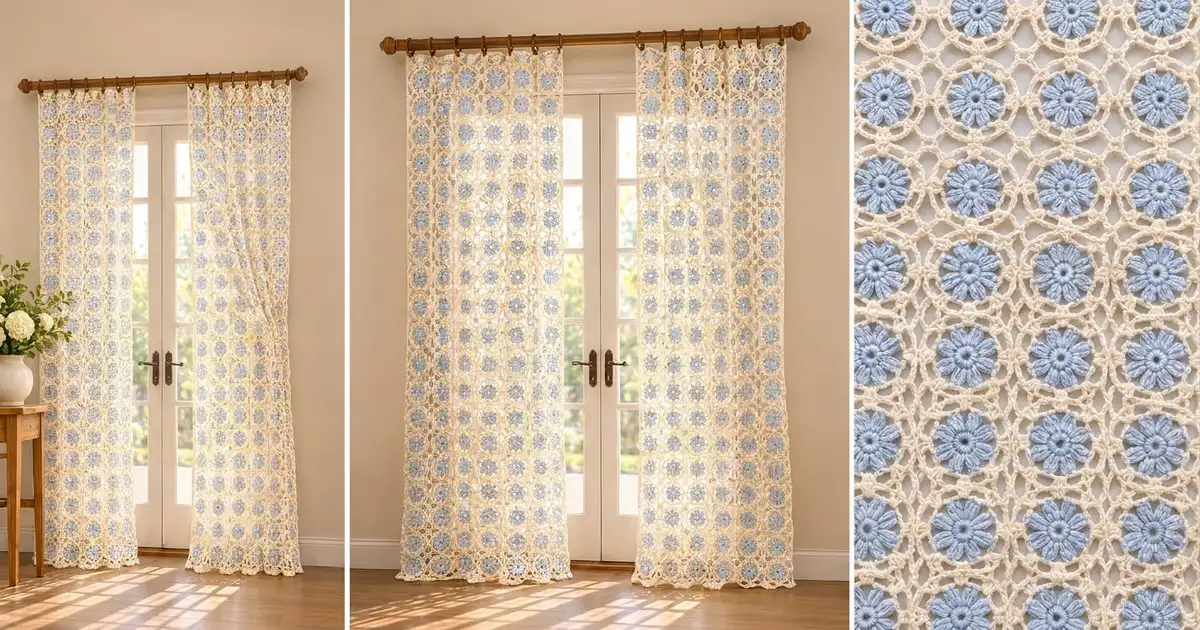
These lace curtains are made from small round flower motifs joined into a light, airy grid. Each motif has a soft powder-blue flower with eight puffy petals around an open center ring. A cream lace frame surrounds each flower and ends in chain loops that link to the motifs next to it.
The colors are deliberately quiet: powder blue and warm cream. Once the curtains hang in a sunny window, the open loops let the light through and the flowers look like they are floating. The style is vintage cottage lace, but the construction is simple and repetitive.
This pattern uses US crochet terms. One finished panel measures 42 x 92 in (106.7 x 233.7 cm). The photo shows a matching pair, so you will make two identical panels.
Construction overview: you crochet each motif in the round, from the center out. Rounds 1–2 are the blue flower, and Rounds 3–5 are the cream frame. From the second motif on, you join while working Round 5 (join-as-you-go), so there is no sewing. When all the motifs are joined, a three-round cream border straightens the edges.
Finished Size and Construction
- Finished panel size: 42 x 92 in (106.7 x 233.7 cm)
- Skill level: Intermediate
- Terminology: US crochet terms
- Yarn weight: Worsted (#4)
- Hook: 5.0 mm (US H-8)
- Number of pieces: 144 motifs per panel; 288 motifs for the pair
- Layout: 8 motifs wide x 18 motifs tall per panel
- Motif size: 5 in (12.7 cm) across the flat sides
- Panel size before border: 40 x 90 in (101.6 x 228.6 cm)
- Border depth: 1 in (2.5 cm) on every side
Materials
Use a smooth cotton or cotton-blend worsted yarn at about 200 m per 100 g. Cotton keeps the petals crisp, blocks well, and won’t fuzz in sunlight. Avoid splitty yarns, because the clusters need clean, defined strands.
Per panel:
- Color A, powder blue: 400 g (800 m)
- Color B, cream: 1,050 g (2,100 m)
For the pair (2 panels):
- Color A, powder blue: 800 g (1,600 m)
- Color B, cream: 2,100 g (4,200 m)
These quantities include a margin of about 10% for gauge differences and swatching.
Tools:
- 5.0 mm (US H-8) crochet hook
- Tapestry needle
- Scissors
- Locking stitch markers
- Rust-proof pins and blocking mats
- Spray bottle
- Measuring tape
- 9 curtain clip rings per panel (18 for the pair)
Abbreviations (US Terms)
- ch – chain
- sl st – slip stitch
- sc – single crochet
- dc – double crochet
- tr – treble crochet
- sp – space
- sk – skip
- st(s) – stitch(es)
- rep – repeat
- 4trCL – four-treble cluster (see below)
Special stitch – 4trCL (four-treble cluster): *Yarn over twice, insert your hook into the stitch, yarn over and pull up a loop, [yarn over, pull through 2 loops] twice; rep from * 3 more times in the same stitch (5 loops on hook). Yarn over and pull through all 5 loops.
Gauge and Checkpoints
Make one complete motif before you start production. Measure it flat after a light mist.
- After Round 2 (flower): 3.25 in (8.3 cm) from petal tip to opposite petal tip
- After Round 3: 3.75 in (9.5 cm) across
- After Round 4: 4.5 in (11.4 cm) across
- After Round 5: 5 in (12.7 cm) across the flat sides
Border gauge: 4 sc = 1 in (2.5 cm) along the loop edge.
A tolerance of ±0.25 in (0.6 cm) per motif is fine, but the error adds up: 18 motifs that are each 0.25 in (0.6 cm) too long make the panel 4.5 in (11.4 cm) too long.
- Motif too big: change to a 4.5 mm (US 7) hook.
- Motif too small: change to a 5.5 mm (US I-9) hook.
- Flower is right but the frame ruffles: change hook size for the cream rounds only.
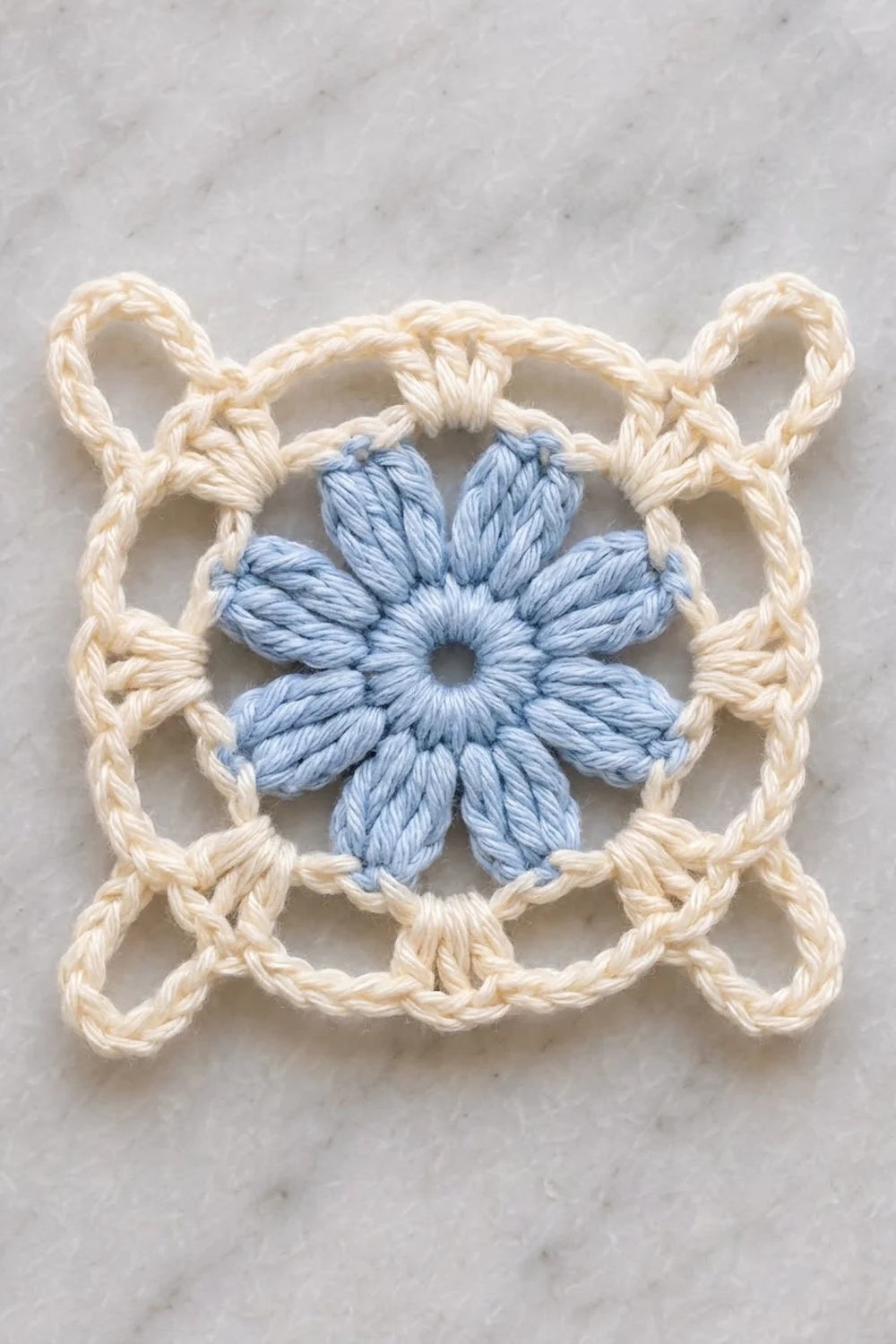
Motif Pattern
Round 1 (Color A, blue)
Make a magic ring. Ch 3 (counts as dc), then work 15 dc into the ring. Pull the ring closed, leaving a small open center. Sl st to the top of the beginning ch-3. (16 dc)
Round 2 (Color A, blue) – Petals
In the next dc work (ch 3, 4trCL, ch 3, sl st); sl st in the next dc. Rep from * 7 more times. (8 petals, 8 clusters)*
Each petal is worked over 2 sts, so 8 petals use exactly 16 sts. The top of each cluster is the petal tip. Fasten off Color A and weave in the ends.
Round 3 (Color B, cream) – Arches
Join Color B with a sc in the top of any 4trCL. Ch 5, sc in the top of the next 4trCL. Rep from * 6 more times, then ch 5 and sl st to the first sc. (8 sc, 8 ch-5 sps)*
The chains run from tip to tip behind the petals and form a ring of arches.
Round 4 (Color B) – Solid Ring
Sl st into the first ch-5 sp. Ch 3 (counts as dc), 4 dc in the same sp. Dc in the next sc, 5 dc in the next ch-5 sp. Rep from * 6 more times, then dc in the last sc. Sl st to the top of the beginning ch-3. (48 dc)*
This is a conversion round: (8 sc worked 1-per-stitch) + (8 sps x 5 dc) = 8 + 40 = 48 dc.
Round 5 (Color B) – Loop Frame
For the first motif only, work this round without joining:
Sc in the same st as the sl st. Ch 7 (corner loop), sk 3 dc, sc in the next dc, ch 5 (side loop), sk 3 dc, sc in the next dc, ch 5 (side loop), sk 3 dc, sc in the next dc. Rep from * 3 more times. On the last repeat, leave out the final sc and sl st to the first sc instead. Fasten off. (12 sc anchors, 4 ch-7 corner loops, 8 ch-5 side loops)*
Each repeat uses 12 dc (3 loops x 4 sts), and 4 repeats x 12 = 48 dc. The round motif now has four defined sides. Each side reads: half a corner loop, side loop, side loop, half a corner loop.
Make All Pieces
Each motif uses roughly 5 m of Color A and 12 m of Color B.
- Per panel: 144 motifs (8 across x 18 down)
- For the pair: 288 motifs
Layout grid (one panel, M = motif):
Row 18:  M M M M M M M M   <- top edge (rings attach here)
Row 17:  M M M M M M M M
  ...    (rows 16 to 3 identical)
Row 2:   M M M M M M M M
Row 1:   M M M M M M M M   <- bottom edge
All the motifs are identical. To work efficiently, make the blue flowers (Rounds 1–2) in batches, then Rounds 3–4 in batches, and save Round 5 for joining.
Joining
Every motif after the first is joined while you work its Round 5. Work Round 5 as written, but use these substitutions on each side that touches a motif already in place:
- Joined side loop: Ch 2, sl st into the matching ch-5 side loop of the neighbor, ch 2. That’s still 5 ch in total: 2 + the joining sl st + 2.
- Joined corner loop: Ch 3, sl st into the center (4th) ch of the neighbor’s corner loop, ch 3. That’s still 7 ch in total.
- Corner where other motifs are already joined: Ch 3, sl st into the existing join sl st, ch 3. All four corner loops then share one point.
Stitch-to-stitch logic: The two side loops on one side of a motif join the two side loops facing them on the neighbor, in mirror order. Keep every motif right side up. A flipped motif shows the wrong side of its clusters.
Tension advice: Work the join sl sts at the same tension as an ordinary chain. A tight join pulls the loops in and puckers the seam.
Working order: Join the first row of 8 motifs from left to right. Start each new row at the left, and join each motif to the motif below it first, then to the motif on its left.
Size checkpoint: After 2 full rows, the strip should measure 40 x 10 in (101.6 x 25.4 cm). If the width is more than 1 in (2.5 cm) off, adjust your hook before you continue.
Border
Work the border in Color B. Border gauge: 4 sc = 1 in (2.5 cm).
Each motif gives 20 sc per side to the edge: 4 sc in one corner-loop half, 6 sc in each of the 2 side loops, and 4 sc in the other corner-loop half. Where two edge motifs meet, their corner-loop halves meet at the join point, so no stitches are added at the seams.
At each panel corner the corner loop is not joined to anything, so it is a full ch-7 loop. It gives 4 sc to one side and 4 sc to the next side, with a ch-2 corner sp between them.
Border Round 1 – Single Crochet
Join Color B in the ch-7 loop at the top right panel corner. Work around the whole panel:
- In each panel-corner ch-7 loop: 4 sc, ch 2, 4 sc
- In each joined corner-loop half: 4 sc
- In each side loop: 6 sc
Sl st to the first sc.
- Short sides: 8 motifs x 20 = 160 sc each
- Long sides: 18 motifs x 20 = 360 sc each
- Total: 1,040 sc, plus 4 corner ch-2 sps
Border Round 2 – Double Crochet
Ch 3 (counts as dc). Dc in each sc. In each corner ch-2 sp work (2 dc, ch 2, 2 dc). Sl st to the top of the ch-3.
- Short sides: (160 dc worked 1-per-stitch) + (2 corner dc at each end) = 164 dc
- Long sides: (360 dc worked 1-per-stitch) + 4 = 364 dc
- Total: 1,056 dc
Border Round 3 – Picot Edge
*Sc in each of the next 4 dc, ch 3, sl st in the 3rd ch from the hook (picot). Rep from * along each side. In each corner ch-2 sp work (sc, ch 3, sc). Sl st to the first sc and fasten off.
- Short sides: (164 sc worked 1-per-stitch) + (1 corner sc at each end) = 166 sc, 41 picots
- Long sides: 364 + 2 = 366 sc, 91 picots
- Total: 1,064 sc and 264 picots
Why the math works: Each motif side is 5 in (12.7 cm), and 20 sc at 4 sc per inch is exactly 5 in, so Round 1 neither stretches nor gathers the lace. Round 2 adds stitches only at the corners, which keeps the edges straight. Round 3 needs side counts divisible by 4: 164 / 4 = 41 and 364 / 4 = 91. That spaces the picots evenly and puts the last picot on each side right before the corner.
Border depth: Round 1 is about 0.25 in (0.6 cm), Round 2 about 0.5 in (1.3 cm), and Round 3 about 0.25 in (0.6 cm), for a total of 1 in (2.5 cm). The panel becomes 40 + 2 = 42 in (106.7 cm) wide and 90 + 2 = 92 in (233.7 cm) long.
Final Blocking
- Weave in all remaining ends along the cream chains, where they hide best.
- Lay the panel flat on blocking mats. Work in sections if you’re short on space.
- Mist the panel evenly until it is damp, not soaked.
- Pin the outer corners first to 42 x 92 in (106.7 x 233.7 cm).
- Pin along each edge every 5 in (12.7 cm), at each motif seam.
- Gently open each flower with your fingers so the petals lie flat and the center ring is round.
- Check that the rows of motifs are straight against a taut string.
- Let the panel dry completely before you unpin it, usually 24 hours.
- Attach 9 clip rings along the top edge: one at each corner and one at each of the 7 motif seams. They’ll sit 5 in (12.7 cm) apart, with 6 in (15.2 cm) gaps at the ends.
Final Quality-Control Checklist
- Every motif has 8 petals, 48 dc in Round 4, and 12 loops in Round 5.
- All motifs face right side up.
- No joins are missing between side loops.
- All four-way corners meet at a single point.
- Short sides have 160 / 164 / 166 sts in border Rounds 1 / 2 / 3.
- Long sides have 360 / 364 / 366 sts in border Rounds 1 / 2 / 3.
- The blocked panel measures 42 x 92 in (106.7 x 233.7 cm), within 1 in (2.5 cm).
- Both panels in the pair are the same size.
Troubleshooting
- Petals curl forward: Your 4trCL is too tight. Pull up the first loop a little taller.
- Center hole is too large: Pull the magic ring tighter and secure the tail well.
- Round 4 ruffles: Count to 48 and go down a hook size for this round.
- Round 4 cups: Go up a hook size for this round.
- Seams pucker: Your join sl sts are too tight. Work them looser.
- Border edge waves: Recount Round 1 and keep to 6 sc per side loop.
- Border pulls in: Check that every corner-loop half has 4 sc.
- Panels differ in length: Block both panels to the same pinned measurements.
Care
Hand wash, or machine wash on a gentle cold cycle in a mesh bag. Lay flat to dry and re-pin if needed. Never hang the panels wet, because their weight will stretch the lace.
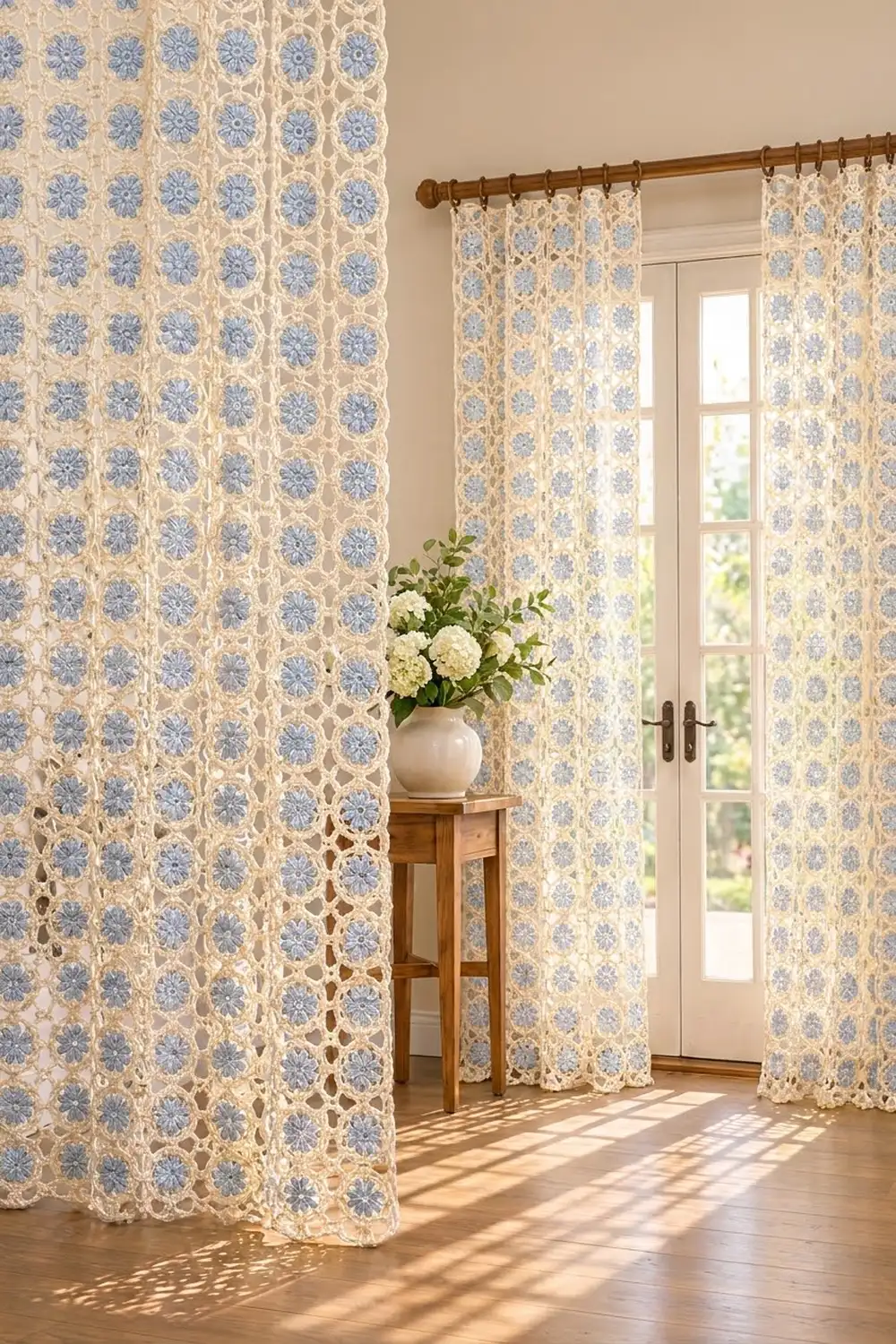
Final Notes
The whole curtain depends on one chain of measurements. The flower is 3.25 in (8.3 cm), the finished motif is 5 in (12.7 cm), and 8 x 18 motifs make 40 x 90 in (101.6 x 228.6 cm). Each motif side gives 20 border sc at 4 sc per inch, and the 1 in (2.5 cm) border brings each panel to 42 x 92 in (106.7 x 233.7 cm). If every link checks out, your two panels will hang straight and match.
Happy crocheting!