
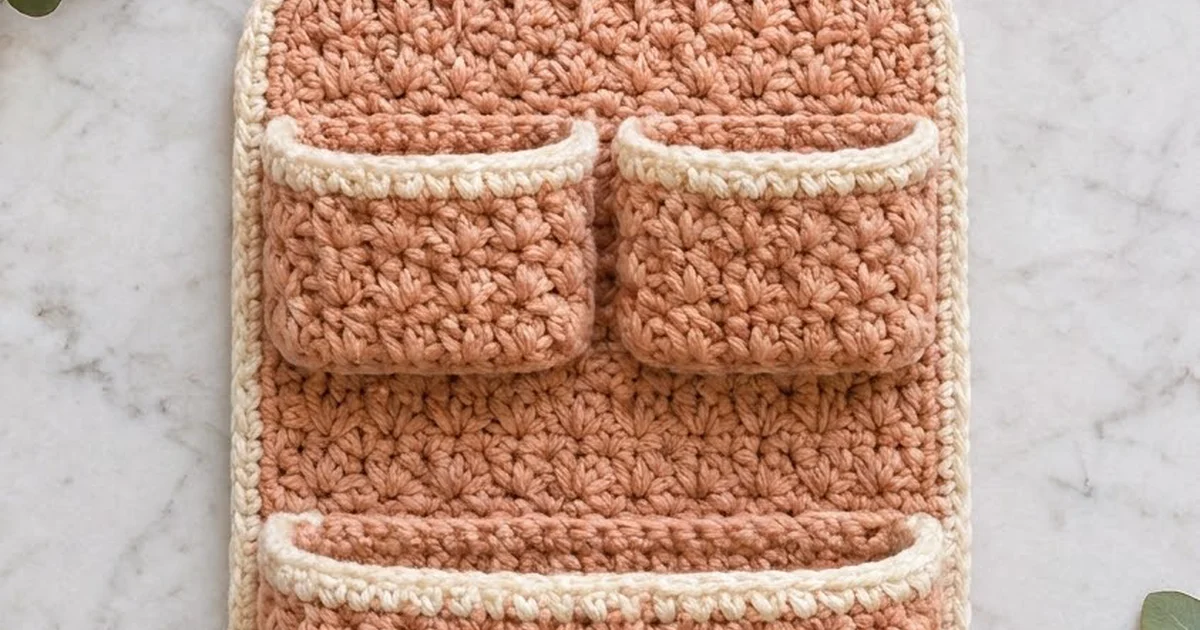
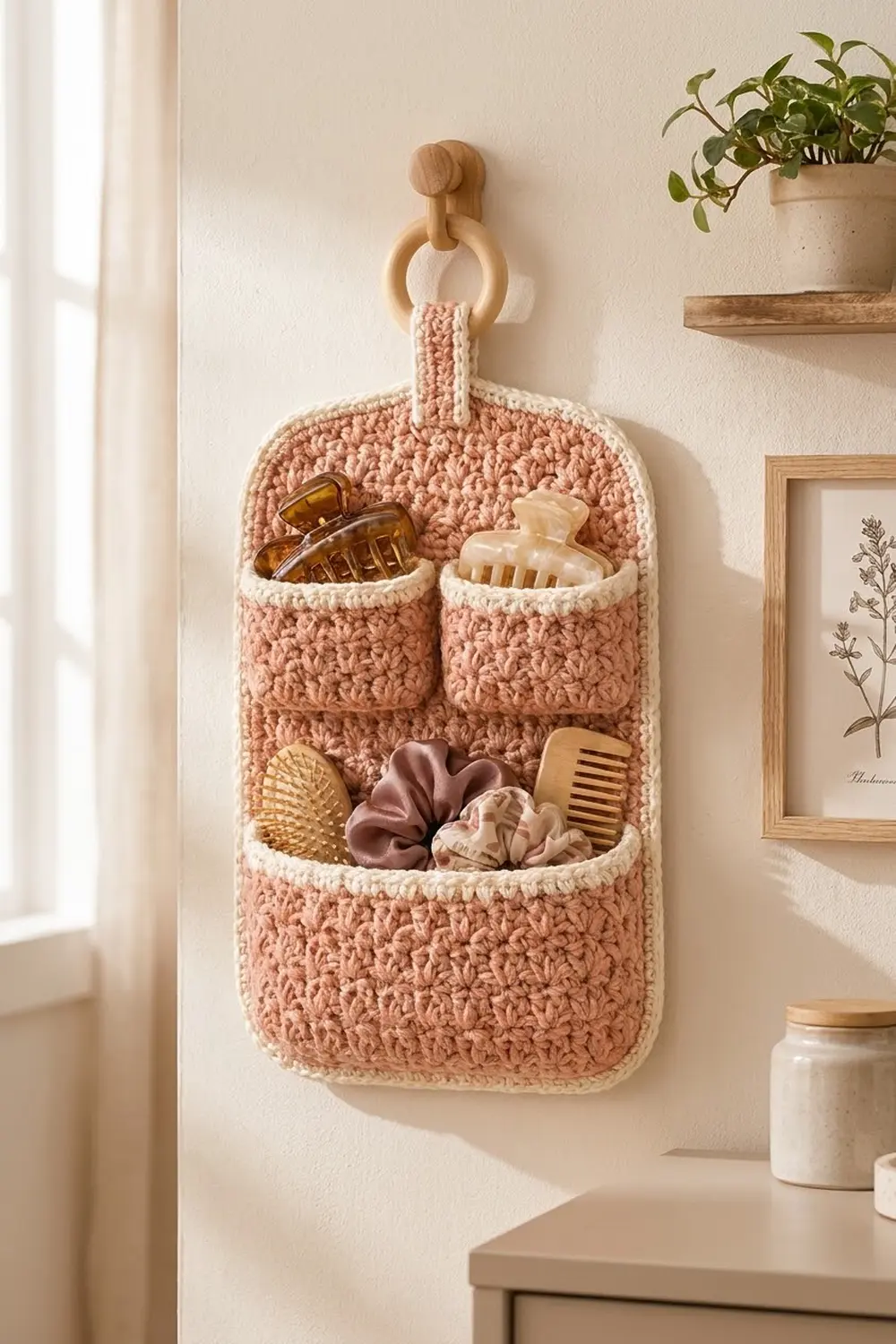
This hanging organizer gives your hair clips, scrunchies and combs a soft home on the wall. A dusty rose back panel holds two small pockets side by side and one wide pocket below. Every piece has cream edging, and a wooden ring at the top is used for hanging.
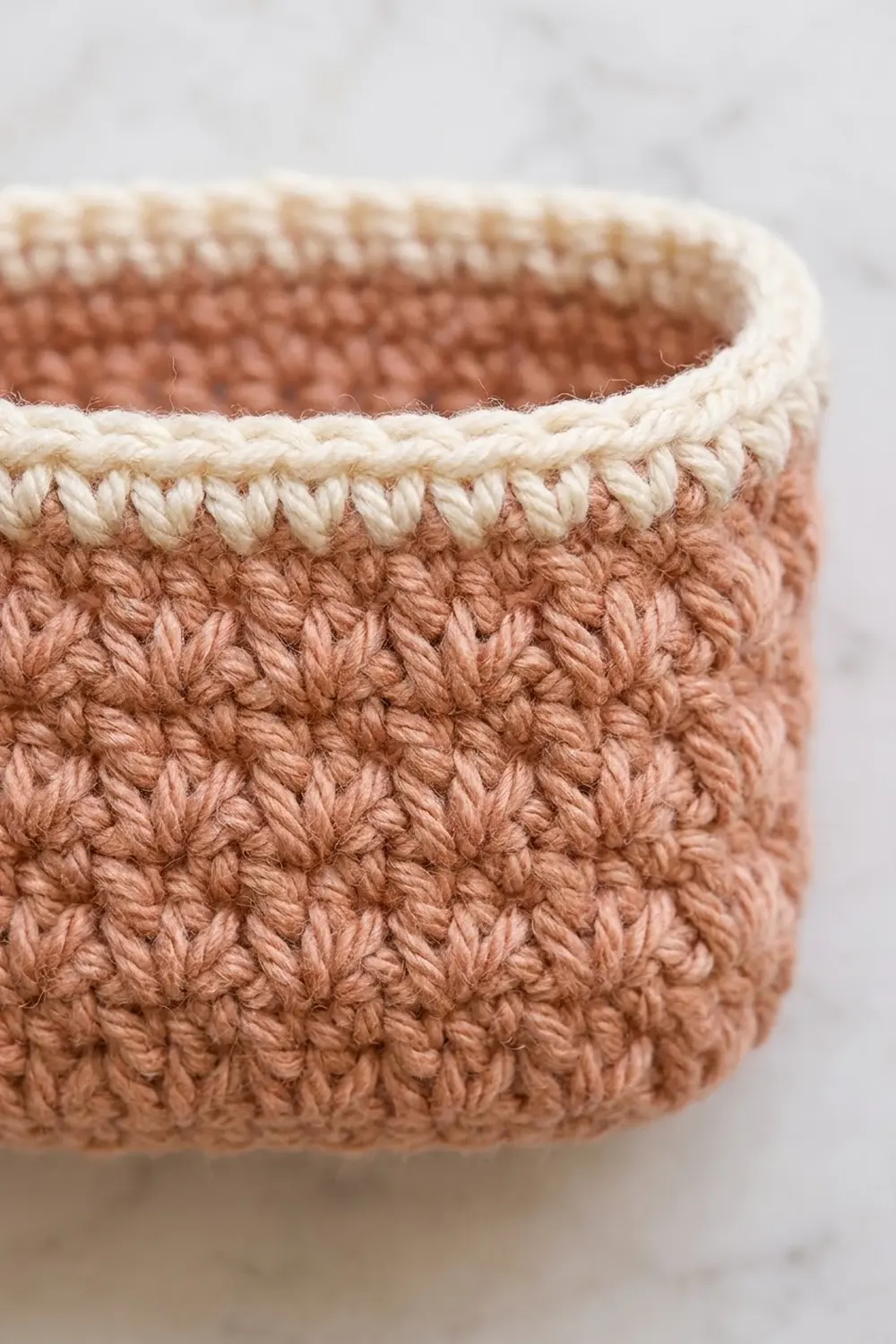
The fabric is suzette stitch, a simple pair of sc and dc that builds a dense, nubby texture. It is firm enough to hold its shape and still pleasant to touch. The cream border adds a corded edge that frames the panel neatly.
The pattern is written in US crochet terms. The finished organizer measures 11 in wide x 15 in tall (27.9 x 38.1 cm), not counting the ring.
Construction is simple. You work the back panel flat in rows with shaped shoulders, then add a two-round border. The pockets are oval-based baskets worked in the round and finished with a cream rim, then sewn to the panel. A short tab loops through the ring and is sewn to the top.
Finished Size and Construction
- Finished size: 11 x 15 in (27.9 x 38.1 cm), plus ring
- Skill level: Easy to intermediate
- Terminology: US crochet terms
- Yarn weight: Worsted (#4)
- Hook: 5.0 mm (US H-8)
- Number of pieces: 5 crocheted pieces (1 panel, 1 tab, 2 small pockets, 1 large pocket) plus 1 wooden ring
- Layout: 2 small pockets side by side over 1 large pocket
- Panel size before border: 10 x 14 in (25.4 x 35.6 cm)
- Border depth: 0.5 in (1.3 cm) per side
- Small pocket: 4 in wide x 3 in tall x 1.5 in deep (10.2 x 7.6 x 3.8 cm)
- Large pocket: 9 in wide x 4.5 in tall x 2 in deep (22.9 x 11.4 x 5.1 cm)
- Tab: 1.5 x 6.5 in (3.8 x 16.5 cm)
Materials
Choose a smooth worsted cotton or cotton blend for crisp stitch definition and good structure. Acrylic also works, but the pockets will be softer.
- Color A, dusty rose: 230 g / 390 m
- Color B, cream: 60 g / 100 m
- 5.0 mm (US H-8) crochet hook
- 1 wooden ring, 2 in (5.1 cm) diameter
- Tapestry needle
- 8–10 locking stitch markers
- Rust-proof pins
- Measuring tape
- Blocking mat and spray bottle
Quantities include about a 15% margin for your gauge swatch and sewing.
Abbreviations (US Terms)
- ch – chain
- sl st – slip stitch
- sc – single crochet
- dc – double crochet
- sc2tog – single crochet 2 together
- inc – 2 sc in the same stitch
- BLO – back loop only
- rsc – reverse single crochet (crab stitch)
- st(s) – stitch(es)
- RS / WS – right side / wrong side
Suzette pair: (sc, dc) in the same stitch. Each pair counts as 2 stitches.
Reverse sc: Working from left to right (right-handers), insert the hook in the next st to the right, yarn over, pull up a loop, yarn over, and pull through both loops.
Gauge and Checkpoints
Gauge: 16 sts and 14 rows = 4 in (10.2 cm) in suzette stitch. 16 sc = 4 in (10.2 cm). That is 4 sts and 3.5 rows per inch.
Test one piece first. Make the tab before anything else. Before its border it should measure 1 x 6 in (2.5 x 15.2 cm). If it does, your gauge is right for every other piece.
Panel checkpoints:
– After Row 1: 10 in (25.4 cm) wide
– After Row 22: about 6.3 in (16.0 cm) tall
– After Row 43: about 12.3 in (31.2 cm) tall
– After Row 49: 14 in (35.6 cm) tall, top edge 7 in (17.8 cm) wide
If your piece is too big, go down a hook size (4.5 mm). If it is too small, go up a size (5.5 mm). Change the hook, not the stitch counts, so the pockets and border still fit.
Hanging Tab (Make 1)
With Color A, ch 5.
Row 1 (RS): Sc in 2nd ch from hook and in each ch across. (4 sts)
Row 2: Ch 1, turn. (Sc, dc) in first st, sk next st, (sc, dc) in next st, sk last st. (4 sts)
Rows 3–21: Repeat Row 2. (4 sts)
The piece measures 1 x 6 in (2.5 x 15.2 cm). Fasten off.
Tab Border: Join Color B in the first foundation ch.
Rnd 1: Ch 1. 3 sc in first ch, sc in next 2 ch, 3 sc in last ch (8 sts across bottom). Along side: sc in each of next 6 row-ends, 2 sc in next row-end; repeat 3 times (24 sts). Across top: 3 sc in first st, sc in next 2 sts, 3 sc in last st (8 sts). Along second side: repeat the side sequence (24 sts). Join with sl st to first sc. (64 sts)
Fasten off. The tab measures 1.5 x 6.5 in (3.8 x 16.5 cm).
Back Panel (Make 1)
With Color A, ch 41.
Row 1 (RS): Sc in 2nd ch from hook and in each ch across. (40 sts)
Row 2: Ch 1, turn. (Sc, dc) in first st, sk next st, (sc, dc) in next st; repeat from * across to last st, sk last st. (40 sts, 20 pairs)
Rows 3–43: Repeat Row 2. (40 sts)
The panel measures about 10 x 12.3 in (25.4 x 31.2 cm).
Shoulder Shaping
Each shoulder row removes 1 st at each end.
Decrease Row: Ch 1, turn. Sc2tog over first 2 sts, (sc, dc) in next st, sk next st; repeat from * until 2 sts remain, sc2tog over last 2 sts.
The math: each sc2tog counts as 1 st, and the pairs replace the stitches between them one for one, so each row is 2 sts shorter.
- Row 44: 38 sts
- Row 45: 36 sts
- Row 46: 34 sts
- Row 47: 32 sts
- Row 48: 30 sts
- Row 49: 28 sts
Fasten off. The panel is 10 in (25.4 cm) wide at the base, 7 in (17.8 cm) across the top and 14 in (35.6 cm) tall.
Small Pocket (Make 2)
Base
With Color A, ch 11.
Rnd 1: 2 sc in 2nd ch from hook, sc in next 8 ch, 4 sc in last ch. Rotate and work along the opposite side of the chain: sc in next 8 ch, 2 sc in same ch as first sts. Join with sl st to first sc. (24 sts)
Rnd 2: Ch 1. Inc in next 2 sts, sc in next 8 sts, inc in next 4 sts, sc in next 8 sts, inc in next 2 sts. Join. (32 sts)
Rnd 3: Ch 1. [Sc in next st, inc] 2 times, sc in next 8 sts, [sc in next st, inc] 4 times, sc in next 8 sts, [sc in next st, inc] 2 times. Join. (40 sts)
Checkpoint: the base measures 4 x 1.5 in (10.2 x 3.8 cm).
Sides
Rnd 4: Ch 1. Sc in BLO of each st around. Join. (40 sts) This makes a crisp fold between the base and the walls.
Rnd 5: Ch 1, turn. (Sc, dc) in same st as join, sk next st, (sc, dc) in next st; repeat from * around, sk last st. Join with sl st to first sc. (40 sts, 20 pairs)
Rnds 6–12: Repeat Rnd 5. (40 sts)
Checkpoint: the walls stand about 2.5 in (6.4 cm) tall. Fasten off Color A.
Rim
Join Color B in any st.
Rnd 13: Ch 1. Sc in each st around. Join. (40 sts)
Rnd 14: Ch 1. Rsc in each st around. Join. (40 sts)
Fasten off. The pocket stands 3 in (7.6 cm) tall.
Large Pocket (Make 1)
Base
With Color A, ch 29.
Rnd 1: 2 sc in 2nd ch from hook, sc in next 26 ch, 4 sc in last ch. Working along the opposite side: sc in next 26 ch, 2 sc in same ch as first sts. Join. (60 sts)
Rnd 2: Ch 1. Inc in next 2 sts, sc in next 26 sts, inc in next 4 sts, sc in next 26 sts, inc in next 2 sts. Join. (68 sts)
Rnd 3: Ch 1. [Sc in next st, inc] 2 times, sc in next 26 sts, [sc in next st, inc] 4 times, sc in next 26 sts, [sc in next st, inc] 2 times. Join. (76 sts)
Rnd 4: Ch 1. [Sc in next 2 sts, inc] 2 times, sc in next 26 sts, [sc in next 2 sts, inc] 4 times, sc in next 26 sts, [sc in next 2 sts, inc] 2 times. Join. (84 sts)
Checkpoint: the base measures 9 x 2 in (22.9 x 5.1 cm).
Sides
Rnd 5: Ch 1. Sc in BLO of each st around. Join. (84 sts)
Rnd 6: Ch 1, turn. (Sc, dc) in same st as join, sk next st, (sc, dc) in next st; repeat from * around, sk last st. Join. (84 sts, 42 pairs)
Rnds 7–18: Repeat Rnd 6. (84 sts)
Checkpoint: the walls stand about 4 in (10.2 cm) tall. Fasten off Color A.
Rim
Rnd 19: Join Color B. Ch 1, sc in each st around. Join. (84 sts)
Rnd 20: Ch 1, rsc in each st around. Join. (84 sts)
Fasten off. The pocket stands 4.5 in (11.4 cm) tall.
Panel Border
Border gauge: 4 sc per inch, the same as the suzette fabric.
With RS facing, join Color B in the first foundation ch at the bottom corner.
Rnd 1: Ch 1.
– Bottom: 3 sc in first ch, sc in next 38 ch, 3 sc in last ch. (44 sts)
– Side: Sc in each of next 6 row-ends, 2 sc in next row-end; repeat 7 times. (56 sts over 49 row-ends)
– Top: 3 sc in first st, sc in next 26 sts, 3 sc in last st. (32 sts)
– Second side: Repeat the side sequence. (56 sts)
Join with sl st to first sc. (188 sts)
Rnd 2: Ch 1. Rsc in each st around. Join. (188 sts)
Fasten off and weave in ends.
Why the math works: The bottom has 40 sts over 10 in, which is 4 per inch. Each side has 56 sc over 14 in, also 4 per inch. Sc gauge equals suzette gauge, so the edge neither ruffles nor pulls in. The 3-sc corner groups give room to turn, and the rsc round is worked one stitch into each stitch, so the corners stay rounded and flat. The two rounds add 0.5 in (1.3 cm) per side: 10 + 1 = 11 in (27.9 cm) wide and 14 + 1 = 15 in (38.1 cm) tall.
Make All Pieces
- Back panel: 1 (Color A body, Color B border)
- Hanging tab: 1 (Color A body, Color B edge)
- Small pockets: 2 (Color A body, Color B rim)
- Large pocket: 1 (Color A body, Color B rim)
Layout on the front of the panel, measured from the bottom of the finished border:
+-------------------------------+
|        [tab + ring]           |  top 15 in
|                               |
|  [Small A] 1 in gap [Small B] |  10 in to 7 in
|                               |  1.5 in gap
|        [Large pocket]         |  5.5 in to 1 in
|                               |
+-------------------------------+  0 in
   1 in margin each side
Joining
Use Color A, a tapestry needle and whipstitch. Sew through the back loops of the pocket and one strand of the panel fabric so the stitches sink into the texture.
Small pockets: On the BLO ridge from Rnd 4, mark the 8 straight sts on the back side plus 4 sts on each end curve. That is 16 sts, or 4 in (10.2 cm). The other 24 sts form the bowed front. Pin the pocket so its base sits 7 in (17.8 cm) above the bottom edge and 1 in (2.5 cm) in from the side. Sew the 16 marked sts flat to the panel, then sew up each side at the markers, then across the 16 matching rim sts. Place the second pocket with a 1 in (2.5 cm) gap.
Large pocket: On the Rnd 5 ridge, mark the 26 straight back sts plus 5 sts on each end. That is 36 sts, or 9 in (22.9 cm). Pin the base 1 in (2.5 cm) above the bottom edge, centered with 1 in (2.5 cm) margins. Sew as above. The front 48 sts bow out to make the 2 in (5.1 cm) depth.
Tension: Pull each stitch snug but not tight. The panel should stay flat with no puckering behind the pockets.
Tab: Thread the tab through the ring and fold it in half (3.25 in, 8.3 cm, doubled). Place the top center of the panel between the two layers, overlapping 1.25 in (3.2 cm). Sew through all layers along both long sides and the bottom.
Size checkpoint: The assembled organizer still measures 11 x 15 in (27.9 x 38.1 cm).
Final Blocking
- Lightly mist the whole organizer with water.
- Lay it flat on a blocking mat, RS up.
- Pin the panel to 11 x 15 in (27.9 x 38.1 cm), easing the shoulders into smooth curves.
- Stuff each pocket with a folded towel so it holds its depth.
- Let it dry completely, at least 24 hours.
- Remove the pins and towels.
Final Quality-Control Checklist
- Panel is 11 x 15 in (27.9 x 38.1 cm) and lies flat
- Border has 188 sts per round, with rounded corners
- Small pockets are 4 in (10.2 cm) wide and 3 in (7.6 cm) tall
- Large pocket is 9 in (22.9 cm) wide and 4.5 in (11.4 cm) tall
- Pockets are level and evenly spaced
- Tab is centered and the ring is secure
- All ends are woven in on the WS
Troubleshooting
Panel edges wave: There are too many border sts on the sides. Recheck the 8 sc per 7 row-ends ratio.
Border cups: There are too few sts. Add one extra sc per side section, then remove it on the next round.
Suzette leans in the round: You are not turning. Turn at the start of each wall round.
Pocket sags forward: The back seam is too long. Sew only the marked sts.
Stitch count drifts: Check that each row ends with a skipped st after the last pair.
Care
Hand wash in cool water and lay flat to dry, reshaping the pockets while damp. Do not tumble dry.
Final Notes
Every measurement leads to the next. A gauge of 4 sts per inch gives a 10 x 14 in (25.4 x 35.6 cm) panel, and the border adds 0.5 in (1.3 cm) per side for 11 x 15 in (27.9 x 38.1 cm). The pockets use the same gauge, so a 16-st back seam covers 4 in (10.2 cm) and a 36-st seam covers 9 in (22.9 cm). Check the tab first, and the rest will fall into place.
Happy crocheting!