
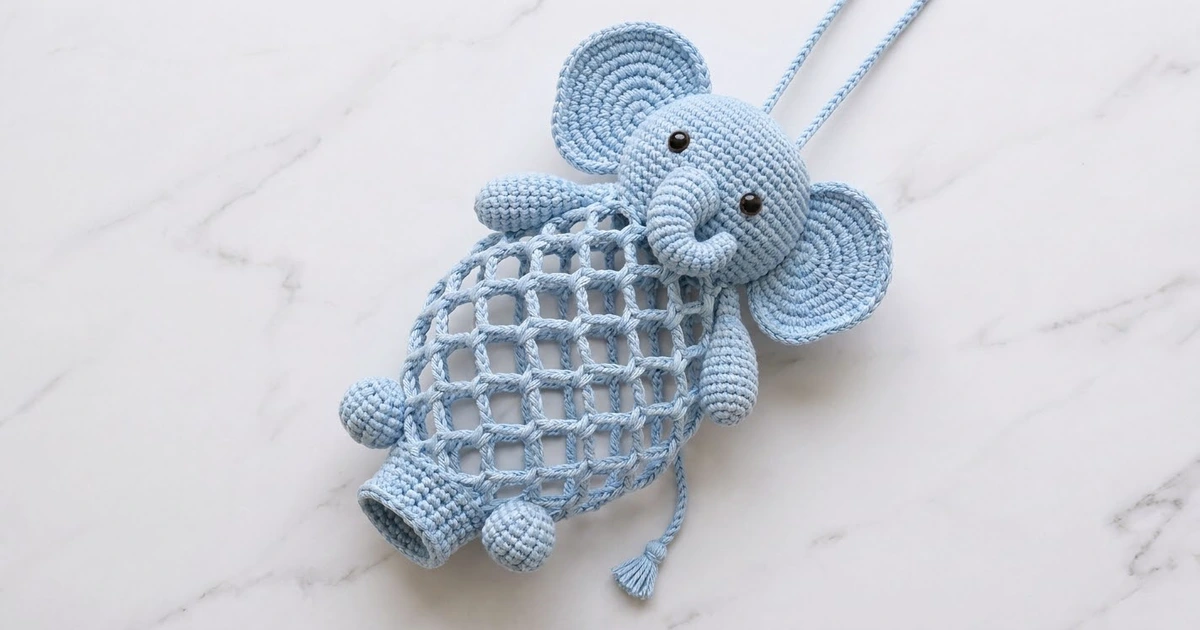
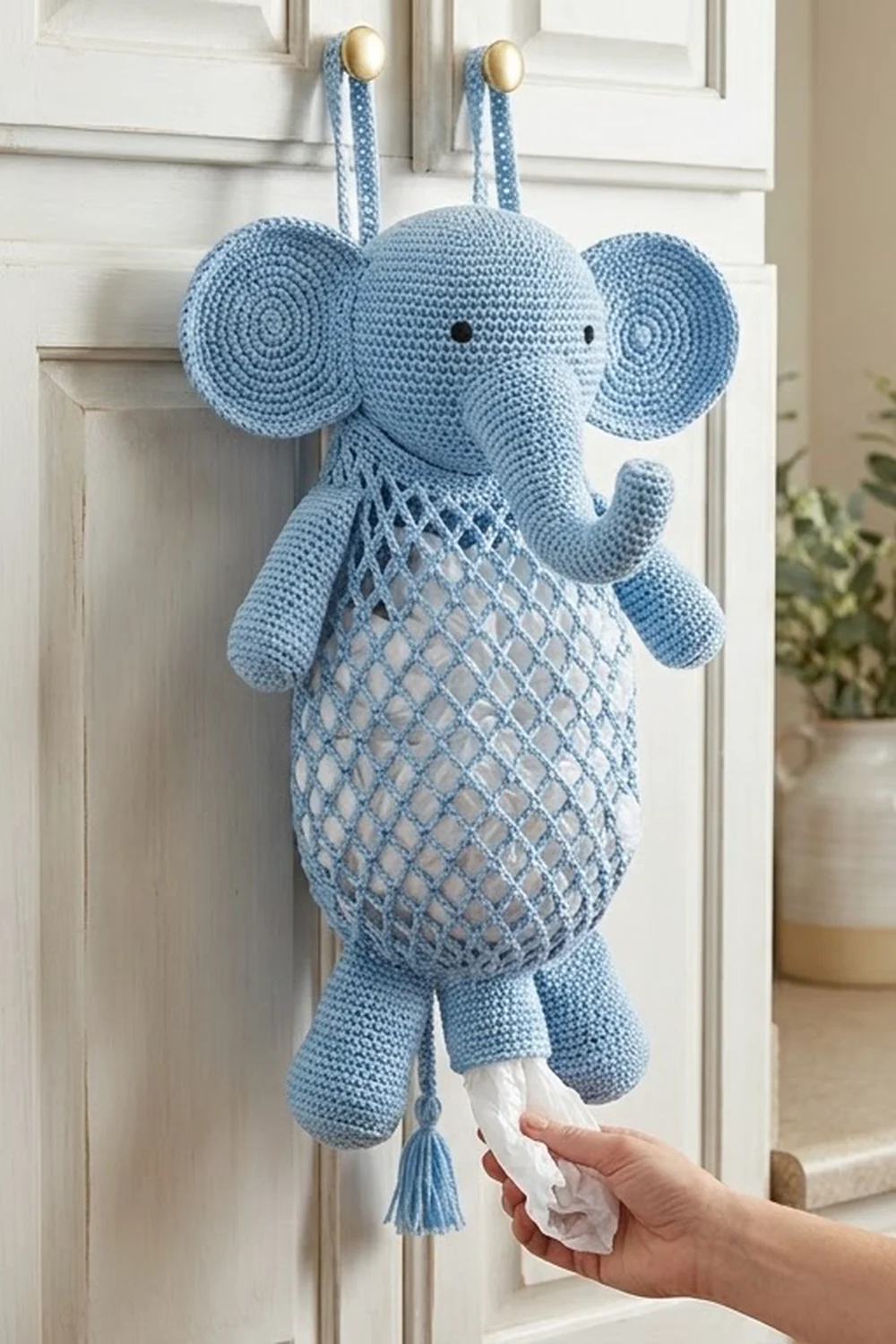
Bubbles is a hanging plastic bag holder shaped like a friendly baby elephant. A rounded head sits on top of an open diamond-mesh belly. Big flat ears, a curled trunk, two soft arms, two round feet and a tasseled tail give it plenty of personality. Bags go in under the head and pull out one at a time through a snug tube at the bottom.
The sample is worked in soft powder blue cotton with black safety eyes. A light gray version uses exactly the same pattern, so you can make a matching pair. The style is clean and simple: dense single crochet for the solid parts and an airy chain mesh for the belly, so you can see the bags inside.
This pattern uses US crochet terms. The finished holder is about 16 in (40.6 cm) tall from the top of the head to the bottom opening, not counting the hanging loops. The mesh belly is about 8 in (20.3 cm) wide when laid flat and relaxed, and the ear span is about 12 in (30.5 cm).
Construction is straightforward. You start with the bottom tube, work the mesh upward in rounds, and finish the top with a solid rim. The head is a separate unstuffed dome sewn to the back half of the rim, so it lifts like a lid for refilling. Ears, trunk, arms, feet, tail and hanging loops are made separately and sewn on.
Finished Size and Construction
- Finished size: about 16 in (40.6 cm) tall, 8 in (20.3 cm) wide at the belly, 12 in (30.5 cm) across the ears
- Skill level: Intermediate
- Terminology: US
- Yarn weight: worsted (medium #4) cotton
- Hook: 4.0 mm (G-6)
- Number of pieces: 12 crocheted parts (body, head, 2 ears, trunk, 2 arms, 2 feet, tail, 2 hanging loops) assembled into one holder
- Layout: one single bag holder, not a set of joined motifs
- Body size before border: about 12 in (30.5 cm) tall (2 in / 5.1 cm tube plus 10 in / 25.4 cm mesh)
- Border depth: top rim 0.4 in (1.0 cm); bottom edge 0.2 in (0.5 cm)
- Body size after border: about 12.6 in (32.0 cm) tall; the head adds about 3.6 in (9.1 cm) above the rim
Materials
Choose a smooth worsted weight cotton or cotton blend. Cotton holds the head’s dome shape without stuffing, and the mesh will not sag under the weight of the bags. Avoid fuzzy or very stretchy acrylic for the mesh.
- Main color (powder blue or light gray): 100 g, about 170 m
- Black safety eyes: 2, 12 mm
- Fiberfill: about 15 g for the trunk, arms and feet
Tools:
- 4.0 mm (G-6) crochet hook
- Tapestry needle
- Stitch markers (at least 4)
- Scissors
- Measuring tape
- Pins
The yarn quantity includes a margin of about 30 percent for gauge swatching and the tassel. One 100 g ball is enough for one complete elephant.
Abbreviations (US Terms)
- ch – chain
- sl st – slip stitch
- sc – single crochet
- hdc – half double crochet
- dc – double crochet
- inc – 2 sc in the same stitch
- dec – sc 2 together (invisible dec recommended)
- MR – magic ring
- st(s) – stitch(es)
- sp – space
- rnd(s) – round(s)
Special stitch – sc in ch-sp: insert the hook under the whole chain loop, not into a single chain, and work a sc. Every mesh round uses this. It lets each loop pull into a neat point and gives the belly its twisted-diamond look.
Gauge and Checkpoints
Gauge: 18 sc and 20 rnds = 4 in (10.2 cm) in sc worked in the round.
Make the bottom tube first, because it doubles as your gauge swatch. Everything else is calculated from this gauge.
- Checkpoint 1 (tube, after Rnd 10): 36 sts, about 4 in (10.2 cm) wide laid flat and 2 in (5.1 cm) tall.
- Checkpoint 2 (mesh, after Net Rnd 9): about 8 in (20.3 cm) wide flat and about 7.6 in (19.3 cm) of mesh above the tube, relaxed.
- Checkpoint 3 (head, after Rnd 8): flat circle about 3.4 in (8.6 cm) across.
- Checkpoint 4 (ear, after Rnd 8): flat circle about 3.4 in (8.6 cm) across.
If your tube is wider than 4 in (10.2 cm), go down to a 3.75 mm hook. If it is narrower, go up to a 4.5 mm hook. The mesh is more forgiving, but if it pulls tight, loosen your chains rather than adding extra chains, so the counts stay correct.
Body: Bottom Tube
Ch 36, join with sl st to the first ch, taking care not to twist.
Rnd 1: ch 1, sc in each ch around, join with sl st to first sc. (36)
Rnds 2–10: ch 1, sc in each st around, join. (36)
The tube measures 4 in (10.2 cm) flat and 2 in (5.1 cm) tall. Do not fasten off.
Body: Diamond Mesh
Each mesh round has 12 sc and 12 ch-loops. The belly widens and narrows only by changing the chain length, so the loop count never changes.
Net Rnd 1: ch 1, sc in first st, ch 5, skip 2 sts, sc in next st, repeat from * 10 more times, ch 5, skip last 2 sts, sl st in first sc. (12 sc, 12 ch-5 loops)
The 36 tube sts are used as 12 groups of 3 (1 sc + 2 skipped).
To start every following round: sl st in first sc, then sl st in the number of chains given, so you sit at the center of the first loop. Ch 1, sc in that ch-sp.
Net Rnd 2: sl st in first sc and next 2 ch, ch 1, sc in same ch-sp, ch 6, sc in next ch-sp, repeat 10 more times, ch 6, sl st in first sc. (12 sc, 12 ch-6 loops)
Net Rnd 3: sl st in first sc and next 3 ch, ch 1, sc in same ch-sp, ch 7, sc in next ch-sp 11 times, ch 7, sl st in first sc. (12 sc, 12 ch-7 loops)
Net Rnd 4: sl st in first sc and next 3 ch, work as Rnd 3 with ch 8. (12 sc, 12 ch-8 loops)
Net Rnds 5–9: sl st in first sc and next 4 ch, work as Rnd 3 with ch 9. (12 sc, 12 ch-9 loops each round)
This is the widest part of the belly. Check Checkpoint 2 here.
Net Rnd 10: sl st in first sc and next 4 ch, work as Rnd 3 with ch 8. (12 sc, 12 ch-8 loops)
Net Rnd 11: sl st in first sc and next 4 ch, work as Rnd 3 with ch 7. (12 sc, 12 ch-7 loops)
Net Rnd 12: sl st in first sc and next 3 ch, work as Rnd 3 with ch 6. (12 sc, 12 ch-6 loops)
Each mesh round adds about 0.85 in (2.2 cm), so the mesh is about 10 in (25.4 cm) tall. Do not fasten off; the top rim is worked in the Border section.
Head
The head is a dome worked from the top down, left open and unstuffed.
Rnd 1: 6 sc in MR. (6)
Rnd 2: inc in each st. (12)
Rnd 3: (sc 1, inc) 6 times. (18)
Rnd 4: (sc 2, inc) 6 times. (24)
Rnd 5: (sc 3, inc) 6 times. (30)
Rnd 6: (sc 4, inc) 6 times. (36)
Rnd 7: (sc 5, inc) 6 times. (42)
Rnd 8: (sc 6, inc) 6 times. (48)
Rnds 9–18: sc in each st around. (48)
Fasten off with a long tail. The head is about 3.6 in (9.1 cm) tall.
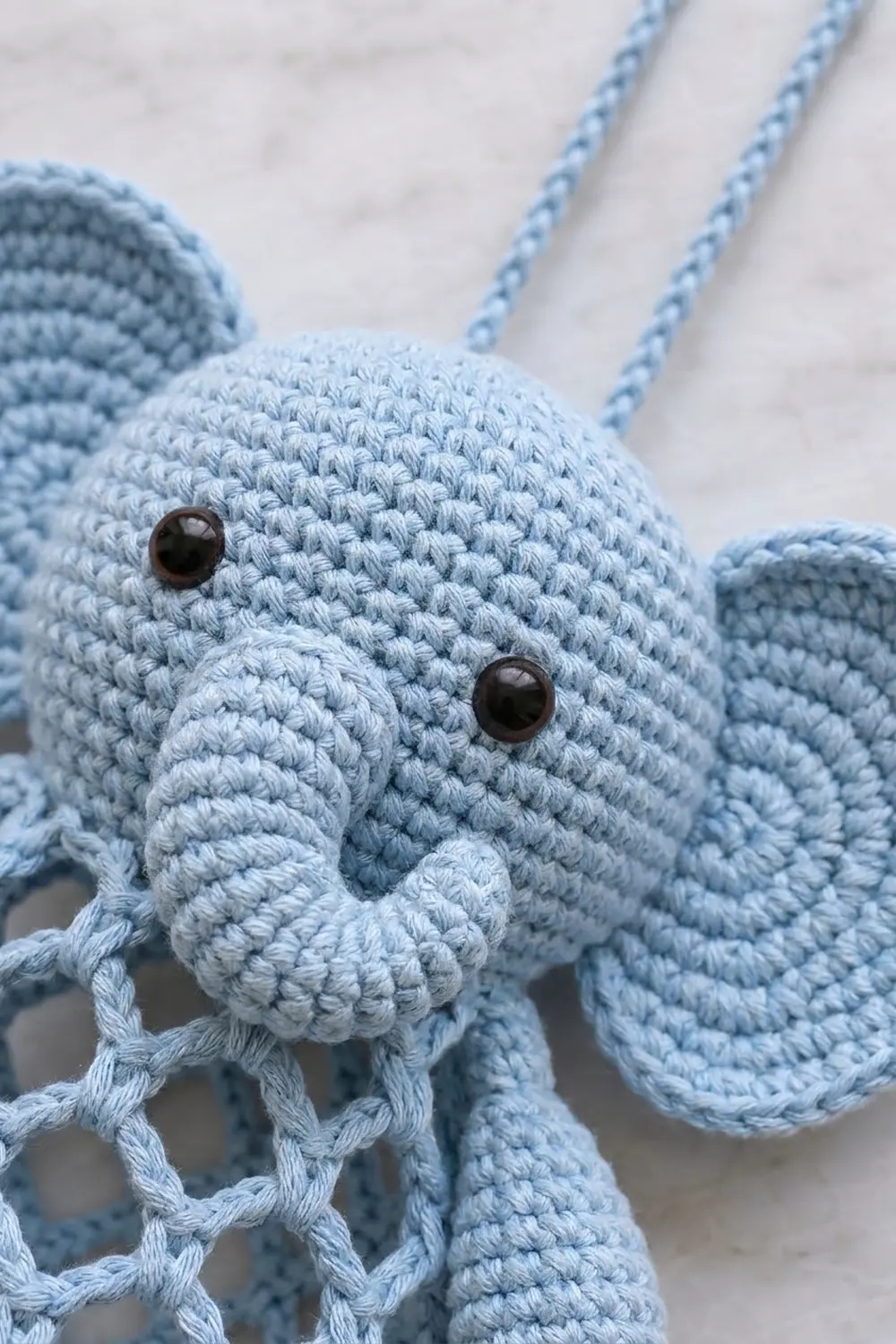
Insert the safety eyes between Rnds 12 and 13, with 8 sts between them, centered on the front. Mark the 24 sts at the back of the last round; this is the hinge.
Ears (Make 2)
Rnd 1: 6 sc in MR. (6)
Rnds 2–8: work as Head Rnds 2–8. (48)
Rnd 9 (shaping): sc in next 12 sts, hdc in next 4 sts, (dc in next st, 2 dc in next st) 4 times, hdc in next 4 sts, sc in next 20 sts, join. (48 worked 1-per-stitch + 4 extra = 52)
Rnd 10 (trim): sl st in each st around. (52 + 0 = 52)
Fasten off with a long tail. The dc section makes the wide, rounded top of the ear. Each ear is about 3.5 in (8.9 cm) wide and 4 in (10.2 cm) tall.
Trunk
Rnd 1: 6 sc in MR. (6)
Rnd 2: (sc 1, inc) 3 times. (9)
Rnds 3–6: sc in next 4 sts, hdc in next 5 sts. (9)
The taller hdc side makes the tip curl upward into a J.
Rnd 7: (sc 2, inc) 3 times. (12)
Rnds 8–11: sc in each st around. (12)
Rnd 12: (sc 3, inc) 3 times. (15)
Rnd 13: sc in each st around. (15)
Fasten off with a long tail. Stuff lightly. The trunk is about 2.6 in (6.6 cm) long.
Arms (Make 2)
Rnd 1: 6 sc in MR. (6)
Rnd 2: inc in each st. (12)
Rnd 3: (sc 1, inc) 6 times. (18)
Rnds 4–10: sc in each st around. (18)
Rnd 11: (sc 1, dec) 6 times. (12)
Stuff lightly. Flatten the opening and sc through both layers across. (6)
Fasten off with a long tail. Each arm is about 2.2 in (5.6 cm) long and 1.3 in (3.3 cm) wide.
Feet (Make 2)
Rnds 1–3: work as Arm Rnds 1–3. (18)
Rnd 4: (sc 2, inc) 6 times. (24)
Rnds 5–8: sc in each st around. (24)
Rnd 9: (sc 2, dec) 6 times. (18)
Stuff firmly and leave open. Fasten off with a long tail. Each foot is about 1.7 in (4.3 cm) across and 1.8 in (4.6 cm) tall.
Tail
Ch 21. Sl st in 2nd ch from hook and in each ch across. (20)
The cord is about 4 in (10.2 cm) long. For the tassel, wrap yarn 8 times around a 3 in (7.6 cm) card, tie at the top through the end of the cord, wrap a neck, and trim to 1 in (2.5 cm).
Hanging Loops (Make 2)
Ch 60, join with sl st to form a ring, taking care not to twist.
Rnd 1: ch 1, sc in each ch around, join. (60)
Fasten off with a long tail. Each loop is about 6.7 in (17.0 cm) long when flattened.
Border
The border is worked at both openings of the body at the same gauge as the tube: 18 sc = 4 in (10.2 cm).
Top Rim
Continue from Net Rnd 12.
Rim Rnd 1: sl st in first sc, ch 1, 4 sc in each ch-6 sp around, skipping the mesh sc, join. (12 loops x 4 sc = 48)
Rim Rnd 2: ch 1, sc in each st around, join. (48)
Fasten off. The rim is 0.4 in (1.0 cm) deep and 10.7 in (27.2 cm) around.
Why the math works: 12 loops x 4 sc gives 48 sts, exactly the head’s 48-st opening. You sew stitch to stitch with no easing.
Bottom Opening Edge
Join yarn in any free loop of the foundation chain.
Edge Rnd 1: ch 1, sc in each free loop around, join. (36)
Edge Rnd 2: sl st in each st around. (36 + 0 = 36)
Fasten off. This adds 0.2 in (0.5 cm). The edge has the same 36 sts as the tube, so it stays flat and does not flare. The firm sl st round keeps the opening from stretching as bags are pulled out.
Assembly
- Head: place the head over the rim, stitch to stitch. Whipstitch the 24 marked back sts to the back 24 rim sts. Leave the front 24 sts free so the head lifts like a lid.
- Trunk: sew the wide end below the eyes, centered, between head Rnds 13 and 17. The curled tip faces up.
- Ears: pinch the lower sc section of each ear slightly and sew it to the side of the head from Rnd 6 to Rnd 14, with the wide dc edge at the top.
- Arms: sew the closed end to the sides of the mesh at Net Rnd 10, pointing down.
- Feet: sew the open end against the junction of tube and Net Rnd 1, one on each side.
- Tail: tie the top of the cord to a mesh sc on the right side at Net Rnd 3.
- Hanging loops: sew the bottom of each loop to the top of the head, 1.5 in (3.8 cm) apart. Sew down through the head and into the hinge seam twice for strength.
Final Blocking
- Lightly mist the ears with water.
- Pin each ear flat on a towel and smooth the curved top.
- Fill the mesh with plastic bags to shape the belly.
- Hang the holder on a knob and let the mesh settle for a few hours.
- Shape the head dome with your fingers while damp.
- Let everything dry completely before use.
Final Quality-Control Checklist
- Tube has 36 sts and measures 4 in (10.2 cm) flat
- Every mesh round has 12 sc and 12 loops
- Rim has 48 sts and matches the head opening
- Eyes are secure and level
- Head lifts at the front and is firmly attached at the back
- Ears, arms and feet are symmetrical
- Hanging loops are double-sewn
- All yarn tails are woven in securely
Troubleshooting
Mesh twists or slants: you may be working into a chain instead of under the loop. Always sc into the ch-sp.
Belly too narrow: chains are too tight. Loosen your chain tension or use a 4.5 mm hook for the mesh only.
Head does not fit the rim: recount both edges; each must have 48 sts.
Ears ruffle: you are adding too many sts. Check that each round increases by exactly 6.
Bags fall out too easily: work Edge Rnd 2 tighter or with a smaller hook.
Care
Hand wash in cool water, reshape and lay flat to dry. Avoid machine washing, because the safety eyes and stuffed parts can be damaged.
Final Notes
The measurement chain is simple. Your gauge sets the 36-st tube at 4 in (10.2 cm) flat. The 12-loop mesh grows to 8 in (20.3 cm) and back, the 48-st rim matches the 48-st head, and the head adds 3.6 in (9.1 cm) for a holder about 16 in (40.6 cm) tall. Check each stage and the finished elephant will hang straight and dispense bags neatly.
Happy crocheting!