

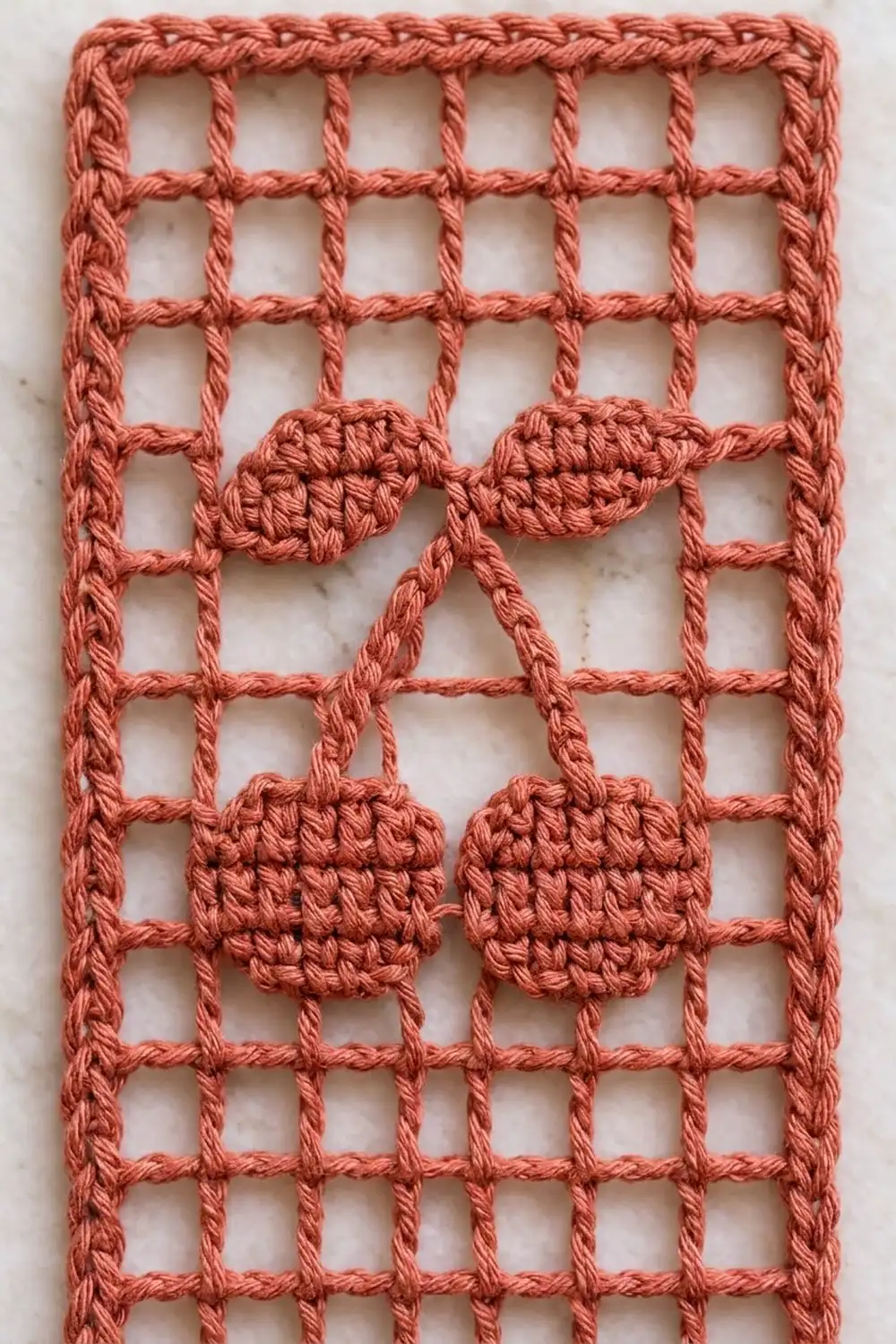
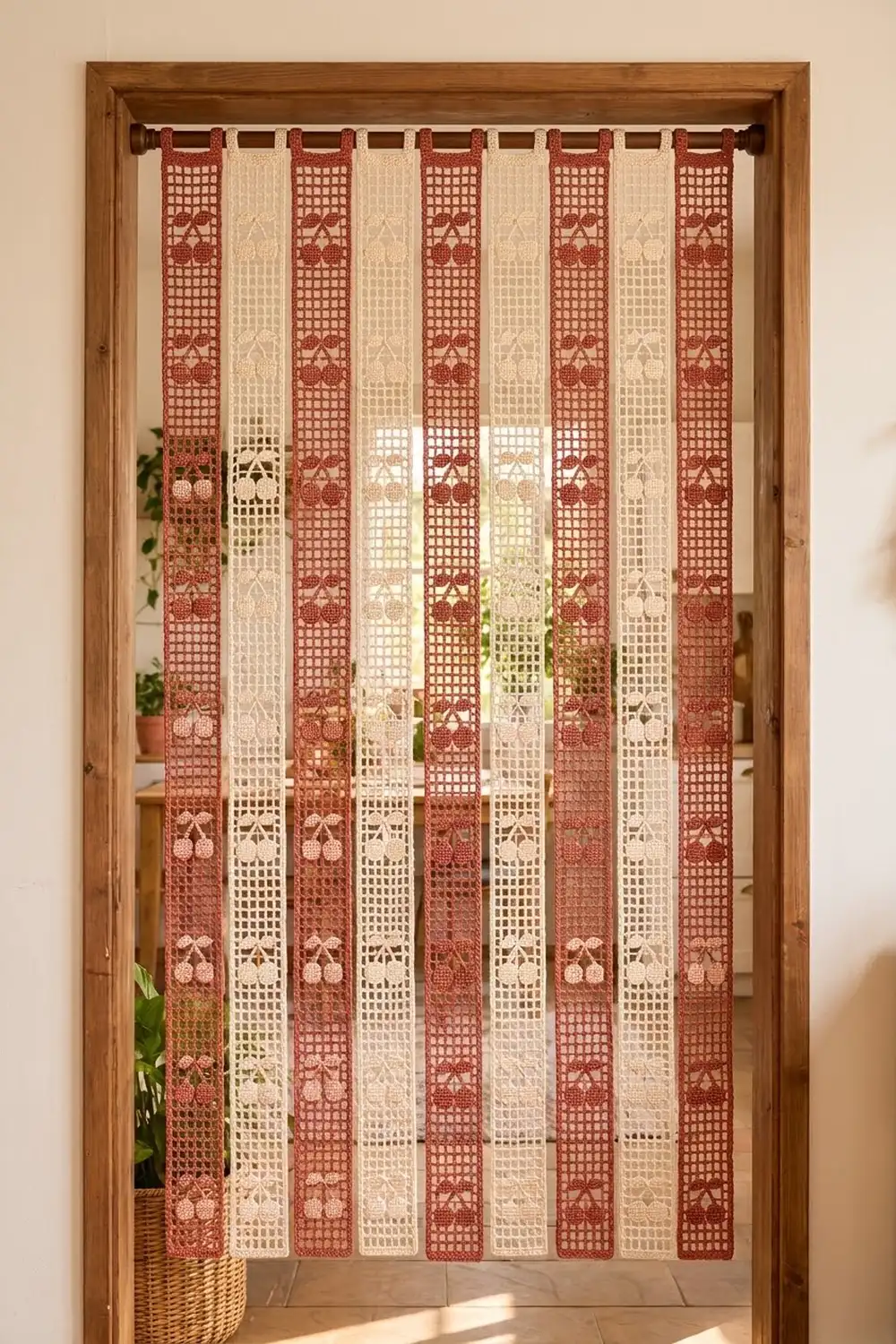
The Cherry Lattice Door Curtain is a light, airy doorway curtain made of nine hanging filet strips. Each strip is an open grid of squares, and solid blocks form twelve cherry motifs along its length: two round cherries, a pair of stems meeting in a V, and two small leaves.
The strips alternate between a warm terracotta red and a soft cream, so the curtain reads as a striped, retro-kitchen design. Light comes through the mesh, and the strips part easily when you walk through. This pattern uses US crochet terms throughout.
Each finished strip measures 5 in (12.7 cm) wide by 76 in (193.0 cm) long before the rod pocket is folded. Once it hangs, it drops 74.25 in (188.6 cm) below the rod.
Each strip is worked flat in rows from the bottom up. It starts with a solid foundation row, continues with mesh and motif rows, and ends with three pocket rows. A single round of single crochet frames each strip. You then fold the top of the strip back to form a rod pocket and thread all nine strips onto the rod. No seaming between strips is needed.
Finished Size and Construction
- Finished strip size: 5 in x 76 in (12.7 cm x 193.0 cm)
- Hanging drop (pocket folded): 74.25 in (188.6 cm)
- Skill level: Intermediate
- Terminology: US crochet terms
- Yarn weight: DK (light worsted / #3) cotton
- Hook: 3.5 mm (US E-4)
- Number of pieces: 9 strips (5 red, 4 cream)
- Layout: 9 strips side by side on one rod, colors alternating
- Strip size before border: 4.5 in x 75.5 in (11.4 cm x 191.8 cm), 9 squares x 151 rows
- Border depth: 0.25 in (0.6 cm) per edge, 1 round of sc
- Total curtain width on rod: about 47 in (119.4 cm) with roughly 0.25 in (0.6 cm) between strips
Materials
Choose a smooth mercerized or combed cotton in DK weight, about 110 m (120 yd) per 50 g. Cotton gives the crisp, defined squares filet work needs, and it hangs straight without stretching too much over time.
Yarn:
– Color A, terracotta red: 250 g, about 550 m (5 strips)
– Color B, cream: 200 g, about 440 m (4 strips)
Each strip uses roughly 45 g (100 m). The quantities above include a margin of about 10% for gauge swatches and variation in tension.
Tools:
– 3.5 mm (US E-4) crochet hook
– Tapestry needle
– Stitch markers
– Rust-proof pins and a long blocking surface (foam mats or a towel-covered floor)
– Spray bottle
– Measuring tape
– Curtain rod, up to 0.75 in (1.9 cm) in diameter
Abbreviations (US Terms)
- ch: chain
- sc: single crochet
- dc: double crochet
- sk: skip
- sp: space
- st(s): stitch(es)
- M: mesh
- B: block
Special stitches:
- Mesh (M): ch 2, sk 2 sts (or the ch-2 sp), dc in next dc.
- Block (B), over a mesh: 2 dc in the ch-2 sp, dc in next dc.
- Block (B), over a block: dc in each of the next 3 dc.
- Mesh (M), over a block: ch 2, sk 2 dc, dc in next dc.
Every row begins with ch 3, which counts as the first dc. Each square adds 3 sts, so every row has 1 + (9 x 3) = 28 sts.
Gauge and Checkpoints
Gauge: 8 squares and 8 rows = 4 in (10.2 cm) in filet mesh, so each square is 0.5 in (1.3 cm) wide and tall.
Make one complete strip before starting the others. It is your real gauge test, and you can use it as a reference for the rest.
Checkpoints:
– After Row 1, the foundation row measures 4.5 in (11.4 cm) wide.
– After Row 4, the strip is 2 in (5.1 cm) long.
– After Row 12 (motif 1 done), it is 6 in (15.2 cm) long.
– After Row 28, it is 14 in (35.6 cm) long.
– After Row 76, it is 38 in (96.5 cm) long.
– After Row 151, it is 75.5 in (191.8 cm) long.
If your strip is too big, go down 0.25 mm in hook size, or shorten your chain-2 loops. If it is too small, go up 0.25 mm. Length matters more than width here: a 0.1 in (0.3 cm) error per row adds up to 15.1 in (38.4 cm) over 151 rows.
Strip Pattern
Make 5 strips in Color A and 4 strips in Color B.
Foundation
Ch 30.
Row 1 (solid): Dc in 4th ch from hook (the skipped ch count as first dc) and in each ch across. Turn. (28 sts: 9 B)
Bottom Mesh
Row 2: Ch 3 (counts as dc), ch 2, sk 2 dc, dc in next dc; repeat from * 8 more times. The last dc goes in the top of the turning ch. Turn. (10 dc, 9 ch-2 sps = 28 sts: 9 M)
Rows 3–4: Ch 3, ch 2, dc in next dc; repeat across. Turn. (28 sts: 9 M)
Cherry Motif (8 Rows)
Read each row from the start of the row. The motif is symmetrical, so the direction you are working does not change it.
Motif Row 1 (cherry bottoms): 2 M, 1 B, 3 M, 1 B, 2 M. (28 sts: 16 dc, 6 ch-2 sps)
Motif Row 2 (cherries): 1 M, 3 B, 1 M, 3 B, 1 M. (28 sts: 22 dc, 3 ch-2 sps)
Motif Row 3 (cherries): 1 M, 3 B, 1 M, 3 B, 1 M. (28 sts)
Motif Row 4 (cherry tops): 2 M, 1 B, 3 M, 1 B, 2 M. (28 sts)
Motif Row 5 (stems): 3 M, 1 B, 1 M, 1 B, 3 M. (28 sts)
Motif Row 6 (stems meet): 4 M, 1 B, 4 M. (28 sts: 12 dc, 8 ch-2 sps)
Motif Row 7 (leaves): 1 M, 2 B, 1 M, 1 B, 1 M, 2 B, 1 M. (28 sts)
Motif Row 8 (leaf tips): 2 M, 2 B, 1 M, 2 B, 2 M. (28 sts)
In Rows 2–3, the two 3-block groups make the round cherries. Rows 1 and 4 taper them to single blocks. The single blocks in Rows 5–6 step toward the center to form the V-shaped stems, and Rows 7–8 make two angled leaves on either side of the stem point.
Strip Sequence
- Rows 5–12: Motif 1
- Rows 13–16: Gap (4 mesh rows)
- Continue alternating 8 motif rows and 4 gap rows. Motif k starts on Row 5 + 12(k – 1).
- Rows 137–144: Motif 12
- Rows 145–148: Top mesh rows (9 M each)
The counts add up: 4 bottom rows + (12 x 8) motif rows + (11 x 4) gap rows + 4 top rows = 148 rows.
Pocket Rows
Rows 149–150: 9 M. (28 sts)
Row 151 (solid): Ch 3, 2 dc in ch-2 sp, dc in next dc; repeat across. (28 sts: 9 B)
Do not fasten off. Continue straight into the border.
Checkpoint: 151 rows, 4.5 in x 75.5 in (11.4 cm x 191.8 cm).
To lengthen or shorten a strip, add or remove one motif plus one gap. Each motif-and-gap set is 12 rows, or 6 in (15.2 cm).
Make All Pieces
- Color A (terracotta red): 5 strips
- Color B (cream): 4 strips
Layout, left to right on the rod:
| A | B | A | B | A | B | A | B | A |
Red strips sit at both outer edges, so the curtain is framed symmetrically.
Joining
The strips are not joined to each other. They hang separately, which lets the curtain part when you walk through. The rod pocket is the only “joining.”
Making the rod pocket (after the border and blocking):
- Lay the strip wrong side up.
- Fold the top along the line between Rows 148 and 149. The folded flap is Rows 149–151 plus the top border, about 1.75 in (4.4 cm) deep.
- Pin the flap’s border edge to the back across the top of Row 145, matching square to square.
- Whipstitch with matching yarn, catching one sc of the border and the top of one dc or chain directly behind it. Keep the stitches stitch-to-stitch so the pocket doesn’t twist.
Tension: Sew loosely enough that the front squares stay square. If the front puckers, your stitches are too tight.
Checkpoint: The pocket should fit a rod up to 0.75 in (1.9 cm) in diameter. Each hanging strip should measure 5 in x 74.25 in (12.7 cm x 188.6 cm).
Thread the strips onto the rod in the layout order and space them about 0.25 in (0.6 cm) apart. The total width is (9 x 5 in) + (8 x 0.25 in) = 47 in (119.4 cm).
Border
Border gauge: 3 sc per dc row-end matches one 0.5 in (1.3 cm) row, so 6 sc = 1 in (2.5 cm) along the long edges. Across the short edges, 1 sc per st matches the row width exactly.
Round 1: With the last loop still on your hook from Row 151, ch 1 and turn the strip so you are working across the top of Row 151.
- Top edge: 3 sc in the first st (corner), sc in the next 26 sts, 3 sc in the last st (corner). (32 sc)
- Long side: Work 3 sc around the post of each row-end, down all 151 rows. (453 sc)
- Bottom edge: Work into the foundation chain, with the base of the turning ch counting as the first st. 3 sc in the first st (corner), sc in the next 26 sts, 3 sc in the last st (corner). (32 sc)
- Second long side: 3 sc around each row-end, up all 151 rows. (453 sc)
Sl st in the first sc to join. Fasten off and weave in the ends. (970 sc in total)
Why the math works: Each short edge has 28 sts. You work 1 sc into 26 of them and 3 sc into each of the 2 corner sts: 26 + 3 + 3 = 32. The corners are counted once, inside each short-edge total. Each long edge is 151 rows x 3 sc = 453, or 75.5 in (191.8 cm) at 6 sc per inch, which matches the body length exactly. The total is 2 x 32 + 2 x 453 = 970.
The border adds 0.25 in (0.6 cm) to every edge, so the strip becomes 5 in x 76 in (12.7 cm x 193.0 cm).
Final Blocking
Block every strip before you sew the pockets.
- Soak the strip in cool water for 10 minutes. Press out the water gently; do not wring.
- Roll it in a towel to remove the excess moisture.
- Lay it flat on the blocking surface, right side up.
- Pin the four corners to 5 in x 76 in (12.7 cm x 193.0 cm).
- Pin along both long edges every 6 in (15.2 cm), checking that the strip is 5 in (12.7 cm) wide at each pin.
- Use your fingers to straighten the mesh columns so the dc posts line up vertically.
- Gently push each cherry into a round shape.
- Let it dry completely, usually 24 hours.
- Unpin, then sew the rod pocket.
Final Quality-Control Checklist
- [ ] Every row has 28 sts (9 squares).
- [ ] Each strip has 12 complete cherry motifs and 11 four-row gaps.
- [ ] The cherries, stems, and leaves are symmetrical, and every motif is upright with the leaves toward the pocket.
- [ ] The border totals 970 sc, with 3 sc at each corner.
- [ ] The blocked strip measures 5 in x 76 in (12.7 cm x 193.0 cm).
- [ ] The pocket is 1.75 in (4.4 cm) deep and sewn straight.
- [ ] All nine strips hang to 74.25 in (188.6 cm) within 0.5 in (1.3 cm) of each other.
- [ ] The ends are woven in securely and are invisible from the front.
Troubleshooting
The squares lean or look like rectangles. Your ch-2 loops are too tight or too loose. Aim for chains about as wide as two dc.
The strip edges wave. Your turning chains are too loose. Try ch 2 plus a firm pull instead of ch 3, keeping it consistent.
A cherry looks lopsided. Check that you worked 2 dc into the ch-2 sp, not 3, for each block over a mesh.
The border ruffles. You are working too many sc per row-end. Keep it at exactly 3 per row, or go down a hook size for the border only.
The border pulls in. Use a hook 0.5 mm larger for the border round.
The strips end up different lengths. Measure at every checkpoint. Correct small differences when blocking, and for a gap over 1 in (2.5 cm), add or remove one gap row.
Care
Hand wash in cool water with mild soap, then re-block flat or hang damp from the rod to straighten. Do not tumble dry, because heat can shrink cotton unevenly between strips.
Final Notes
The measurement chain is simple and stable:
- 1 square = 0.5 in (1.3 cm).
- 9 squares = 4.5 in (11.4 cm) wide.
- 151 rows = 75.5 in (191.8 cm) long.
- The border brings the strip to 5 in x 76 in (12.7 cm x 193.0 cm).
- Folding the pocket leaves a 74.25 in (188.6 cm) drop.
- Nine strips spaced 0.25 in (0.6 cm) apart fill 47 in (119.4 cm) of rod.
Check your first strip against every number, and the other eight will follow.
Happy crocheting!