

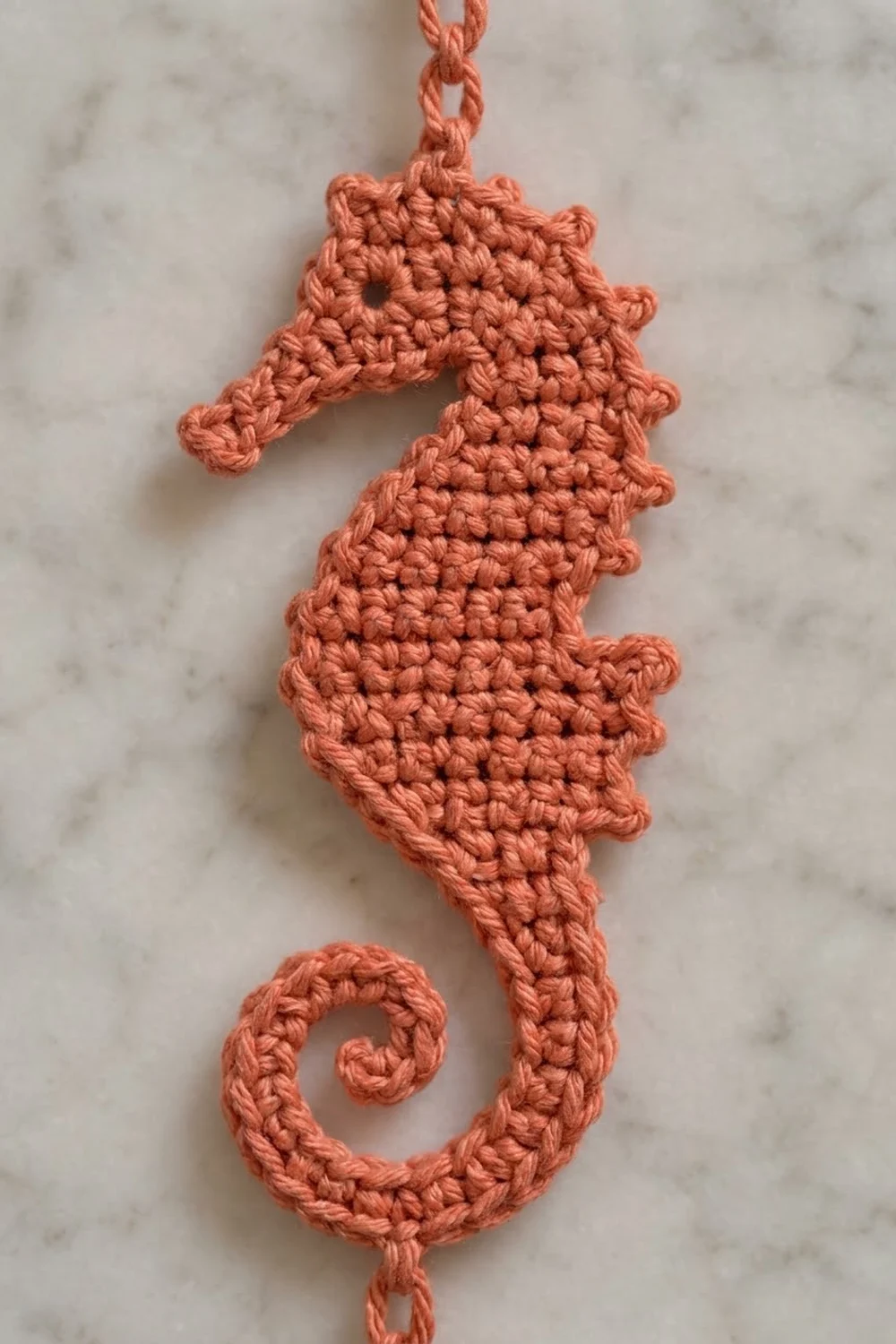
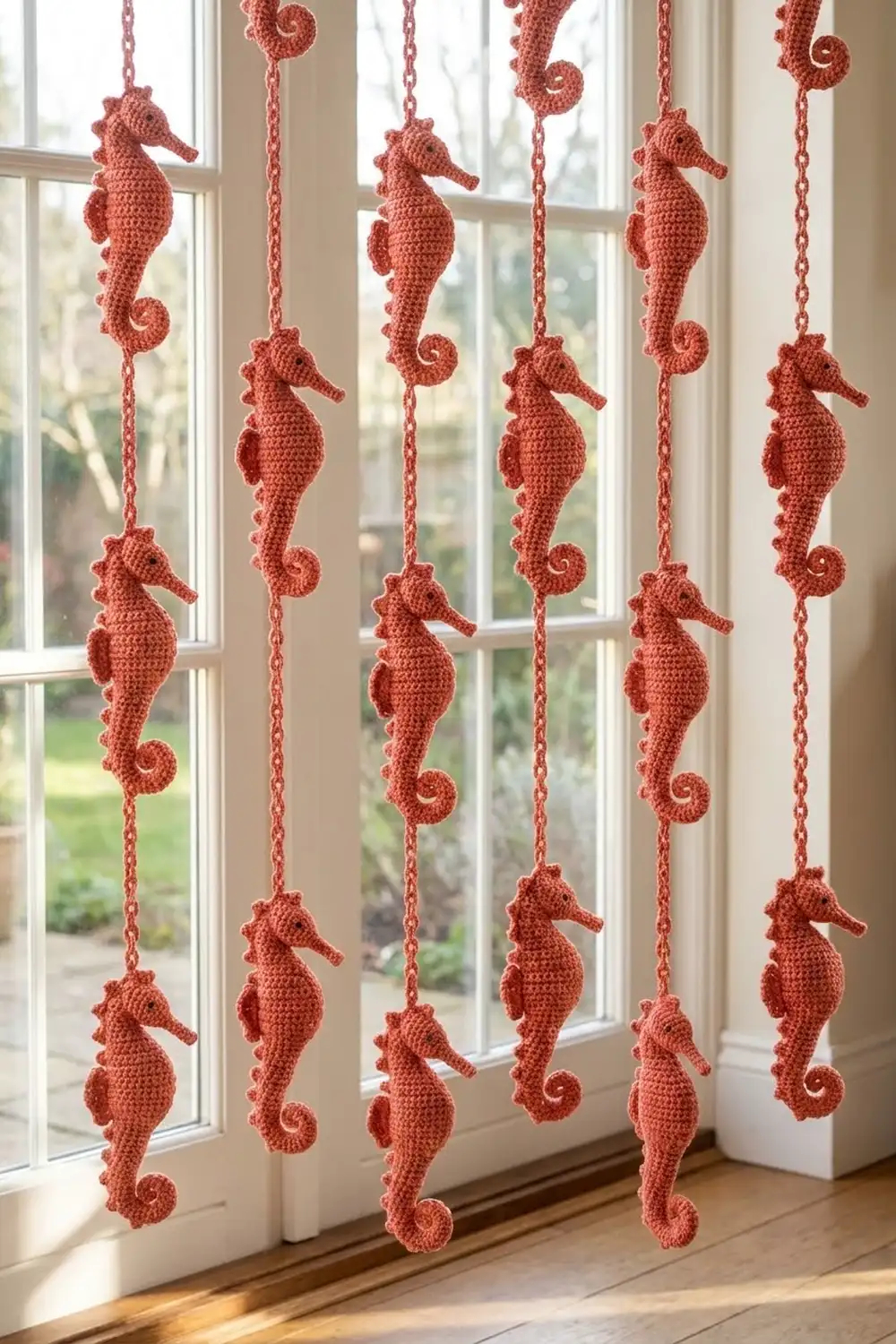
This seahorse strand is a set of flat seahorse motifs worked in one warm coral color. Each seahorse is joined to the next by a firm chain cord. The seahorses have a rounded belly, a pointed snout, a small eyelet eye, picot spines down the back and a curled spiral tail. Hung in a window, the strand moves in the breeze and catches the light.
The style is relaxed and coastal. The single-crochet fabric is dense enough for the seahorse shapes to show clearly against glass, sheer fabric or a pale bedspread. Because everything is one color, the outline does all the work.
This pattern uses US crochet terms. One finished seahorse is about 6 in (15.2 cm) tall and 3.2 in (8.1 cm) wide at the snout. One strand has five seahorses and measures about 39 in (99.1 cm) from the top of the first cord to the end of the bottom cord, plus a 1 in (2.5 cm) hanging loop.
Each seahorse body is worked flat in rows of single crochet from the belly up to the crown. The tail strip and spiral are worked from the bottom edge. The seahorses are then linked with doubled chain cords. Last, a spine edging is worked around each body to lock the joins in place.
Finished Size and Construction
- Finished strand: 39 in (99.1 cm) long, plus a 1 in (2.5 cm) hanging loop
- One seahorse: 6 in (15.2 cm) tall x 3.2 in (8.1 cm) wide
- Skill level: Easy-intermediate
- Terminology: US
- Yarn weight: DK / light worsted (#3), cotton
- Hook: 3.5 mm (E-4)
- Number of pieces: 5 seahorses per strand
- Layout: 1 column x 5 seahorses, joined vertically
- Body size before edging: 2.4 in (6.1 cm) wide at the belly x 4.2 in (10.7 cm) tall
- Edging depth: picot spines add about 0.2 in (0.5 cm) along the back. The slip-stitch front edge adds about 0.1 in (0.3 cm).
Materials
Use a smooth, mercerized or combed cotton in DK weight. Cotton keeps the spines and the spiral crisp, and it doesn’t stretch much under its own weight when it hangs. Avoid fuzzy or very soft acrylics, because they blur the outline.
- Coral: 50 g (about 105 m / 115 yd) for one strand of five seahorses
One seahorse with its edging uses about 14 m (7 g). The connector cords and hanging loop use about 7 m in total. The amount listed includes a margin for your gauge swatch and small differences in tension.
Tools
– 3.5 mm (E-4) crochet hook
– Tapestry needle
– Scissors
– Stitch markers
– Rust-proof pins and a foam blocking mat
– Spray bottle
– Ruler or tape measure
Abbreviations (US Terms)
- ch – chain
- sc – single crochet
- sc2tog – single crochet 2 together
- sl st – slip stitch
- sk – skip
- st(s) – stitch(es)
- RS / WS – right side / wrong side
Special stitch – picot: Ch 3, sl st in the 3rd ch from the hook. This makes one small spine bump. A picot is not counted as a stitch.
Turning chain: The ch 1 at the start of each row does not count as a stitch.
Gauge and Checkpoints
Gauge: 20 sc and 22 rows = 4 in (10.2 cm) in single crochet. That works out to 5 sts and 5.5 rows per inch.
Make one complete seahorse before starting the strand. It works as your gauge swatch, and you can use it as one of the five.
Checkpoints for one seahorse:
– After Row 5: 12 sts, 2.4 in (6.1 cm) wide
– After Row 10: 1.8 in (4.6 cm) tall
– After Row 18: 15 sts, about 3.0 in (7.6 cm) from snout tip to back edge
– After Row 23: body is 4.2 in (10.7 cm) tall
– Finished tail spiral: about 1.25 in (3.2 cm) across
– Finished seahorse: 6 in (15.2 cm) tall
If your seahorse is more than 0.2 in (0.5 cm) too big, change to a 3.25 mm hook. If it’s too small, change to a 3.75 mm or 4.0 mm hook. The stitch counts stay the same, so only the hook changes.
Seahorse Body
The RS faces you on odd rows. When the RS faces you, the seahorse faces left. Odd rows start at the back edge (right side) and end at the front edge (left side). Even rows go the other way. Ch 1 and turn at the end of every row.
Row 1 (RS): Ch 5, sc in 2nd ch from hook and in each ch across. (4 sts)
Row 2: 2 sc in first st, sc in next 2 sts, 2 sc in last st. (6 sts)
Row 3: 2 sc in first st, sc in next 4 sts, 2 sc in last st. (8 sts)
Row 4: 2 sc in first st, sc in next 6 sts, 2 sc in last st. (10 sts)
Row 5: 2 sc in first st, sc in next 8 sts, 2 sc in last st. (12 sts)
Checkpoint: 2.4 in (6.1 cm) wide.
Rows 6–10: Sc in each st across. (12 sts) This is the full, rounded belly.
Row 11: Sc2tog, sc in next 8 sts, sc2tog. (10 sts)
Row 12: Sc in each st across. (10 sts)
Row 13: Sc2tog, sc in next 6 sts, sc2tog. (8 sts)
Row 14: Sc in each st across. (8 sts)
Row 15: Sc in next 6 sts, sc2tog. (7 sts) The decrease is at the front edge, which makes the inward curve of the neck.
Row 16: Sc in each st across. (7 sts)
Row 17: 2 sc in first st, sc in next 5 sts, 2 sc in last st. (9 sts) This widens the row into the head.
Head and Snout
Row 18 (WS, snout): Ch 7. Sc in 2nd ch from hook and in next 5 ch (6 snout sts), then sc in each of the 9 head sts. (15 sts)
Checkpoint: about 3.0 in (7.6 cm) from snout tip to back edge.
Row 19 (RS, eye row): Sc in next 5 sts, ch 1, sk next st (eye), sc in next 3 sts, sc in next 4 snout sts. Leave the last 2 snout sts unworked. (13 sts: 12 sc + 1 ch-1 space)
Row 20 (WS): Sl st in first 4 sts (the snout), then sc in next 9 sts, working 1 sc into the ch-1 space. (9 sc + 4 sl st) The sl sts taper the top of the snout to a point. The eyelet stays open as the eye.
Row 21: Work over the 9 sc only. Sc2tog, sc in next 5 sts, sc2tog. Leave the 4 sl sts unworked. (7 sts)
Row 22: Sc2tog, sc in next 3 sts, sc2tog. (5 sts)
Row 23: Sc in each st across. (5 sts) This is the crown.
Fasten off and weave in the end. Checkpoint: body is 4.2 in (10.7 cm) tall.
Tail and Spiral
Hold the body with the RS facing and Row 1 at the top, so the bottom edge is facing up. Work into the free loops of the foundation chain.
Row T1: Join yarn at the front (belly) corner. Ch 1, sc in each of the 4 free loops. (4 sts)
Row T2: Ch 1, turn, sc in each st. (4 sts)
Row T3: Ch 1, turn, sc2tog, sc in next 2 sts. (3 sts)
Row T4: Ch 1, turn, sc in each st. (3 sts)
Row T5: Ch 1, turn, sc2tog, sc in next st. (2 sts)
The decreases are at the front edge, so the tail strip leans toward the back. It is about 0.9 in (2.3 cm) long.
Row T6 (spiral): Ch 13. Work 2 sc in 2nd ch from hook and 2 sc in each of next 5 ch (12 sts). Sc in each of the last 6 ch (6 sts). Sc2tog over the 2 tail sts (1 st). (19 sts)
The increases at the tip make the strip twist into a spiral on its own. Coil it toward the back of the seahorse into a tight spiral about 1.25 in (3.2 cm) across. Use the yarn tail to tack the tip in the center with 2 small stitches, then weave in the end.
Make All Pieces
Make 5 seahorses in Coral. Each one needs the body (Rows 1–23) and the tail (Rows T1–T6). Don’t add the edging yet.
Lay them out in one column, all facing left:
[hanging loop]
     |  cord A
[Seahorse 1]
     |  cord B
[Seahorse 2]
     |  cord C
[Seahorse 3]
     |  cord D
[Seahorse 4]
     |  cord E
[Seahorse 5]
     |  cord F (bottom tail)
Check that all five match. Each body should be 2.4 in (6.1 cm) wide and 4.2 in (10.7 cm) tall, within 0.1 in (0.3 cm).
Joining
Each connector is a doubled chain cord: a chain with a row of slip stitches worked back along it. This makes it thicker and firmer than a plain chain, so it doesn’t twist or stretch.
Anchor points: The top anchor on every seahorse is the center st of Row 23 (the 3rd of 5 crown sts). The bottom anchor is the lowest point on the outside of the tail spiral. Each cord connects exactly 1 bottom anchor to 1 top anchor. No other stitches are added to the seahorses.
Cord A and hanging loop: Ch 15, sl st in the first ch to form a ring (the hanging loop). Ch 10, sl st in the crown center st of Seahorse 1. Turn and sl st in the back bump of each of the 10 ch back to the loop. (10 ch + 10 sl st) Fasten off.
Cords B–E: Join yarn with a sl st at the bottom anchor of Seahorse 1. Ch 10, sl st in the crown center st of Seahorse 2. Sl st in the back bump of each of the 10 ch back up to the spiral, then sl st into the spiral once more. (10 ch + 10 sl st) Fasten off. Repeat to join Seahorse 2 to 3, 3 to 4 and 4 to 5.
Cord F (bottom tail): Join at the bottom anchor of Seahorse 5. Ch 10, then sl st in the back bump of each ch back to the spiral. (10 ch + 10 sl st) Fasten off.
Tension: Keep the chains even and medium-firm. If they’re too loose, the cords sag and the seahorses tilt. If they’re too tight, the cords pucker the crown. Each cord should measure 1.5 in (3.8 cm).
Checkpoint: 6 cords x 1.5 in (3.8 cm) + 5 seahorses x 6 in (15.2 cm) = 9 in + 30 in = 39 in (99.1 cm). The hanging loop adds 1 in (2.5 cm) above that.
Border: Spine Edging
Work this edging on each seahorse after the strand is joined. That way, the crown stitches lock the cord anchor in place. The tail strip and spiral are not edged.
Border gauge: 1 sc per row-end on the back edge and 1 sl st per row-end on the front edge. A row-end in single crochet is very close to one stitch wide (5.5 rows vs. 5 sts per inch). One stitch per row-end therefore keeps the edge flat, with no ruffling and no cupping.
Back edge (Rows 1–23): With the RS facing, join yarn with sc in the back row-end of Row 1. Sc in each row-end up to Row 23. Work a picot after the 3rd, 6th, 9th, 12th, 15th, 18th and 21st sc. (23 sc + 7 picots)
Crown (Row 23 sts): Sc in the first 2 sts, picot, sc in the center st (insert the hook under both the stitch and the cord’s sl st), sc in the next st, picot, sc in the last st. (5 sc + 2 picots)
Front edge: Sl st down the front, working 1 sl st into each spot:
| Section | Sl sts |
|---|---|
| Row-ends of Rows 23, 22, 21 | 3 |
| The 4 sl sts of Row 20 along the top of the snout | 4 |
| The 2 unworked snout sts of Row 18 | 2 |
| Snout tip | 1 |
| The 6 free foundation loops under the snout | 6 |
| Row-ends of Rows 17 down to 1 | 17 |
| Front edge total | 33 |
Fasten off and weave in the end.
Why the math works: The back edge has 23 row-ends, so it takes 23 sc. A picot every 3 sc places one spine about every 0.5 in (1.3 cm). That gives 7 spines between Row 3 and Row 21, leaving the belly bottom and the neck top smooth. The crown has 5 sts, so 2 picots placed symmetrically around the center leave the center stitch free for the cord. The front edge uses slip stitches. They outline the shape without adding width, so the snout stays pointed and the belly stays smooth.
Final Blocking
- Lay the strand flat on a blocking mat, straight from top to bottom.
- Spray each seahorse until it’s damp but not dripping.
- Pin each body to 2.4 in (6.1 cm) across the belly and 4.2 in (10.7 cm) tall.
- Pin the snout tip so the snout is straight, and push a pin through the eyelet to open it.
- Pin each picot outward so the spines stand up evenly.
- Shape each spiral into a round coil about 1.25 in (3.2 cm) across.
- Pin each cord straight at 1.5 in (3.8 cm).
- Check that the full strand measures 39 in (99.1 cm) without the loop, and leave it to dry completely.
Final Quality-Control Checklist
- All 5 seahorses face the same way.
- Each seahorse measures 6 in (15.2 cm) x 3.2 in (8.1 cm).
- Every eyelet is open.
- Every back edge has 7 spines and every crown has 2.
- The snouts are pointed and lie flat.
- Every spiral is tacked and round.
- All 6 cords are 1.5 in (3.8 cm) long and attached at the crown center.
- The strand measures 39 in (99.1 cm) plus the loop.
- All ends are woven in securely.
Troubleshooting
The belly cups. Your tension is too tight. Use a hook 0.25 mm larger and check that Rows 2–5 have exactly one increase at each edge.
The edging ruffles. You’ve worked more than 1 st per row-end. Count each section against the table above.
The snout curls up. Block it firmly. Next time, work the Row 18 chain a little looser.
The tail won’t coil. Check that you worked 6 increase stitches at the tip (12 sc). Dampen the spiral, coil it and pin it while it dries.
The seahorses tilt on the strand. The cord isn’t on the center crown st. Remove it and reattach it to the 3rd of the 5 sts.
The strand is too long. The cords are probably loose. Rework them with a smaller hook or firmer tension.
Care
Hand wash in cool water with mild soap, press out the water in a towel, and lay flat to dry, re-pinning the spirals if needed. Don’t hang the strand while it’s wet, because the cords will stretch.
Final Notes
The measurement chain is simple. The gauge of 20 sc x 22 rows = 4 in (10.2 cm) gives a body 2.4 in (6.1 cm) wide and 4.2 in (10.7 cm) tall. The tail and spiral bring each seahorse to 6 in (15.2 cm). Five seahorses and six 1.5 in (3.8 cm) cords make a 39 in (99.1 cm) strand. The spine edging adds texture without changing the length. To make a longer strand, add seahorses and cords in pairs, adding 7.5 in (19.1 cm) each time. To make a full curtain, make as many strands as you need.
Happy crocheting!