
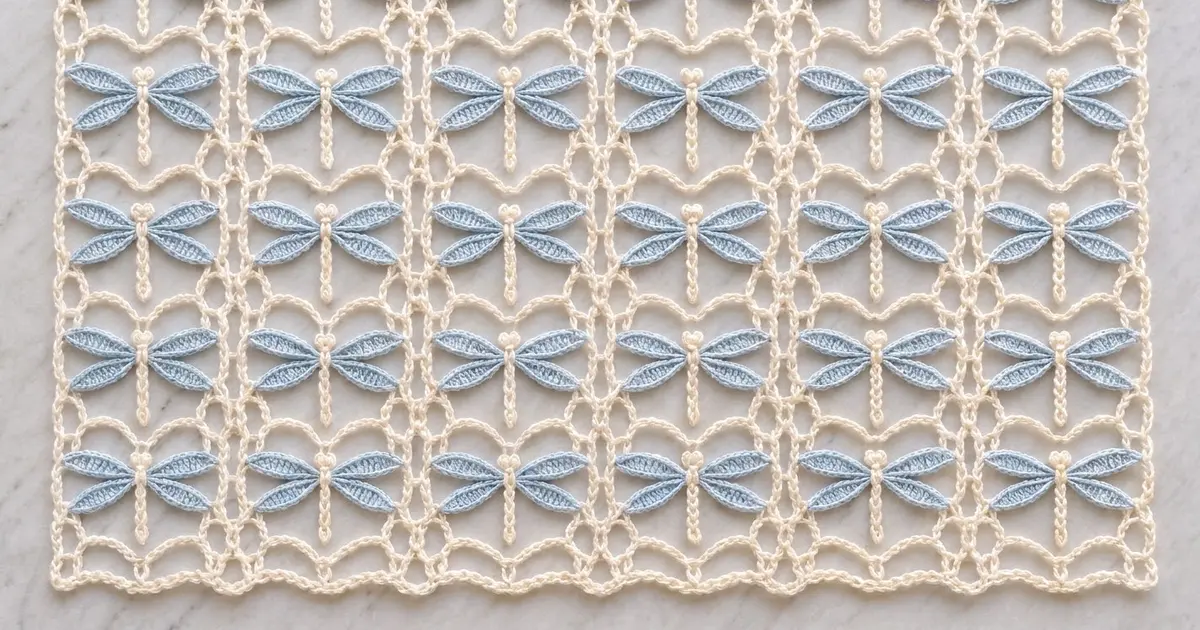
This airy curtain panel is filled with soft blue dragonflies floating in an ivory lace grid. Each dragonfly has four pointed, leaf-shaped wings with ridged texture, a slim ivory body and a tiny two-loop head. Wavy chain arches and slim bars divide one dragonfly from the next, and a small scalloped border frames the panel.
The palette is just ivory and light powder blue. The style is light cottage lace that lets sunlight through and casts dragonfly shadows on the floor. This pattern uses US crochet terms throughout.
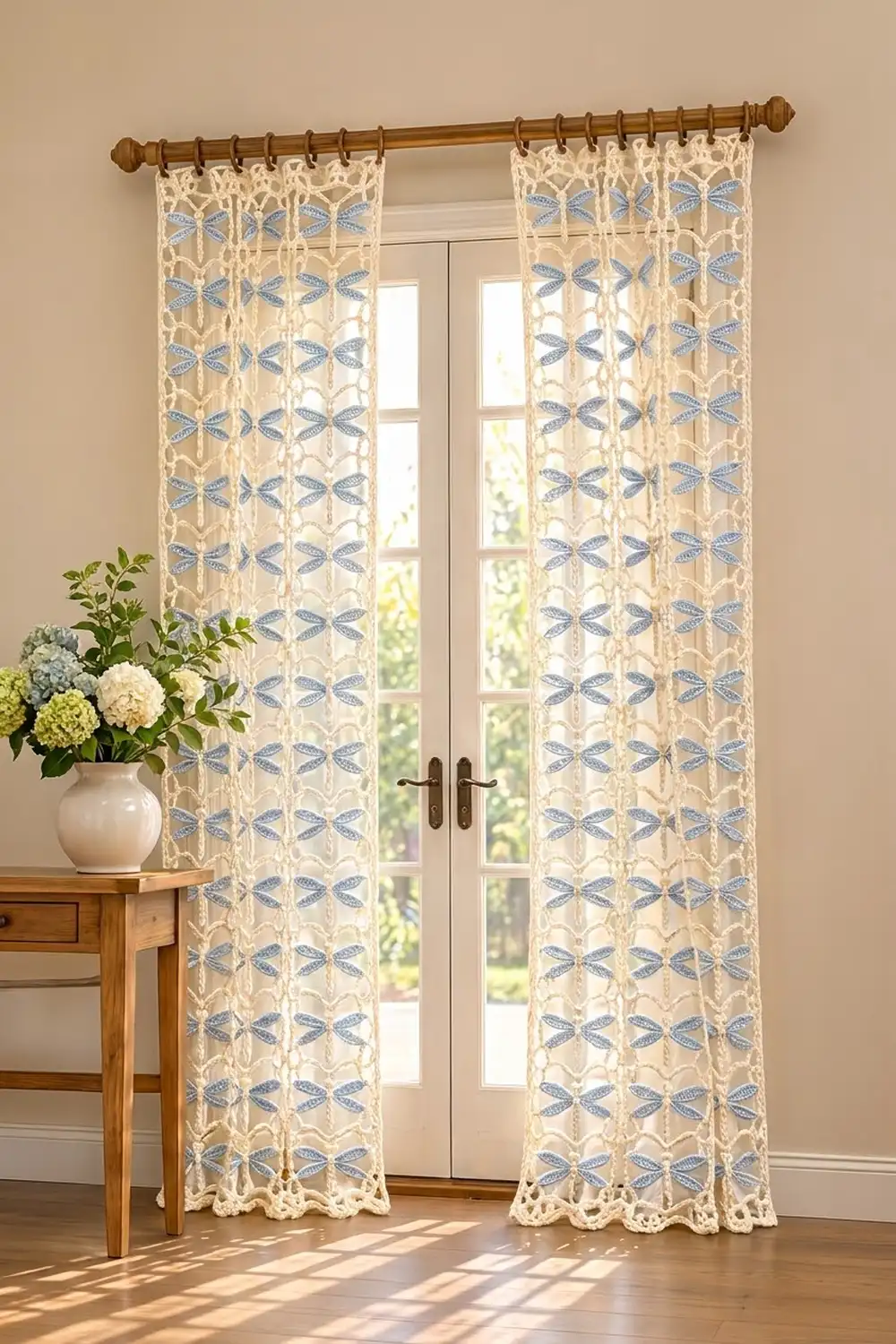
One finished panel measures 26.5 in x 78.75 in (67.3 cm x 200.0 cm) after blocking. The photo shows a matching pair, so make two panels for a doorway or wide window.
You crochet five long ivory lace strips in rows from the bottom up. Next, you sew four small blue wings onto each dragonfly body. Then you slip-stitch the strips together and finish with a three-round scalloped border.
Finished Size and Construction
- Finished size (one panel): 26.5 in x 78.75 in (67.3 cm x 200.0 cm)
- Skill level: Intermediate
- Terminology: US crochet terms
- Yarn weight: DK (#3)
- Hook: 4.0 mm (US G-6)
- Number of pieces per panel: 5 lace strips + 440 wing appliqués
- Layout: 5 strips across, 22 dragonflies tall
- Strip size: 5 in x 77.25 in (12.7 cm x 196.2 cm)
- Panel size before border: 25 in x 77.25 in (63.5 cm x 196.2 cm)
- Border depth: 0.75 in (1.9 cm) on every side
Materials
Choose a smooth DK cotton or cotton blend at about 120 m per 50 g. Cotton keeps the wing points crisp and resists stretching on a rod. Avoid fuzzy yarns, which blur the lace.
Per panel:
- Ivory (strips, seams, border): 300 g / 720 m
- Light blue (wings): 450 g / 1,080 m
For a pair: 600 g / 1,440 m ivory and 900 g / 2,160 m light blue.
All quantities include a margin of roughly 15-20% for swatching, sewing tails and re-dos.
Tools:
- 4.0 mm (US G-6) crochet hook
- Tapestry needle
- Stitch markers
- Rust-proof pins and blocking mats
- Measuring tape
- Spray bottle
- Optional: curtain clip rings
Abbreviations (US Terms)
- ch – chain
- sl st – slip stitch
- sc – single crochet
- hdc – half double crochet
- dc – double crochet
- sp – space
- st(s) – stitch(es)
- RS / WS – right side / wrong side
Special stitch – ttr (triple treble crochet): Yarn over 4 times, insert hook in stitch, yarn over and pull up a loop (6 loops on hook), [yarn over, draw through 2 loops] 5 times. A beginning ch 6 counts as 1 ttr.
Special stitch – picot: Ch 3, sl st in the top of the sc just made.
Gauge and Checkpoints
Gauge: 20 sc = 4 in (10.2 cm). One 4-row dragonfly repeat (Rows 2-5) is 3.5 in (8.9 cm) tall. Each ttr row is about 1.5 in (3.8 cm) tall.
Test one piece first. Work a short strip of Row 1 plus 2 repeats (9 rows), then make 8 wings and sew them on.
Checkpoints:
- Test strip: 5 in x 7.25 in (12.7 cm x 18.4 cm)
- One wing: 2.25 in (5.7 cm) long x 1 in (2.5 cm) wide
- Strip after 6 repeats: 21.25 in (54.0 cm) long
- Strip after 11 repeats: 38.75 in (98.4 cm) long
- Finished strip: 77.25 in (196.2 cm) long
Too wide? Go up a hook size. Too narrow? Go down a size. If the width is right but the repeats are too tall, wrap your ttr loops more snugly. If they’re too short, pull the first loop up a little higher. If the wings overhang their windows, make the wings with a 3.75 mm hook.
Lace Strip (make 5 per panel)
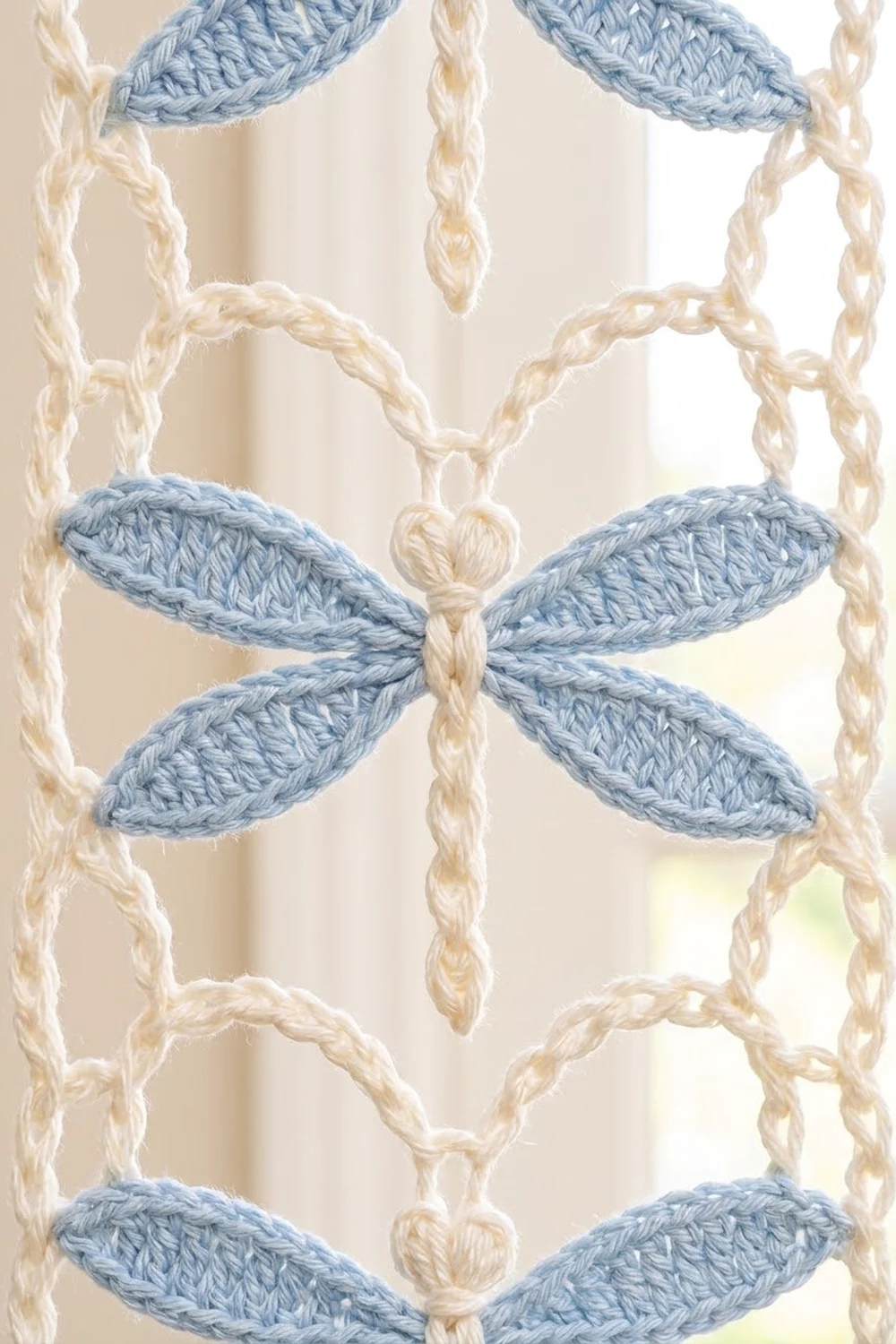
The strip is 25 sts wide. The center st (st 13) becomes the dragonfly body, and sts 1 and 25 become the side rails.
With ivory, ch 26.
Row 1 (RS): Sc in 2nd ch from hook and in each ch across, turn. (25 sc)
Row 2 (WS, arch row): Ch 1 (does not count), sc in first sc, [ch 5, skip next 5 sc, sc in next sc] 4 times, turn. (5 sc + 20 ch = 25 sts)
The sc now sit in sts 1, 7, 13, 19 and 25. The ch-5 loops form the wavy arches below each dragonfly.
Row 3 (RS, lower window row): Ch 6 (counts as ttr), ch 11, skip next ch-5 sp, sc and ch-5 sp, ttr in center sc, ch 11, skip next ch-5 sp, sc and ch-5 sp, ttr in last sc, turn. (3 ttr + 22 ch = 25 sts)
This row builds the tail and the two lower-wing windows.
Row 4 (WS, upper window row): Ch 6 (counts as ttr), ch 11, skip ch-11 sp, ttr in center ttr, ch 11, skip ch-11 sp, ttr in 6th ch of beginning ch of Row 3, turn. (3 ttr + 22 ch = 25 sts)
This row builds the upper body and the two upper-wing windows.
Row 5 (RS, bar row with head): Ch 1, sc in first ttr, 11 sc in ch-11 sp, sc in center ttr, [picot] twice, 11 sc in next ch-11 sp, sc in 6th ch of beginning ch of Row 4, turn. (25 sc; picots not counted)
The two picots sit at the top of the body and form the heart-shaped head.
Rows 6-89: Repeat Rows 2-5 another 21 times. (22 repeats, 22 dragonfly bodies, 89 rows; last row 25 sc)
Fasten off and weave in ends.
Wings (make 4 per dragonfly)
With light blue, ch 12.
Rnd 1: Sc in 2nd ch from hook, hdc in next ch, dc in next 7 ch, hdc in next ch, 3 sc in last ch (tip). Rotate and work along the free loops of the chain: hdc in next ch, dc in next 7 ch, hdc in next ch, 2 sc in the same ch as the first sc. Sl st to first sc. (24 sts)
Rnd 2: Sl st loosely in each st around, join to first sl st. (24 sl st)
Rnd 2 outlines the wing and sharpens both points, and the dc columns create the ridges. Fasten off, leaving a 10 in (25.4 cm) tail.
Wing check: 2.25 in (5.7 cm) x 1 in (2.5 cm).
Attaching the Wings
Each dragonfly has four windows: two upper windows (Row 4) and two lower windows (Row 3).
- Upper wings: Place one wing in each Row 4 window. Sew the inner point to the center ttr just below the head and angle the wing slightly upward. Tack the outer point to the Row 4 ch-11, about 9 chains out from the body.
- Lower wings: Place one wing in each Row 3 window. Sew the inner point to the center ttr just below the upper wings and angle the wing slightly downward. Tack the outer point to the nearest Row 2 ch-5 arch.
- Add one tacking stitch at the middle of each wing so it can’t flip.
Keep all wings on the RS and sew loosely so the lace doesn’t pucker.
Make All Pieces
Per panel:
- Ivory: 5 lace strips (22 repeats each)
- Light blue: 440 wings (88 per strip)
For a pair: 10 strips and 880 wings.
Layout grid (one panel, RS facing):
S1   S2   S3   S4   S5
D    D    D    D    D     dragonfly row 22 (top)
D    D    D    D    D     dragonfly row 21
...  ...  ...  ...  ...   rows 20-3
D    D    D    D    D     dragonfly row 2
D    D    D    D    D     dragonfly row 1 (bottom)
S = strip, D = one dragonfly. The strips are identical, so the dragonfly rows line up across the panel.
Joining
Join with ivory using a flat slip-stitch seam through the row-ends.
Row-end count per strip side:
- Row 1: 1 st
- Each repeat: Row 2 = 1, Row 3 = 7, Row 4 = 7, Row 5 = 1, for 16 per repeat
- Total: 1 + (22 x 16) = 353 sts per long side
Method: Hold Strip 1 and Strip 2 with WS together and the Row 1 ends aligned. Join ivory at the bottom. Working through both strips at once, sl st into each row-end: 1 sl st per sc row-end and 7 sl st evenly around each pair of ttr posts. That’s 353 sl st. Fasten off.
Because the strips are identical, each row meets its twin, bar to bar and ttr to ttr. Join Strip 3 to Strip 2, and so on, for 4 seams.
Tension: Keep the sl sts as loose as the lace. A tight seam shortens the panel at the joins.
Size checkpoint: The joined panel should measure 25 in x 77.25 in (63.5 cm x 196.2 cm).
Border
Border gauge: The top and bottom edges carry 5 sc per inch, matching the strip gauge. The long sides carry 16 sc per 3.5 in repeat, which keeps the lace edge flat.
Starting counts:
- Top edge: 5 strips x 25 sts = 125 sts
- Bottom edge (free loops of the foundation chain): 5 x 25 = 125 sts
- Each long side: 1 strip x 353 row-ends = 353 sts
No stitches are added at the seams. The first and last sts of the top and bottom edges are the 4 corner sts.
Rnd 1: With RS facing, join ivory in the top-right corner st. Work 3 sc in the corner st, sc in next 123 sts, 3 sc in the corner st. Work 353 sc down the side (1 sc per bar and arch row-end, 7 sc around each ttr post). Along the bottom: 3 sc in the corner ch, sc in next 123 ch, 3 sc in the corner ch. Work 353 sc up the second side. Sl st to first sc.
Count: 956 sts worked 1-per-existing-st + 8 extra corner sts = 964 sc. If you count each corner center sc on both sides it touches, the top and bottom have 127 sc each and the long sides have 357 sc each.
Rnd 2: Sl st in next sc (corner center). Ch 1, (sc, ch 3, sc) in corner center. [Ch 3, skip 1 st, sc in next st] 62 times, ch 3, skip 1 st, (sc, ch 3, sc) in corner center. [Ch 3, skip 1 st, sc in next st] 177 times, ch 3, skip 1 st*, (sc, ch 3, sc) in corner center. Repeat from * to ** once more, then sl st to first sc.
Count: 63 arches on the top and bottom, 178 arches on each long side and 4 corner arches = 486 ch-3 sps.
Rnd 3: Sl st in first ch-3 sp. (Sc, hdc, dc, hdc, sc) in each ch-3 sp around. Sl st to first sc. (486 scallops, 2,430 sts)
Fasten off and weave in ends.
Why the math works: Each arch advances 2 sts. The top and bottom have 125 sts between corner centers (127 – 2), so 126 steps / 2 = 63 arches, landing exactly on the next corner. The long sides have 355 sts between corner centers, so 356 steps / 2 = 178 arches.
Border checkpoint: 0.75 in (1.9 cm) deep.
Final Blocking
- Soak the panel in cool water for 15 minutes.
- Press the water out gently without wringing, then roll the panel in towels.
- Lay it flat on mats, or block one half at a time.
- Pin the corners to 26.5 in x 78.75 in (67.3 cm x 200.0 cm).
- Pin every 4 in (10.2 cm) along each edge, keeping the bars straight.
- Pin each scallop point.
- Smooth the wings flat and mist them lightly.
- Let the panel dry completely, 24-48 hours.
Final Quality-Control Checklist
- Each strip has 89 rows and 22 dragonflies.
- Every bar row has 25 sc, and every head has 2 picots.
- Each dragonfly has 4 wings, all on the RS, with the points tacked.
- All 4 seams have 353 sl st and lie flat.
- The dragonfly rows line up straight across the panel.
- Border counts: Rnd 1 = 964 sc, Rnd 2 = 486 arches, Rnd 3 = 486 scallops.
- The panel measures 26.5 in x 78.75 in (67.3 cm x 200.0 cm).
- All ends are woven in securely.
Troubleshooting
One strip is longer than the others: Count the repeats, then compare ttr heights.
The ch-11 spaces sag: Chain more firmly.
The wings cup: Rnd 2 is too tight. Rework it loosely.
The seams pucker: Redo them with looser sl sts or a 0.5 mm larger hook.
The border ruffles: Recount Rnd 1 on that side. It should have 353 sc.
The head picots get lost: Pin them out during blocking.
Care
Hand wash in cool water and dry flat, reshaping the wings and scallops while damp. Limit long exposure to harsh sun so the blue doesn’t fade.
Final Notes
The whole panel follows one measurement chain. A gauge of 20 sc = 4 in (10.2 cm) makes a 25-st strip 5 in (12.7 cm) wide. Each 3.5 in (8.9 cm) repeat holds one dragonfly, and Row 1 plus 22 repeats makes a 77.25 in (196.2 cm) strip. Five strips give 25 in (63.5 cm) of width, and the 0.75 in (1.9 cm) border brings the panel to 26.5 in x 78.75 in (67.3 cm x 200.0 cm).
Check your test strip and one wing first, and make a second panel for a matching pair.
Happy crocheting!