
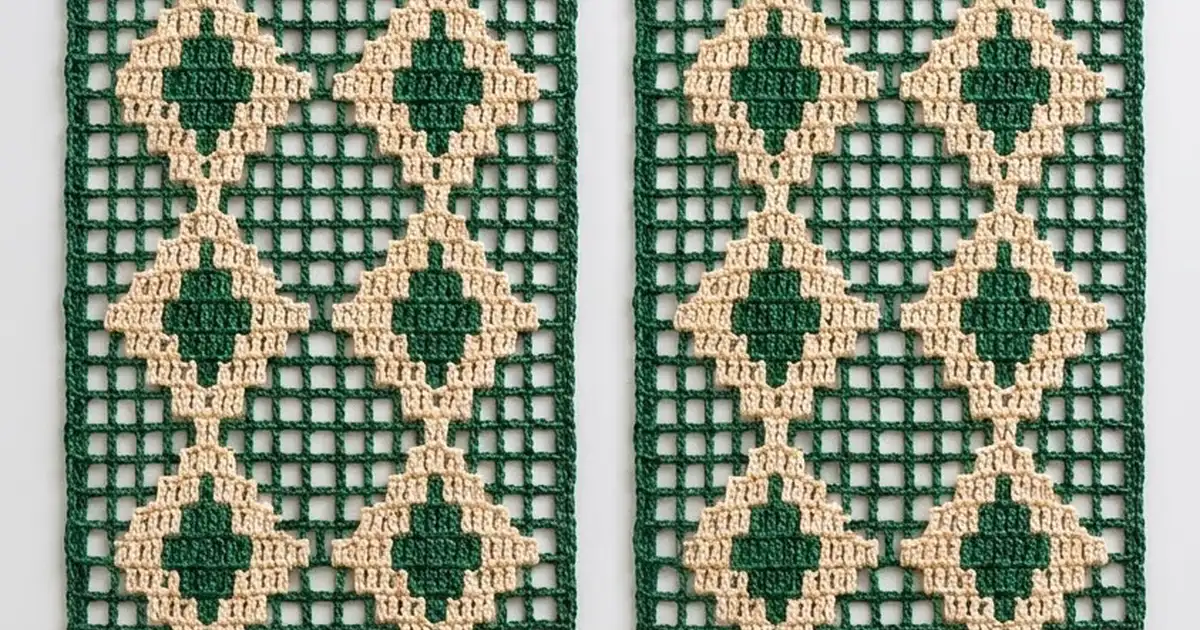
The Emerald Lattice Curtain Panel is a tall filet crochet panel in deep forest green and soft cream. Open green mesh fills the background. Three vertical columns of stacked cream diamonds run up the panel, and each diamond holds a solid green center diamond. Where two diamonds meet, their single-cell tips stack into a short two-row neck, so each column reads as one continuous chain.
The style mixes vintage filet lace with modern geometric decor. Light comes through the mesh, and the solid blocks give the design enough weight to read from across a room.
This pattern uses US crochet terms. One finished panel measures 30.6 x 83.4 in (77.7 x 211.8 cm) after blocking. Make two identical panels for a pair.
Each panel is one single piece worked flat in rows from the bottom up, with no joining. You follow a cell sequence for each row, change colors with intarsia bobbins, and finish with a two-round single crochet border.
Finished Size and Construction
- Finished size (one panel): 30.6 x 83.4 in (77.7 x 211.8 cm)
- Skill level: Intermediate
- Terminology: US crochet terms
- Yarn weight: Worsted (#4) cotton
- Hook: 5.0 mm (H-8)
- Number of pieces: 1 per panel (make 2 for a pair)
- Layout: 37 cells wide x 103 rows tall
- One diamond: 9 cells x 9 rows, 7.2 x 7.2 in (18.3 x 18.3 cm)
- Size before border: 29.6 x 82.4 in (75.2 x 209.3 cm)
- Border depth: 0.5 in (1.3 cm) per edge, 2 rounds of sc
Materials
Use a smooth, mercerized or combed worsted-weight cotton. Cotton keeps the square filet grid crisp, hangs straight, and handles sunlight and washing well. Choose two colors with strong contrast so the diamonds stay sharp.
Yarn, per panel:
- Color A, forest green: 450 g, approx. 765 m (837 yd)
- Color B, cream: 250 g, approx. 425 m (465 yd)
Double these amounts for a pair. The quantities include a margin of about 15% for the swatch, carried strands, and weaving in ends.
Tools:
- 5.0 mm (H-8) crochet hook
- 3 yarn bobbins (one per diamond column)
- Locking stitch markers
- Yarn needle
- Scissors and tape measure
- Blocking mats or a sheet-covered carpet, rust-proof pins, and a spray bottle
- 10 curtain clip rings per panel
Abbreviations (US Terms)
- ch – chain
- sc – single crochet
- dc – double crochet
- sk – skip
- st(s) – stitch(es)
- sp – space
- A – Color A (green)
- B – Color B (cream)
Special stitches and terms:
- Post: one dc forming the vertical bar between cells. Every row has 38 posts.
- Mesh (M): ch 2, sk the next 2 sts (or ch-2 sp), dc in the next post. Always worked in A.
- Green block (G): dc in each of the next 2 sts (or 2 dc in a ch-2 sp), dc in the next post. Worked in A.
- Cream block (C): same as a green block, worked in B.
- Color change: work the last dc before the new color until 2 loops remain on the hook, then finish it with the new color.
- Carry: lay the unused color along the top of the row and work your dc over it so it stays hidden inside the stitches.
Each cell has 3 stitches: 2 fill stitches plus the post that closes it. Every row has 37 cells, or 112 sts (38 posts + 74 fill or chain sts).
Gauge and Checkpoints
Blocked gauge: 5 cells and 5 rows = 4 x 4 in (10.2 x 10.2 cm). One cell is a 0.8 in (2.0 cm) square.
Test one piece first. Make a 15-cell swatch with one diamond:
- Ch 50.
- Work Row 1 as written below (15 mesh), then 1 more mesh row.
- Work Diamond Rows A–I. In each row, work 3 mesh, the 9 diamond cells, then 3 mesh.
- Work 2 more mesh rows, for 13 rows total.
Block the swatch. It should measure 12 x 10.4 in (30.5 x 26.4 cm), and the diamond should measure 7.2 in (18.3 cm) each way.
- Too big: go down 0.5 mm in hook size.
- Too small: go up 0.5 mm.
- Cells wider than tall: pull up a slightly taller dc. Blocking also lengthens cotton filet a little.
Panel checkpoints (gently stretched):
- After Row 2: 29.6 in (75.2 cm) wide
- After Row 11 (first diamond complete): 8.8 in (22.4 cm) tall
- After Row 56: 44.8 in (113.8 cm) tall
- After Row 103: 82.4 in (209.3 cm) tall
Panel
Every row is symmetrical, so each sequence reads the same from either end. You never have to reverse a row on the wrong side.
Foundation and Background
With A, ch 116.
Row 1: Dc in 8th ch from hook (the skipped chains count as the first post plus ch-2), *ch 2, sk 2 ch, dc in next ch; rep from * across. Turn. (37 mesh; 38 posts; 112 sts)
Row 2: Ch 5 (counts as first post plus ch-2), dc in next post, *ch 2, dc in next post; rep from * across, working the last dc in the 3rd ch of the turning ch. Turn. (37 mesh; 112 sts)
Mesh Row: Rep Row 2.
Turning rule: If the first cell is mesh, start with ch 5. If the first cell is a block, start with ch 3 (counts as first post) and work the block into the next 3 sts. Always end with a dc in the top of the turning chain.
Bobbins and Carrying
Wind 1 bobbin of B (about 10 g) for each diamond column, and start it at that column’s first cream cell. When a bobbin runs low, join a fresh one at the start of a cream block and hide both tails in the next few dc.
A runs across the full row and is carried through every cream block. In Rows C–G, carry B through the green center blocks so it reaches the far cream edge.
When a cream area grows or shrinks by one cell, move B over that one cell along the top of the previous row and work the post over it. Never let B float more than 1 cell, 0.8 in (2.0 cm).
Diamond Repeat (9 rows)
Work each sequence across the full row. M = mesh, C = cream block, G = green block.
Row A: 6 M, 1 C, 11 M, 1 C, 11 M, 1 C, 6 M. (37 cells: 34 M + 3 C; 112 sts)
Row B: 5 M, 3 C, 9 M, 3 C, 9 M, 3 C, 5 M. (37 cells: 28 M + 9 C; 112 sts)
Row C: 4 M, [2 C, 1 G, 2 C], 7 M, [2 C, 1 G, 2 C], 7 M, [2 C, 1 G, 2 C], 4 M. (37 cells: 22 M + 12 C + 3 G; 112 sts)
Row D: 3 M, [2 C, 3 G, 2 C], 5 M, [2 C, 3 G, 2 C], 5 M, [2 C, 3 G, 2 C], 3 M. (37 cells: 16 M + 12 C + 9 G; 112 sts)
Row E: 2 M, [2 C, 5 G, 2 C], 3 M, [2 C, 5 G, 2 C], 3 M, [2 C, 5 G, 2 C], 2 M. (37 cells: 10 M + 12 C + 15 G; 112 sts)
Row F: Work as Row D.
Row G: Work as Row C.
Row H: Work as Row B.
Row I: Work as Row A.
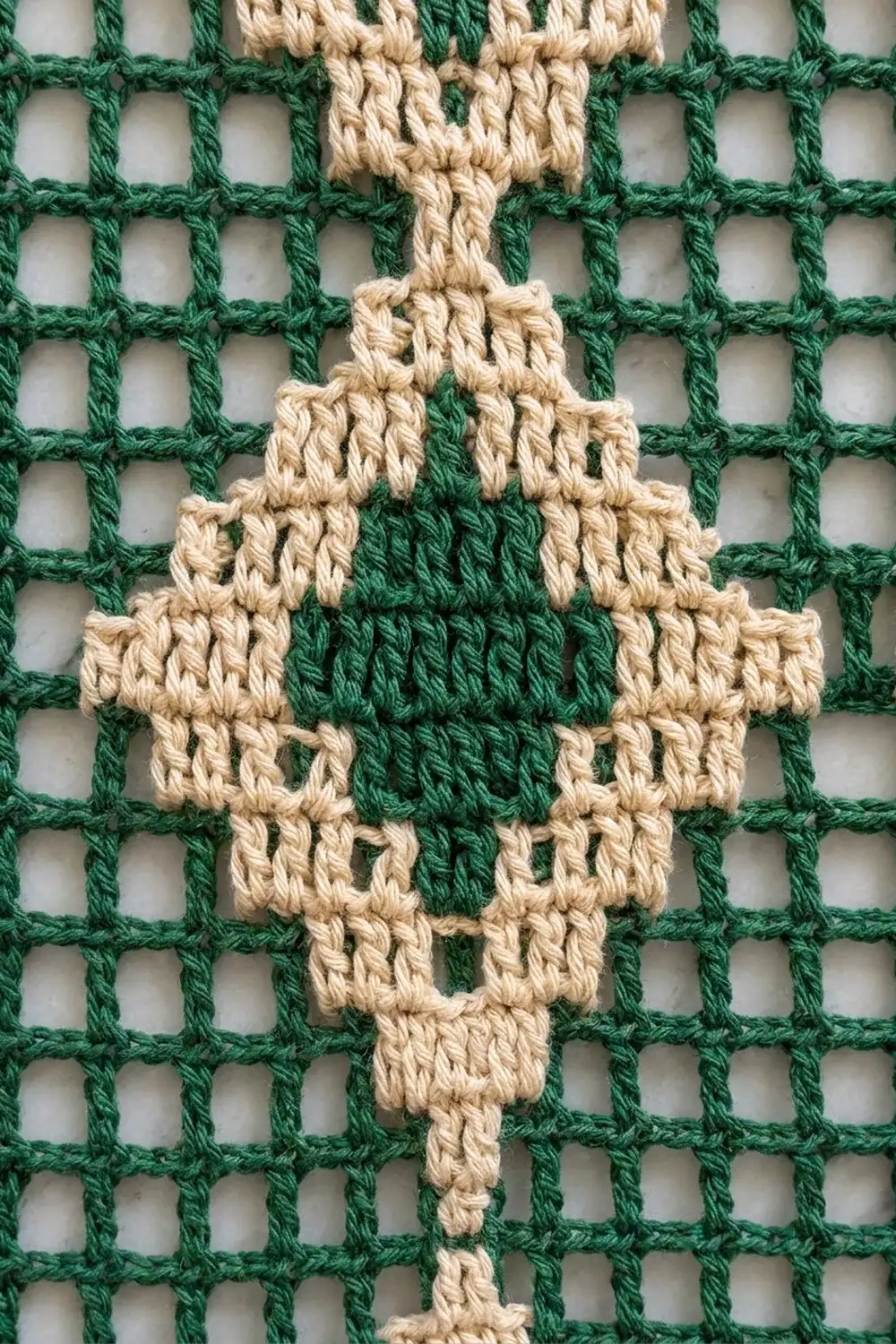
Each diamond uses 41 cells: 28 cream and 13 green center cells. The cream outline is 2 cells thick down each side, and the tip rows (A, B, H, I) are solid cream. Row I of one repeat sits directly under Row A of the next, so the single tip cells stack into the 2-row neck that links the diamonds.
Panel Row Order
- Rows 1–2: Row 1, then Row 2.
- Rows 3–101: Work the Diamond Repeat 11 times. Repeat 1 is Rows 3–11, repeat 2 is Rows 12–20, and repeat 11 is Rows 93–101.
- Rows 102–103: Work the Mesh Row twice.
Fasten off each B bobbin after its last cream cell in Row 101. Keep A attached after Row 103.
The panel now has 103 rows and 33 diamonds (3 columns of 11) and measures 29.6 x 82.4 in (75.2 x 209.3 cm). Weave each B tail at least 2 in (5.1 cm) through cream stitches before you start the border.
Border
Border gauge: 15 sc = 4 in (10.2 cm), or 3 sc per cell, 0.8 in (2.0 cm).
The per-side counts below include both corner stitches. The corner stitch is the center sc of each 3-sc corner group.
Round 1 (A): Turn, ch 1.
- Top edge (Row 103): 3 sc in the first st, sc in each of the next 110 sts, 3 sc in the last st.
- First long side: rotate, then work 3 sc in each of the 103 row-ends (309 sc).
- Bottom edge (foundation): rotate, then work 3 sc in the base of the first post. Sc in the base of each of the next 110 sts (1 sc under each post, 2 sc in each ch-2 sp), then 3 sc in the base of the last post.
- Second long side: rotate, then work 3 sc in each of the 103 row-ends (309 sc).
- Join with sl st to the first sc.
Round 1 counts:
- Top and bottom: 114 sc each (corner + 1 + 110 + 1 + corner)
- Sides: 313 sc each (corner + 1 + 309 + 1 + corner)
- Total: 850 sc (114 + 313 + 114 + 313, minus 4 shared corners)
Round 2 (A): Ch 1, sc in each sc around, working 3 sc in each corner stitch. Join with sl st to the first sc.
- Top and bottom: 116 sc each
- Sides: 315 sc each
- Total: 858 sc (850 + 2 at each of 4 corners)
Fasten off and weave in.
Why the math works: One panel stitch is 0.267 in (0.7 cm) wide (4 in / 15 sts), and so is one border sc. The top and bottom edges have 3 sts per cell, so 1 sc per st matches exactly. Each row is one cell tall, so 3 sc per row-end matches too, and the edges lie flat without ruffling or pulling in. The 3-sc corner groups add the extra length each corner needs to turn. Two rounds add 0.5 in (1.3 cm) per edge, so the panel grows from 29.6 x 82.4 in (75.2 x 209.3 cm) to 30.6 x 83.4 in (77.7 x 211.8 cm).
Final Blocking
- Soak the panel in cool water with a little mild soap for 15 minutes.
- Press out the water and roll the panel in towels. Do not wring it.
- Lay it flat on mats or a sheet-covered carpet.
- Pin the four corners to 30.6 x 83.4 in (77.7 x 211.8 cm).
- Pin along each long side every 4 in (10.2 cm), keeping the posts in straight vertical lines.
- Square the cells to 0.8 in (2.0 cm) and each diamond to 7.2 in (18.3 cm) each way.
- Let the panel dry completely, usually 24–48 hours.
- Block the second panel to the same pin marks.
Final Quality-Control Checklist
- Every row has 37 cells and 38 posts.
- The panel has 103 rows and 33 diamonds in 3 straight columns.
- Each diamond has a 2-cell cream outline around a solid green center.
- Tip cells stack into a clean 2-row neck between diamonds.
- No B float is longer than 1 cell.
- Carried A doesn’t show through the cream blocks.
- The border rounds count 850 and 858 sc.
- The blocked panel measures 30.6 x 83.4 in (77.7 x 211.8 cm).
- Both panels match in length within 0.5 in (1.3 cm).
Troubleshooting
Cells are rectangles: your dc is too short. Pull up a taller first loop, or block more firmly lengthwise.
Wrong cell count: count posts, not chains. If you have 37 or 39 posts, check the turning chain and the final dc worked into it.
Diamonds drift sideways: a sequence was misread. The rows are symmetrical, so the edge margins should always match. Count both of them.
Green specks in cream blocks: keep the carried strand flat and snug along the top of the row, under the hook.
Border waves: go down 0.5 mm for the border only, and keep 3 sc per row-end.
Border pulls in: go up 0.5 mm for the border only.
Panels differ in length: re-wet the shorter panel and block it to match the longer one.
Care
Hand wash, or machine wash cold on a gentle cycle in a mesh bag. Reshape, dry flat, and avoid long periods of harsh direct sun to protect the green.

Final Notes
Every measurement in this pattern follows from the cell size:
- One cell is 0.8 in (2.0 cm).
- One diamond is 9 cells, or 7.2 in (18.3 cm).
- The panel is 37 cells by 103 rows, or 29.6 x 82.4 in (75.2 x 209.3 cm).
- Two rounds of sc bring it to 30.6 x 83.4 in (77.7 x 211.8 cm).
If your swatch meets gauge, every later number will match. Make one panel, check it, then make its twin and hang the pair on clip rings.
Happy crocheting!