

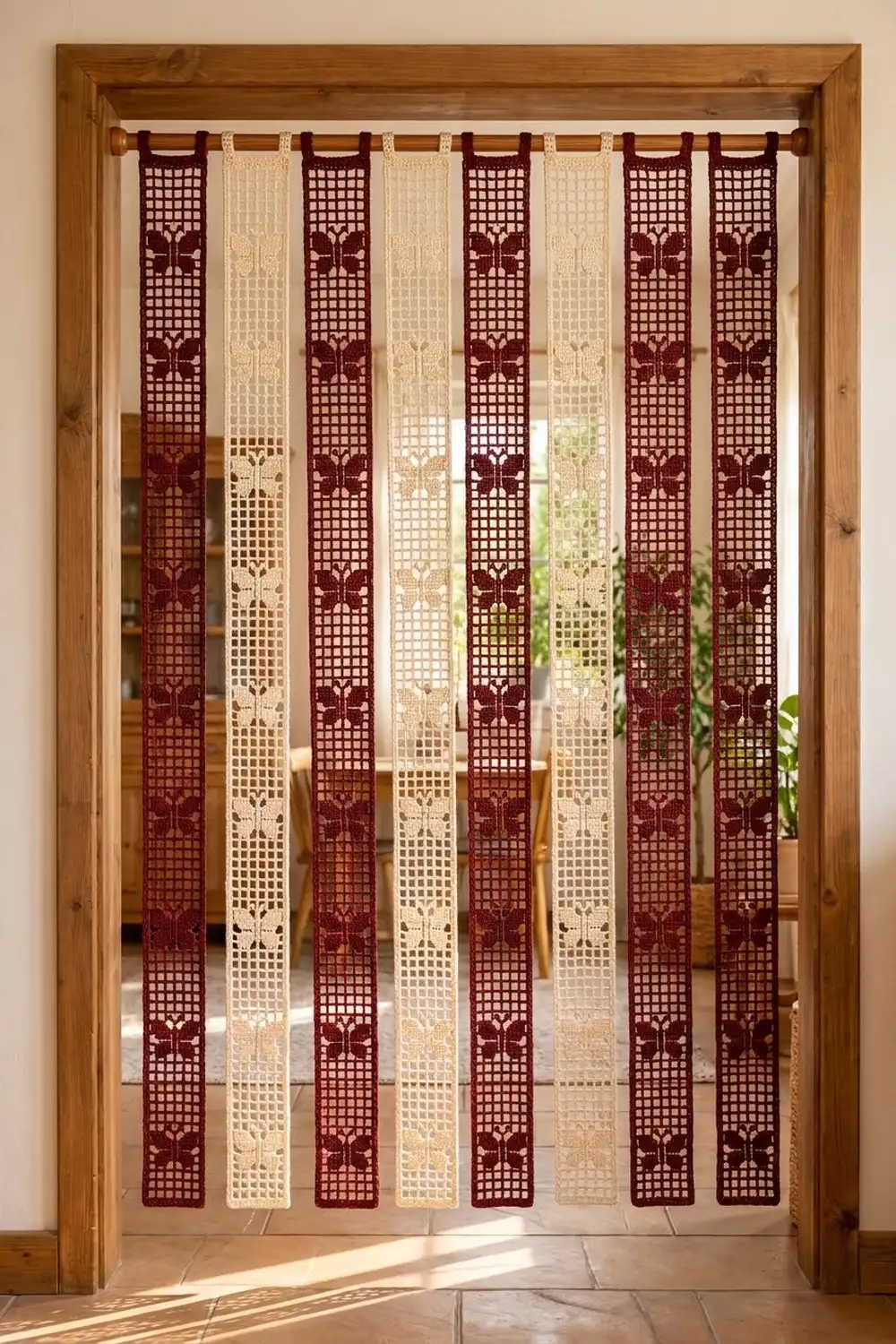
The Flutter Lane curtain is a set of narrow filet crochet strips that hang side by side from a rod in a doorway. Each strip is an open mesh grid with solid butterflies set down its center. A slim border with a braided look keeps the edges straight and crisp.
The colors are deep burgundy and soft cream. Five burgundy strips alternate with four cream strips, so the color changes with every strip and the butterflies stand out clearly against the light.
This pattern uses US crochet terms. Each finished curtain strip measures 5 in (12.7 cm) wide by 79 in (200.7 cm) long, plus a folded hanging tab. A shorter 3-butterfly strip, 5 in (12.7 cm) by 23 in (58.4 cm), is included as a test piece. It is also the version shown laid flat.
Construction is simple. You work each strip flat in filet rows from the bottom up. Then you add one round of single crochet and one round of slip stitch as a border, and sew on a small rod tab. The strips are never joined to each other.
Finished Size and Construction
- Finished strip size: 5 in (12.7 cm) wide x 79 in (200.7 cm) long
- Test strip size: 5 in (12.7 cm) x 23 in (58.4 cm)
- Skill level: Easy-intermediate (filet mesh and blocks)
- Terminology: US
- Yarn weight: Light (3), sport/light DK mercerized cotton
- Hook: 3.5 mm (E-4)
- Number of pieces: 9 strips plus 9 hanging tabs
- Layout: 9 strips in one row on the rod, not joined
- Strip size before border: 4.5 in (11.4 cm) x 78.5 in (199.4 cm)
- Border depth: 0.25 in (0.6 cm) on every side
Materials
Choose a smooth mercerized cotton of about 155 m per 50 g. Cotton holds the grid open, hangs straight, and shows the butterfly blocks sharply. Avoid fuzzy or very stretchy yarn, because long strips will grow as they hang.
- Burgundy: 650 g / 2,015 m (5 strips and 5 tabs)
- Cream: 520 g / 1,612 m (4 strips and 4 tabs)
- Test strip only: 35 g / 109 m in one color
These amounts include a margin of about 10 percent for swatching and blocking differences.
Tools:
- 3.5 mm (E-4) crochet hook
- Tapestry needle
- Stitch markers
- Rust-proof pins and blocking mats
- Spray bottle
- Measuring tape
- Curtain rod, at least 48 in (121.9 cm) long and up to 0.75 in (1.9 cm) thick
Abbreviations (US Terms)
- ch – chain
- sc – single crochet
- dc – double crochet
- sl st – slip stitch
- sp – space
- st(s) – stitch(es)
- RS – right side
Special stitches:
- Open mesh: ch 2, skip 2 sts (or the ch-2 sp), dc in next dc.
- Block: dc in each of next 2 sts (2 dc in a ch-2 sp, or 1 dc in each dc of a block below), dc in next dc.
- Turning ch-5: counts as 1 dc plus ch 2 and forms the first open mesh.
Every row has 9 meshes: 10 dc posts and 18 fill sts, for 28 sts in total.
Gauge and Checkpoints
Gauge: 8 meshes and 8 rows = 4 in (10.2 cm) in filet mesh. One mesh is 0.5 in (1.3 cm) square.
Swatch: Ch 29, dc in 8th ch from hook, *ch 2, skip 2 ch, dc in next ch; rep from * 6 more times (8 meshes). Work 7 more rows of open mesh, steam lightly, and measure.
Then make the 45-row test strip before you start the long strips. Checkpoints:
- After Row 1: 4.5 in (11.4 cm) wide
- After Row 4: 2 in (5.1 cm) tall
- After Row 13 (first butterfly): 6.5 in (16.5 cm) tall
- After Row 27: 13.5 in (34.3 cm) tall
- After Row 45: 22.5 in (57.2 cm) tall
If your strip is too big, go down 0.25 mm in hook size. If it is too small, go up 0.25 mm. If only the height is off, change how tall you make each dc by pulling the first loop up more or less. The chains control the width.
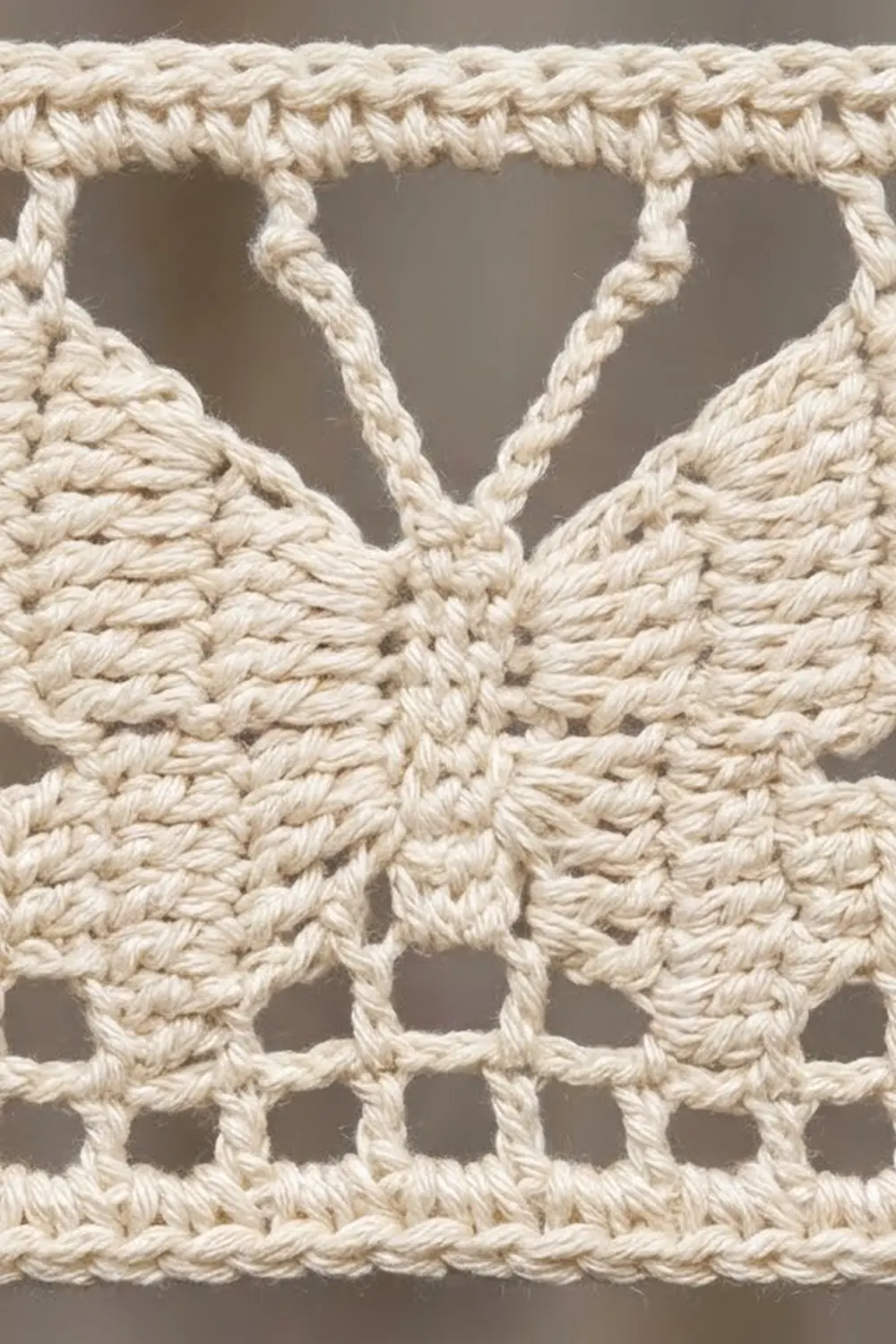
Strip Pattern
Work every strip the same way in its assigned color. The columns are numbered 1–9. Columns 1 and 9 are always open, so every row begins with the turning ch-5. Every row ends with ch 2, dc in the 3rd ch of the turning ch-5 below.
Foundation: Ch 32.
Row 1 (RS): Dc in 8th ch from hook, *ch 2, skip 2 ch, dc in next ch; rep from * 7 more times. Turn. (9 open meshes, 28 sts)
Rows 2–4: Ch 5 (counts as dc and ch 2), skip ch-2 sp, dc in next dc, *ch 2, dc in next dc; rep from * across, working last dc in 3rd ch of turning ch-5. Turn. (9 open meshes)
Butterfly Motif (Rows 5–13)
Each row is written as a sequence of meshes from the start of the row. Every row has 9 meshes and 28 sts.
- Row 5: 2 open, 2 blocks, 1 open, 2 blocks, 2 open. (4 blocks – lower wing tips)
- Row 6: 1 open, 7 blocks, 1 open. (7 blocks – full lower wings)
- Row 7: 2 open, 5 blocks, 2 open. (5 blocks)
- Row 8: 4 open, 1 block, 4 open. (1 block – waist)
- Row 9: 2 open, 5 blocks, 2 open. (5 blocks)
- Row 10: 1 open, 7 blocks, 1 open. (7 blocks – upper wings)
- Row 11: 1 open, 7 blocks, 1 open. (7 blocks)
- Row 12: 1 open, 2 blocks, 1 open, 1 block, 1 open, 2 blocks, 1 open. (5 blocks – wing tops and head)
- Row 13: 3 open, 1 block, 1 open, 1 block, 3 open. (2 blocks – antennae)
Each butterfly uses 43 blocks. The center column (5) is solid from Row 6 to Row 12 and forms the body. The motif is symmetrical, so it looks the same on RS and WS rows.
Rows 14–18: Work as Row 2. (9 open meshes each)
Strip Length
Curtain strip: Work Rows 5–18 a total of 10 times (Rows 5–144). Work Rows 5–13 once more as Rows 145–153 for the 11th butterfly. Work Rows 154–157 as Row 2. Do not fasten off. (157 rows, 78.5 in / 199.4 cm)
Each 14-row repeat adds 7 in (17.8 cm). To fit your doorway, add or remove whole repeats only, and keep 4 open rows at each end.
Test strip: Work Rows 5–18 twice (Rows 5–32). Work Rows 5–13 once as Rows 33–41, then Rows 42–45 as Row 2. (45 rows, 3 butterflies, 22.5 in / 57.2 cm)
Make All Pieces
- Burgundy: 5 curtain strips, 5 tabs
- Cream: 4 curtain strips, 4 tabs
Layout on the rod, left to right:
B C B C B C B C B
B = burgundy, C = cream. The strips hang on their own and are not joined. When the strips touch, the total width is 45 in (114.3 cm).
Work all strips with the same hook and the same yarn lot for each color. To keep the butterflies level across the curtain, count rows rather than measuring. Put a marker in the first row of every butterfly so you can compare strips quickly.
Border
Border gauge: 6 sc = 1 in (2.5 cm), both across the rows and along the row ends.
Keep using the same yarn and continue from the last dc of the final row.
Round 1 (RS): Ch 1.
– Top edge: 3 sc in the last dc worked (corner), sc in each of next 26 sts, 3 sc in 3rd ch of turning ch-5 (corner).
– First side: 3 sc around each row-end post down the side (3 sc per row).
– Bottom edge: 3 sc in base of first dc (corner), 2 sc in ch-2 sp, sc in base of next dc; rep from * 7 more times, 2 sc in last ch-2 sp, 3 sc in base of last dc (corner).
– Second side:* 3 sc around each row-end post.
– Join with sl st to first sc.
The count for each side includes both corner center sts and the outer sc of each corner group:
- Top: 1 + 1 + 26 + 1 + 1 = 30 sc
- Bottom: 1 + 1 + 26 + 1 + 1 = 30 sc
- Each side, curtain strip: 1 + 1 + (157 x 3 = 471) + 1 + 1 = 475 sc
- Each side, test strip: 1 + 1 + (45 x 3 = 135) + 1 + 1 = 139 sc
Round totals, with each corner counted once:
– Curtain strip: 4 x 3 + 2 x 26 + 2 x 471 = 1,006 sc
– Test strip: 12 + 52 + 270 = 334 sc
Round 2: Sl st loosely in each sc around, including each corner center sc. Join and fasten off. (Curtain strip: 1,006 sl sts. Test strip: 334 sl sts.)
Why the math works: Each row is 0.5 in (1.3 cm) tall. At 6 sc per inch, 3 sc also cover 0.5 in (1.3 cm), so the sides lie flat without ruffling or pulling in. Across the top, 28 base sts over 4.5 in (11.4 cm) matches the same gauge, and the 3-sc groups turn the corners. The two rounds add 0.25 in (0.6 cm) to each side. That takes the strip from 4.5 in (11.4 cm) to 5 in (12.7 cm) wide, and from 78.5 in (199.4 cm) to 79 in (200.7 cm) long.
Hanging Tab (make 1 per strip)
Ch 27.
Row 1: Sc in 2nd ch from hook and in each ch across. Turn. (26 sc)
Rows 2–16: Ch 1, sc in each sc across. Turn. (26 sc)
Fasten off and leave a long tail. The tab measures about 4.25 in (10.8 cm) wide by 2.25 in (5.7 cm) tall.
Fold the tab in half to make a rod loop about 1.1 in (2.8 cm) deep. Center it on the back of the strip’s top border, leaving 0.375 in (1.0 cm) of strip edge on each side. Whipstitch both tab edges to the back of the border. The front of the strip stays clean.
Final Blocking
- Soak each strip in cool water, then press the water out in a towel. Do not wring it.
- Lay the strip flat on the mats. Block curtain strips one 24 in (61.0 cm) section at a time.
- Pin the side edges straight at 5 in (12.7 cm) wide, with a pin every 2 in (5.1 cm).
- Check that each mesh is square, about 0.5 in (1.3 cm), and that the butterfly rows sit level.
- Ease the length toward the target, but do not stretch it more than 0.5 in (1.3 cm) per 24 in (61.0 cm).
- Let each section dry completely before you unpin it and move on to the next one.
- Block the tabs flat, and sew them on only after the strip is dry.
Final Quality-Control Checklist
- Every row has 9 meshes and 10 dc posts.
- Columns 1 and 9 are open on every row.
- Each butterfly has 43 blocks, centered on column 5.
- Butterflies are 5 open rows apart, with 4 open rows at each end.
- Border Round 1 has 30 sc on the top and bottom, and 475 sc on each side of a curtain strip.
- The strip is 5 in (12.7 cm) wide along its full length.
- All 9 strips are within 1 in (2.5 cm) of each other in length.
- Tabs are centered and can’t be seen from the front.
- Yarn ends are woven into blocks or the border, not across open meshes.
Troubleshooting
Strip leans or twists: The last dc of the row is going into the wrong ch of the turning ch-5. Always work it into the 3rd ch.
Meshes are taller than wide: Make your dc shorter or go down a hook size. A slight sideways stretch during blocking also helps.
Blocks look slanted: Work block dc into the ch-2 sp, not into the individual chains. Work into separate sts only when the row below is a block.
Side border ruffles: Work 2 sc per row end in a few places, then check that the side lies flat.
Side border puckers: Your sc are too tight. Add a 4th sc at every third row end.
Strips differ in length: Count rows, not inches. Row counts stay the same, but measurements drift.
Burgundy fibers show on cream: Wash your hands and work the cream strips on a clean towel.
Care
Hand wash in cool water, or machine wash on a gentle cycle in a mesh bag. Lay flat to dry and re-pin if needed. Do not hang wet strips, because their weight will stretch them.
Final Notes
The measurement chain is short. One mesh is 0.5 in (1.3 cm), 9 meshes give 4.5 in (11.4 cm), and 157 rows give 78.5 in (199.4 cm). The border adds 0.25 in (0.6 cm) to each side, for a strip that measures 5 in (12.7 cm) by 79 in (200.7 cm). Nine strips in alternating burgundy and cream make the full curtain. Each one hangs free, so the butterflies sway as you walk through.
Happy crocheting!