

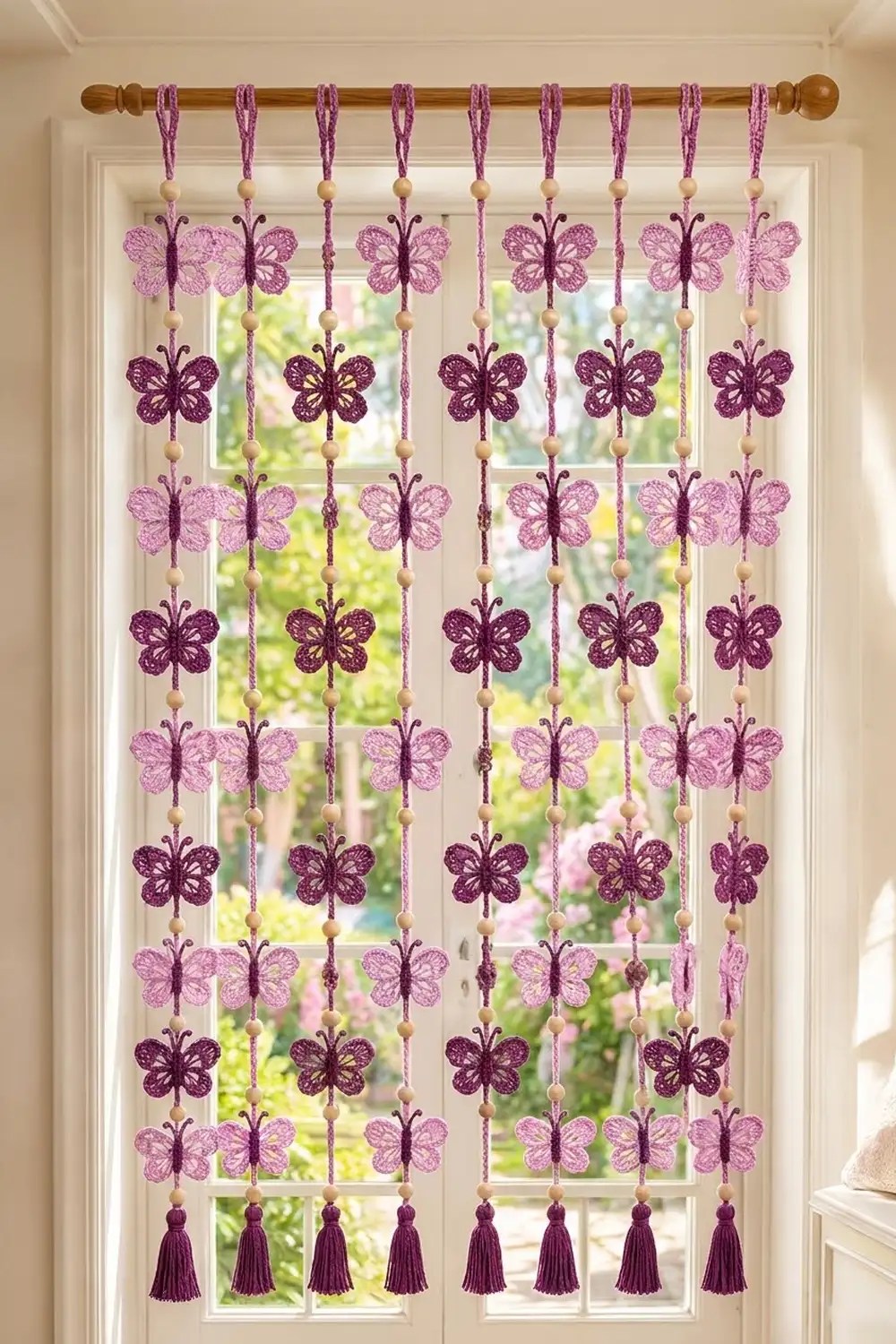
This curtain is made of 9 beaded strands that hang from a wooden rod. Each strand holds 8 lacy butterflies, with a wooden bead between them and a fat plum tassel at the bottom. When the window is open, the butterflies move in the breeze, and the light shows through their open wing windows.
Two colors carry the design: light orchid pink and deep plum. Each horizontal row of butterflies is one color, and the rows alternate orchid and plum from top to bottom. Every butterfly, in either color, gets a raised plum body with curled antennae. Natural wooden beads add a soft, warm contrast.
The pattern uses US crochet terms. The finished curtain is about 35.5 in (90.2 cm) wide and 53.1 in (134.9 cm) long from the top of the hanging loops to the tassel tips.
Each butterfly starts as a short single crochet body strip. You work two lace rows along each long edge to make the wings, then sew a plum body on top. Each strand is one long chain with the beads pre-strung on it. The butterflies are sewn onto the strands, and a slim header cord at the top keeps the strands evenly spaced.
Finished Size and Construction
- Finished size: 35.5 in (90.2 cm) wide × 53.1 in (134.9 cm) long
- Skill level: Intermediate (simple stitches, lots of repetition, careful finishing)
- Terminology: US crochet terms
- Yarn weight: DK / light worsted cotton (weight 3)
- Hook: 3.5 mm (E-4)
- Number of pieces: 72 butterflies (36 orchid, 36 plum), 72 plum bodies, 9 strands, 9 tassels, 1 header cord
- Layout: 9 strands across × 8 butterflies down
- Piece size: each butterfly is 3.5 in (8.9 cm) wide × 2.75 in (7.0 cm) tall, or 3.75 in (9.5 cm) tall including the antennae
- Size before border: 35.5 in (90.2 cm) wide, measured from the outer wing tip of strand 1 to the outer wing tip of strand 9
- Border (header cord) depth: 0.25 in (0.6 cm); it adds no width or length
Materials
Choose a smooth mercerized or matte cotton in DK weight. Cotton holds the scallops crisply and does not stretch much under the weight of the beads. Avoid fuzzy yarns, because they blur the lace windows.
- Light orchid pink: 150 g / 345 m (3 balls of 50 g / 115 m)
- Deep plum: 200 g / 460 m (4 balls of 50 g / 115 m)
These quantities include a margin of about 15% for gauge swatches, tassel trimming and yarn tails.
Tools and notions:
– 3.5 mm (E-4) crochet hook
– 81 natural wooden beads, 12 mm (0.5 in / 1.3 cm), with holes at least 4 mm wide
– Tapestry needle
– Big-eye beading needle or dental floss threader (for stringing beads)
– Stitch markers
– Piece of cardboard 4 in (10.2 cm) tall (for tassels)
– Scissors, measuring tape, blocking mat and rustproof pins
– Spray bottle
– Wooden curtain rod up to 0.75 in (1.9 cm) in diameter
Abbreviations (US Terms)
- ch – chain
- sl st – slip stitch
- sc – single crochet
- dc – double crochet
- sk – skip
- sp – space
- st(s) – stitch(es)
- PM – place marker
- rep – repeat
Special stitch – Shell: work 5 dc in the same stitch.
Gauge and Checkpoints
Gauge: 20 sc × 24 rows = 4 in (10.2 cm) in sc. Chain gauge: 5 ch = 1 in (2.5 cm), worked at a relaxed tension.
Make one complete butterfly before you start the others, and check it at every stage:
- Body strip (after Row 3): 2.4 in (6.1 cm) long × 0.5 in (1.3 cm) wide.
- After Wing Row 2 on both sides: about 2.5 in (6.4 cm) wide.
- Finished butterfly: 3.5 in (8.9 cm) wide × 2.75 in (7.0 cm) tall.
- Chain test: chain 25. It should measure 5 in (12.7 cm).
If your pieces are too big: go down a hook size, to 3.25 mm. If they are too small: go up to 3.75 mm. If only the chain test is off, change your chain tension or use a different hook for the strands only. The strand chain must match 5 ch per inch, or the butterflies will not line up with their sewing zones.

Butterfly (make 36 orchid, 36 plum)
Body Strip
Use the wing color.
Foundation: Ch 13.
Row 1: Sc in 2nd ch from hook and in each ch across, turn. (12 sc)
Rows 2–3: Ch 1 (does not count as a stitch), sc in each st across, turn. (12 sc)
Do not fasten off. Mark which short end will be the head end: put a marker in the last sc you worked. That end gets the upper wings and the antennae.
Checkpoint: 2.4 in (6.1 cm) × 0.5 in (1.3 cm).
Wing Side 1 (along the top of Row 3)
Number the Row 3 stitches 1–12, starting at the head end. You may need to turn the strip so you start at st 1.
Wing Row 1: Ch 1, sc in st 1, ch 7, sk sts 2–5, sc in st 6, sc in st 7, ch 5, sk sts 8–11, sc in st 12, turn. (4 sc, 1 ch-7 sp, 1 ch-5 sp)
The ch-7 arch makes the upper wing, and the ch-5 arch makes the lower wing. Each arch bows away from the 4 stitches it skips. That gap is the open window next to the body.
Wing Row 2: Sl st in first sc, 13 dc in ch-5 sp, sl st in each of next 2 sc, 17 dc in ch-7 sp, sl st in last sc, turn. (30 dc: 13 in the lower wing, 17 in the upper wing; plus 4 sl sts)
Wing Row 3 (scallop edge):
– Upper wing: Ch 1, sc in first dc, sk 1 dc, shell in next dc, sk 1 dc, sc in next dc; rep from * 3 more times. This uses all 17 dc. (4 shells, 5 sc)
– Between the wings: Sl st in each of next 2 sl sts.
– Lower wing: Sc in first dc, sk 1 dc, shell in next dc, sk 1 dc, sc in next dc; rep from * 2 more times. This uses all 13 dc. (3 shells, 4 sc)
– Sl st in last sl st. Fasten off.
Totals for Wing Row 3: 7 shells (35 dc) + 9 sc.
The math works because both fans follow a 4-stitch repeat plus 1 (4 × 4 + 1 = 17, and 4 × 3 + 1 = 13). Each fan therefore begins and ends with a sc, so the scallop edges stay symmetrical.
Wing Side 2 (along the foundation chain)
Rotate the strip. Join the wing yarn in the free loop of the foundation chain at the head end. Number the free loops 1–12 from that end. Work Wing Rows 1–3 exactly as for Side 1, so the stitch counts match. Fasten off and weave in the ends.
Checkpoint: 3.5 in (8.9 cm) × 2.75 in (7.0 cm).
Plum Body with Antennae (make 72)
Use plum for every butterfly.
Foundation: Ch 13.
Row 1: Sc in 2nd ch from hook and in each ch across. (12 sc)
First antenna: Ch 6, 3 sc in 2nd ch from hook (this makes the knob), sl st in each of next 4 ch, sl st in last sc of the body.
Second antenna: Ch 6, 3 sc in 2nd ch from hook, sl st in each of next 4 ch, sl st in same sc. Fasten off and leave a 12 in (30.5 cm) tail for sewing.
Each antenna is 1 in (2.5 cm) long.
Make All Pieces
- Orchid butterflies: 36
- Plum butterflies: 36
- Plum bodies: 72 (one for every butterfly)
- Tassels: 9 (plum)
Block the butterflies flat before you assemble them (see Final Blocking).
Layout grid (O = orchid, P = plum; 9 strands across, Row 1 at the top):
Row 1:  O O O O O O O O O
Row 2:  P P P P P P P P P
Row 3:  O O O O O O O O O
Row 4:  P P P P P P P P P
Row 5:  O O O O O O O O O
Row 6:  P P P P P P P P P
Row 7:  O O O O O O O O O
Row 8:  P P P P P P P P P
Strands (make 9)
Use orchid. Before you start, string 9 beads onto the ball.
Hanging loop: Ch 15, sl st in first ch to form a ring. The loop is 3 in (7.6 cm) around and hangs 1.5 in (3.8 cm) tall.
Module (work 8 times):
1. Ch 5, slide 1 bead up against the hook, ch 5. The bead is locked between the chains.
2. Ch 16 for the butterfly zone. PM in the 3rd and 14th of these chains.
Each module is 26 ch plus 1 bead, which measures 1 in + 0.5 in + 1 in + 3.2 in = 5.7 in (14.5 cm).
Tail: Ch 5, slide up the last bead, ch 5. Fasten off and leave a 6 in (15.2 cm) tail.
Chain total per strand: 15 + (8 × 26) + 10 = 233 ch, with 9 beads.
Checkpoint: the 8 modules measure 45.6 in (115.8 cm) together.
Joining
Method: Whipstitch with the plum body tail.
- Lay a butterfly face up. Slide the strand under it so the cord runs straight down behind the center of the body strip, with the head end toward the hanging loop.
- Line up the body strip’s 12 stitches with the zone’s chains 3 to 14, between the markers. That is one stitch to one chain, because both measure 5 per inch. Chains 1–2 and 15–16 stay free, which leaves 0.4 in (1.0 cm) of cord above and below the body.
- Lay the plum body on top, with the antennae at the head end.
- Whipstitch down one long edge of the plum body, going through the plum body, the wing body strip and one chain of the cord at each of the 12 stitches. Come back up the other edge the same way.
- Tie off on the back, then weave the tail into the cord.
Tension: Snug the stitches enough that the body sits flat and raised, but not so tight that the strip cups or the cord bunches up. After sewing, the cord behind the body should still measure 2.4 in (6.1 cm).
Follow the layout grid: Module 1 is Row 1 (orchid), Module 2 is Row 2 (plum), and so on.
Size checkpoint: Hang one finished strand from its loop. From the top of the loop to the bottom bead should measure 1.5 + 45.6 + 2.5 = 49.6 in (126.0 cm).
Tassels
Wrap plum 30 times around the 4 in (10.2 cm) card. Slide an 8 in (20.3 cm) strand under the wraps at the top and tie it tightly. Cut the wraps at the bottom. Wrap a second plum strand 6 times around the bundle, 0.5 in (1.3 cm) below the top, and knot it. Trim the tassel to 3.5 in (8.9 cm). Use the top ties to fasten it to the strand’s tail chain, then weave the cord tail into the tassel head.
Border: Header Cord
The header cord is the top “border.” It holds the strands at even spacing just below the rod.
Border gauge: 5 sts = 1 in (2.5 cm), the same as the chain gauge.
Row 1: With plum, sc around the base of the hanging loop on strand 1 (where the loop was joined). Ch 19, sc around the base of the next strand’s loop; rep from * 7 more times. (9 sc + 8 × 19 ch = 161 sts)*
Row 2: Ch 1, turn, sc in each st across. (161 sc) Fasten off and weave in the ends.
Why the math works: Each strand-to-strand interval is 1 sc + 19 ch = 20 sts, which is 4 in (10.2 cm). Eight intervals give 160 sts, or 32 in (81.3 cm), between strand 1 and strand 9. The final sc on strand 9 brings the total to 161. A butterfly is 3.5 in (8.9 cm) wide and the strands are 4 in (10.2 cm) apart, so neighboring wing tips have a 0.5 in (1.3 cm) gap and never overlap. The overall width is 32 in + 3.5 in = 35.5 in (90.2 cm).
Final Blocking
- Before assembly, lightly spritz the butterflies with water until they are damp, not soaked.
- Pin each one to 3.5 in (8.9 cm) × 2.75 in (7.0 cm). Put a pin in the tip of every scallop so the shells fan out evenly.
- Push a pin through each lace window to open the space next to the body.
- Wrap each damp antenna around a toothpick, curling it outward, and leave it until dry.
- After assembly, hang the curtain and spritz the strands. The beads and tassels act as weights while the cords dry straight.
- Comb the tassel strands with your fingers while they are damp, and trim them evenly if needed.
Final Quality-Control Checklist
- Every butterfly is 3.5 in (8.9 cm) wide, give or take 0.25 in (0.6 cm).
- Each fan has 4 upper and 3 lower scallops on both sides.
- Every wing has a clear open window next to the body.
- The plum bodies are centered on chains 3–14 of their zones.
- All antennae point toward the hanging loop.
- The colors follow the layout grid: orchid in odd rows, plum in even rows.
- Each strand has 9 beads and 233 chains.
- The header cord has 161 sc, with strands 4 in (10.2 cm) apart.
- The tassels all hang at the same level.
Troubleshooting
Wings ruffle: Your dc tension is too tight for the 17-dc fan. Work the dc more loosely, or go up half a hook size for the wing rows only.
Windows close up: The arch chains are too tight. Chain loosely, and pin the windows open when blocking.
Scallops are uneven: Recount the dc in Wing Row 2. The upper wing needs exactly 17 and the lower wing exactly 13.
Butterflies tilt sideways: The cord isn’t centered behind the body. Unpick the whipstitching and realign the cord.
Strands are different lengths: Your chain tension varied. Measure each strand against the first one and redo the module that is off.
Beads slide: Use beads with smaller holes, or work a sl st into the chain right after each bead.
Care
Dust the curtain gently or shake it out. If it needs washing, hand-wash it in cool water, roll it in a towel, and hang it to dry.
Final Notes
The measurements build on each other. A 2.4 in (6.1 cm) body strip gives a 3.5 in (8.9 cm) butterfly. Each butterfly sits on a 3.2 in (8.1 cm) zone, and each 5.7 in (14.5 cm) module includes a bead. Eight modules plus the loop, the tail and the tassel make a 53.1 in (134.9 cm) strand. Nine strands spaced 4 in (10.2 cm) apart along the header make a 35.5 in (90.2 cm) curtain. Check each stage and the next one will come out right.
Happy crocheting!