
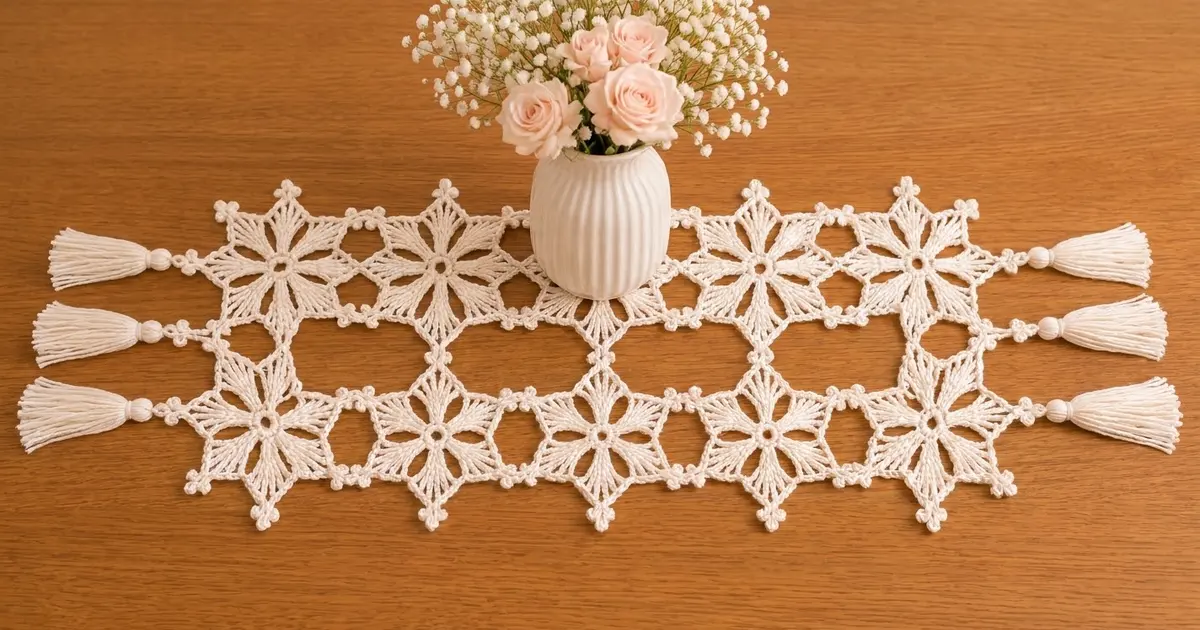
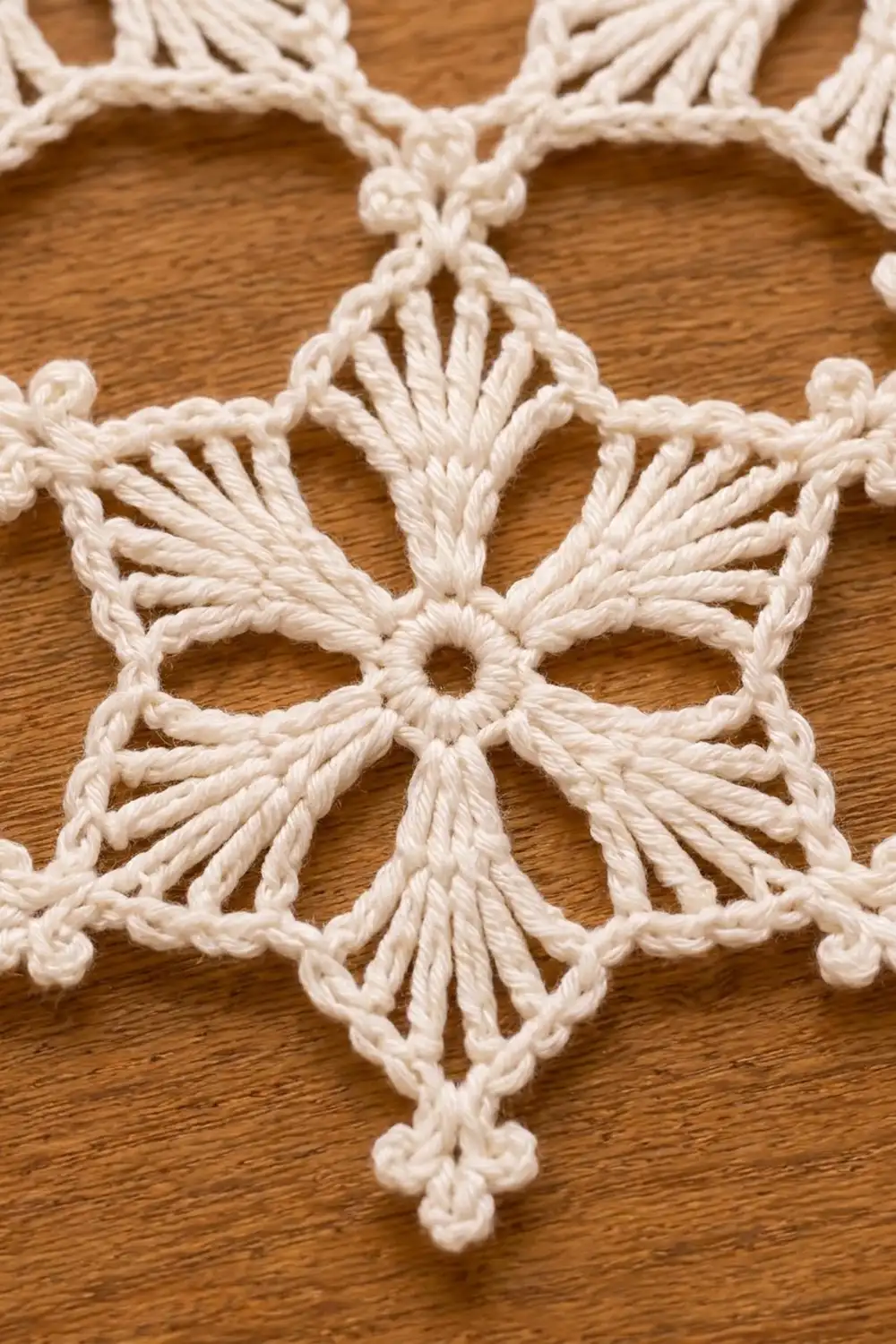
The Frost Star Lace Table Runner is made of crisp six-pointed star motifs joined into an open lattice. Each star has a tiny center ring, six fanned petals and a sharp chain outline that ends in a three-loop trefoil at every tip. Where the stars meet, the gaps form hexagonal windows, so the wood of your table shows through.
The whole runner is worked in one ivory cotton, which makes it suit winter tables, weddings and everyday use alike. Three tassels finish each short end and give the runner a little weight and swing. The pattern uses US crochet terms throughout.
The finished runner measures 13 in (33.0 cm) wide by 35 in (88.9 cm) long, not counting tassels. Each tassel adds 4 in (10.2 cm) plus a 0.75 in (1.9 cm) hanger.
To make it, you work 21 motifs in four rounds each and join them as you go at the trefoil tips while working Round 4. There is no stitched border; the star points form the edge. Tassels go on last.
Finished Size and Construction
- Finished size: 13 in x 35 in (33.0 cm x 88.9 cm), excluding tassels
- Skill level: Intermediate
- Terminology: US crochet terms
- Yarn weight: DK (#3) mercerized cotton
- Hook: 3.5 mm (E-4)
- Number of pieces: 21 star motifs, plus 6 tassels
- Layout: 3 motifs wide x 7 motifs long, aligned (not offset)
- Motif size: 5 in (12.7 cm) from top point to bottom point; 4.3 in (10.9 cm) from side point to side point
- Size before border: 13 in x 35 in (33.0 cm x 88.9 cm)
- Border depth: 0 in (0 cm). The points form the edge, and the tassels hang from the short-end points.
Materials
Yarn: Use a smooth, mercerized DK cotton of about 2.2 m per gram (for example, 50 g / 110 m balls). Cotton keeps the points sharp and holds blocking well. Acrylic will drape more but won’t hold the trefoils as crisply.
- Ivory (only color): 250 g / about 550 m
Each motif uses about 7 g (15.4 m), so the motifs need about 147 g. Each tassel uses about 3.5 g, so the tassels need about 21 g. The total comes to about 170 g. The 250 g quantity includes a comfortable margin for a test motif, gauge differences and tassel trimming.
Tools:
– 3.5 mm (E-4) crochet hook
– Tapestry needle
– Scissors
– Stitch markers (2–3)
– Stiff card cut to 4.5 in (11.4 cm) tall, for tassels
– Blocking mats, rust-proof pins and a spray bottle
– Ruler or tape measure
Abbreviations (US Terms)
- ch – chain
- sl st – slip stitch
- sc – single crochet
- hdc – half double crochet
- dc – double crochet
- tr – treble crochet
- sp(s) – space(s)
- st(s) – stitch(es)
- rep – repeat
Special stitch – Trefoil (tref): [Ch 4, sl st in 4th ch from hook] 3 times, then sl st into the same chain where the first picot closed. This gathers three small loops into a cluster.
Joining Trefoil (j-tref): Ch 4, sl st in 4th ch from hook (first picot). For the middle picot, ch 2, sl st into the middle picot of the matching trefoil on the finished neighbor motif, ch 2, sl st into the same chain where the first picot closed. Then ch 4, sl st in 4th ch from hook (third picot), and sl st into the same base chain again.
Gauge and Checkpoints
Make one complete test motif before anything else. Gauge is measured on the motif itself, round by round:
- After Round 1: the ring of dc measures 1.25 in (3.2 cm) across.
- After Round 2: 2 in (5.1 cm) across.
- After Round 3: 3.5 in (8.9 cm) across, measured petal tip to petal tip.
- After Round 4 (blocked): 5 in (12.7 cm) from top point to bottom point, and 4.3 in (10.9 cm) from side point to side point.
If your motif is too big by more than 0.25 in (0.6 cm), go down a hook size to 3.25 mm, or tighten the ch-6 point legs. If it is too small, go up to 3.75 mm. A difference of 0.25 in (0.6 cm) per motif adds up to 1.75 in (4.4 cm) over the 7-motif length, so it’s worth fixing now.
Star Motif (Make 21)
Work in continuous rounds with the right side facing. Don’t turn.
Round 1: Make a magic ring. Ch 3 (counts as dc), 17 dc in ring. Pull the ring snug, leaving a small open center about 0.25 in (0.6 cm) wide. Sl st to the top of the beginning ch-3. (18 dc)
Round 2 (petal bases): Ch 3 (counts as dc), dc in next 2 dc, ch 5. Dc in next 3 dc, ch 5; rep from * 4 more times. Sl st to the top of the beginning ch-3. (18 dc in 6 groups of 3; 6 ch-5 sps)
Each ch-5 sits between two dc groups without skipping any stitches. These chains lift the petals apart so the triangular gaps between them stay open.
Round 3 (petal fans): Ch 4 (counts as tr), tr in same st, 2 tr in each of next 2 dc, ch 7, skip the ch-5 sp. 2 tr in each of next 3 dc, ch 7, skip the ch-5 sp; rep from * 4 more times. Sl st to the top of the beginning ch-4. (36 tr in 6 fans of 6; 6 ch-7 sps)
Each fan grows from 3 stitches to 6, which gives the flared petal shape. The ch-7 bridges over the ch-5 below, framing an open triangle between petals.
Round 4 (outline and points): Each repeat is one petal: work across its 6 tr, build the point at its center, then work the valley in the ch-7 space.
Ch 1, sc in same st (1st tr of fan), sc in next tr, hdc in next tr. For the point: ch 6, tref, ch 6. Then hdc in next tr, sc in each of next 2 tr. In the ch-7 sp: (sc, ch 3, sc).
Sc in next 2 tr, hdc in next tr, ch 6, tref, ch 6, hdc in next tr, sc in next 2 tr, (sc, ch 3, sc) in next ch-7 sp; rep from * 4 more times. Sl st to the first sc. Fasten off.
Stitch count for Round 4: each repeat has (4 sc + 2 hdc) worked one per existing tr, plus 2 sc added in the space. That is 6 + 2 = 8 sts per repeat, so 48 sts in total (36 worked into tr + 12 added in spaces), plus 6 points and 6 valley ch-3 sps.
The two ch-6 legs pull straight out from the petal and meet at the trefoil, which forms the sharp star tip. The (sc, ch 3, sc) valleys sit closer to the center, which creates the star silhouette.
Weave in the center tail through the back of Round 1 to keep the ring neat.
Make All Pieces
Make 21 motifs in Ivory: 3 columns x 7 rows. Make only the first one as a free-standing motif; join the other 20 as you go in Round 4 (see Joining).
Orient every motif with one point straight up and one straight down. The other four points then sit at upper-left, upper-right, lower-left and lower-right.
Layout grid (A = column 1, B = column 2, C = column 3):
Row 1:  A1  B1  C1   <- tassel end
Row 2:  A2  B2  C2
Row 3:  A3  B3  C3
Row 4:  A4  B4  C4
Row 5:  A5  B5  C5
Row 6:  A6  B6  C6
Row 7:  A7  B7  C7   <- tassel end
Work in order: A1, B1, C1, then A2, B2, C2, and so on.
Joining
Method: Join as you go. In Round 4, use a j-tref instead of a regular tref at any point that touches a finished motif. Every other part of the round stays the same, so the motif’s stitch count (48 sts, 6 points) doesn’t change.
Stitch-to-stitch logic:
– Side by side (same row): the new motif’s upper-left and lower-left points join to the left neighbor’s upper-right and lower-right points. That is 2 joins.
– Above and below (same column): the new motif’s top point joins to the bottom point of the motif above. That is 1 join.
Because the side points sit at 30 degrees from horizontal, the horizontal pitch is 5 in x 0.866 = 4.33 in (11.0 cm). That is exactly the motif’s side-to-side width, so neighbors meet at their points without stretching.
Joins per motif:
– A1: none
– B1 and C1: 2 each
– A2–A7: 1 each (top only)
– All B and C motifs from Row 2 onward: 3 each (2 side + 1 top)
Total joins: 28 horizontal (2 per seam x 2 seams per row x 7 rows) + 18 vertical (6 seams x 3 columns) = 46 joins.
Tension: keep the ch-2 legs of the j-tref relaxed. If they’re tight, the points pucker and the hexagonal windows distort. Lay the work flat after every row to check.
Size checkpoints:
– After Row 1: 13 in (33.0 cm) wide x 5 in (12.7 cm) tall
– After Row 2: 10 in (25.4 cm) tall
– After Row 7: 35 in (88.9 cm) long
Border: Edge and Tassel Finish
This runner has no stitched border round. The star points are the edge, as in the finished piece. Adding a solid border would hide the trefoils and close up the outer windows.
Border gauge: 0 rounds, 0 in (0 cm) of added depth. The finished size equals the joined size: 13 in x 35 in (33.0 cm x 88.9 cm).
Edge counts per side (why the math works):
– Each long side: 7 motifs x 2 outer points each (upper and lower side point) = 14 trefoil tips.
– Each short end: 3 motifs x 1 outer point each (top or bottom point) = 3 trefoil tips. Those 3 tips take the 3 tassels.
Nothing is added at the seams, so these counts are exactly the motif counts multiplied out.
Tassel hanger (make 6, 3 per end): With the right side facing, join yarn with a sl st in the middle picot of an end point’s trefoil. Ch 5, sl st in the same picot to form a loop, and fasten off. The loop hangs about 0.75 in (1.9 cm).
Tassels (make 6):
1. Wrap yarn 30 times around the 4.5 in (11.4 cm) card.
2. Slide a 10 in (25.4 cm) strand under the wraps at the top. Thread it through a hanger loop and tie it tightly.
3. Cut the wraps open at the bottom edge. Each strand is 9 in (22.9 cm) long, folded in half.
4. Wrap a separate 8 in (20.3 cm) strand around the tassel 0.75 in (1.9 cm) below the top, 5 times. Knot it and bury the ends inside the tassel.
5. Trim to an even 4 in (10.2 cm).
Final Blocking
- Weave in all remaining ends along the chain outlines, away from the trefoils.
- Pin out a 13 in x 35 in (33.0 cm x 88.9 cm) rectangle on the blocking mats.
- Lay the runner right side up. Pin every trefoil tip along the edge: 14 per long side and 3 per short end.
- Pin each interior join so the rows sit square, 5 in (12.7 cm) apart.
- Spray until damp through. Don’t soak the tassels.
- Open each petal gap and hexagonal window gently with your fingertips.
- Leave it to dry completely, at least 12 hours, before unpinning.
- Steam the tassels lightly and comb them straight.
Final Quality-Control Checklist
- [ ] 21 motifs, each with 48 sts, 6 points and 6 valleys in Round 4
- [ ] Every star has points straight up and straight down
- [ ] 46 joins, with no missed or doubled connections
- [ ] Width 13 in (33.0 cm) and length 35 in (88.9 cm)
- [ ] 14 tips per long side and 3 per short end, all pinned crisp
- [ ] 6 tassels, each 4 in (10.2 cm), hanging from ch-5 loops
- [ ] All ends woven in invisibly
Troubleshooting
Center hole too big: pull the magic ring tighter before joining Round 1, and weave the tail through the base of the dc.
Petals curl or cup: your tr may be tight. Go up a hook size for Round 3 only.
Points look blunt: keep the ch-6 legs even, and make sure the tref closes into its own base chain.
Runner skews diagonally: a side join was made to the wrong point. Check that upper points join to upper points and lower to lower.
Windows pucker: loosen the ch-2 legs in the j-tref, then re-block.
Tassels uneven: trim them while they hang straight, after steaming.
Care
Hand wash in cool water with mild soap, press out the water in a towel, and dry flat, pinning the points if needed. Don’t tumble dry.

Final Notes
The measurement chain is simple. Round 1 at 1.25 in (3.2 cm) leads to Round 3 at 3.5 in (8.9 cm), which leads to a 5 in (12.7 cm) motif. Three motifs across give 13 in (33.0 cm), and seven rows down give 35 in (88.9 cm). With no border to add, a correct test motif is all you need to get the right final size. Check your first motif carefully, join with relaxed tension, and block every point.
Happy crocheting!