

This curtain is made of 32 lacy cream angels hanging on 9 beaded strands. Ivory pearl beads and small gold beads alternate down every cord, and the angels are staggered from strand to strand. Hung in a doorway, it looks soft and festive at the same time.
Each angel has a small stuffed ball head, a flat bell-shaped skirt with columns of paired double crochets, a scalloped shell hem, and two fan wings. The look is classic heirloom Christmas: one color of thread, plus the shine of pearl and gold beads.
The pattern uses US crochet terms. The finished curtain is about 35 in (88.9 cm) wide and hangs 72 in (182.9 cm) below the rod. Each angel is 3 in × 3 in (7.6 cm × 7.6 cm).
The construction is simple. First you crochet 32 angels, each made from a head, a skirt and two wings. Then you work each strand from the top down: a hanging loop, then chain sections that lock a bead in place every 2 in (5.1 cm). The angels are joined to the strand as you go.
Finished Size and Construction
- Finished size: 35 in wide × 72 in drop (88.9 cm × 182.9 cm)
- Skill level: Intermediate
- Terminology: US crochet terms
- Yarn weight: Size 3 cotton crochet thread (super fine)
- Hooks: 2.25 mm for the angels, 3.0 mm for the strands
- Number of pieces: 32 angels (4 parts each) on 9 strands
- Layout: 9 strands spaced 4 in (10.2 cm) apart. 5 strands hold 4 angels and 4 strands hold 3 angels, in a staggered pattern
- Piece size: one angel is 3 in × 3 in (7.6 cm × 7.6 cm)
- Size before border: the beaded strands measure 72 in (182.9 cm) from the top of the strand to its bottom end
- Border depth: a hanging loop of 5 in (12.7 cm) at the top of each strand, which sits 2.5 in (6.4 cm) deep when folded over the rod
Materials
Yarn: Use mercerized size 3 cotton crochet thread. It holds the shape of the lace well, gives crisp stitches, and is easy to stiffen. Avoid fuzzy or very stretchy fibers, because the strands have to keep their length.
- Cream: 200 g / 548 m (four 50 g / 137 m balls)
This amount includes a margin of about 25% for gauge swatches and differences in tension.
Tools and notions:
- 2.25 mm and 3.0 mm crochet hooks
- 139 ivory pearl beads, 6 mm
- 135 gold beads, 4 mm
- About 10 g polyester fiberfill
- Big-eye beading needle and tapestry needle
- Stitch markers
- Measuring tape and scissors
- Blocking mat, rustproof pins, optional fabric stiffener
- Curtain rod, 1 in (2.5 cm) diameter, at least 36 in (91.4 cm) wide
Abbreviations (US Terms)
- ch – chain
- sl st – slip stitch
- sc – single crochet
- dc – double crochet
- inc – 2 sc in the same stitch
- dec – single crochet 2 together
- MR – magic ring
- sp – space
- st(s) – stitch(es)
Special stitches
- V-st: (dc, ch 1, dc) in the stitch or space given.
- Bead unit (BU): Ch 11, slide 1 bead up against the hook, ch 1 around the bead to lock it. One bead unit is 12 chains plus 1 bead and measures 2 in (5.1 cm).
Gauge and Checkpoints
Make one complete angel before you start the batch. Measure each part as you go.
- Angel gauge (2.25 mm): 9 sc and 10 rounds = 1 in (2.5 cm)
- Strand gauge (3.0 mm, thread doubled): 6 ch = 1 in (2.5 cm), and 1 bead unit = 2 in (5.1 cm)
Checkpoints:
- Head, after Rnd 9: 0.75 in (1.9 cm) across
- Skirt after Row 2: 1.25 in (3.2 cm) wide
- Skirt after Row 5: 2.75 in (7.0 cm) wide
- Skirt after Row 6: 3 in (7.6 cm) wide and 2.25 in (5.7 cm) tall
- One wing: 1.5 in (3.8 cm) across
- Whole angel: 3 in × 3 in (7.6 cm × 7.6 cm)
If your pieces are too big, go down 0.25 mm in hook size. If they are too small, go up 0.25 mm. For the strands, measure 5 bead units. They should total 10 in (25.4 cm). If not, change the cord hook rather than the chain counts, so the angels still land at the right heights.
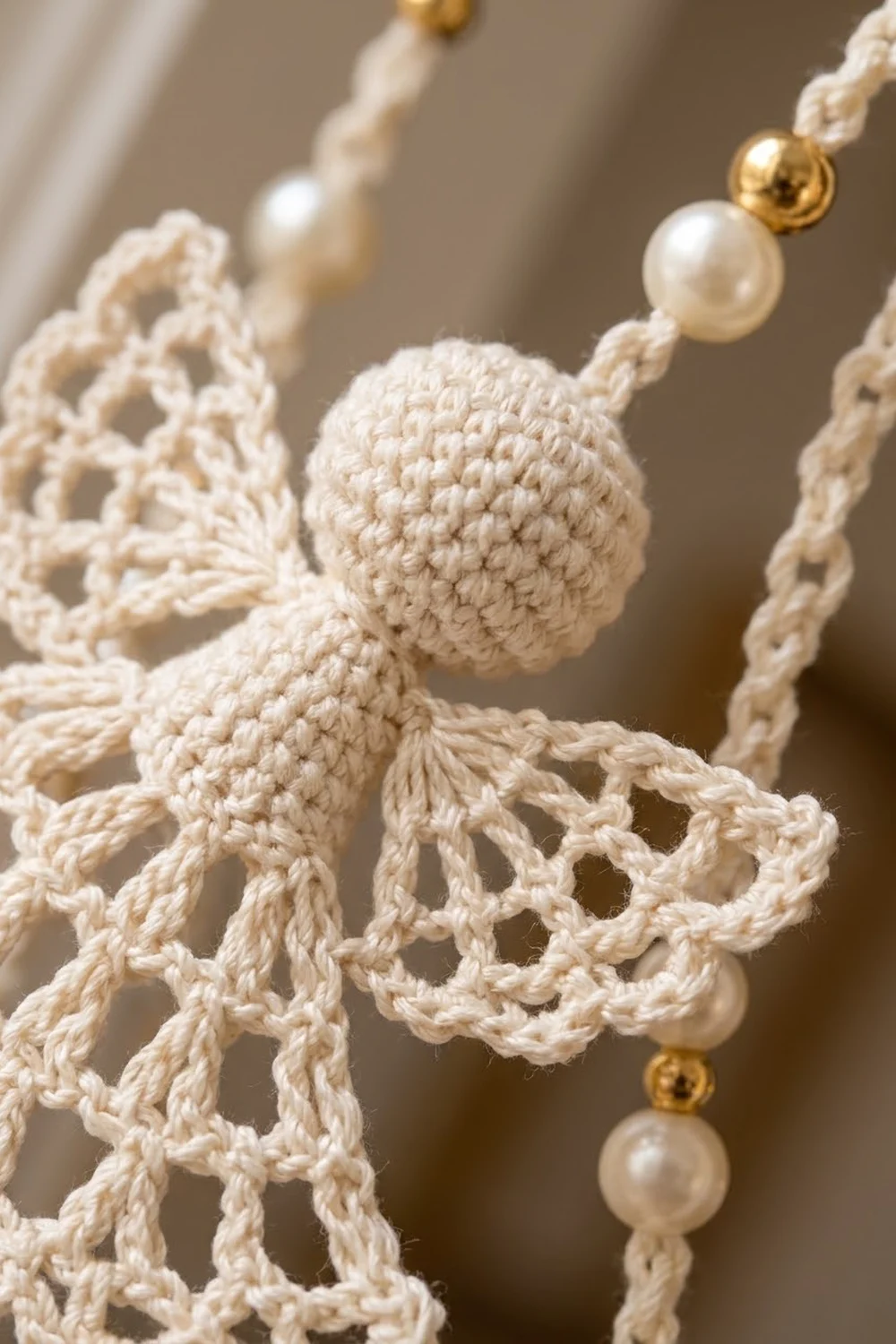
Angel Pattern
Make 32 angels. Each one has a head, a skirt and 2 wings. Use the 2.25 mm hook throughout.
Head
Work in continuous rounds and mark the first stitch of each round.
- Rnd 1: 6 sc in MR. (6)
- Rnd 2: Inc in each st around. (12)
- Rnd 3: (Sc in next st, inc) 6 times. (18)
- Rnds 4–7: Sc in each st around. (18 per round, 4 rounds)
- Rnd 8: (Sc in next st, dec) 6 times. (12)
Stuff the head firmly into a round ball.
- Rnd 9: Dec 6 times. (6)
Fasten off, leaving a 6 in (15.2 cm) tail. Thread the tail through the front loops of the 6 sts, pull tight to close, and leave the tail for sewing. The small closed hole is the top of the head. Later, the strand is anchored here.
Skirt
The skirt is worked flat in rows, from the neck down to the hem.
- Foundation: Ch 4.
- Row 1: 5 dc in 4th ch from hook. The 3 skipped chains count as the first dc. (6 dc)
- Row 2: Ch 3 (counts as dc), turn. Dc in the same st, then 2 dc in each remaining st, including the top of the turning ch. (12 dc)
Rows 1–2 make the solid yoke just under the head.
- Row 3: Ch 3 (counts as dc), turn. Dc in next dc, then ch 2, dc in next 2 dc 5 times. (12 dc in 6 pairs, 5 ch-2 sps)
- Row 4: Ch 3, turn. Dc in next dc, then ch 3, skip ch-2 sp, dc in next 2 dc 5 times. (12 dc in 6 pairs, 5 ch-3 sps)
The pairs of dc stacked in Rows 3–4 make the vertical columns in the skirt.
- Row 5 (growth row): Ch 3, turn. Dc in next dc, then ch 2, V-st in next ch-3 sp, ch 2, dc in next 2 dc 5 times. (22 dc total: 12 dc in pairs + 10 dc in 5 V-sts)
- Row 6 (scallop row): Ch 1, turn. Sc in first 2 sts, then skip ch-2 sp, 7 dc in ch-1 sp of next V-st, skip ch-2 sp, sc in next 2 dc 5 times. The last sc goes into the top of the turning ch. (5 shells of 7 dc = 35 dc, plus 12 sc)
Fasten off. The 3rd shell sits at the center of the hem, and its 4th dc is the center bottom stitch. Mark it now, because the strand is anchored there later.
Wings (make 2)
- Foundation: Ch 4.
- Row 1: 6 dc in 4th ch from hook. (7 dc)
- Row 2: Ch 5 (counts as dc + ch 2), turn. Skip first dc, then dc in next dc, ch 2 5 times. Dc in top of turning ch. (7 dc, 6 ch-2 sps)
- Row 3: Ch 6 (counts as dc + ch 3), turn. Skip first dc, then dc in next dc, ch 3 5 times. Dc in 3rd ch of turning ch. (7 dc, 6 ch-3 sps)
- Row 4: Ch 1, turn. Sc in first dc, then 5 dc in next ch-3 sp, sc in next dc 6 times. (6 shells = 30 dc, plus 7 sc)
Fasten off and leave a tail for sewing.
Assembly
- Center the head over the foundation chain of the skirt. Sew it on with the head tail, with the closed top facing up.
- Lay the angel face down. Sew the base of each wing (its foundation ch) to the back of the yoke at Row 2, one on each side of center. Angle the wings so the scalloped edges point up and out.
- Weave in all ends except one short tail on the head, which you can trim after joining.
Make All Pieces
Quantities (all in Cream):
- 32 heads
- 32 skirts
- 64 wings
- 9 strands: 5 Strand A (4 angels each = 20 angels) and 4 Strand B (3 angels each = 12 angels)
That is 20 + 12 = 32 angels.
Beads per strand: Strand A uses 30 beads (15 pearl, 15 gold). Strand B uses 31 beads (16 pearl, 15 gold).
- Pearl: 5 × 15 + 4 × 16 = 139
- Gold: 5 × 15 + 4 × 15 = 135
Layout grid. Strands are numbered 1–9 from left to right. Each tier is measured from the top of the strand to the top of the angel’s head.
TIER 1 (8 in / 20.3 cm):    ANGEL beads ANGEL beads ANGEL beads ANGEL beads ANGEL
TIER 2 (17 in / 43.2 cm):   beads ANGEL beads ANGEL beads ANGEL beads ANGEL beads
TIER 3 (25 in / 63.5 cm):   ANGEL beads ANGEL beads ANGEL beads ANGEL beads ANGEL
TIER 4 (34 in / 86.4 cm):   beads ANGEL beads ANGEL beads ANGEL beads ANGEL beads
TIER 5 (42 in / 106.7 cm):  ANGEL beads ANGEL beads ANGEL beads ANGEL beads ANGEL
TIER 6 (51 in / 129.5 cm):  beads ANGEL beads ANGEL beads ANGEL beads ANGEL beads
TIER 7 (59 in / 149.9 cm):  ANGEL beads ANGEL beads ANGEL beads ANGEL beads ANGEL
Odd-numbered strands are Strand A and even-numbered strands are Strand B.
Joining: Building the Strands
Method: Join as you go. Each strand is chained from the top down with the 3.0 mm hook, holding 2 strands of Cream together. Each angel is anchored to the strand with 2 slip stitches.
Prepare the beads: Use the beading needle to thread the beads onto both strands at once. The last bead you string is the first one you use.
- Strand A: String a gold bead first, then alternate pearl and gold, ending with a pearl. That is 30 beads, and the first bead used will be a pearl.
- Strand B: String 31 beads, alternating and starting and ending with pearl.
Push the beads well down the thread.
Each strand begins with its hanging loop. Work the loop first, following the Border section below, then continue straight on with the steps for your strand.
Strand A:
- Work 4 BU (8 in / 20.3 cm).
- Angel join: Insert the hook through the top of the head from front to back and sl st. Ch 18 behind the angel (3 in / 7.6 cm). Sl st into the back of the center bottom stitch of the skirt.
- Work 7 BU (14 in / 35.6 cm), then an angel join 3 times.
- Work 5 BU (10 in / 25.4 cm) for the tail. Fasten off and knot the end tightly under the last bead.
Strand A check: 8 + 3 + 3 × (14 + 3) + 10 = 72 in (182.9 cm). 4 + 21 + 5 = 30 bead units, which uses all 30 beads.
Strand B:
- Work 8 BU, then ch 6 (17 in / 43.2 cm).
- Make an angel join.
- Work 7 BU, then an angel join 2 times.
- Work 9 BU (18 in / 45.7 cm) for the tail. Fasten off and knot.
Strand B check: 17 + 3 + 2 × 17 + 18 = 72 in (182.9 cm). 8 + 14 + 9 = 31 bead units, which uses all 31 beads.
Stitch-to-stitch logic: The 18 chains behind each angel match its 3 in (7.6 cm) height. Because of this, the angel lies flat against the cord instead of tipping forward or bunching up.
Tension: Keep the chains even and slightly firm. Loose chains stretch under the weight of the beads. Pull every bead lock snug.
Size checkpoint: Hang each finished strand and measure it. It should be 72 in ± 0.5 in (182.9 cm ± 1.3 cm).
Border: Top Hanging Loops
On this curtain, the top hanging loops take the place of a border. They finish the top of each strand and set the spacing along the rod.
Border gauge: 6 sts = 1 in (2.5 cm), using the 3.0 mm hook with the thread doubled.
- Rnd 1: Leaving a 6 in (15.2 cm) tail, ch 30 and sl st to the first ch to form a ring. (30 ch)
- Rnd 2: Ch 1, then sc in each ch around. Sl st to the first sc. (30 sc: 15 sts on the front side and 15 on the back side when the loop is folded over the rod)
Without fastening off, keep going with Step 1 of Strand A or Strand B. Weave the starting tail into the loop.
Why the math works:
- The loop measures 30 ÷ 6 = 5 in (12.7 cm) around. A 1 in (2.5 cm) rod measures 3.14 in (8.0 cm) around. That leaves 1.86 in (4.7 cm) of ease, so the loops slide freely but don’t flop.
- Space the 9 loops 4 in (10.2 cm) apart. That gives 8 gaps × 4 in = 32 in (81.3 cm) between the outer strands.
- Add half an angel width (1.5 in / 3.8 cm) on each side, and the curtain is 35 in (88.9 cm) wide. That fits a 36 in (91.4 cm) doorway.
Final Blocking
- Before you build the strands, wet each angel’s skirt and wings and squeeze out the extra water.
- Pin each angel flat, face up. Open each skirt to 3 in (7.6 cm) wide and pin each scallop into a rounded point.
- Pin each wing open to 1.5 in (3.8 cm) across, with the shells fanned out evenly.
- Optional: brush on a little fabric stiffener for crisp lace.
- Let everything dry completely. Keep blocking water off the stuffed heads.
- Once the strands are built, hang them overnight so the chains relax and settle to their length.
Final Quality-Control Checklist
- 32 angels, each 3 in × 3 in (7.6 cm × 7.6 cm)
- Every skirt has 5 shells, and every wing has 6 shells
- Heads are round, firmly stuffed and closed at the top
- Wings are sewn symmetrically at Row 2
- Strand A has 4 angels and 30 beads, and Strand B has 3 angels and 31 beads
- Every strand measures 72 in (182.9 cm)
- Beads alternate pearl and gold all the way down every strand
- All ends are woven in and the tail knots are secure
Troubleshooting
- Skirt curls into a cone: Your dc stitches are too tight. Relax your tension in Rows 1–2, or go up one hook size for the skirt only.
- Hem ruffles: You may have worked 8 dc in a shell. Count again so each shell has exactly 7.
- Head looks lumpy: Pull out a little stuffing and shape the ball with your fingers before closing.
- Angel tilts forward on the strand: The chain behind it is too long. Redo the join with exactly 18 chains.
- Strand is too long: Your chain is loose. Go down to a 2.75 mm hook for the strands.
- Beads slide around: Pull the locking chain tighter around each bead.
Care
Dust the curtain gently, or spot-clean it with cool water and mild soap, then lay it flat to dry. To store it, wind each strand loosely around a piece of card so the strands don’t tangle.
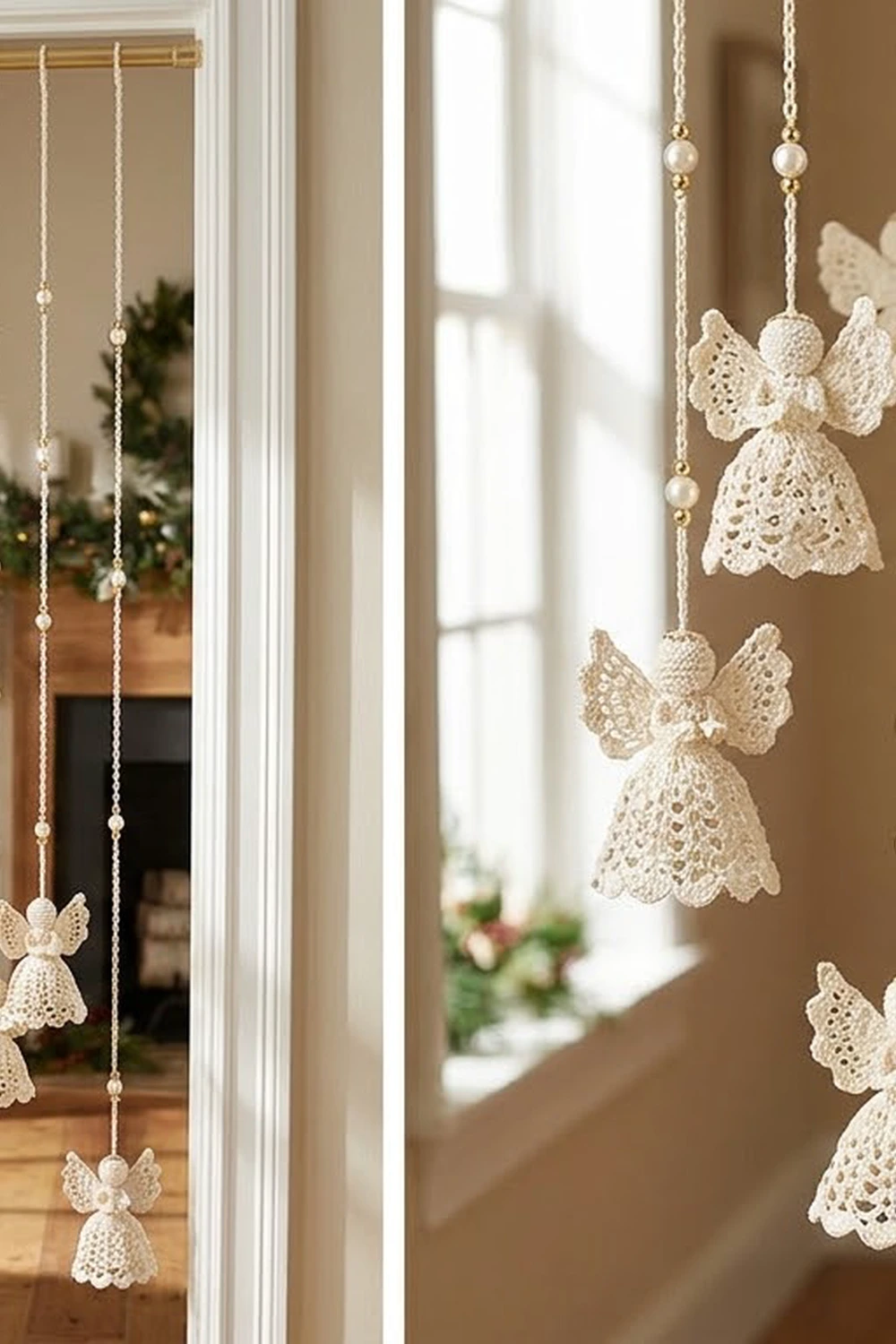
Final Notes
Here is the full measurement chain:
- Each angel measures 3 in (7.6 cm): a 0.75 in (1.9 cm) head plus a 2.25 in (5.7 cm) skirt.
- One bead unit measures 2 in (5.1 cm).
- 18 chains behind each angel match its 3 in (7.6 cm) height.
- Every strand adds up to exactly 72 in (182.9 cm).
- Nine 5 in (12.7 cm) loops spaced 4 in (10.2 cm) apart give a curtain 35 in (88.9 cm) wide.
Check your gauge at every stage, count your shells, and your angels will hang straight and even.
Happy crocheting!