

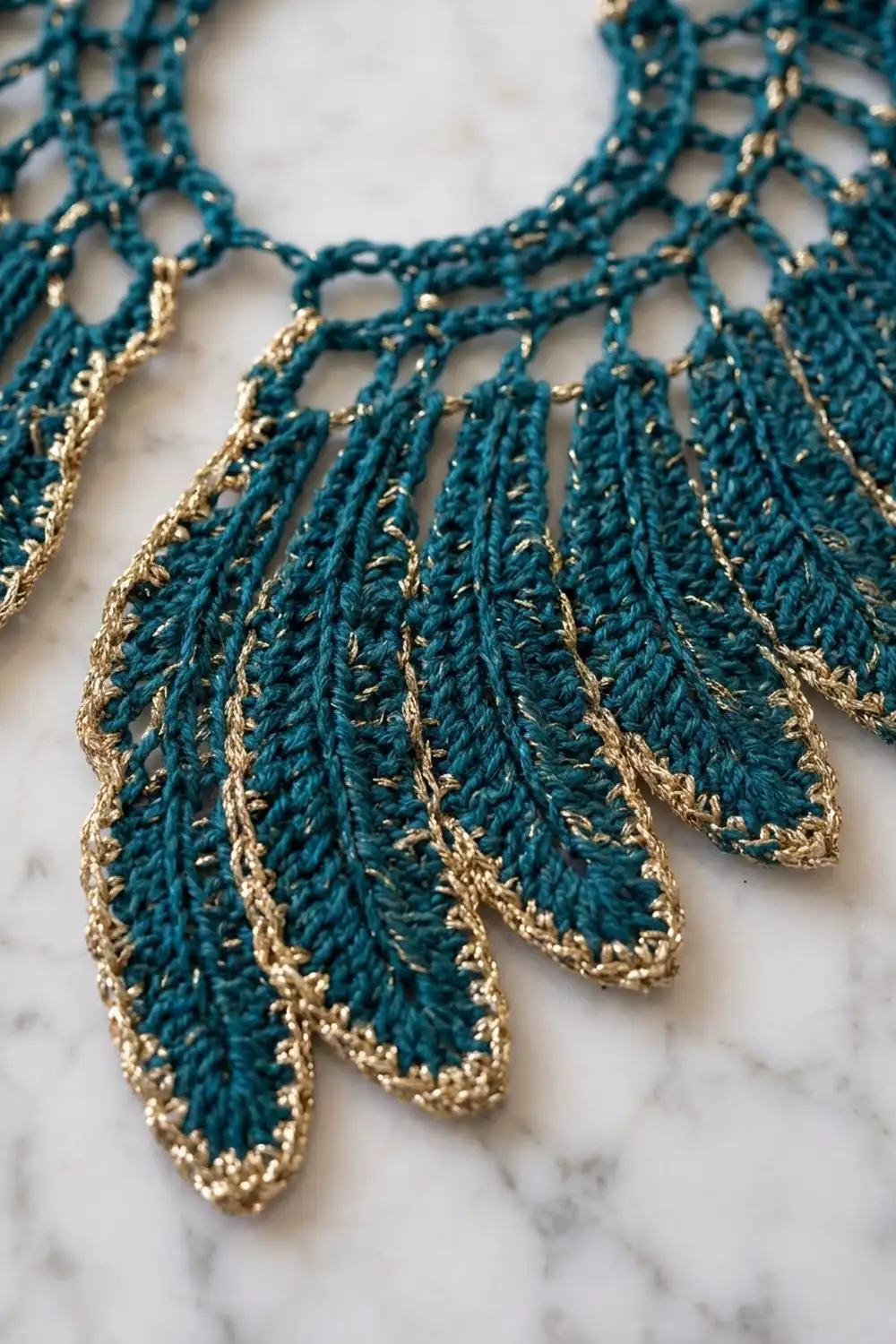
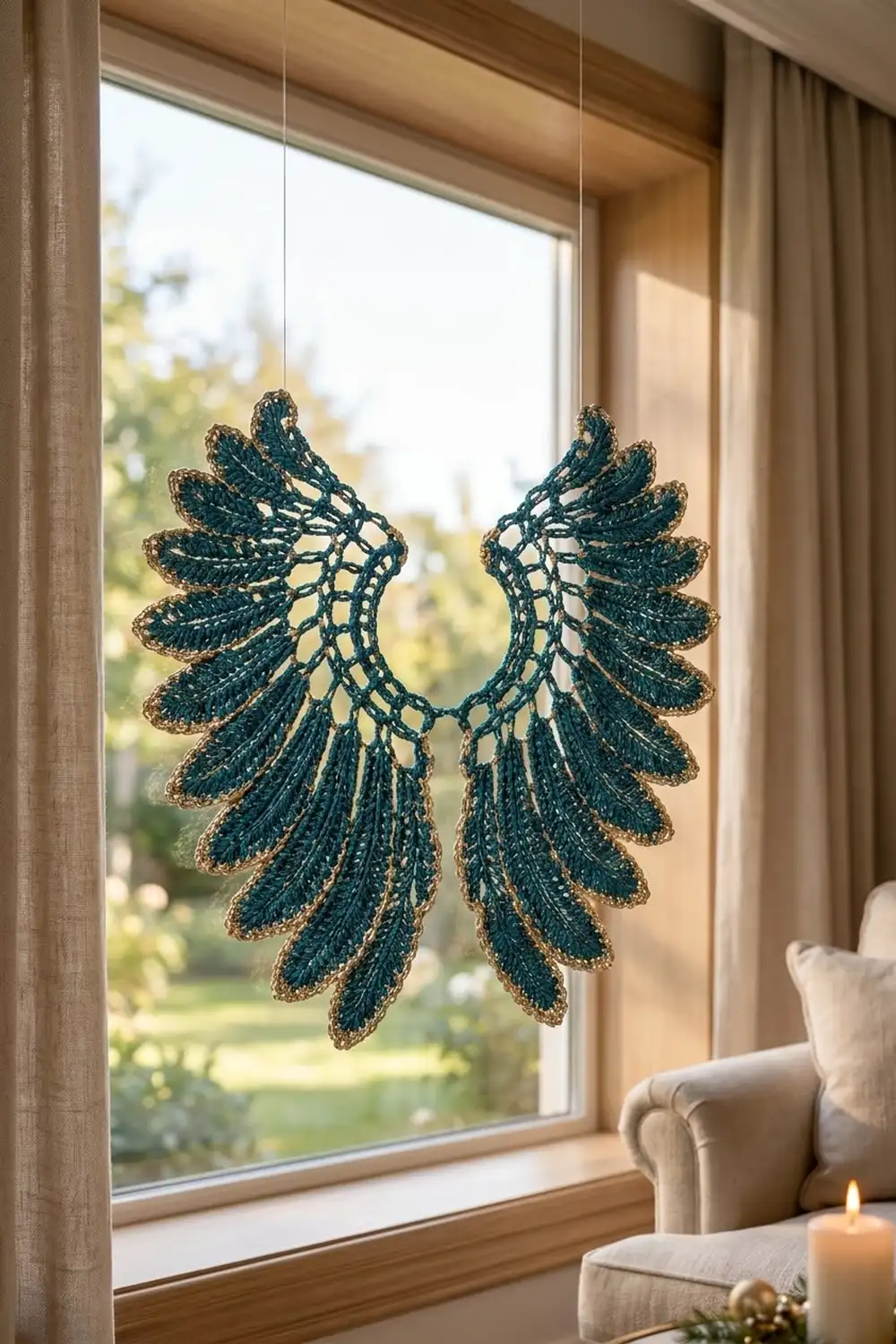
The Gilded Seraph is a lace motif of two mirrored angel wings, joined low at the center. Each wing curves into a soft crescent. An open mesh band sits along the inner edge, and twelve long feathers fan out from it, short at the top and long at the bottom.
The palette is deep teal with a metallic gold outline on every feather. The gold catches the light and makes each feather stand out against the teal. It looks rich and a little old-fashioned, and it works well as holiday décor, a wall appliqué, or a centerpiece motif.
This pattern uses US crochet terms. The finished motif measures 12 in (30.5 cm) wide by 11 in (27.9 cm) tall after blocking.
You will make two wings separately. Each one starts as a single row of sc, then two mesh rows, then a feather row with twelve feathers of graded length. You then join the wings with a short teal zigzag, add the gold border to each wing’s feather edge, and block the piece flat.
Finished Size and Construction
- Finished size: 12 in (30.5 cm) wide x 11 in (27.9 cm) tall
- Skill level: Intermediate
- Terminology: US crochet terms
- Yarn weight: DK (3) cotton for the teal; DK-compatible metallic for the gold
- Hook: 3.5 mm (E-4)
- Number of pieces: 2 (one left wing, one right wing)
- Layout: 2 wings side by side, mirrored
- Piece size: each wing 6 in (15.2 cm) wide x 11 in (27.9 cm) tall, bordered
- Size before border: 11.5 in (29.2 cm) x 10.5 in (26.7 cm) for the joined pair
- Border depth: 0.25 in (0.6 cm), gold sc on the feather edges only
Materials
Use a smooth mercerized cotton in DK weight for the teal. It shows stitch definition clearly and holds the feather points well after blocking. For the gold, pick a soft metallic yarn or a metallic-wrapped thread that works at DK gauge. A scratchy, stiff metallic will distort the feather tips.
- Teal (Color A): 60 g / 125 m
- Metallic Gold (Color B): 25 g / 60 m
Both quantities include a margin of about 25% for your gauge swatch and weaving in ends.
Tools:
- 3.5 mm (E-4) crochet hook
- Tapestry needle
- Scissors
- Locking stitch markers (at least 4)
- Rust-proof pins and a blocking mat
- Spray bottle with clean water
- Ruler or measuring tape
Abbreviations (US Terms)
- ch – chain
- sl st – slip stitch
- sc – single crochet
- hdc – half double crochet
- dc – double crochet
- sk – skip
- st(s) – stitch(es)
- sp – space
- RS – right side
Special stitch – Feather-n (F-n): “n” is the number of working chains in the feather.
- Sc in the indicated st, then ch n + 1.
- Side A: Sc in the 2nd ch from the hook, hdc in the next ch, dc in each of the next n – 4 ch, hdc in the next ch, and sc in the last ch (n sts). Sl st in the same st as the starting sc.
- Side B: Rotate the work. Working in the free loops of the same foundation chain, sc in the first ch, hdc in the next ch, dc in each of the next n – 4 ch, hdc in the next ch, and sc in the next ch (n sts).
- Tip: Work (sc, ch 2, sc) in the skipped tip ch.
- Vein: Work n surface sl sts loosely down the center line of the feather, then sl st in the base st.
Each feather has 2n + 2 sts plus 1 ch-2 tip sp.
Surface sl st: With the yarn held behind the work, insert the hook from front to back between two sts, pull up a loop, and draw it through the loop on the hook.
Gauge and Checkpoints
Gauge: 18 sc = 4 in (10.2 cm), and 16 dc = 4 in (10.2 cm), with a 3.5 mm hook. One dc row is about 0.5 in (1.3 cm) tall.
Make one complete wing before you start the second. The first wing is your real gauge test.
Checkpoints:
- After Row 1: 37 sc measure 8.2 in (20.8 cm).
- After Row 3: The mesh band is 1.75 in (4.4 cm) deep.
- Feather 1 (F-10): about 2.5 in (6.4 cm) long and 1 in (2.5 cm) wide.
- Feather 12 (F-22): about 5.5 in (14.0 cm) long before the border.
- Unbordered wing: 5.75 in (14.6 cm) wide x 10.5 in (26.7 cm) tall, blocked.
If your piece is too big, go down one hook size, to 3.25 mm (D-3). If it is too small, go up to 3.75 mm (F-5). Within 0.25 in (0.6 cm) of each checkpoint is fine, because blocking evens out small differences.
Wing Pattern (Make 2)
Work both wings in Teal through Row 4. The left wing and right wing differ only in the order of the feathers in Row 4.
Row 1 (Inner Arc)
With Teal, ch 38.
Sc in the 2nd ch from the hook and in each ch across, then turn. (37 sc)
The first sc of this row marks the bottom end of the left wing. Place a marker in it.
Row 2 (Mesh)
Ch 1. Sc in the first sc. Ch 5, sk 2 sc, sc in the next sc. Repeat from * 11 more times (12 repeats total), then turn. (13 sc, 12 ch-5 loops)
The math: 1 sc + (12 repeats x 3 sts) = 37 sts, so the last sc lands in the last st of Row 1. On Row 1, the mesh sc sit in sts 1, 4, 7 and so on up to 37, counting from either end. The joining step uses these same positions.
Row 3 (Offset Mesh)
Sl st in each of the first 3 ch of the first loop, then sc in the same loop. Ch 5, sc in the next ch-5 loop. Repeat from * 10 more times (11 repeats total), then turn. (12 sc, 11 ch-5 loops)
The 12 sc in this row are the bases for the 12 feathers.
Checkpoint: The mesh band should be 1.75 in (4.4 cm) deep, with an inner arc of 8.2 in (20.8 cm).
Row 4 (Feathers), RS Facing
Feathers come in four groups of three, from shortest to longest:
- Feathers 1–3: F-10 (ch 11; 6 dc per side; 22 sts)
- Feathers 4–6: F-14 (ch 15; 10 dc per side; 30 sts)
- Feathers 7–9: F-18 (ch 19; 14 dc per side; 38 sts)
- Feathers 10–12: F-22 (ch 23; 18 dc per side; 46 sts)
Left wing: Ch 1. Work the next feather in the next sc, then 3 sc in the next ch-5 loop. Repeat from * for Feathers 1 through 11. Work Feather 12 in the last sc. This row starts at the top of the wing and ends at the marked bottom end.
Right wing: Work the same row, but in reverse feather order. Start with Feather 12 (F-22) and finish with Feather 1 (F-10). The RS of both wings then faces up, and the feathers point in opposite directions.
Row 4 totals: 12 feathers, 408 feather sts, 192 vein sl sts, and 33 sc between feathers (11 groups of 3).
Fasten off and weave in the ends.
Checkpoint: Pin the wing into a C-curve with the mesh band on the inside. It should measure 5.75 in (14.6 cm) wide x 10.5 in (26.7 cm) tall. Feather 1 should curl outward at the top, and Feathers 10–12 should hang down from the bottom.
Make All Pieces
You need two pieces in total, both in Teal, with Gold added later as the border:
- Left wing: 1 (Row 4 runs Feather 1 to Feather 12)
- Right wing: 1 (Row 4 runs Feather 12 to Feather 1)
Layout grid (RS up):
ROW 1: LEFT WING | RIGHT WING
The mesh bands face each other across the center, and the feathers point outward. The bottom ends of the inner arcs meet at the center line.
Joining
Method: A teal ch-3 zigzag between the inner arcs (Row 1) of the two wings.
Setup: Lay both wings RS up on a flat surface, with the bottom ends of their inner arcs about 0.5 in (1.3 cm) apart.
On each wing, count Row 1 sc from the bottom end, and mark sc 1, sc 4 and sc 7. These match the Row 2 mesh positions, so the zigzag lines up with the mesh pattern.
Join:
- With Teal, sl st in sc 7 of the left wing.
- Ch 3, then sc in sc 7 of the right wing.
- Ch 3, then sc in sc 4 of the left wing.
- Ch 3, then sc in sc 4 of the right wing.
- Ch 3, then sc in sc 1 of the left wing.
- Ch 3, then sc in sc 1 of the right wing.
- Fasten off.
This gives 5 ch-3 links, and no stitches are added to either wing. The two arcs above the join stay open, which forms the rounded center opening.
Tension: Keep the ch-3 links the same size as your Row 2 chains. Links that are too tight pull the wings into a V. Links that are too loose let the center sag.
Size checkpoint: The joined pair should measure 11.5 in (29.2 cm) wide x 10.5 in (26.7 cm) tall, pinned flat.
Border (Gold Feather Edging)
Border gauge: One row of gold sc, 0.25 in (0.6 cm) deep. Work it on each wing’s feather edge as one continuous pass, from Feather 1 to Feather 12. Each wing counts as one side.
Per-feather edge count: Each feather has n edge sts on each side, 1 tip sc on each side of the tip, and 1 ch-2 tip sp.
Gold pass (repeat on each wing):
- Join Gold with a sc in the first base st of Feather 1’s upper side.
- Sc in each of the remaining n – 1 side sts and the tip sc. That is n + 1 sc for the side.
- Work (sc, ch 2, sc) in the ch-2 tip sp.
- Sc in the tip sc and in each of the n sts of the lower side. That is n + 1 sc.
- Valley: Sk 1 sc, sl st in the center sc of the 3-sc group, sk 1 sc.
- Repeat steps 2–5 for each feather. Start each new feather with a regular sc instead of a joining sc. Leave out the valley after Feather 12.
- Fasten off.
Counts per feather (2n + 4 sc + 1 ch-2):
- F-10: 24 sc each, x 3 = 72 sc
- F-14: 32 sc each, x 3 = 96 sc
- F-18: 40 sc each, x 3 = 120 sc
- F-22: 48 sc each, x 3 = 144 sc
Per side (one wing): 432 sc, plus 12 ch-2 tips and 11 valley sl sts.
Both sides: 2 sides x 432 sc = 864 sc.
Why the math works: Each feather edge has (n + 1) + (n + 1) = 2n + 2 sts. The border works 1 sc into each of those, plus 2 sc at the point, for 2n + 4. The extra 2 sc at the tip let the gold go around the point without cupping. Skipping 1 sc on each side of the valley sl st keeps the dip between feathers sharp. You add 1 sc to every existing st and do not double-count any st. Both wings have the same feathers, so both sides total 432.
Final Blocking
- Weave in all ends before you block.
- Spray the motif with water until it is evenly damp, not dripping.
- Lay it RS up on the blocking mat.
- Pin the center join first, then shape each inner arc into a smooth C. The open center should be about 3 in (7.6 cm) across.
- Pin each feather tip at its ch-2 sp, fanning the feathers evenly. Feathers 1–3 curl outward and upward, and Feathers 10–12 hang down and slightly apart.
- Check the size: 12 in (30.5 cm) wide x 11 in (27.9 cm) tall.
- Leave it to dry completely, at least 12 hours, before removing the pins.
Final Quality-Control Checklist
- [ ] Row 1 has 37 sc on each wing.
- [ ] Row 2 has 12 ch-5 loops and Row 3 has 11.
- [ ] Each wing has 12 feathers in the correct order of length.
- [ ] Each feather has a raised center vein and a pointed tip.
- [ ] The two wings mirror each other with the RS up.
- [ ] The join has 5 ch-3 links at sc 1, 4 and 7.
- [ ] Each wing’s gold border has 432 sc, 12 ch-2 tips and 11 valley sl sts.
- [ ] The finished size is 12 in (30.5 cm) x 11 in (27.9 cm), within 0.25 in (0.6 cm).
- [ ] All ends are woven in and none show on the RS.
Troubleshooting
Feathers twist: You probably worked Side B into the wrong loops. Work only into the free loops left after Side A, and keep the foundation chain flat as you rotate the work.
Feather tips are rounded: Make sure you work (sc, ch 2, sc) into the skipped tip ch. In the gold border, pin each tip at its ch-2 sp while blocking.
Vein puckers the feather: Your surface sl sts are too tight. Rip them out and redo them loosely, or use a hook one size larger just for the vein.
Wing will not curve: Your Row 2 chains are too short. Ch-5 loops should be relaxed. Damp blocking also helps the curve.
Gold edge ruffles: Your metallic yarn is thicker than your teal. Use a thinner metallic, or work the border with a 3.25 mm hook.
Wings don’t mirror: You worked Row 4 in the same feather order on both wings. Remake the right wing’s Row 4 starting with Feather 12.
Care
Hand wash in cool water with a mild soap, then press out the water in a towel. Do not wring it. Reshape and dry flat, re-pinning the feather tips if needed, and keep it away from heat so the metallic doesn’t tarnish.
Final Notes
Here is the full measurement chain. Row 1 has 37 sc and measures 8.2 in (20.8 cm). The mesh band is 1.75 in (4.4 cm) deep. Feathers grow from 2.5 in (6.4 cm) to 5.5 in (14.0 cm) long.
Each unbordered wing is 5.75 in (14.6 cm) wide, and the joined pair is 11.5 in (29.2 cm) x 10.5 in (26.7 cm). The 0.25 in (0.6 cm) gold border brings the finished motif to 12 in (30.5 cm) x 11 in (27.9 cm).
If you check your size at each stage, the wings will come out even and the feathers will shape well when you block. Take your time with the veins and tips, because they give the feathers their shape.
Happy crocheting!