

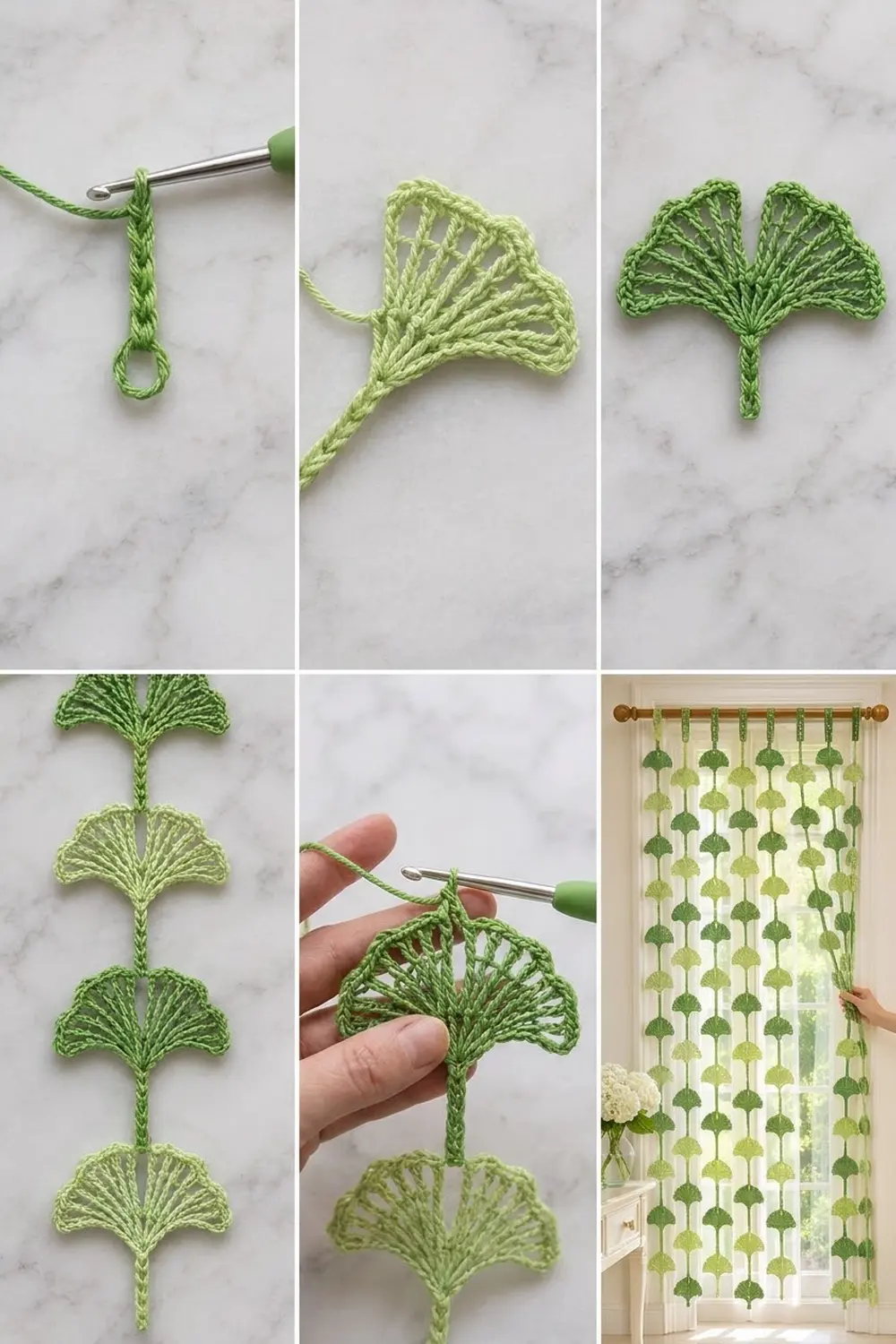
The Ginkgo Breeze Leaf Curtain is a light, airy hanging made of small ginkgo leaves strung on slim chain cords. Sunlight passes through the open treble spokes of each leaf, and the strands sway when you walk past.
The design uses two greens: a grass green and a soft pistachio. Leaves alternate colors down each strand, and every other strand starts with the opposite color, so the whole curtain reads as a gentle checkerboard. The cords and hanging tabs are grass green. Each leaf gets a raised, rope-like reverse single crochet edge that gives it a crisp outline.
This pattern uses US crochet terms. The finished curtain measures about 35 in (88.9 cm) wide on the rod and about 72 in (182.9 cm) long. Each leaf is 3 in (7.6 cm) wide and 2.75 in (7.0 cm) tall.
Construction is simple. You make 126 identical leaves, then work 9 chain cords from the top down, joining each leaf to its cord with slip stitches at three points as you go. No sewing is needed.
Finished Size and Construction
- Finished size: about 35 in (88.9 cm) wide x 72 in (182.9 cm) long
- Skill level: Easy to Intermediate
- Terminology: US crochet terms
- Yarn weight: DK (light, #3) cotton or cotton blend
- Hook: 3.5 mm (US E-4)
- Number of pieces: 126 leaves and 9 cords with tabs
- Layout: 9 strands x 14 leaves, strands spaced 4 in (10.2 cm) apart
- Leaf size: 3 in (7.6 cm) wide x 2.75 in (7.0 cm) tall
- Leaf size before edging: 2.25 in (5.7 cm) wide x 2.375 in (6.0 cm) tall
- Edging depth: 0.375 in (1.0 cm)
Materials
Choose a smooth mercerized or matte cotton in DK weight. Cotton holds the fan shape, shows the spokes clearly, and does not stretch much when hanging. Avoid fuzzy yarn because it hides the rope edge. The amounts below assume a yarn of about 115 m per 50 g.
- Color A, grass green (63 leaves, 9 cords and tabs): 300 g, about 690 m
- Color B, pistachio green (63 leaves): 250 g, about 575 m
Each leaf uses about 3 g (6.9 m), and each cord with its tab uses about 4 g (9.2 m). The quantities above include a margin of roughly 25 to 30 percent for gauge differences and tails.
Tools:
- 3.5 mm (US E-4) crochet hook
- Tapestry needle
- Scissors
- Rust-proof pins and a blocking mat
- Spray bottle
- Measuring tape
- Curtain rod, up to 1.25 in (3.2 cm) in diameter
Abbreviations (US Terms)
- ch – chain
- sl st – slip stitch
- sc – single crochet
- tr – treble crochet (yarn over twice)
- rev sc – reverse single crochet
- sp – space
- st(s) – stitch(es)
Special stitch – Reverse single crochet (rev sc, crab stitch): Do not turn. Working from left to right (right-handed), insert the hook into the next stitch to the right, yarn over, pull up a loop, yarn over, and pull through both loops. This builds the twisted, rope-like edge.
Gauge and Checkpoints
Make one full leaf and one short test cord before you commit to all 126 leaves.
- Chain gauge: 6 ch = 1 in (2.5 cm)
- Edge gauge: 11 sc = 2 in (5.1 cm) along the lobe arc
Checkpoints for one leaf:
- Base loop, stem, and fan ring: about 1.5 in (3.8 cm) long.
- After Row 1: fan 2.25 in (5.7 cm) wide; whole leaf 2.375 in (6.0 cm) tall.
- After Row 2: fan about 2.65 in (6.7 cm) wide.
- After Round 3: 3 in (7.6 cm) wide x 2.75 in (7.0 cm) tall.
If your leaf is too big, go down to a 3.25 mm hook. If it is too small, go up to a 3.75 mm hook. If the leaf cups upward, your edge rows are too tight; loosen them or go up a hook size for Rows 2 and 3 only. If the edge ripples, check your sc counts first.
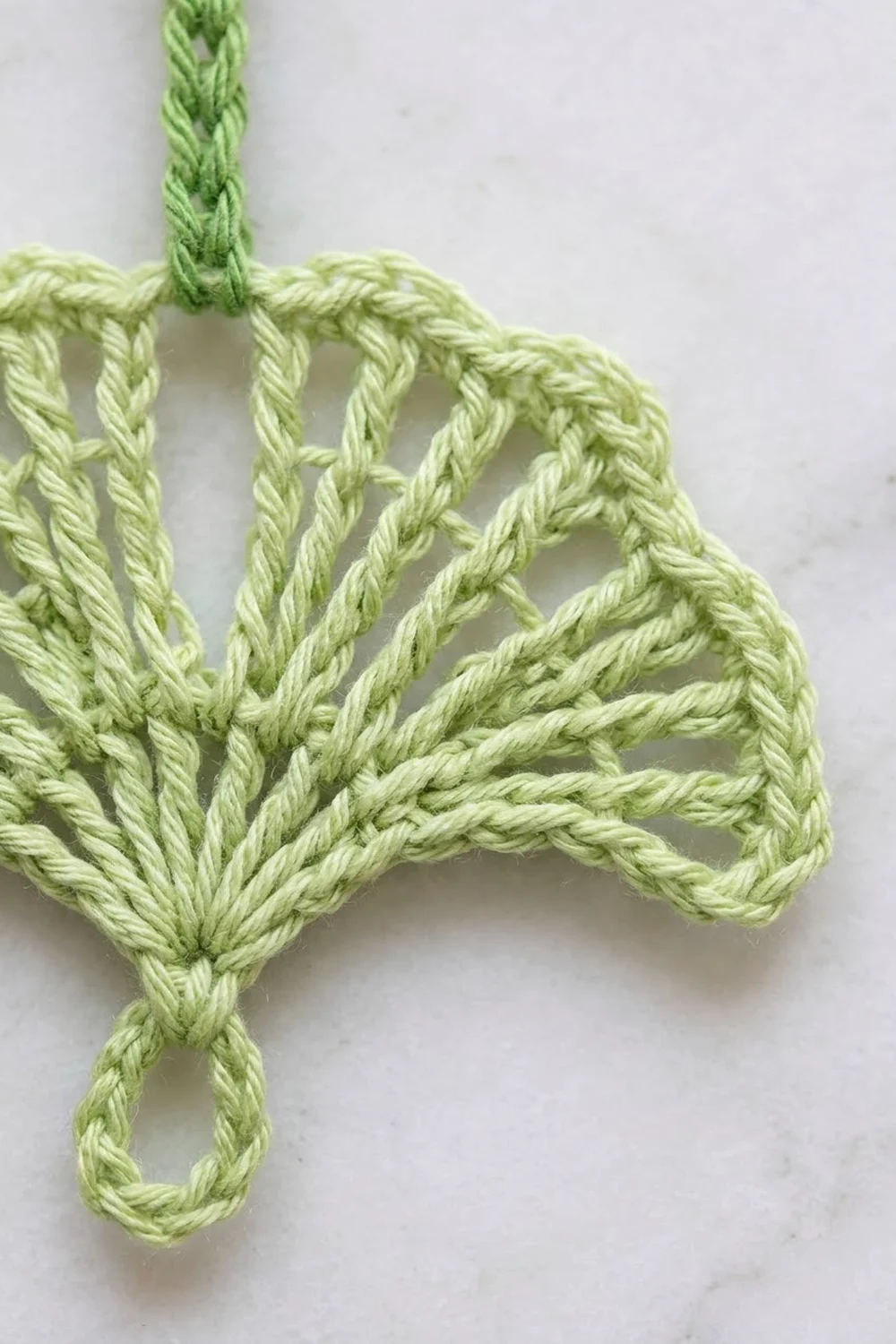
Leaf (make 126)
Each leaf starts at the base loop and works up the stem to a small fan ring. Both lobes are worked into that ring in one row, with a chain notch between them.
Base loop and stem: Ch 4, sl st in first ch to form the base loop. Ch 11, sl st in 4th ch from hook to form the fan ring. You now have a base loop, a stem of 7 ch, and a small fan ring at the top.
Row 1 (spokes): Work all stitches into the fan ring.
- Lobe A: Ch 4 (counts as tr), [ch 1, tr] 4 times. (5 tr)
- Notch: Ch 3.
- Lobe B: [Tr, ch 1] 4 times, tr. (5 tr)
Turn. Row 1 total: 10 tr, 8 ch-1 sps, 1 ch-3 notch sp.
The tr stitches fan out like the veins of a ginkgo leaf. Spread them gently with your fingers so the two lobes sit side by side with the notch at the top center.
Checkpoint: the fan should measure 2.25 in (5.7 cm) wide.
The leaf is now ready for its edging, which is written in the Border section below. Rows 2 and 3 are part of every leaf.
Make All Pieces
Make 63 leaves in Color A and 63 leaves in Color B. Weave in all leaf tails before blocking, and leave the base loop open.
You make the cords during joining, all in Color A: 9 cords, one per strand.
Layout grid (A = grass green, B = pistachio; columns are strands 1 to 9, rows are leaf positions from top to bottom):
Leaf   S1 S2 S3 S4 S5 S6 S7 S8 S9
 1     A  B  A  B  A  B  A  B  A
 2     B  A  B  A  B  A  B  A  B
 3     A  B  A  B  A  B  A  B  A
 4     B  A  B  A  B  A  B  A  B
 ...   (continue alternating)
13     A  B  A  B  A  B  A  B  A
14     B  A  B  A  B  A  B  A  B
Odd strands start with A, and even strands start with B. Every strand has 7 A leaves and 7 B leaves, for 63 of each color in total.
Joining
Each strand is one continuous Color A cord, worked from the top tab down. You attach the leaves with slip stitches as you chain, at three points per leaf: the notch, the fan ring, and the base loop.
Joining slip stitch: With the leaf right side facing you, insert the hook from front to back through the stated point of the leaf, yarn over, and pull through the leaf and the loop on your hook.
Tab: With Color A, ch 30, sl st in first ch to form a ring. Ch 1, work 28 sc into the ring (over the chain), sl st in first sc. The tab ring is 5 in (12.7 cm) around and hangs as a 2.5 in (6.4 cm) loop over the rod.
Strand:
- Ch 12 (drop to the first leaf).
- Join the notch: joining sl st through the sl st at the notch of the leaf.
- Ch 6, laying the chain down the center of the leaf front. Joining sl st through the fan ring.
- Ch 7, laying the chain along the stem. Joining sl st through the base loop.
- Ch 17 (gap to the next leaf).
- Repeat Steps 2 to 5 for leaves 2 to 13, then Steps 2 to 4 for leaf 14. Fasten off and weave in.
Stitch logic: The 6 ch between notch and fan ring match the height of one tr spoke. The 7 ch between fan ring and base loop match the 7-ch stem exactly. That makes 13 ch on each leaf. Adding the 17-ch gap gives a pitch of 30 ch, or 5 in (12.7 cm) from one notch to the next.
Cord total per strand: 12 + (14 x 13) + (13 x 17) = 12 + 182 + 221 = 415 ch, plus the tab.
Tension: Keep the cord chains at the same tension as your gauge chain. A tight cord puckers the leaf center, and a loose cord sags in front of it. Lay the leaf flat on the table while working Steps 3 and 4.
Size checkpoint: Before fastening off, lay the strand flat. From the top of the tab fold to the base loop of leaf 14 should be about 72 in (182.9 cm): 2.5 in (6.4 cm) tab + 2 in (5.1 cm) drop + 13 pitches of 5 in (12.7 cm) + about 2.375 in (6.0 cm) for the last leaf’s cord and loop. If you are more than 2 in (5.1 cm) off, rework this strand with your chain tension adjusted to gauge.
Slide the 9 tabs onto the rod and space them 4 in (10.2 cm) apart, center to center. That gives 32 in (81.3 cm) between the outer strands plus one 3 in (7.6 cm) leaf width, for 35 in (88.9 cm) total.
Border (Leaf Edging, Rows 2 and 3)
Every leaf gets this two-round edging, worked straight after Row 1. Each lobe counts as one “side” of the edging: its top arc plus its outer post.
Border gauge: 11 sc = 2 in (5.1 cm) along the arc, and 5 sc cover one tr post.
Row 2 (sc frame): Ch 1, turn.
- Lobe B arc: Sc in first tr, 2 sc in next ch-1 sp, sc in next tr, sc in next ch-1 sp, sc in next tr, sc in next ch-1 sp, sc in next tr, 2 sc in next ch-1 sp, sc in last tr of lobe. (11 sc)
- Notch: Sl st in ch-3 notch sp.
- Lobe A arc: Repeat the Lobe B arc sequence, working the last sc in the top ch of the beginning ch-4. (11 sc)
- Lobe A post: Work 5 sc evenly down the side of the beginning ch-4. (5 sc)
- Sl st in fan ring.
- Lobe B post: Work 5 sc evenly up the side of the last tr of Row 1. (5 sc)
- Join with sl st in first sc.
Row 2 total: 32 sc (16 per lobe: 11 arc + 5 post), plus 1 sl st at the notch and 1 sl st at the fan ring.
Round 3 (rope edge): Ch 1, do not turn. Work rev sc in each sc around, and sl st (not rev sc) in the notch sl st and the fan ring sl st. Join with sl st in first rev sc and fasten off.
Round 3 total: 32 rev sc (16 per lobe), plus 2 sl sts.
Why the math works: At the edge gauge, the lobe arc after Row 1 is about 2 in (5.1 cm) long, which takes 11 sc. The 2 sc in each outer ch-1 sp add fullness where the arc is widest, and the 1 sc in each inner sp keeps the lobe from ruffling near the notch. Each tr post is about 0.9 in (2.3 cm), which takes 5 sc. The sl sts at the notch and fan ring add no height, so the notch dips and the base stays tight. Round 3 is worked as 1 rev sc into each sc, so the count stays at 16 per lobe and the edge stays flat. Each round adds about 0.1875 in (0.5 cm) all around the fan, so the 2.25 in (5.7 cm) fan grows by 0.375 in (1.0 cm) on each side to 3 in (7.6 cm).
Final Blocking
- Block the leaves before joining if you can, because flat leaves are easier to join.
- Pin each leaf on the mat, right side up, to 3 in (7.6 cm) wide x 2.75 in (7.0 cm) tall.
- Spread the spokes evenly, with the notch centered above the stem.
- Pin the stem straight and the base loop open.
- Spray until damp, not soaked. Let dry fully.
- After joining, hang the finished strands for 24 hours so the cords relax to length.
- Lightly steam any leaf that has twisted, holding the iron above the work, never on it.
Final Quality-Control Checklist
- 126 leaves: 63 in Color A, 63 in Color B.
- Each leaf: 10 tr in Row 1, 32 sc in Row 2, 32 rev sc in Round 3.
- Each leaf measures 3 in (7.6 cm) x 2.75 in (7.0 cm).
- Colors alternate down each strand and across strands, matching the grid.
- Each leaf is joined at the notch, fan ring, and base loop.
- Leaf pitch is 5 in (12.7 cm) on every strand.
- All 9 strands are about 72 in (182.9 cm) long and within 1 in (2.5 cm) of each other.
- All tails are woven in and trimmed.
Troubleshooting
Leaf cups or curls upward: The Row 2 edge is too tight. Work Rows 2 and 3 with a 3.75 mm hook.
Lobe edge ripples: There are too many sc in the arc. Recount to 11 sc per lobe.
Notch disappears: You worked sc instead of sl st at the notch. Rework it with a sl st in both rows.
Leaf twists on the cord: One of the three join points was skipped. Add the missing joining sl st.
Strands differ in length: Your cord tension drifted. Count the gap chains, measure the 5 in (12.7 cm) pitch, and redo the longest or shortest strand.
Tab is too tight for the rod: Make the tab with ch 36 and 34 sc for a 6 in (15.2 cm) ring.
Care
Hand wash in cool water with mild soap, roll in a towel, and lay the strands flat to dry. Reshape the leaves while damp.
Final Notes
The whole curtain rests on a short measurement chain. Your chain gauge of 6 ch to 1 in (2.5 cm) gives a 30-ch pitch of 5 in (12.7 cm). Your edge gauge of 11 sc to 2 in (5.1 cm) turns a 2.25 in (5.7 cm) fan into a 3 in (7.6 cm) leaf. Fourteen leaves on one cord give a 72 in (182.9 cm) strand, and 9 strands spaced 4 in (10.2 cm) apart give a 35 in (88.9 cm) curtain. Check one leaf and one strand, and the rest will follow.
Happy crocheting!