

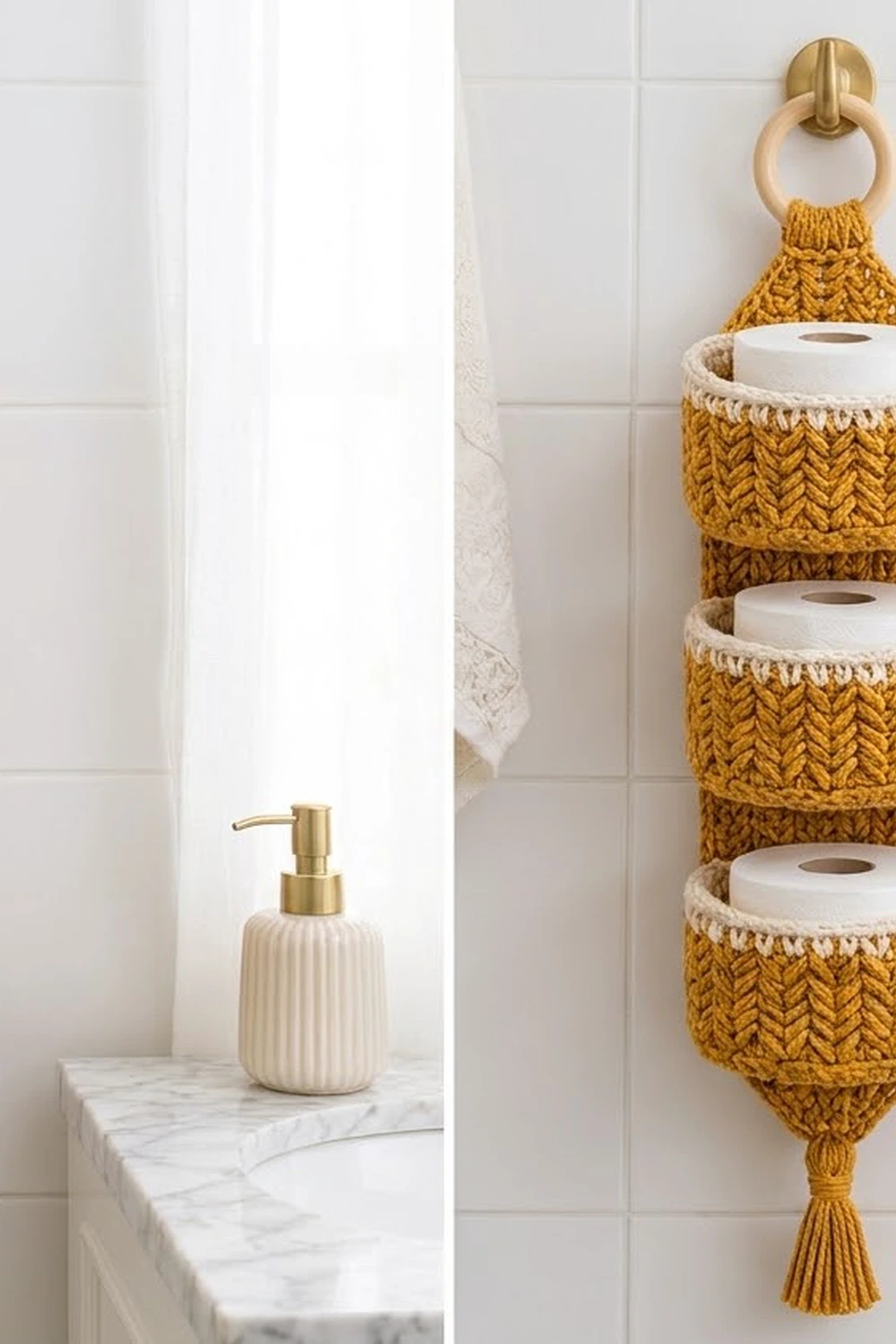
The Golden Hour Hanging Toilet Paper Holder is a tidy vertical organizer with three oval baskets stacked down a textured backing panel. It hangs from a natural wooden ring and finishes with a soft tassel, so it looks decorative while holding three standard rolls.
The palette is warm and simple: golden mustard for the baskets, panel, and tassel, with crisp cream rims on each basket. The walls and panel are worked in waistcoat stitch, which forms vertical columns of V shapes that look knitted and stay firm.
This pattern uses US crochet terms. The finished holder is about 28 in (71.1 cm) long from the top of the ring to the tip of the tassel. Each basket measures about 7 in (17.8 cm) wide, 5 in (12.7 cm) deep, and 3.5 in (8.9 cm) tall.
You crochet three baskets from the base up and add a cream border to each. Then you crochet the backing panel as a flattened tube, shape the top strap and bottom point, and sew the baskets to the panel stitch for stitch.
Finished Size and Construction
- Finished size: about 28 in (71.1 cm) long, 7 in (17.8 cm) wide at the baskets
- Skill level: Easy intermediate
- Terminology: US crochet terms
- Yarn weight: Worsted (#4), cotton or cotton blend
- Hook: 5.0 mm (H-8)
- Number of pieces: 3 baskets, 1 backing panel, 1 tassel, plus 1 wooden ring
- Layout: 3 baskets in a single vertical column (1 x 3)
- Piece size (basket): 7 in x 5 in x 3.5 in (17.8 cm x 12.7 cm x 8.9 cm)
- Basket size before border: 7 in x 5 in x 3 in (17.8 cm x 12.7 cm x 7.6 cm)
- Border depth: 0.5 in (1.3 cm), 2 rounds in cream
- Panel body: 5 in x 16 in (12.7 cm x 40.6 cm)
Materials
Choose a smooth worsted weight cotton or cotton blend. Cotton keeps the baskets firm and shows the V texture clearly.
- Golden mustard: 400 g, about 760 m
- Cream: 50 g, about 95 m
- Wooden ring: 1 ring, about 2.75 in (7.0 cm) outside diameter
- 5.0 mm (H-8) crochet hook
- Tapestry needle
- 4 locking stitch markers
- Scissors
- A piece of cardboard 5.5 in (14.0 cm) tall for the tassel
- Rust-proof pins and a blocking mat
The yarn quantities include a margin of about 15 percent for gauge differences and swatching.
Abbreviations (US Terms)
- ch – chain
- sl st – slip stitch
- sc – single crochet
- sc2tog – single crochet 2 together
- sc3tog – single crochet 3 together
- BLO – back loop only
- inc – 2 sc in the same stitch
- rev sc – reverse single crochet (crab stitch), worked left to right
- wst – waistcoat stitch
- st(s) – stitch(es)
- rnd(s) – round(s)
Special stitch – Waistcoat stitch (wst): Look at the sc below from the front. Each sc forms a small V with two vertical legs. Insert your hook from front to back through the center of that V, between the two legs and below the top loops. Yarn over, pull up a loop, yarn over, and pull through both loops. Worked in continuous rounds, this stacks the Vs into straight knit-look columns.
Gauge and Checkpoints
Gauge: 15 sts and 16 rnds = 4 in (10.2 cm), in sc and in waistcoat stitch worked in the round.
Make one basket completely before you start the others. It works as your gauge swatch and shows you whether a standard roll fits.
Checkpoints:
- After Rnd 5: base about 4.5 in x 2.75 in (11.4 cm x 7.0 cm)
- After Rnd 10: base 7 in x 5 in (17.8 cm x 12.7 cm), 76 sts
- After Rnd 22: wall height 3 in (7.6 cm) above the base ridge
- After border: wall height 3.5 in (8.9 cm), rim circumference about 20.25 in (51.4 cm)
If your base is too big, go down half a hook size. If it is too small, go up half a hook size. Waistcoat stitch tends to tighten. If the walls lean inward while the base is correct, use a hook 0.5 mm larger for the walls only.
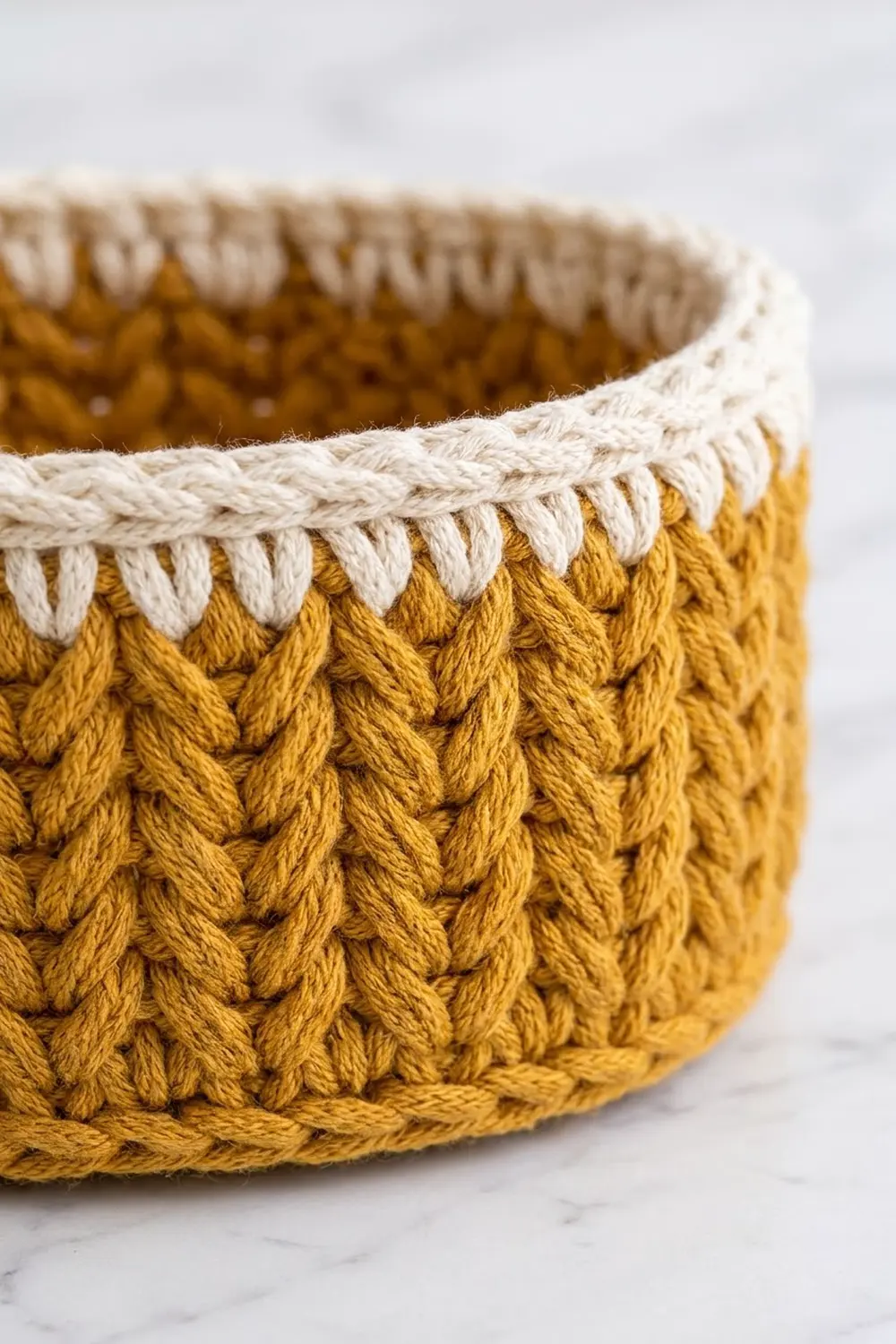
Basket (Make 3)
Use golden mustard. Work in continuous rounds without joining. Move a marker up to the first stitch of each round.
Base
Ch 11.
Rnd 1: Sc in 2nd ch from hook, sc in next 8 ch, 3 sc in last ch. Working along the opposite side of the chain, sc in next 8 ch, 2 sc in same ch as first sc. (22 sts: 8 per straight side, 3 per end)
Rnd 2: Inc in first st, sc in next 8 sts, inc in each of next 3 sts, sc in next 8 sts, inc in each of last 2 sts. (28 sts: 8 per straight side, 6 per end)
Rnd 3: [Sc, inc] once, sc in next 8 sts, [sc, inc] 3 times, sc in next 8 sts, [sc, inc] 2 times. (34 sts: 8 per straight side, 9 per end)
Rnd 4: [Sc in next 2 sts, inc] once, sc in next 8 sts, [sc in next 2 sts, inc] 3 times, sc in next 8 sts, [sc in next 2 sts, inc] 2 times. (40 sts: 8 per straight side, 12 per end)
Rnds 5–10: Continue the same way. In each round, work 1 more plain sc before each inc at the ends, keep 8 sc along each straight side, and work 6 incs in total.
- Rnd 5: 46 sts
- Rnd 6: 52 sts
- Rnd 7: 58 sts
- Rnd 8: 64 sts
- Rnd 9: 70 sts
- Rnd 10: 76 sts (8 per straight side, 30 per end)
Check the base now. It should lie flat and measure 7 in x 5 in (17.8 cm x 12.7 cm).
Walls
Rnd 11: Sc in BLO of each st around. (76 sts) This leaves the front loops of Rnd 10 as a crisp ridge where the base turns into the wall.
Rnds 12–22: Wst in each st around. (76 sts)
The walls now stand 3 in (7.6 cm) tall above the ridge. Sl st in the next st and fasten off the mustard yarn.
Mark the quarters: Lay the basket flat. Find the center stitch of one straight side in Rnd 22 and place a marker there; this side is the back. Count 9 sts to each side of the marker. Those 19 sts are the back quarter. Divide the remaining 57 sts into front, left, and right quarters of 19 sts each, and mark the first stitch of each quarter. (19 + 19 + 19 + 19 = 76 sts)
Make All Pieces
Make 3 baskets, each with 76 sts per round and a cream border.
Per color:
- Golden mustard: 3 basket bases and walls, 1 backing panel, 1 tassel
- Cream: 3 basket borders
Layout, viewed from the front:
        [ ring ]
        | strap |
     \ top taper /
   [ panel 1 in   ]
   [ Basket 1     ]
   [ gap 1.75 in  ]
   [ Basket 2     ]
   [ gap 1.75 in  ]
   [ Basket 3     ]
   [ panel 1 in   ]
    \ bottom point /
        [tassel]
Backing Panel
Use golden mustard. You work the panel as a flattened tube, so it is double thickness and very sturdy.
Ch 20.
Rnd 1: Sc in 2nd ch from hook and in next 18 ch. Working along the opposite side of the chain, sc in each of the 19 ch. (38 sts: 19 per face)
Rnds 2–64: Wst in each st around. (38 sts)
The tube is now 16 in (40.6 cm) long and 5 in (12.7 cm) wide when flattened. Lay it flat so the marker sits at one folded edge and the V columns run straight up both faces.
Top taper
Row 1: Ch 1. Working through both layers at once, sc in each pair of stitches across. (19 sts) Turn.
Rows 2–7: Ch 1, sc2tog, sc across to last 2 sts, sc2tog. Turn.
- Row 2: 17 sts
- Row 3: 15 sts
- Row 4: 13 sts
- Row 5: 11 sts
- Row 6: 9 sts
- Row 7: 7 sts
The taper is 1.75 in (4.4 cm) tall.
Strap
Rows 8–23: Ch 1, sc in each st across. (7 sts) Turn.
The strap is 4 in (10.2 cm) long. Fasten off and leave a 12 in (30.5 cm) tail. Pass the strap through the wooden ring from front to back. Fold it down behind the panel and sew Row 23 to the back of Row 7. To get the neat bound look, wrap the tail 5 times around the strap just below the ring, then secure it.
Bottom point
Join mustard at one corner of the foundation edge.
Row 1: Ch 1. Sc in each of the 19 foundation chains, inserting the hook under the base of each sc pair so you catch both faces. (19 sts) Turn.
Rows 2–9: Ch 1, sc2tog, sc across to last 2 sts, sc2tog. Turn. (17, 15, 13, 11, 9, 7, 5, 3 sts)
Row 10: Ch 1, sc3tog. (1 st) Fasten off.
The point is about 2.25 in (5.7 cm) tall, not counting the tip stitch.
Tassel
Wrap mustard 25 times around the 5.5 in (14.0 cm) cardboard. Slide a 10 in (25.4 cm) strand under the wraps at the top and tie it tightly. Cut the loops at the bottom. Wrap a second strand 6 times around the bundle 0.75 in (1.9 cm) below the top and knot it. Trim the tassel to 5 in (12.7 cm). Use the top tie to sew it to the tip of the bottom point.
Joining
Finish the cream border on all three baskets (see Border) before joining. Sew each basket to the panel with mustard and a tapestry needle, using a firm whipstitch. Every seam joins 1 stitch to 1 stitch: the 19 back-quarter stitches of a basket match the 19 V columns of the panel face.
Positions on the panel front, counted from the bottom:
- Basket 3: base ridge at Rnd 4, rim at Rnd 18
- Basket 2: base ridge at Rnd 25, rim at Rnd 39
- Basket 1: base ridge at Rnd 46, rim at Rnd 60
Check the math: 4 + 14 + 7 + 14 + 7 + 14 + 4 = 64 rounds. That gives a 1 in (2.5 cm) margin at the top and bottom and 1.75 in (4.4 cm) gaps between baskets.
Base seam: Center the basket on the panel. Whipstitch the 19 front loops of Rnd 10 in the back quarter to the 19 sts of the matching panel round.
Rim seam: Whipstitch the 19 back-quarter sts of border Rnd 23 to the 19 sts of the matching panel round. Keep these stitches below the rev sc edge so they stay hidden.
Side tacks: Add 3 small tacks up each side of the back quarter to keep the back wall flat.
Keep your tension snug but not tight, so the panel stays flat between the baskets with no puckers. After all three baskets are sewn on, the panel body should still measure 16 in (40.6 cm) long.
Border
Each basket gets a 2-round cream border. Border gauge: 2 rnds = 0.5 in (1.3 cm), with 76 sts in every round.
Rnd 23: Join cream in the first st of the back quarter. Ch 1, sc in each st around, keeping 19 sts in each quarter. Join with sl st to first sc. (76 sts: 19 back, 19 right, 19 front, 19 left)
Rnd 24: Ch 1, rev sc in each st around, working left to right. Join with sl st to first rev sc. (76 sts: 19 per quarter)
Fasten off and weave in all ends.
Why the math works: The basket keeps 76 sts from Rnd 10 to the rim, so the border neither gains nor loses stitches. Since 76 divides into four quarters of 19, the back quarter matches the 19 columns of the panel exactly. As a result, the rim lies flat against the panel instead of bowing outward, and the rev sc rolls into the beaded cream edge.
Final Blocking
- Weave in every remaining end, including the tassel ties.
- Put a toilet roll or a rolled towel in each basket to support its shape.
- Lay the holder face up on a blocking mat with the panel straight.
- Pin the panel edges to 5 in (12.7 cm) wide and the body to 16 in (40.6 cm) long.
- Mist the whole piece lightly with cool water.
- Shape each basket rim into an even oval 7 in (17.8 cm) wide.
- Comb the tassel straight with your fingers and trim it to 5 in (12.7 cm).
- Let everything dry completely, then remove the pins and rolls.
Final Quality-Control Checklist
- Each base measures 7 in x 5 in (17.8 cm x 12.7 cm) and has 76 sts.
- Each wall stands 3.5 in (8.9 cm) tall, including the border.
- Each border round has 76 sts, 19 per quarter.
- The panel body measures 5 in x 16 in (12.7 cm x 40.6 cm).
- The gaps between baskets are 1.75 in (4.4 cm).
- The strap is sewn securely and the ring does not slip.
- The tassel is firmly attached at the bottom point.
- A standard roll fits in each basket.
Troubleshooting
The walls lean inward. Waistcoat stitch is tight. Use a hook 0.5 mm larger for Rnds 12–22.
The base cups or ruffles. Your increases are off. Recount: each base round adds exactly 6 sts.
The V columns twist. You are inserting the hook in the wrong place. Always go through the center of the V, not between two stitches.
The rim flares. Your cream tension is loose. Use a 4.5 mm hook for Rnd 24.
A basket tilts forward. Add one more tack on each side of the back quarter, halfway up the wall.
A roll will not fit. Your base is smaller than the gauge. Go up a hook size and remake the basket.
Care
Hand wash in cool water with mild soap. Dry flat and reshape the baskets around rolls. Remove the wooden ring before washing.
Final Notes
The measurements build on each other. A gauge of 15 sts and 16 rnds per 4 in (10.2 cm) gives a 76-st base of 7 in x 5 in (17.8 cm x 12.7 cm). The 12 wall rounds add 3 in (7.6 cm), and the cream border adds 0.5 in (1.3 cm), for a basket 3.5 in (8.9 cm) tall. Each 19-st back quarter matches the 19-st panel face. The 64-round panel body is 16 in (40.6 cm) long and holds three baskets with even 1.75 in (4.4 cm) gaps. With the strap, ring, point, and tassel added, the holder hangs about 28 in (71.1 cm) long.
Happy crocheting!