

The Golden Hour Star Bedspread is a lacy coverlet built from many small six-point star motifs, all worked in one warm mustard-gold yarn. Each star has a tiny open center ring, twelve chain spokes, and six pointed arms edged with picots. The finished bedspread reads as a field of stars with open lattice holes between them.
The look is vintage and textural, but the construction is simple: one motif, repeated, joined tip to tip as you go. Because the whole piece is a single color, the stitch texture does all the work. A golden mustard shade looks especially rich in warm bedroom light.
This pattern uses US crochet terms. Each star measures 7 in (17.8 cm) from tip to tip. The bedspread is 91 x 91 in (231.1 x 231.1 cm) before the border and 92 x 92 in (233.7 x 233.7 cm) after a two-round border.
You will work 188 stars in 15 offset rows, joining each one to its neighbors on the final round. A short single crochet border then follows the pointed outer edge. It keeps the scalloped star outline while firming up the edge.
Finished Size and Construction
- Finished size: 92 x 92 in (233.7 x 233.7 cm)
- Skill level: Intermediate
- Terminology: US
- Yarn weight: Worsted (#4)
- Hook: 5 mm (H-8)
- Number of pieces: 188 six-point star motifs
- Layout: 15 rows, alternating 13 and 12 stars, offset by half a star
- Piece size: 7 in (17.8 cm) tip to tip
- Size before border: 91 x 91 in (231.1 x 231.1 cm)
- Border depth: 0.5 in (1.3 cm), 2 rounds
Materials
Choose a smooth worsted yarn with good stitch definition. Mercerized cotton or a cotton-acrylic blend shows the picots and chain spokes clearly and blocks crisply. Avoid fuzzy or very splitty yarns, which blur the lace.
- Mustard gold: about 1,800 g / 3,600 m (3,937 yd), for example 18 balls of 100 g / 200 m (219 yd)
- Stars: about 8 g / 16 m (17.5 yd) each, or 1,504 g / 3,008 m for all 188
- Border: about 120 g / 240 m (262 yd)
These amounts include a margin of roughly 10 percent for gauge differences and joining tails.
Tools:
– 5 mm (H-8) crochet hook
– Tapestry needle
– Scissors
– Stitch markers
– Rustproof pins and blocking mats
– Spray bottle
– Tape measure
Abbreviations (US Terms)
- ch – chain
- sl st – slip stitch
- sc – single crochet
- dc – double crochet
- sc3tog – single crochet 3 together
- sp – space
- st(s) – stitch(es)
- rep – repeat
Special stitches:
– V-st (Round 3): (dc, ch 2, dc) in the same space.
– V-st (Round 6): (dc, ch 1, dc) in the same space.
– Shell: (3 dc, ch 3, 3 dc) in the same space. At the start of a round, ch 3 counts as the first dc, so work (ch 3, 2 dc, ch 3, 3 dc).
– Picot: (sc, ch 3, sc) in the same space.
– Tip: (3 dc, ch 4, 3 dc) in the same space.
Gauge and Checkpoints
Make one complete star and block it before starting the bedspread. Gauge is measured by the size of the star, not by a stitch swatch.
Measure each round flat, without stretching:
- After Round 1: 1.5 in (3.8 cm) across the ring
- After Round 2: 3.5 in (8.9 cm) across the spokes
- After Round 3: 4 in (10.2 cm)
- After Round 4: 5 in (12.7 cm) tip to tip
- After Round 5: 5.75 in (14.6 cm) tip to tip
- After Round 6: 6.5 in (16.5 cm) tip to tip
- After Round 7: 7 in (17.8 cm) tip to tip
If your blocked star is larger than 7 in (17.8 cm), go down a hook size. If it is smaller, go up a hook size. Small errors add up: being off by 0.25 in (0.6 cm) per star adds up to 3.25 in (8.3 cm) across 13 stars.
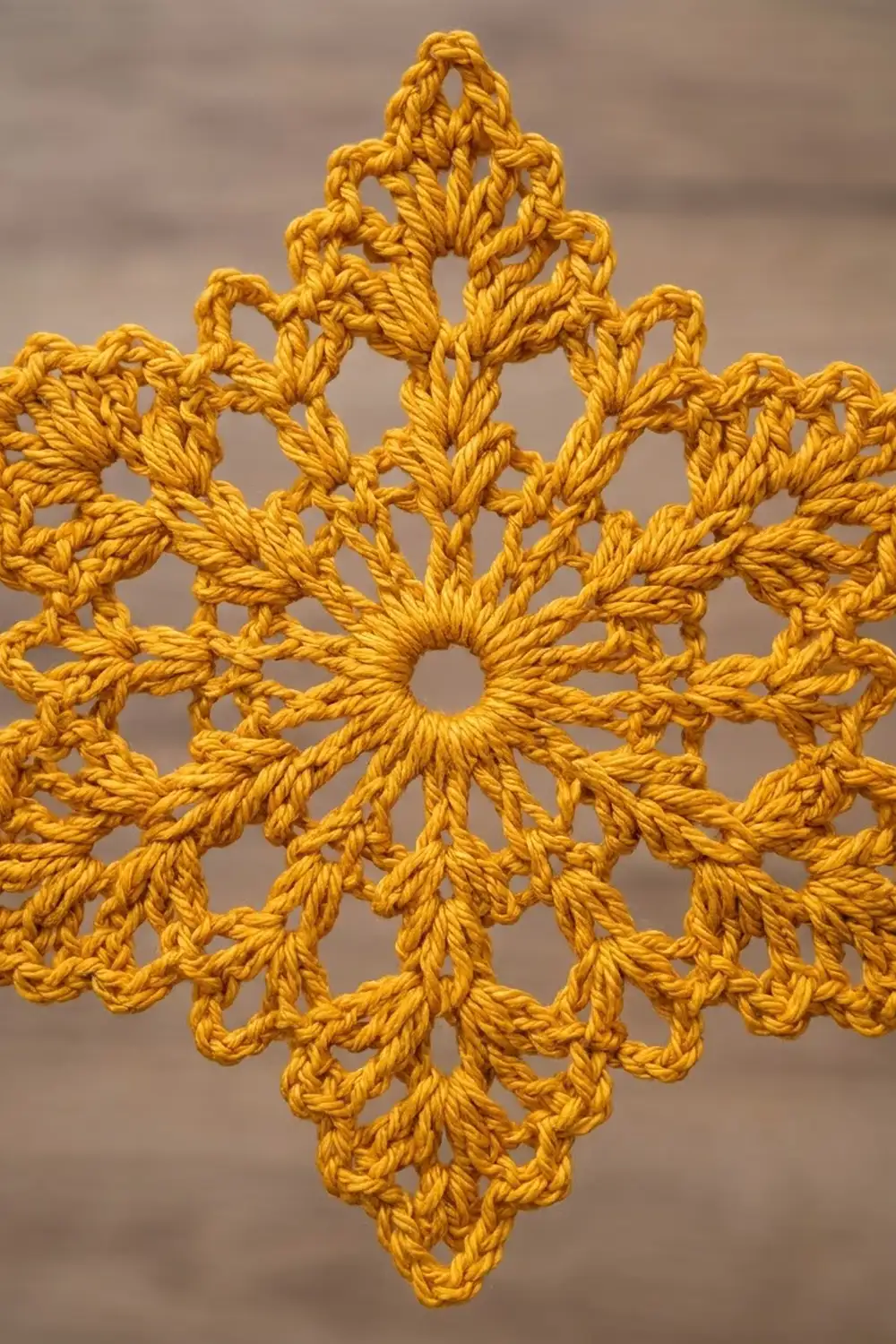
Star Motif
Round 1: Center Ring
Ch 6 and join with a sl st to form a ring.
Ch 3 (counts as dc), work 23 dc in the ring. Join with a sl st to the top of the beginning ch-3. (24 dc)
The ring leaves the small open hole at the center of the star.
Round 2: Spokes
Ch 1, sc in the same st, ch 7, skip next dc, sc in next dc, ch 7, skip next dc; rep from * 10 more times. Join with a sl st to the first sc. (12 sc, 12 ch-7 loops)*
These twelve loops are the spokes that radiate from the center.
Round 3: Point Bases
Sl st in the next 4 ch to reach the center of the first loop. Ch 1, sc in the same loop, ch 3, V-st (dc, ch 2, dc) in the next loop, ch 3, sc in the next loop; rep from * 5 more times, leaving out the final sc. Join with a sl st to the first sc. (6 sc, 6 V-sts, 12 ch-3 sps)*
The loops now alternate. The loops with an sc become the valleys, and the loops with a V-st become the base of each point.
Round 4: First Shells
Sl st in the next 3 ch, sl st in the next dc, sl st in the ch-2 sp. Ch 3, (2 dc, ch 3, 3 dc) in the same sp. Ch 4, skip the ch-3 sp, sc in the next sc, ch 4, shell in the next V-st ch-2 sp; rep from * 4 more times, ch 4, sc in the next sc, ch 4. Join with a sl st to the top of the beginning ch-3. (6 shells = 36 dc, 6 sc, 12 ch-4 sps)*
Round 5: Building the Points
Sl st in the next 2 dc and in the ch-3 sp. Ch 3, (2 dc, ch 3, 3 dc) in the same sp. Ch 5, skip the ch-4 sp, sc in the next sc, ch 5, skip the ch-4 sp, shell in the next shell ch-3 sp; rep from * 4 more times, ch 5, sc in the next sc, ch 5. Join. (6 shells = 36 dc, 6 sc, 12 ch-5 sps)*
Working each shell into the shell below pushes each point outward, and the ch-5 sps deepen the valleys.
Round 6: Leaf Sides
Sl st in the next 2 dc and in the ch-3 sp. Ch 3, (2 dc, ch 3, 3 dc) in the same sp. Ch 2, V-st (dc, ch 1, dc) in the next ch-5 sp, ch 3, sc in the next sc, ch 3, V-st in the next ch-5 sp, ch 2, shell in the next shell ch-3 sp; rep from * 5 more times, leaving out the final shell. Join. (6 shells, 12 V-sts, 60 dc total, 6 sc)*
The V-sts form the leaf-like clusters along both sides of each point.
Round 7: Picot Edge (First Star Only)
Sl st in the next 2 dc and in the ch-3 sp. Ch 3, (2 dc, ch 4, 3 dc) in the same sp. Ch 4, picot in the next V-st ch-1 sp, ch 4, sc in the next sc (valley), ch 4, picot in the next V-st ch-1 sp, ch 4, tip in the next shell ch-3 sp; rep from * 5 more times, leaving out the final tip. Join. Fasten off. (6 tips = 36 dc, 12 picots, 24 ch-4 side sps, 6 valley sc)*
Each side of a point is now made of a ch-4 sp, a picot, and another ch-4 sp. Keep this in mind, because the border counts are built from it.
For every star after the first, work Rounds 1–6 as written and join on Round 7 (see Joining).
Make All Pieces
All stars are worked in mustard gold. Make 188 stars:
- Odd rows (1, 3, 5, 7, 9, 11, 13, 15): 8 rows x 13 stars = 104 stars
- Even rows (2, 4, 6, 8, 10, 12, 14): 7 rows x 12 stars = 84 stars
Turn each star so one tip points straight left and one points straight right. Even rows shift right by half a star, 3.5 in (8.9 cm), so each even-row star sits between two odd-row stars.
Row  1: O-O-O-O-O-O-O-O-O-O-O-O-O
Row  2:  O-O-O-O-O-O-O-O-O-O-O-O
Row  3: O-O-O-O-O-O-O-O-O-O-O-O-O
Row  4:  O-O-O-O-O-O-O-O-O-O-O-O
  ...continue alternating...
Row 14:  O-O-O-O-O-O-O-O-O-O-O-O
Row 15: O-O-O-O-O-O-O-O-O-O-O-O-O
Joining
Join as you go on Round 7. Join every tip that touches a neighbor’s tip, and nothing else.
Joined tip: in the shell ch-3 sp, work 3 dc, ch 2, sl st in the tip ch-4 sp of the neighboring finished star, ch 2, 3 dc.
The ch 2 + sl st + ch 2 replaces the ch 4, so a joined tip is exactly the same size as a free tip and the 7 in (17.8 cm) spacing holds.
Order:
– Row 1: join each star by its left tip to the right tip of the previous star.
– Even rows: join each star by its upper-left and upper-right tips to the two stars above, and by its left tip to the previous star in the row.
– Odd rows after Row 1: the first star joins by its upper-right tip only. Inner stars join by their left, upper-left, and upper-right tips. The last star joins by its left and upper-left tips.
Each tip meets exactly one other tip. The valleys between stars stay open, which creates the lattice holes.
Tension: keep the joining sl st snug but not tight. A tight join puckers the tips, and a loose one lets stars drift apart. Lay the work flat after each row to check.
Size checkpoint: Row 1 should measure 91 in (231.1 cm) from the left tip of the first star to the right tip of the last. Because the offset rows overlap, each new row adds only 6.06 in (15.4 cm) of length. After 2 rows the work measures about 12.12 in (30.8 cm) from top tip to bottom tip. After all 15 rows it measures 91 in (231.1 cm).
Border
Border gauge: 16 sc = 4 in (10.2 cm). Each side of a point is about 2 in (5.1 cm) long, so 8 sc per side fills it without ruffling.
The outer edge is made of three elements. Here is how many sc each one gets:
– Side of a point (ch-4 sp, picot, ch-4 sp): 3 sc + 2 sc + 3 sc = 8 sc
– Free tip (ch-4 sp): 5 sc
– Edge join (sl st of a joined tip): 1 sc
Skip the valley sc and the dc groups.
Edge totals:
– Top: 26 free tips, 12 joins, 76 point sides
– Bottom: same as top
– Left side: 29 free tips, 14 joins, 86 point sides
– Right side: same as left
Each side ends at a corner star, in the valley between that star’s top-edge (or bottom-edge) tips and its side tips.
Border Round 1
Join yarn in any ch-4 sp along the top. Work around the whole outer edge: 3 sc in each ch-4 sp, 2 sc in each picot ch-3 sp, 5 sc in each free tip ch-4 sp, and 1 sc in the sl st of each edge join. Join with a sl st to the first sc.
- Top: (76 x 8) + (26 x 5) + 12 = 608 + 130 + 12 = 750 sc
- Bottom: 750 sc
- Left: (86 x 8) + (29 x 5) + 14 = 688 + 145 + 14 = 847 sc
- Right: 847 sc
- Total: 750 + 750 + 847 + 847 = 3,194 sc
Border Round 2
Ch 1, sc in each sc around, with two exceptions. Work 3 sc in the center (3rd) sc of each 5-sc tip group. At each edge join, work sc3tog over the sc before the join sc, the join sc itself, and the sc after it. Join and fasten off.
Each tip adds 2 sts, and each join removes 2 sts.
- Top: 750 + (26 x 2) − (12 x 2) = 750 + 52 − 24 = 778 sc
- Bottom: 778 sc
- Left: 847 + (29 x 2) − (14 x 2) = 847 + 58 − 28 = 877 sc
- Right: 877 sc
- Total: 778 + 778 + 877 + 877 = 3,310 sc
Why the math works: 3 sc in a ch-4 sp and 2 sc in a ch-3 picot match the length of the chains under them. The extra stitches at each tip let the border turn a sharp point. The sc3tog at each join pulls in the deep notch between two stars so it does not flare. The border adds 0.5 in (1.3 cm) on each edge, taking 91 in (231.1 cm) to 92 in (233.7 cm).
Final Blocking
- Weave in all ends along the chain spaces, following the path of the stitches.
- Lay the bedspread on blocking mats or on a clean carpet covered with a sheet. Block in sections if needed.
- Spray until evenly damp, not dripping.
- Pin each free tip first, checking that opposite tips of each star are 7 in (17.8 cm) apart.
- Pin each row straight, checking that rows are 6.06 in (15.4 cm) apart.
- Pin the border tips so the scalloped edge is even.
- Check the overall size: 92 x 92 in (233.7 x 233.7 cm).
- Let it dry completely before unpinning.
Final Quality-Control Checklist
- All 188 stars are present: 8 rows of 13 and 7 rows of 12.
- Every star has 6 tips, 12 picots, and an open center ring.
- Each pair of touching tips is joined once, and no valleys are joined.
- No joins are twisted or skipped.
- Border Round 1 totals 3,194 sc, and Round 2 totals 3,310 sc.
- Corners and tips lie flat and pointed.
- Finished size is 92 x 92 in (233.7 x 233.7 cm).
- All ends are woven in securely.
Troubleshooting
Star cups instead of lying flat: your ch-5 and ch-4 loops are too short. Loosen your chains or go up a hook size.
Star ruffles: your chains are too long. Tighten them or go down a hook size.
Points look blunt: in Rounds 4–7, work each shell or tip into the shell ch-3 sp, not around it.
Rows will not line up: check that even rows have 12 stars and odd rows have 13, and that each star has one tip pointing left and one pointing right.
Border ruffles along the sides: you may be working 4 sc in the ch-4 sps. Use 3.
Notches between stars flare: check that each sc3tog is centered on the join sc.
Care
Hand wash in cool water with mild detergent, press the water out in a towel, and dry flat. Reshape the star tips while damp.

Final Notes
The measurement chain is simple:
– One blocked star is 7 in (17.8 cm).
– 13 stars across make 91 in (231.1 cm).
– 15 offset rows at 6.06 in (15.4 cm) each make 91 in (231.1 cm).
– A 0.5 in (1.3 cm) border brings the finished size to 92 x 92 in (233.7 x 233.7 cm).
Check the first star carefully and the rest will follow.
Happy crocheting!