

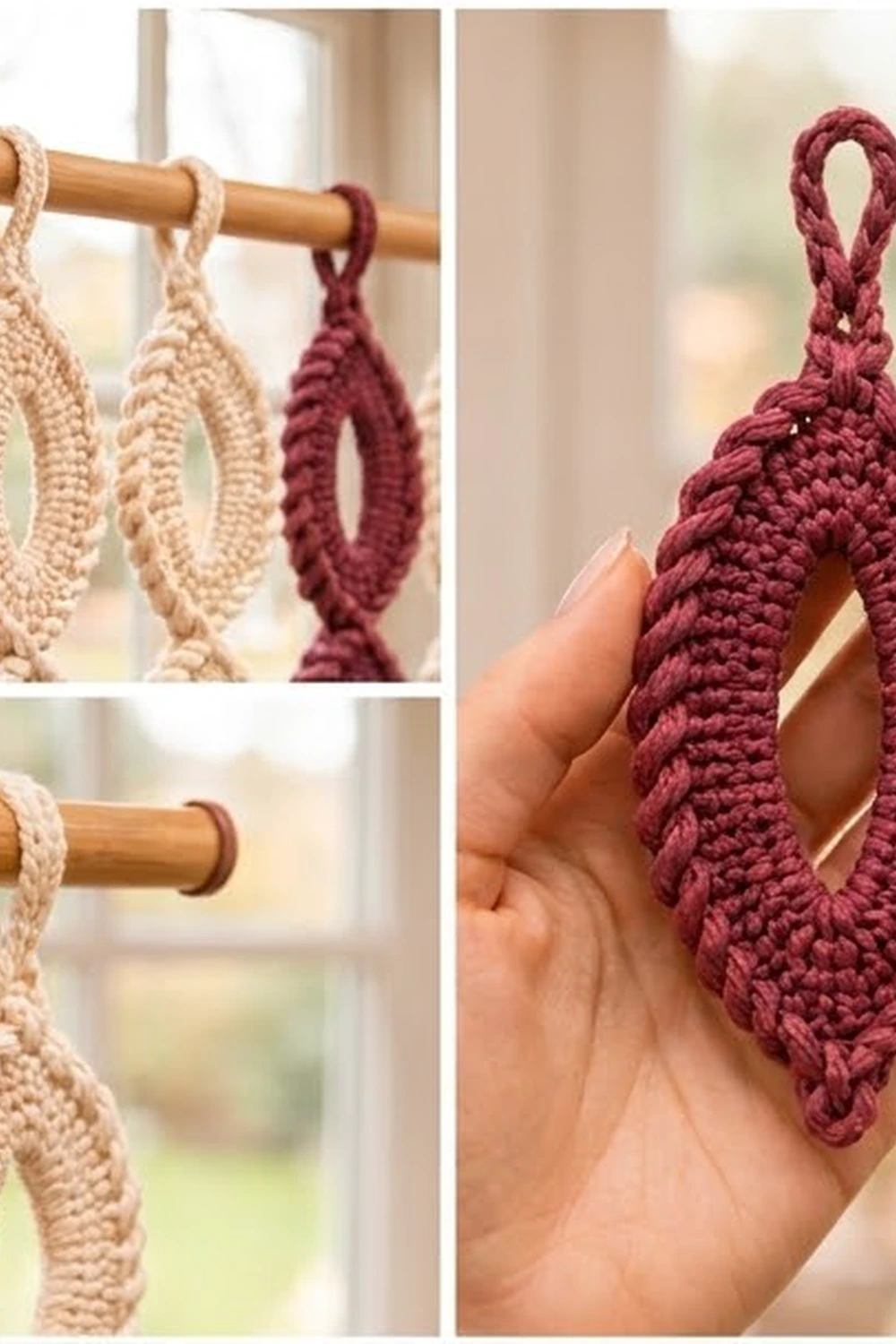
The Hearthside Almond Link Curtain is a strand curtain made from pointed oval motifs, like stacked almonds. Each motif has an open center and a firm single crochet body. One continuous rope-style edge runs down each strand and links the motifs together, so the strand reads as one twisted cord.
The curtain has eight strands, alternating deep burgundy and warm cream. Each strand has a hanging loop at the top and a full matching tassel at the bottom. It looks cozy and a little bohemian, and it works well in a window, a doorway, or as a holiday backdrop.
This pattern uses US crochet terms. The finished curtain measures about 35 in (88.9 cm) wide and 52.25 in (132.7 cm) long from the top of the hanging loops to the tassel tips.
Here is the construction. You crochet each almond motif in joined rounds, working outward from a chain ring. You sew eight motifs point to point into a strand, then work a reverse single crochet “rope” border around the whole strand. Last, you add a hanging loop and a tassel.
Finished Size and Construction
- Finished curtain: 35 in (88.9 cm) wide x 52.25 in (132.7 cm) long
- Skill level: Easy intermediate
- Terminology: US crochet terms
- Yarn weight: Worsted (#4) cotton
- Hook: 5 mm (H-8)
- Number of pieces: 64 motifs (32 burgundy, 32 cream) and 8 tassels
- Layout: 8 strands of 8 motifs each, alternating burgundy and cream
- Motif size before border: 5.5 in (14.0 cm) long x 3 in (7.6 cm) wide
- Motif width after border: 3.5 in (8.9 cm)
- Strand length before border: 44 in (111.8 cm)
- Strand length after border: 44.5 in (113.0 cm)
- Border depth: 0.25 in (0.6 cm)
- Hanging loop drop: 1.75 in (4.4 cm)
- Tassel length: 6 in (15.2 cm)
Materials
Use a smooth, tightly plied worsted cotton or cotton blend. Cotton holds the pointed shape, shows the rope edge clearly, and hangs straight without stretching. Avoid fuzzy or very soft acrylic because the strands may sag.
- Burgundy: 300 g (about 510 m)
- Cream: 300 g (about 510 m)
Each color makes 4 strands: 32 motifs, 4 borders, 4 loops, and 4 tassels. The quantities include a margin of about 15 percent for your gauge test and tassel trimming.
Tools:
- 5 mm (H-8) crochet hook
- Tapestry needle
- 4 locking stitch markers
- Scissors
- Stiff card 6.5 in (16.5 cm) tall for the tassels
- Wooden dowel, 40 in (101.6 cm) long and no more than 1 in (2.5 cm) thick
- Blocking mats, rust-proof pins, and a spray bottle
Abbreviations (US Terms)
- ch – chain
- sc – single crochet
- 2 sc – 2 single crochet in the same stitch (increase)
- sl st – slip stitch
- st(s) – stitch(es)
- rnd – round
- rev sc – reverse single crochet (crab stitch)
- RS – right side
Special stitch – rev sc: Work from left to right (right to left if you are left-handed). Insert the hook into the next stitch to the right, yarn over, pull up a loop, yarn over, and draw through both loops. Each rev sc twists over the one before it. That is what forms the rope edge.
Point stitch: The single center stitch at each tip of the almond. Keep a marker in each point stitch and move it up every round.
Gauge and Checkpoints
Gauge: 16 sc and 18 rnds = 4 in (10.2 cm) in sc.
Make one complete motif before you begin the full set. Pin it flat and measure it without stretching.
- After Rnd 1: opening about 3.25 in (8.3 cm) long x 0.75 in (1.9 cm) wide when laid flat
- After Rnd 3: about 4.5 in (11.4 cm) x 2 in (5.1 cm)
- After Rnd 5: 5.5 in (14.0 cm) x 3 in (7.6 cm)
If your motif is too big, go down half a hook size. If it is too small, go up half a hook size. A difference of 0.25 in (0.6 cm) per motif adds up to 2 in (5.1 cm) over a strand, so check this carefully.
If the tips curl up, your point increases are too tight. Work them looser. If the sides ruffle, your side increases are too loose. Tighten your tension a little.
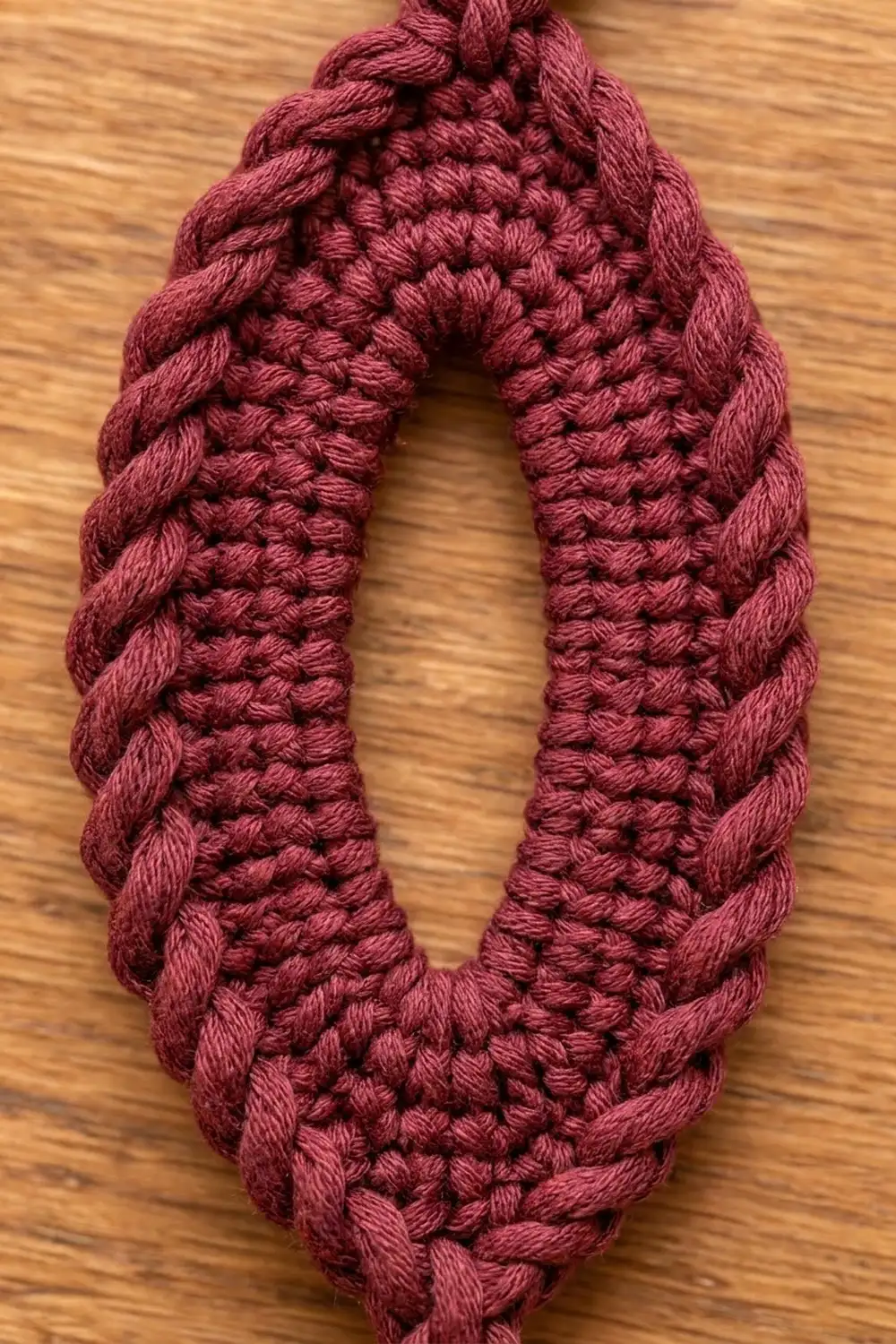
Almond Motif
Make 32 in burgundy and 32 in cream.
Counting rule: Each motif has 2 point stitches. A “side” is all the stitches between the two point stitches. Point stitches do not belong to either side. So every round total equals 2 point stitches plus two equal sides.
Foundation: Ch 30. Sl st into the first ch to form a ring. Make sure the chain is not twisted.
Rnd 1: Ch 1. Sc in each ch around. Join with a sl st to the first sc. (30 sc)
Place a marker in sc 1 and sc 16. These are the point stitches. Each side has 14 sts.
Rnd 2 (growth): Ch 1. Work 3 sc in the point st. Sc in the next 4 sts, 2 sc in the next st, sc in the next 4 sts, 2 sc in the next st, sc in the next 4 sts. Work 3 sc in the next point st. Repeat from * to * once. Join to the first sc. Sl st into the next st, which is the center sc of the first 3-sc group. (38 sc: 2 point sts + 18 per side)
Move the markers to the center sc of each 3-sc group.
Rnd 3 (growth): Ch 1. Work 3 sc in the point st. Sc in the next 5 sts, 2 sc in the next st, sc in the next 6 sts, 2 sc in the next st, sc in the next 5 sts. Work 3 sc in the next point st. Repeat from * to * once. Join, then sl st into the next st. (46 sc: 2 point sts + 22 per side)
Rnd 4 (growth): Ch 1. Work 3 sc in the point st. Sc in the next 7 sts, 2 sc in the next st, sc in the next 6 sts, 2 sc in the next st, sc in the next 7 sts. Work 3 sc in the next point st. Repeat from * to * once. Join, then sl st into the next st. (54 sc: 2 point sts + 26 per side)
Rnd 5 (growth): Ch 1. Work 3 sc in the point st. Sc in the next 8 sts, 2 sc in the next st, sc in the next 8 sts, 2 sc in the next st, sc in the next 8 sts. Work 3 sc in the next point st. Repeat from * to * once. Join to the first sc. (62 sc: 2 point sts + 30 per side)
Fasten off and leave a 10 in (25.4 cm) tail on every motif. You will use it for joining.
Why it makes an almond: Every round, each point gets a 3-sc group that adds 2 sts, so the tips stay sharp. Each side gets 2 increases near its middle, so the sides bow out gently. Each round adds 8 sts: 4 at the points and 4 on the sides.
Make All Pieces
- Burgundy: 32 motifs and 4 tassels
- Cream: 32 motifs and 4 tassels
- Total: 64 motifs and 8 tassels
Block the motifs in batches before joining (see Final Blocking). Matching shapes make the strands hang straight.
Layout grid (columns are strands from left to right; rows are motifs from top to bottom; B = burgundy, C = cream):
        S1 S2 S3 S4 S5 S6 S7 S8
Row 1:  B  C  B  C  B  C  B  C
Row 2:  B  C  B  C  B  C  B  C
Row 3:  B  C  B  C  B  C  B  C
Row 4:  B  C  B  C  B  C  B  C
Row 5:  B  C  B  C  B  C  B  C
Row 6:  B  C  B  C  B  C  B  C
Row 7:  B  C  B  C  B  C  B  C
Row 8:  B  C  B  C  B  C  B  C
        +  +  +  +  +  +  +  +   tassel
Joining
Method: Sew the motifs point to point. Each strand uses only one color.
Lay 8 motifs in a vertical line with the RS facing up. The tips should touch, and the long axes should be lined up.
Stitch-to-stitch logic: Thread the tail from the upper motif. Sew its bottom point st to the top point st of the motif below. Pass through both point sts three times, going through both loops each time. Then weave the tail into the upper motif. Only the 2 point sts are joined. All 30 side sts on each side of each motif stay free for the border.
Tension: Pull snug so the tips meet with no gap, but do not pull so hard that the points pucker. The join should look like a small pinch.
Size checkpoint: Lay the joined strand flat. It should measure 44 in (111.8 cm) from tip to tip: 8 motifs x 5.5 in (14.0 cm). If it is more than 0.5 in (1.3 cm) off, check which motif is out of size and re-block it.
Border: Rope Edge
You work the border in one round around the whole strand, in the strand’s color.
Border gauge: Work 1 rev sc into each stitch. This edge adds 0.25 in (0.6 cm) on every free edge.
Starting counts for one strand:
- Each long side: 8 motifs x 30 side sts = 240 sts
- Each free end point (top of motif 1, bottom of motif 8): 1 st
- The 7 joined point pairs get no stitches. They sit inside the seam.
Rnd 1 (trim round): With the RS facing, join yarn in the top point st of motif 1. Ch 1. Work 3 rev sc in the point st. Work 1 rev sc in each of the 30 side sts of motif 1.
At the seam, skip the joined point sts. Insert the hook into the first side st of the next motif and pull the edge snug across the pinch. Continue with 1 rev sc in each side st of motifs 2 through 8 (240 sts down this side). Work 3 rev sc in the bottom point st of motif 8. Work up the other side the same way (240 sts). Join with a sl st to the first rev sc.
Count: (240 + 240 + 1 + 1 = 482 stitches worked 1 per existing stitch) + (2 extra at each free point = 4) = 486 rev sc.
Hanging loop: Ch 14. Sl st into the top point st again to close the loop. This gives a drop of 1.75 in (4.4 cm), which fits a dowel up to 1 in (2.5 cm) thick. Fasten off and weave in the end.
Why the math works: Working 1 rev sc per stitch keeps the edge exactly the same length as the motif sides, so the strand lies flat. Skipping the joined points removes the 2 sts that the seam already uses, so nothing piles up at the joins. The 2 extra sts at each free tip let the edge turn sharply. That adds 0.25 in (0.6 cm) at each end: 44 in + 0.5 in = 44.5 in (113.0 cm).
Tassel (make 8): Wrap yarn 40 times around the 6.5 in (16.5 cm) card. Slide a 12 in (30.5 cm) strand under the wraps at the top and tie tightly. Cut the loops at the bottom. Wrap a second strand around the bundle 0.75 in (1.9 cm) below the top, 8 times, and tie it off. Trim the ends to 6 in (15.2 cm). Use the top ties to sew the tassel to the bottom point of the strand.
Final Blocking
- Wet or steam each finished strand evenly.
- Lay it flat on the mats with the RS facing up.
- Pin each motif to 3.5 in (8.9 cm) wide, with the opening centered.
- Pin the full strand to 44.5 in (113.0 cm) from tip to tip.
- Shape the points so they are sharp and lined up with the center.
- Let the strand dry completely before you unpin it.
- Steam the tassels and smooth them straight with your fingers. Trim any uneven ends.
- Slide the loops onto the dowel in color order, and space them 4.5 in (11.4 cm) apart, center to center. That leaves gaps of about 1 in (2.5 cm) and a total width of 35 in (88.9 cm).
Final Quality-Control Checklist
- Every motif has 62 sc after Rnd 5.
- Every motif is 5.5 in (14.0 cm) x 3 in (7.6 cm) before the border.
- Each strand’s border has 486 rev sc.
- All 7 joins on each strand are snug, with no gaps.
- The strands hang straight and do not twist sideways.
- Each strand is 44.5 in (113.0 cm) before the loop and tassel.
- All tassels are 6 in (15.2 cm) and tied at the same height.
- All tails are woven in on the wrong side.
Troubleshooting
Points are rounded. Make sure you are working 3 sc into the actual center point st. Move your markers up every round.
Motif cups like a bowl. You have too few stitches, or your tension is too tight. Recount the round, or go up half a hook size.
Sides ripple. Your increases are stacking too loosely. Tighten your tension, or shift the side increases by one stitch.
Rope edge flares. Your rev sc are too loose. Work them tighter, or use a hook half a size smaller for the border only.
Strand twists when hung. Block it again, pinning it straight. Make sure every motif faces RS out.
Strands are uneven in length. Re-block the longest strand to match, or redo one motif that is out of gauge.
Care
Hand wash in cool water with mild soap. Press out the water in a towel, then dry flat and re-pin the points. Do not hang strands while they are wet, because the cotton will stretch.
Final Notes
The measurement chain is simple. A 30-chain ring grows to a 62-stitch almond that is 5.5 in (14.0 cm) long and 3 in (7.6 cm) wide. Eight almonds joined at their points make a 44 in (111.8 cm) strand. The 486-stitch rope border brings it to 44.5 in (113.0 cm), and each motif to 3.5 in (8.9 cm) wide. With the 1.75 in (4.4 cm) loop and the 6 in (15.2 cm) tassel, each strand is 52.25 in (132.7 cm) long. Eight strands spaced on the dowel make a curtain 35 in (88.9 cm) wide.
If your motifs match at each checkpoint, everything after that will fit.
Happy crocheting!