

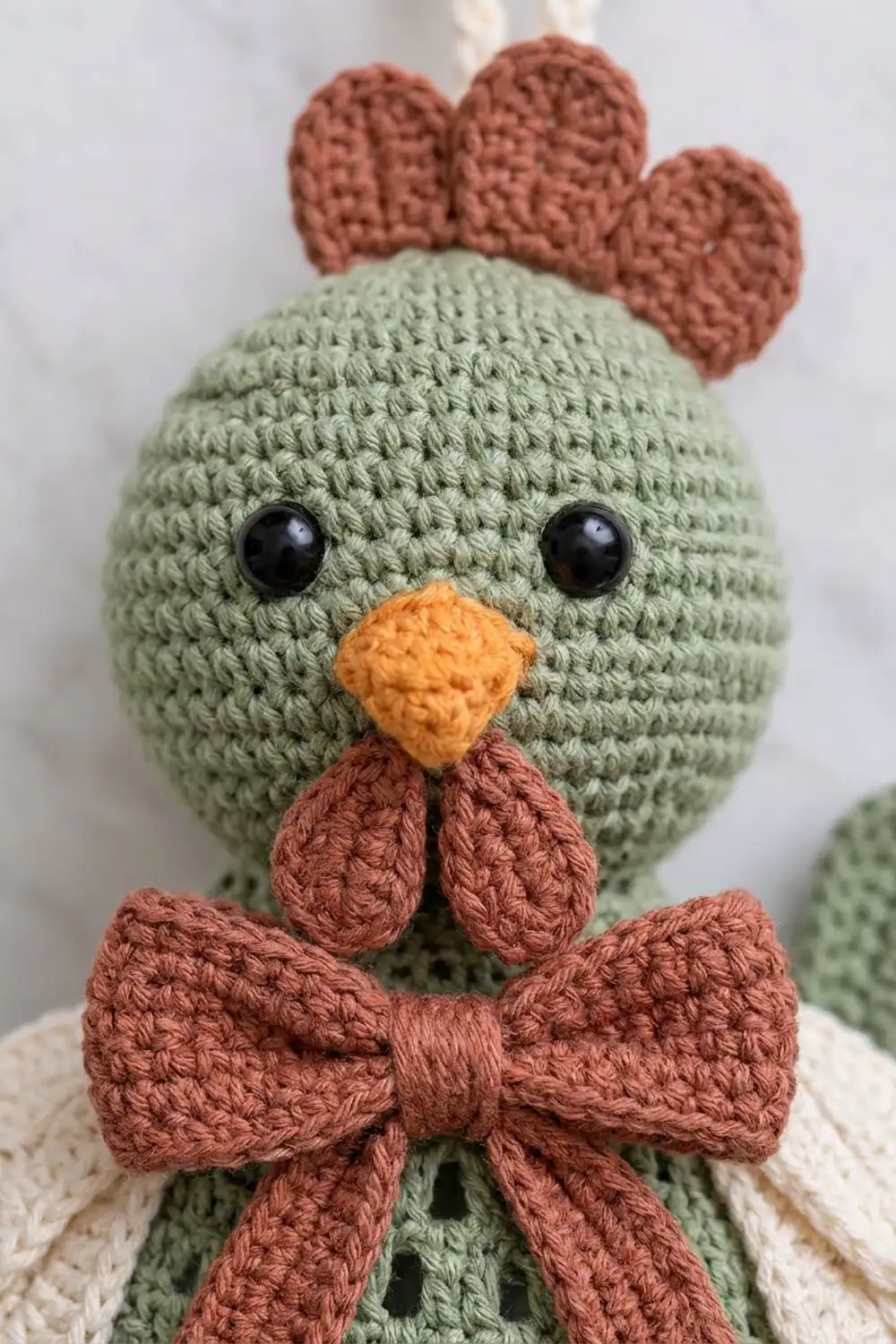
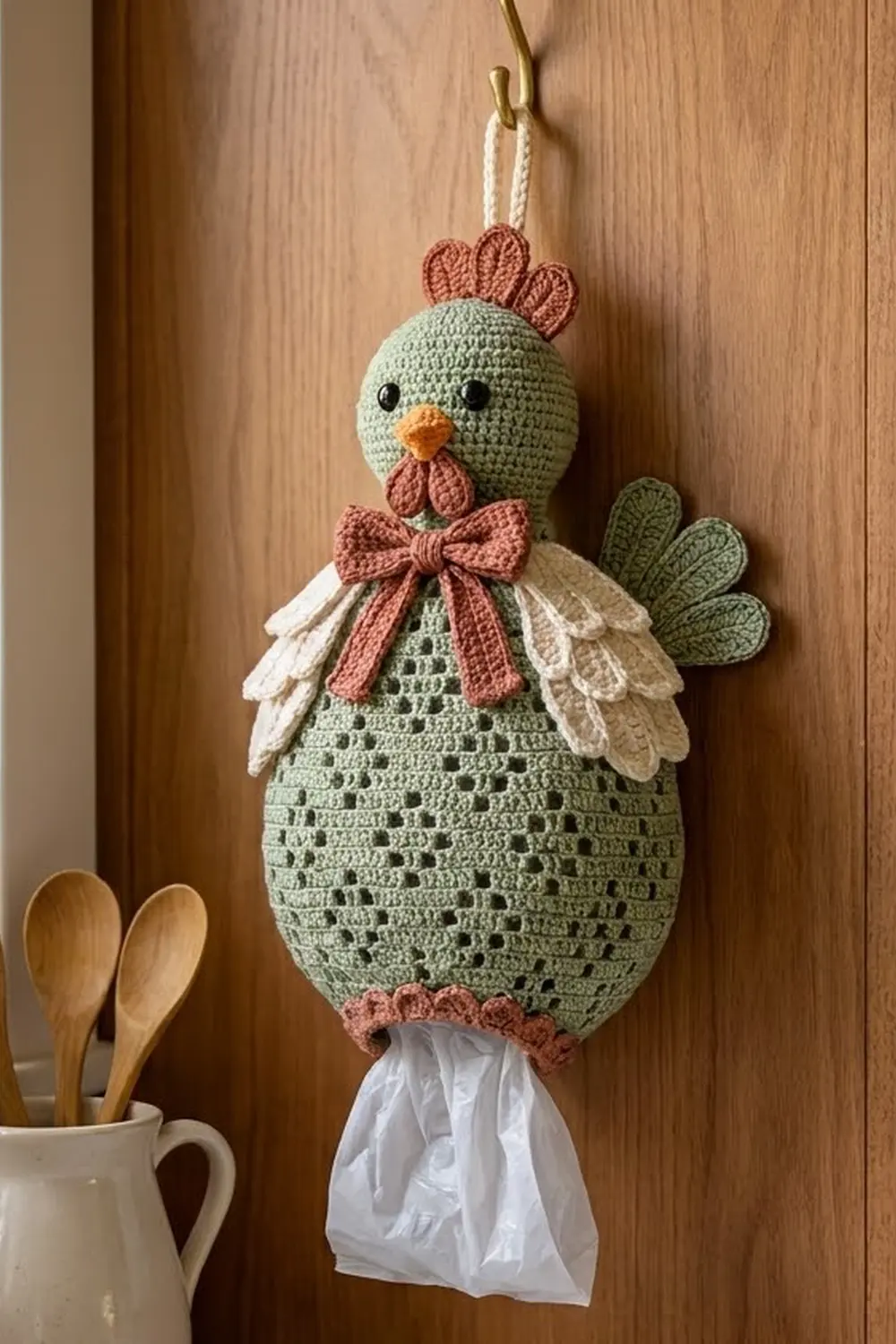
Henrietta is a hanging chicken that holds your plastic grocery bags. You stuff bags in at the neck and pull them out one at a time from the scalloped opening at the bottom. Her body is open filet mesh with staggered diamonds, so you can see how many bags are left and the bags get some air.
The main color is a soft sage green. Terracotta is used for the comb, wattles, bow and bottom edging, cream for the layered wings and the hanging loop, and a small amount of orange for the beak. For a second colorway, make the body and head in dusty blue and keep the other colors the same.
The pattern uses US crochet terms. Finished, the holder is about 18 in (45.7 cm) tall without the loop and 12 in (30.5 cm) wide across the wings and tail. The body is 9 in (22.9 cm) wide at its widest point.
You work the body in joined rounds from the bottom opening up to the neck. The head is a separate sc cap, and the small parts are worked flat. Everything is sewn on at the end. The head is sewn only along the back half of the neck, so the front lifts like a lid for loading bags.
Finished Size and Construction
- Finished size: 18 in (45.7 cm) tall × 12 in (30.5 cm) wide, without the loop
- Skill level: Intermediate
- Terminology: US
- Yarn weight: Worsted (#4) cotton
- Hook: 4.0 mm (G-6)
- Number of pieces: 11 (body, head, comb, beak, 2 wattles, 2 wings, bow, tail, loop)
- Layout: Head on top of the body; wings at the sides; tail at the back right; bow at the front of the neck
- Body size: 9 in (22.9 cm) wide × 11.75 in (29.8 cm) tall before the border
- Border depth: 1 in (2.5 cm) of terracotta edging at the bottom opening
Materials
Use a smooth worsted-weight cotton or cotton blend. Cotton keeps the filet mesh crisp and doesn’t stretch much under the weight of the bags. The amounts below assume about 170 m per 100 g.
- Sage green (body, head, tail): 130 g / 221 m
- Cream (wings, loop): 30 g / 51 m
- Terracotta (comb, wattles, bow, edging): 35 g / 60 m
- Orange (beak): 5 g / 9 m
- Alternate colorway: 130 g / 221 m dusty blue in place of the sage green
All quantities include a margin of about 15%.
Tools:
– 4.0 mm (G-6) crochet hook
– Two 9 mm black safety eyes
– Tapestry needle
– Stitch markers
– Scissors
– Pins
– Optional: a 3.5 in (8.9 cm) circle of plastic canvas to keep the crown round
Abbreviations (US Terms)
- ch – chain
- sl st – slip stitch
- sc – single crochet
- hdc – half double crochet
- dc – double crochet
- tr – treble crochet
- sc2tog – single crochet 2 together
- dc2tog – double crochet 2 together
- BLO – back loop only
- MR – magic ring
- sp – space
- st(s) – stitch(es)
Special stitches
- Open mesh: dc in the next dc, ch 1, skip the next st or ch-sp. This makes 2 sts.
- Block: dc in the next dc, dc in the next st or ch-sp. This makes 2 sts.
- Inc mesh: dc in the next dc, ch 1, dc in the next ch-1 sp, ch 1. This turns 1 mesh into 2.
- Dec mesh: dc2tog with the first leg in the next dc, skip the ch-sp, and the second leg in the following dc; then ch 1. This turns 2 meshes into 1.
- Round starts: If the first mesh is open, ch 4; this counts as dc + ch 1. If it is a block, ch 3; this counts as a dc. Join each round with a sl st in the 3rd ch of the starting chain.
Gauge and Checkpoints
- Filet / dc gauge: 16 sts (8 meshes) and 8 rounds = 4 in (10.2 cm). One mesh is 0.5 in (1.3 cm) square.
- Sc gauge: 16 sts and 16 rows = 4 in (10.2 cm).
Make the head first as your test piece. Flattened, it should measure 5.25 in (13.3 cm) across. If it does, your sc gauge is right.
Then check the body at each stage:
- After Rnd 1: 5 in (12.7 cm) wide, flattened
- After Rnd 4: 9 in (22.9 cm) wide, flattened
- After Rnd 16: 8 in (20.3 cm) from the foundation
- After Rnd 22: 11 in (27.9 cm) tall; neck 4.5 in (11.4 cm) wide, flattened
- After Rnd 25: 11.75 in (29.8 cm) tall
If your piece is too big, go down 0.5 mm in hook size. If it is too small, go up 0.5 mm. Filet stretches lengthwise, so measure the piece hanging, not stretched.
Body
Use sage green.
Foundation: Ch 40 and join with a sl st to the first ch, without twisting. (40 ch)
Rnd 1: Ch 3 (counts as dc), dc in each ch around, join. (40 dc)
Rnd 2: Ch 4, skip the next dc. Dc in the next dc, ch 1, skip 1; repeat from * around and join. (20 meshes / 40 sts)
Rnd 3 (growth): Ch 4 (first open mesh). Inc mesh. Open mesh, inc mesh; repeat from * 8 more times and join. (30 meshes / 60 sts)
Rnd 4 (growth): Open mesh 4 times, inc mesh; repeat from * 6 times in total and join. Work the first open mesh of the round as ch 4. (36 meshes / 72 sts)
Rnds 5–16 (diamond bands): Work even at 36 meshes. The diamond repeat is 6 meshes wide, and you work it 6 times around. O = open mesh, B = block.
Band A (Rnds 5–10):
– Rnd 5: O O B O O O
– Rnd 6: O B O B O O
– Rnd 7: B O O O B O
– Rnd 8: O B O B O O
– Rnd 9: O O B O O O
– Rnd 10: O O O O O O
Band B (Rnds 11–16): Work the same six rounds, but start each repeat 3 meshes later. Rnd 11 is O O O O O B; Rnd 13 is O B O B O O; and so on. This staggers the diamonds.
Every one of these rounds has 36 meshes / 72 sts.
Rnd 17 (shaping): Open mesh 4 times, dec mesh; repeat from * 6 times in total and join. (30 meshes / 60 sts)
Rnd 18: Open mesh around. (30 meshes / 60 sts)
Rnd 19: Open mesh 3 times, dec mesh; repeat from * 6 times in total and join. (24 meshes / 48 sts)
Rnd 20: Open mesh around. (24 meshes / 48 sts)
Rnd 21: Open mesh twice, dec mesh; repeat from * 6 times in total and join. (18 meshes / 36 sts)
Rnd 22: Open mesh around. (18 meshes / 36 sts)
Rnd 23 (conversion): Ch 1. Sc in each dc (18) + sc in each ch-1 sp (18), join. (18 + 18 = 36 sc)
Rnds 24–25: Ch 1, sc in each st around, join. (36 sc) Fasten off.
Head
Use sage green and work in continuous spiral rounds.
- Rnd 1: 6 sc in a MR. (6)
- Rnd 2: 2 sc in each st. (12)
- Rnd 3: Sc 1, 2 sc in next; repeat around. (18)
- Rnd 4: Sc 2, 2 sc in next; repeat around. (24)
- Rnd 5: Sc 3, 2 sc in next; repeat around. (30)
- Rnd 6: Sc 4, 2 sc in next; repeat around. (36)
- Rnd 7: Sc 5, 2 sc in next; repeat around. (42) The crown should now be 3.5 in (8.9 cm) across.
- Rnds 8–17: Sc around. (42)
- Rnd 18: Sc 5, sc2tog; repeat around. (36)
Sl st in the next st and fasten off. Place the safety eyes between Rnds 11 and 12, with 6 sts between them. The finished head is 5.25 in (13.3 cm) wide and 4.5 in (11.4 cm) tall.
Comb
Use terracotta.
- Ch 8.
- Row 1: Sc in the 2nd ch from the hook and in each ch across. (7 sc)
- Row 2: Sl st in the first sc. Work 6 dc in the next sc, then sl st in the next sc. Work (2 dc, 3 tr, 2 dc) in the next sc, then sl st in the next sc. Work 6 dc in the next sc, then sl st in the last sc. (3 shells)
Fasten off. The comb measures 2.25 in (5.7 cm) wide and 1.25 in (3.2 cm) tall.
Beak
Use orange.
- Ch 4.
- Row 1: Sc in the 2nd ch from the hook and in the next 2 ch. (3)
- Row 2: Ch 1, turn, sc2tog, sc. (2)
- Row 3: Ch 1, turn, sc2tog. (1)
Fasten off. You now have a small triangle.
Wattles (make 2)
Use terracotta.
- Ch 6.
- Sc in the 2nd ch from the hook, hdc in the next ch, dc in the next 2 ch, and 5 dc in the last ch.
- Working along the other side of the chain: dc in the next 2 ch, hdc in the next ch, sc in the next ch.
- Sl st to the first sc. (13 sts)
Each teardrop is 1.25 in (3.2 cm) long.
Wings (make 2)
Use cream. Each wing is made from three feather strips, which you stack later.
Feather (worked off the base row):
– Ch 6.
– Sc in the 2nd ch from the hook, hdc in the next ch, dc in the next 2 ch, and 5 dc in the last ch.
– Working along the other side of the chain: dc in the next 2 ch, hdc in the next ch, sc in the next ch.
Strip A:
– Ch 12.
– Row 1: Sc in the 2nd ch from the hook and in each ch across. (11 sc)
– Row 2: Sl st in the first sc. Work 1 feather, skip 1 sc, sl st in the next sc; repeat from * 5 times in total. (5 feathers)
Strip B: Ch 10 and work Row 1 the same way. (9 sc) Repeat Row 2 four times. (4 feathers)
Strip C: Ch 8 and work Row 1 the same way. (7 sc) Repeat Row 2 three times. (3 feathers)
Because the feathers are wider than their 2-st bases, they overlap slightly. That gives the packed, rounded feather look.
Stack: Lay Strip B on top of Strip A so B’s feathers cover A’s base row. Then lay Strip C on top of B the same way. Sew the base rows down. All the feathers point down. The finished wing measures 2.75 in (7.0 cm) wide × 3 in (7.6 cm) tall.
Tail
Use sage green.
Long feather:
– Ch 11.
– Sc in the 2nd ch from the hook, hdc in the next ch, dc in the next 3 ch, tr in the next 4 ch, and 7 tr in the last ch.
– Working along the other side of the chain: tr in the next 4 ch, dc in the next 3 ch, hdc in the next ch, sc in the next ch.
Tail:
– Ch 10.
– Row 1: Sc in the 2nd ch from the hook and in each ch across. (9 sc)
– Row 2: Sl st in the first sc. Work 1 long feather, skip 1 sc, sl st in the next sc; repeat from * 4 times in total. (4 feathers)
Each feather is 2.75 in (7.0 cm) long. Curve the base row when you sew it on so the feathers fan out.
Bow
Use terracotta. The bow is made from three strips.
- Loop strip: Ch 25. Row 1: Sc in the 2nd ch from the hook and in each ch across. (24) Rows 2–5: Ch 1, turn, sc across. (24) The strip measures 6 in (15.2 cm) × 1.25 in (3.2 cm). Join the short ends, then flatten the strip with the seam at the center back.
- Tails strip: Ch 21. Work Row 1 the same way. (20) Rows 2–3: Ch 1, turn, sc across. (20) Fold the strip into an upside-down V.
- Center strip: Ch 6. Work Row 1 the same way. (5) Rows 2–6: Ch 1, turn, sc across. (5) Wrap it around the loop and the tails, then sew it closed at the back.
The finished bow is 3 in (7.6 cm) wide.
Hanging Loop
Hold 2 strands of cream together. Ch 41, then sl st in the back bump of each ch. (40 sl st) The cord is 10 in (25.4 cm) long.
Make All Pieces
| Color | Pieces |
|---|---|
| Sage green | 1 body, 1 head, 1 tail |
| Cream | 2 wings, 1 loop |
| Terracotta | 1 comb, 2 wattles, 1 bow, bottom edging |
| Orange | 1 beak |
Layout (front view):
          [ LOOP ]
          [ COMB ]
      [    HEAD    ]
      [ eye   eye  ]
      [ BEAK+WATTLES ]
[WING][    BOW    ][WING][TAIL]
      [    BODY    ]
      [ scallop edge ]
Joining (Assembly)
Sew everything with a whip stitch using matching yarn, working stitch to stitch.
Head to body: Place the head’s last round (36 sts) on top of the neck’s last round (36 sts). Sew the back 18 head sts to the back 18 neck sts, 1 to 1. Leave the front 18 sts unsewn so the head lifts like a lid for loading bags.
Face: Sew the beak between the eyes, 2 rounds lower than the eyes. Sew the wattles just under the beak. Sew the comb’s base row to the crown along Rnds 3–5.
Loop: Pass both ends of the loop through the crown behind the comb. Knot them inside and secure them with several stitches. The visible loop is about 4.5 in (11.4 cm) tall.
Bow: Sew it to the front of the body over Rnds 21–22, just below the rim, so the lid still opens.
Wings and tail: Sew each wing’s base row to one side of the body over Rnds 15–20. Sew the tail to the back right over Rnds 14–18, with the feathers fanned outward.
Keep the sewing tension even. Pulling too tight puckers the filet mesh.
Size checkpoint: The assembled holder should measure 12 in (30.5 cm) across the wings and tail.
Border
The border is the terracotta edging around the bottom opening. Border gauge is the same as the sc gauge: 16 sts = 4 in (10.2 cm).
Join terracotta to a free loop of the foundation chain.
- Rnd 1: Ch 1, sc in each free loop around, join. (40 sc: 20 front + 20 back)
- Rnd 2: Ch 1, sc BLO in each st, join. (40 sc: 20 front + 20 back)
- Rnd 3: Sl st in the first st. Skip 1, 5 dc in the next st, skip 1, sl st in the next st; repeat from * 10 times in total. The last sl st goes into the first sl st. (10 scallops: 5 front + 5 back)
Why the math works: Each scallop uses exactly 4 sts. 40 sts ÷ 4 = 10 scallops, with no leftover sts. The opening stays 10 in (25.4 cm) around, which is 5 in (12.7 cm) flat. The border adds 1 in (2.5 cm) of depth, bringing the body to 12.75 in (32.4 cm).
Final Blocking
- Lightly mist the body with water.
- Stuff it with plastic bags or a rolled towel to fill out the pear shape.
- Check that it is 9 in (22.9 cm) wide and 12.75 in (32.4 cm) tall.
- Pin the wing and tail feathers flat, and pin the scallops open.
- Leave everything to dry completely.
- Optional: tuck the plastic canvas circle inside the crown to keep the head round.
Final Quality-Control Checklist
- Body rounds have 36 meshes in the belly and 18 meshes at the neck.
- The diamonds are staggered evenly between the two bands.
- The bottom edging has 10 even scallops.
- The head is sewn across the back half only, and the front lifts freely.
- The eyes are level.
- The beak and wattles are centered.
- The wings sit at the same height on both sides.
- The loop is anchored securely.
- All ends are woven in.
Troubleshooting
- Diamonds look slanted: You probably skipped the ch-1 when joining a round. Recount the meshes in each round.
- Body is too short: Your dc rounds are too tight. Go up a hook size.
- Body is too wide at the belly: Check Rnd 4. It should have 36 meshes, not more.
- Scallops ruffle: Use 4 dc per scallop instead of 5.
- Head flops forward: Add 2 more sewn sts on each side of the back seam.
- Wings curl: Steam-block them flat.
Care
Spot clean, or hand wash in cool water. Reshape the piece and lay it flat to dry.
Final Notes
Here is the full measurement chain:
- A 40-st opening of 5 in (12.7 cm) grows to a 72-st belly that is 9 in (22.9 cm) wide.
- The body then narrows to a 36-st neck that is 4.5 in (11.4 cm) wide.
- The body reaches 11.75 in (29.8 cm), and the edging brings it to 12.75 in (32.4 cm).
- The 4.5 in (11.4 cm) head and the comb bring the finished holder to 18 in (45.7 cm).
If each checkpoint matches, Henrietta will come out the right size.
Happy crocheting!