

The Honeycomb Bloom curtain is a tall lace panel with tabs along the top, made from flower hexagons. Each hexagon has a raised six-petal flower in the middle, a ring of open tall-stitch spokes around it, and a solid frame. Joined together, the motifs form a honeycomb with a soft texture that lets light through.
It’s worked in one color, a warm natural ecru, so the stitch texture stands out. It suits farmhouse kitchens, cottage windows, and any room where you want privacy without blocking daylight.
This pattern uses US crochet terms. One finished panel is 35.75 in (90.8 cm) wide and 81.875 in (208.0 cm) long, not counting the tab loops. The instructions are for one panel; make two for the pair shown.
The panel is built from separate pieces: full hexagons worked in rounds, half hexagons worked in rows for the top and bottom edges, and small triangular wedges for the sides. Everything is joined with slip-stitch seams. Then you work a three-round border with a shell edge along the bottom and add seven tabs along the top.
Finished Size and Construction
- Finished panel: 35.75 in x 81.875 in (90.8 cm x 208.0 cm), plus 3 in (7.6 cm) tab loops
- Skill level: Intermediate
- Terminology: US
- Yarn weight: DK (#3) cotton or cotton blend
- Hook: 4.0 mm (G-6); 4.5 mm (7) for seaming
- Pieces per panel: 52 full hexagons, 6 half hexagons, 22 side wedges
- Layout: 5 vertical columns. The 3 offset columns (1, 3, 5) each have a half hexagon at each end and 10 full hexagons between them. The 2 straight columns (2, 4) each have 11 full hexagons.
- Full hexagon: 4.25 in (10.8 cm) per side, 7.25 in (18.4 cm) flat to flat, 8.5 in (21.6 cm) point to point
- Size before border: 34 in x 79.75 in (86.4 cm x 202.6 cm)
- Border depth: 0.875 in (2.2 cm) on the top and sides, 1.25 in (3.2 cm) on the bottom
Materials
Choose a smooth, matte DK cotton or cotton-linen blend. Mercerized cotton shows the petals clearly. Avoid fuzzy yarns, which blur the open spokes.
- Natural ecru: 1,000 g / 2,300 m per panel (2,000 g / 4,600 m for a pair), based on a yarn with about 115 m per 50 g
Tools:
– 4.0 mm (G-6) and 4.5 mm (7) hooks
– Tapestry needle
– Locking stitch markers
– Rust-proof pins and blocking mats
– Measuring tape
These quantities include a margin of about 10% for swatching and seaming.
Abbreviations (US Terms)
- ch – chain
- sl st – slip stitch
- sc – single crochet
- hdc – half double crochet
- dc – double crochet
- tr – treble crochet
- dtr – double treble crochet (yarn over 3 times, then work off the loops in pairs)
- sk – skip
- sp – space
- st(s) – stitch(es)
- RS / WS – right side / wrong side
Petal (special stitch): Work (sc, hdc, 2 dc, 3 tr, ch 3, 3 tr, 2 dc, hdc, sc) into one ch-8 loop. That’s 14 sts plus a ch-3 tip, and it makes a pointed petal with a slight center ridge.
Gauge and Checkpoints
Gauge: 20 sc and 22 rows = 4 in (10.2 cm). In Round 5 of the hexagon, 19 dc = 4 in (10.2 cm).
Make one full hexagon before anything else. It’s your real gauge swatch.
- After Round 3: the flower measures 4.5 in (11.4 cm) from petal tip to opposite petal tip.
- After Round 5: 7 in (17.8 cm) flat to flat.
- After Round 6, lightly blocked: 7.25 in (18.4 cm) flat to flat, 4.25 in (10.8 cm) per side.
If the hexagon is too big, go down 0.5 mm. If it’s too small, go up 0.5 mm. Being off by just 0.25 in (0.6 cm) per motif adds up to 2.75 in (7.0 cm) over the 11 motifs in a column.
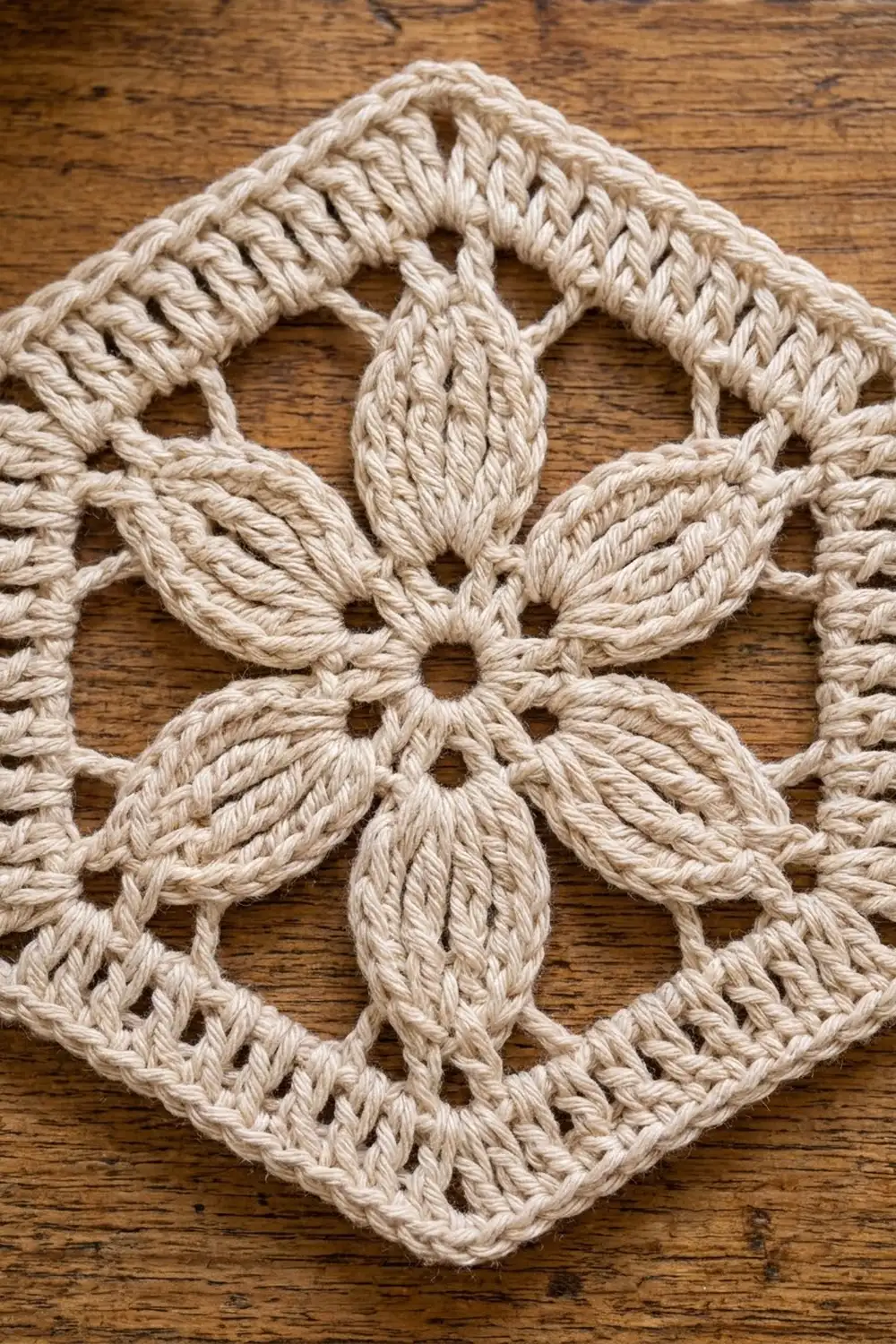
Full Hexagon (make 52)
Use the 4.0 mm hook.
Round 1: Ch 4 and sl st into the first ch to form a ring. Ch 1, work 12 sc into the ring, and join with a sl st to the first sc. (12 sc)
Round 2: Ch 1, sc in the first sc, ch 8, sk 1 sc. Sc in the next sc, ch 8, sk 1 sc. Repeat from * 4 more times, then join to the first sc. (6 sc, 6 ch-8 loops)
Round 3: Work 1 Petal in the next ch-8 loop, then sl st in the next sc. Repeat from * 5 more times. (6 petals, 6 sl st) Each sl st sits on a Round 2 sc between two petals.
Round 4: Sl st in the first 7 sts of the first petal, then sl st into its ch-3 tip. Ch 1, sc in the tip, ch 6. Work (dtr, ch 2, dtr) in the next sl st between petals, ch 6, sc in the next petal tip, ch 6. Repeat from * 4 more times. Work (dtr, ch 2, dtr) in the last sl st, ch 6, and join to the first sc. (6 sc, 12 dtr, 12 ch-6 sps, 6 ch-2 corners)
The petal tips sit at the middle of each side, and the dtr pairs form the corners. This round makes the open ring of spokes.
Round 5: Ch 3 (counts as dc), 6 dc in the next ch-6 sp, dc in the next dtr, then (2 dc, ch 2, 2 dc) in the corner sp. Dc in the next dtr, 6 dc in the ch-6 sp, dc in the sc, 6 dc in the ch-6 sp, dc in the dtr, then (2 dc, ch 2, 2 dc) in the corner sp. Repeat from * 4 more times. Dc in the last dtr, 6 dc in the last ch-6 sp, and join to the top of the ch-3.
Each side has 2 + 1 + 6 + 1 + 6 + 1 + 2 = 19 dc between corner sps. (114 dc, 6 ch-2 sps)
Round 6: Ch 1. Sc in each dc to the corner, then (sc, ch 2, sc) in the corner sp. Repeat around and join. (126 sc, 6 ch-2 sps)
Each side now has 21 sc (19 + 2). That count already includes one corner sc at each end of the side. Fasten off.
Half Hexagon (make 6)
The half hexagon is a full hexagon cut from point to point. It has three petals, three outer sides, and one straight edge. Work it in rows and turn at the end of each row.
Row 1: Ch 4 and sl st to form a ring. Ch 1, work 7 sc into the ring, turn. (7 sc)
Row 2: Ch 1, sc in the first sc. Ch 8, sk 1, sc in the next sc. Repeat from * 2 more times, turn. (4 sc, 3 ch-8 loops)
Row 3: Ch 1, sc in the first sc. Work 1 Petal in the next loop, sc in the next sc. Repeat from * 2 more times, turn. (3 petals, 4 sc)
Row 4: Ch 5 (counts as dtr), ch 6, sc in the first petal tip, ch 6. Work (dtr, ch 2, dtr) in the next sc, ch 6, sc in the next tip, ch 6. Repeat from * once more. Dtr in the last sc, turn. (2 end dtr, 2 corners, 3 tip sc, 6 ch-6 sps)
Row 5: Ch 3 (counts as dc), 2 dc in the first dtr, 6 dc in the ch-6 sp, dc in the sc, 6 dc in the ch-6 sp, dc in the dtr, then (2 dc, ch 2, 2 dc) in the corner. Dc in the dtr, 6 dc, dc in the sc, 6 dc, dc in the dtr, then (2 dc, ch 2, 2 dc) in the corner. Dc in the dtr, 6 dc, dc in the sc, 6 dc, and 3 dc in the top of the ch-5. Turn.
The three sides count:
– 3 + 6 + 1 + 6 + 1 + 2 = 19
– 2 + 1 + 6 + 1 + 6 + 1 + 2 = 19
– 2 + 1 + 6 + 1 + 6 + 3 = 19
(57 dc)
Row 6: Ch 1, 2 sc in the first dc. Sc in each dc across, working (sc, ch 2, sc) in each corner sp, and finish with 2 sc in the last st. The three sides count:
– 2 + 18 + 1 = 21
– 1 + 19 + 1 = 21
– 1 + 18 + 2 = 21
(63 sc) Do not turn.
Row 7: Rotate the piece and work 42 sc evenly along the straight edge, through the row ends and the ring. Fasten off.
Checkpoint: The straight edge measures 8.5 in (21.6 cm), and each outer side measures 4.25 in (10.8 cm).
Side Wedge (make 22)
Each wedge is a triangle with a 120-degree point that fills the notch between two outer motifs, so the side edges come out straight.
Row 1: Make a magic ring. Ch 3 (counts as dc), work 6 dc into the ring, pull it closed, and turn. (7 dc)
Row 2: Ch 3, dc in the same st, then 2 dc in each st across, turn. (14 dc)
Row 3: Ch 3, dc in the same st, dc in the next st. 2 dc in the next st, dc in the next st. Repeat across, turn. (21 dc)
Row 4: Ch 3, dc in the same st, dc in the next 2 sts. 2 dc in the next st, dc in the next 2 sts. Repeat across, turn. (28 dc)
Row 5: Ch 3, dc in the same st, dc in the next 3 sts. 2 dc in the next st, dc in the next 3 sts. Repeat across. (35 dc) Do not turn.
Row 6: Ch 1. Work 21 sc evenly down the first leg to the ring (about 4 sc per row end, plus 1 at the ring). Ch 1, then work 21 sc evenly up the second leg. Fasten off.
Checkpoint: Each leg measures 4.25 in (10.8 cm). The long edge (the top of Row 5) measures about 7.25 in (18.4 cm).
Make All Pieces
For one panel, make 52 full hexagons, 6 half hexagons, and 22 side wedges, all in natural ecru. Lay them out RS up, with each hexagon flat-top (a straight side at the top and bottom). Columns sit 6.375 in (16.2 cm) apart, center to center.
H = half hexagon, F = full hexagon, W = wedge:
     Col1  Col2  Col3  Col4  Col5
W    H     F     H     F     H    W
W    F     F     F     F     F    W
...  (10 F in Cols 1/3/5, 11 F in Cols 2/4)
W    H     F     H     F     H    W
Columns 1, 3, and 5 run H, 10 F, H, with each half hexagon’s straight edge facing out. Columns 2 and 4 each hold 11 F. Place 11 wedges down each side. Point each wedge’s tip into a notch, with its long edge on the outside.
Joining
Use the 4.5 mm hook. Hold two pieces WS together and sl st through the outer loops of both, one stitch to one stitch.
- Within each column: Join the flat sides, 21 sts to 21 sts, and include the ch-2 corner sps at each end.
- Columns to each other: Join along the zigzag edges. Each seam is one side to one side, 21 sts to 21. Where three motifs meet, sl st through all of their ch-2 corners.
- Wedges: Join each wedge leg to the outer side of a motif, 21 sts to 21.
Keep your tension loose so each seam stays 4.25 in (10.8 cm), the same as the motif sides. If a seam pulls, take it out and redo it more loosely. Lay the panel flat every few seams to catch puckering early.
Size checkpoint: The joined panel measures 34 in x 79.75 in (86.4 cm x 202.6 cm), and all four edges are straight.
Border
Border gauge: Along the top and bottom, 20 sc = 4 in (10.2 cm). Along the sides, follow the wedges: 35 sts per 7.25 in (18.4 cm).
Round 1: With the 4.0 mm hook, join at the top right corner. Sc in each edge st all the way around, with ch 2 at each corner. The corner chains are not counted as sts.
– Top and bottom: 3 half-hexagon edges x 42 + 2 hexagon sides x 21 = 168 sc each
– Each side: 11 wedges x 35 = 385 sc
– Total: 1,106 sc and 4 ch-2 corners
Round 2: Ch 3 (counts as dc). Dc in each sc, with (2 dc, ch 2, 2 dc) in each corner sp. Join.
– Top and bottom: 2 + 168 + 2 = 172 dc each
– Each side: 2 + 385 + 2 = 389 dc
Round 3: Ch 1. Along the top and sides, sc in each dc, and work (sc, ch 2, sc) in both top corners. This gives the top 1 + 172 + 1 = 174 sc, and each side 389 sc.
At the first bottom corner, work 1 sc in the corner sp. Sk 1, 5 dc in the next st, sk 1, sc in the next st. Repeat from * 43 times in all. The last sc lands in the final dc before the next corner. Work 1 sc in that corner sp, then continue up the side. Join and fasten off.
Why the math works: Each shell repeat uses 4 sts. The bottom has 172 sts, and 4 x 43 = 172, so you get 43 even shells with nothing left over. Along the top, the 174 sts divide into 7 tabs x 12 sts + 6 gaps x 15 sts.
Tabs (make 7): With the RS facing, start at the top right corner. Mark 12 tab sts, then skip 15 sts. Repeat until you finish with 12 tab sts at the top left corner.
For each tab, join in its first st. Ch 1, sc in each of the 12 sts, turn. (12 sc) Repeat this row until you have 33 rows; the tab should measure 6 in (15.2 cm). Fold the tab to the WS and sew its last row to the base of Round 1. You now have a loop 3 in (7.6 cm) deep and 2.4 in (6.1 cm) wide.
Final Blocking
- Weave in the ends along the seams, not across the open spokes.
- Soak the panel in cool water for 15 minutes. Roll it in a towel and press out the water without wringing.
- Lay it flat and pin the corners to 35.75 in x 81.875 in (90.8 cm x 208.0 cm).
- Pin the sides straight, then spread each bottom shell into an even fan.
- Lift the petals with your fingers and open the spoke spaces.
- Let it dry completely, 24 to 48 hours.
- Block the second panel to the same measurements.
Final Quality-Control Checklist
- Every hexagon has 126 sc in Round 6 and 21 sts per side.
- Every seam is 21 sts to 21 sts, with no corners skipped.
- Before the border, each column measures 79.75 in (202.6 cm).
- Border Round 1 has 168 sc on the top and bottom and 385 sc on each side.
- The bottom has 43 even shells.
- The 7 tabs are evenly spaced, 15 sts apart.
- The two panels match within 0.5 in (1.3 cm).
Troubleshooting
- Hexagon cups: The Round 5 dc are too tight. Go up a hook size or loosen your dc.
- Hexagon ruffles: The Round 4 chains are too loose. Tighten them or go down a hook size.
- Petals flop: Work the tr groups more firmly and lift the petals during blocking.
- Side edge waves: A wedge’s long edge is too long. Rework its Row 5 with a smaller hook.
- Seams pucker: Redo them more loosely with the 4.5 mm hook.
- Shell count is off: Recount bottom Round 2. It must be exactly 172 dc.
Care
Hand wash cool, or machine wash on gentle in a mesh bag. Reshape and dry flat, and never hang the panel while it’s wet, because the weight will stretch the columns.

Final Notes
Here’s how the measurements build on each other. A 4.25 in (10.8 cm) hexagon side gives a 7.25 in (18.4 cm) motif. Eleven motif heights make a 79.75 in (202.6 cm) column. Five columns plus the side wedges make a panel 34 in (86.4 cm) wide. The border brings it to 35.75 in x 81.875 in (90.8 cm x 208.0 cm). If your first hexagon is accurate, the rest of the panel will follow.
Happy crocheting!