
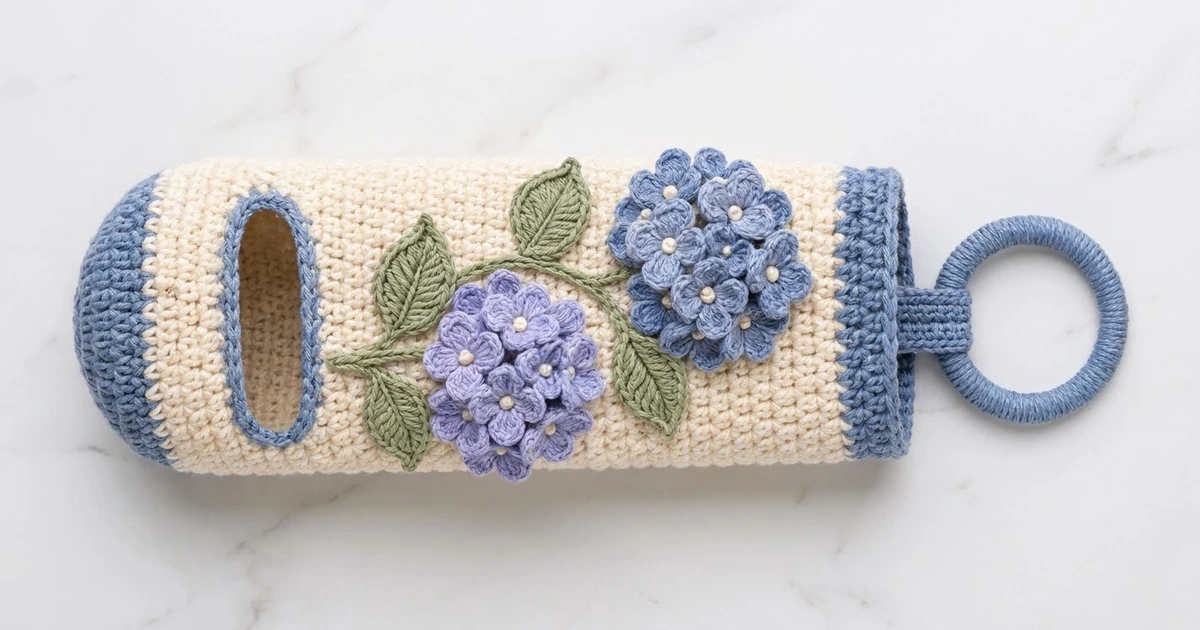
This hanging bag holder turns a kitchen chore into something pretty. It is a tall, sturdy tube of cream single crochet. It has a rounded denim-blue base, a rolled blue rim and an oval slot near the bottom so you can pull bags out one at a time. A covered ring at the top hangs neatly from a cabinet hook.
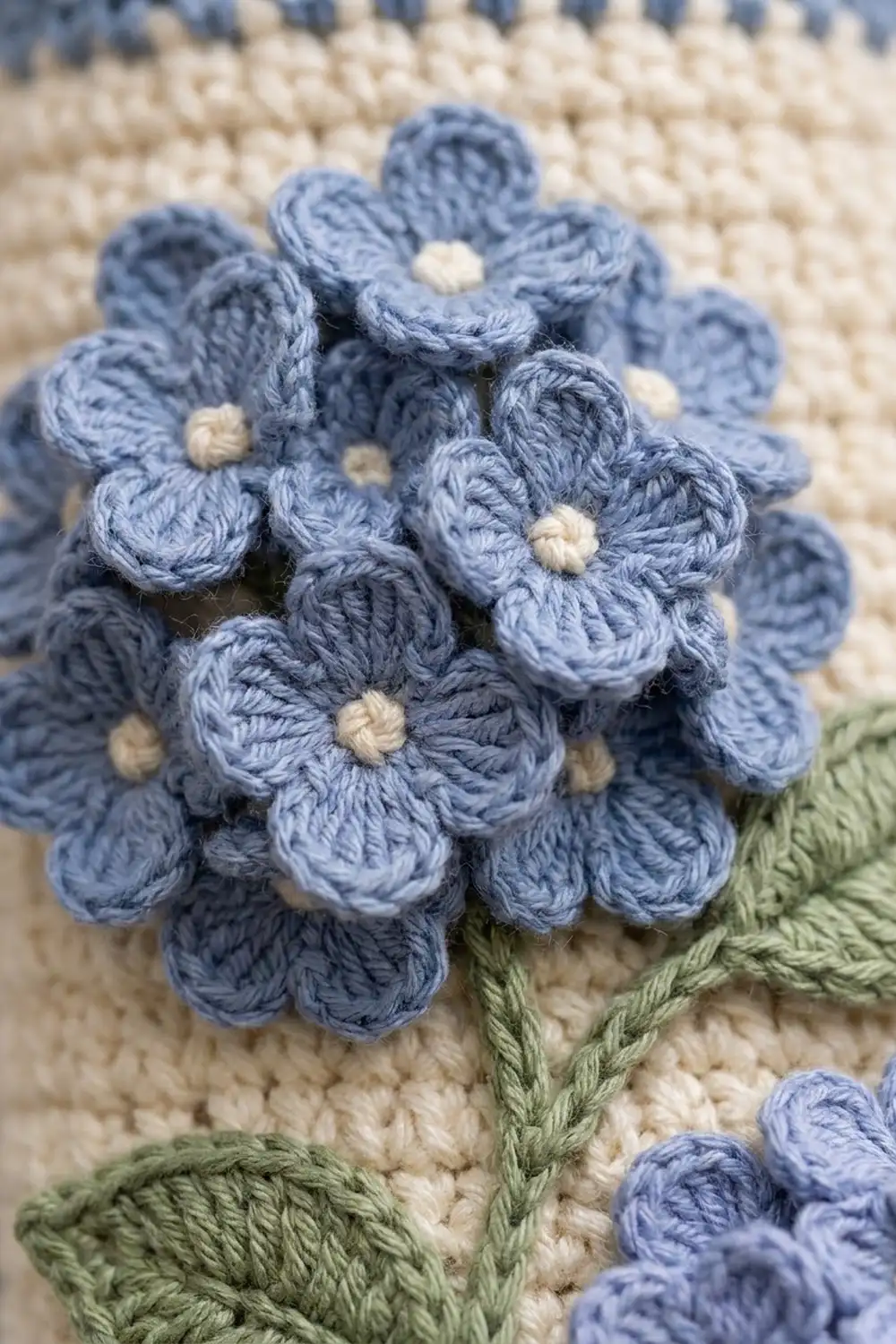
The front has two hydrangea clusters, one denim blue and one soft lavender. Small five-petal florets with cream centers are stacked into raised domes, and sage-green stems and leaves link them. The palette is calm and cottage-style: cream, denim blue, lavender and sage.
This pattern uses US crochet terms throughout. The finished holder measures 16 in (40.6 cm) tall and 5.25 in (13.3 cm) wide when laid flat, with a circumference of 10.5 in (26.7 cm). With the ring and tab, it hangs about 19 in (48.3 cm) long.
Construction is simple. You work the base in the round from a magic ring and continue straight up into a seamless tube. You make the slot by working a few turned rows and then chaining across the gap. The top rim acts as the border. Then you make the ring, tab and appliqués separately and sew them on.
Finished Size and Construction
- Finished size: 16 in (40.6 cm) tall × 5.25 in (13.3 cm) wide flat; 10.5 in (26.7 cm) around
- Hanging length with ring: about 19 in (48.3 cm)
- Skill level: Intermediate (easy body, fiddly appliqués)
- Terminology: US
- Yarn weight: #4 worsted, cotton or cotton blend
- Hook: 4.0 mm (G-6)
- Number of pieces: 1 holder body, plus 1 covered ring, 1 tab and appliqués sewn on
- Layout: single tube, slot centered on the front, appliqués above the slot
- Body size before border: about 15 in (38.1 cm) tall flat
- Border depth (top rim): about 1 in (2.5 cm)
Materials
Use a smooth worsted cotton. It holds its shape, shows texture clearly and survives a busy kitchen. Acrylic also works but gives a softer, slouchier tube.
- Cream (main body): 60 g / 108 m
- Denim blue (base, rim, slot edging, tab, ring, blue florets, backing): 40 g / 72 m
- Lavender (lavender florets, backing): 10 g / 18 m
- Sage green (stems, leaves): 10 g / 18 m
Quantities include a margin of about 20 percent for gauge swatches and sewing tails.
Tools:
– 4.0 mm (G-6) crochet hook
– 1 plastic or metal ring, 2.5 in (6.4 cm) outer diameter
– Stitch marker
– Tapestry needle
– Scissors
– Pins
– Tape measure
Abbreviations (US Terms)
- ch – chain
- sl st – slip stitch
- sc – single crochet
- hdc – half double crochet
- dc – double crochet
- inc – 2 sc in the same stitch
- MR – magic ring
- st(s) – stitch(es)
- RS / WS – right side / wrong side
Special technique – French knot: Bring the needle up, wrap the yarn twice around the needle, then insert the needle back down right next to where it came up. Hold the wraps snug while you pull the needle through.
Gauge and Checkpoints
Gauge: 16 sc × 18 rounds = 4 in (10.2 cm) in sc worked in joined rounds.
Before committing, make the base (Rounds 1–12) as your test piece. It is small, and it shows whether your tension will give the right circumference.
- After Round 8: a shallow cup with 42 sts, about 3.5 in (8.9 cm) across the bottom.
- After Round 20: the tube is 10.5 in (26.7 cm) around and 5.25 in (13.3 cm) wide flat.
- After Round 28: the slot is 3.5 in (8.9 cm) wide and 1.6 in (4.1 cm) tall before edging.
- After Round 68: the body is about 15 in (38.1 cm) tall flat.
- After the border: the body is 16 in (40.6 cm) tall.
Too big? Go down to a 3.75 mm hook. Too small? Go up to a 4.5 mm hook. Do not change the stitch counts: the slot, border and appliqué placement all depend on 42 sts.
Body
Work in joined rounds. Do not turn unless the pattern says so. The ch 1 at the start of a round does not count as a stitch.
Base (Denim Blue)
Round 1: MR, ch 1, 6 sc in ring, sl st to first sc. (6)
Round 2: Ch 1, inc in each st around, join. (12)
Round 3: Ch 1, (sc 1, inc) 6 times, join. (18)
Round 4: Ch 1, (sc 2, inc) 6 times, join. (24)
Round 5: Ch 1, (sc 3, inc) 6 times, join. (30)
Round 6: Ch 1, (sc 4, inc) 6 times, join. (36)
Round 7: Ch 1, sc in each st, join. (36)
Round 8: Ch 1, (sc 5, inc) 6 times, join. (42)
The even Round 7 between increase rounds makes the base cup upward instead of lying flat. This creates the rounded bottom.
Rounds 9–12: Ch 1, sc in each st, join. (42)
Change to cream on the final yo of the Round 12 join. Fasten off the blue.
Lower Body (Cream)
Rounds 13–20: Ch 1, sc in each st, join. (42)
Dispensing Slot
At this stage you work turned rows over 28 sts. The remaining 14 sts are left unworked to form the bottom edge of the slot.
Row 21 (RS): Ch 1, sc in the first 28 sts, turn. Leave the last 14 sts unworked. (28)
Rows 22–27: Ch 1, sc in each st, turn. (28)
Row 27 is a RS row and ends at the 28th stitch. Do not turn.
Round 28 (closing round): Ch 14, then sl st into the first sc of Row 27 to close the circle. Ch 1, sc in the same st and the next 27 sc, then sc in each of the 14 ch, join. This is a conversion round: 28 sc worked 1 per existing stitch + 14 sc worked into the new chains = 42.
The slot is 14 sts wide, or 3.5 in (8.9 cm), and 7 rows tall, or 1.6 in (4.1 cm). Turned rows look slightly different from rounds, but the edging hides this.
Upper Body (Cream)
Rounds 29–68: Ch 1, sc in each st, join. (42)
Flatten the tube so the slot is centered on the front. The round join should now sit toward the back. Check that the body measures about 15 in (38.1 cm) tall. Add or remove cream rounds only here if you want a different height.
Slot Edging (Denim Blue)
With the RS facing, join blue at the bottom-right corner of the slot.
Round 1: Ch 1. Work 14 sc along the bottom edge (into the unworked Round 20 sts). Work 7 sc up the side, 1 in each row end. Work 14 sc across the top edge (into the free loops of the Round 28 chain). Work 7 sc down the other side. Also work 1 extra sc at each of the 4 corners to round them. Join. This is a trim round: 42 sc worked 1 per existing stitch or row end + 4 corner sc = 46.
Round 2: Sl st loosely in each st, join. (46)
Fasten off. The finished opening is about 3 in (7.6 cm) wide and 1.1 in (2.8 cm) tall, with soft oval ends.
Border (Top Rim)
The blue rim finishes the top and stops the tube from stretching. Border gauge is the same as the body: 16 sc = 4 in (10.2 cm). Count the rim as 2 sides of the flattened tube, front and back, with 21 sts each.
Join blue in the last cream st of Round 68.
Round 69: Ch 1, sc in each st, join. (42: 21 front + 21 back)
Rounds 70–72: Ch 1, sc in each st, join. (42: 21 front + 21 back)
Round 73: Sl st in each st, join. (42: 21 front + 21 back)
Fasten off and weave in the end.
Why the math works: The body has 42 sts, which is 2 × 21. The rim keeps 42 sts with no increases or decreases, so it stays the same width as the body. The rim matches the body at exactly 5.25 in (13.3 cm) flat, without flaring or pulling in. Four sc rounds add about 0.9 in (2.3 cm), and the firm slip-stitch round makes the rolled top edge. That brings the total to about 1 in (2.5 cm), and the body reaches 16 in (40.6 cm).
Hanging Ring and Tab
Covered Ring (Denim Blue)
Hold the 2.5 in (6.4 cm) ring and make a slip knot on the hook. Work sc directly over the ring, packing the stitches tightly, until the ring is fully covered: about 60 sc. Sl st to the first sc and fasten off, leaving a short tail to weave in.
Tab (Denim Blue)
Ch 7.
Row 1: Sc in 2nd ch from hook and in each ch across, turn. (6)
Rows 2–16: Ch 1, sc in each st, turn. (6)
The tab measures 1.5 in (3.8 cm) wide × 3.6 in (9.1 cm) long. Fasten off with a long tail.
Attaching: Loop the tab through the covered ring and fold it in half. Center both ends on the inside back wall of the holder, 0.5 in (1.3 cm) below the top edge. Whipstitch all around both layers so the weight is spread out.
Hydrangea Appliqués
Florets (make 11 denim blue and 11 lavender)
Round 1: MR, ch 1, 5 sc in ring, join. (5)
Round 2: In each sc work (ch 2, dc, ch 2, sl st), so the petals sit side by side. (5 petals)
Fasten off with a 6 in (15.2 cm) tail and pull the MR tight. Each floret is about 0.75 in (1.9 cm) across. With cream, work 1 French knot in the center of each floret.
Cluster Backings (make 1 denim blue, 1 lavender)
Round 1: MR, ch 1, 6 sc, join. (6)
Round 2: Inc in each st around, join. (12)
Round 3: (Sc 1, inc) 6 times, join. (18)
Round 4: (Sc 2, inc) 6 times, join. (24)
Each backing is about 1.9 in (4.8 cm) across. Fasten off with a long tail.
Stacking each cluster: Sew 8 florets around the outer edge of a matching-color backing, letting the petals overhang slightly. Sew 3 more florets in the center, raised over the first layer, to form a dome. The finished cluster is about 3 in (7.6 cm) across.
Leaves (make 4, sage green)
Ch 9.
Round 1: Sc in 2nd ch from hook. Work hdc, dc, dc, dc, hdc and sc in the next 6 ch. Work 3 sc in the last ch (the tip). Rotate and work along the opposite side of the chain: sc, hdc, dc, dc, dc, hdc, sc. Sl st to the first sc. (17: 7 + 3 + 7)
Each leaf is a pointed oval about 2 in (5.1 cm) long. The base chain forms a center vein. If you like, backstitch along it with a split strand of green to make the vein stronger.
Stems (sage green)
Chain gauge is about 4 ch = 1 in (2.5 cm).
- Stem A: Ch 16, sl st in back bump of 2nd ch from hook and each ch across. (15 sl st) About 3.75 in (9.5 cm).
- Stem B: Ch 20, sl st in back bump of 2nd ch from hook and each ch across. (19 sl st) About 4.75 in (12.1 cm).
Placing the Appliqués
Slide a rolled towel inside the tube so you do not sew through both layers.
- Pin the lavender cluster on the right half of the front, with its lower edge 2 in (5.1 cm) above the top of the slot edging.
- Pin the blue cluster on the upper left, with its top 1.5 in (3.8 cm) below the rim.
- Run Stem A from under the lavender cluster straight down, ending just above the slot.
- Run Stem B from the lower part of Stem A, curving up and left under the blue cluster.
- Place 1 leaf left of the blue cluster, 1 left of the lavender cluster, and 2 on either side of the lower stem.
- Sew each piece down with matching yarn using small whipstitches around the edges. Tack only the backing circles of the clusters, so the florets stay raised.
Final Blocking
- Weave in all ends on the inside of the tube.
- Lightly mist the body with water. Do not soak the appliqués.
- Fill the tube with a rolled towel so it is 10.5 in (26.7 cm) around.
- Lay it flat, slot centered, and pat it to 16 in (40.6 cm) tall × 5.25 in (13.3 cm) wide.
- Shape the base into a smooth cup with your fingers.
- Fluff each floret’s petals with a fingertip and press the leaves flat.
- Let it dry completely before removing the towel.
Final Quality-Control Checklist
- Body has 42 sts on every round from Round 8 to Round 73.
- Flat width is 5.25 in (13.3 cm) from base to rim.
- Height is 16 in (40.6 cm) excluding the ring.
- Slot is centered on the front with an even, rounded blue edging.
- Round joins line up at the back or side, not on the front.
- Tab is centered at the back and sewn through only the inner wall.
- Ring is fully covered with no plastic showing.
- Each cluster has 11 florets, each with a cream center.
- 4 leaves and 2 stems are sewn flat with no loose edges.
- No ends are visible on the outside.
Troubleshooting
- Base lies flat instead of cupping: Make sure you worked the even Round 7. If not, add one even round before Round 8.
- Tube spirals or leans: This is common in joined sc. Steam-block it straight. Next time, start each round with a firm ch 1 and work the first sc into the same stitch.
- Slot gapes at the corners: Add the 4 corner sc in the edging and keep the sl st round snug but not tight.
- Rim flares: Your rim tension is looser than the body. Rework it with a hook one size smaller.
- Tab sags under weight: Sew it lower, or whipstitch a second line across it.
- Clusters look flat: Stack the 3 center florets higher by tacking only their centers.
Care
Hand wash in cool water with mild soap, press out the water in a towel and dry flat over a rolled towel. Remove the metal ring before washing if it might rust.
Final Notes
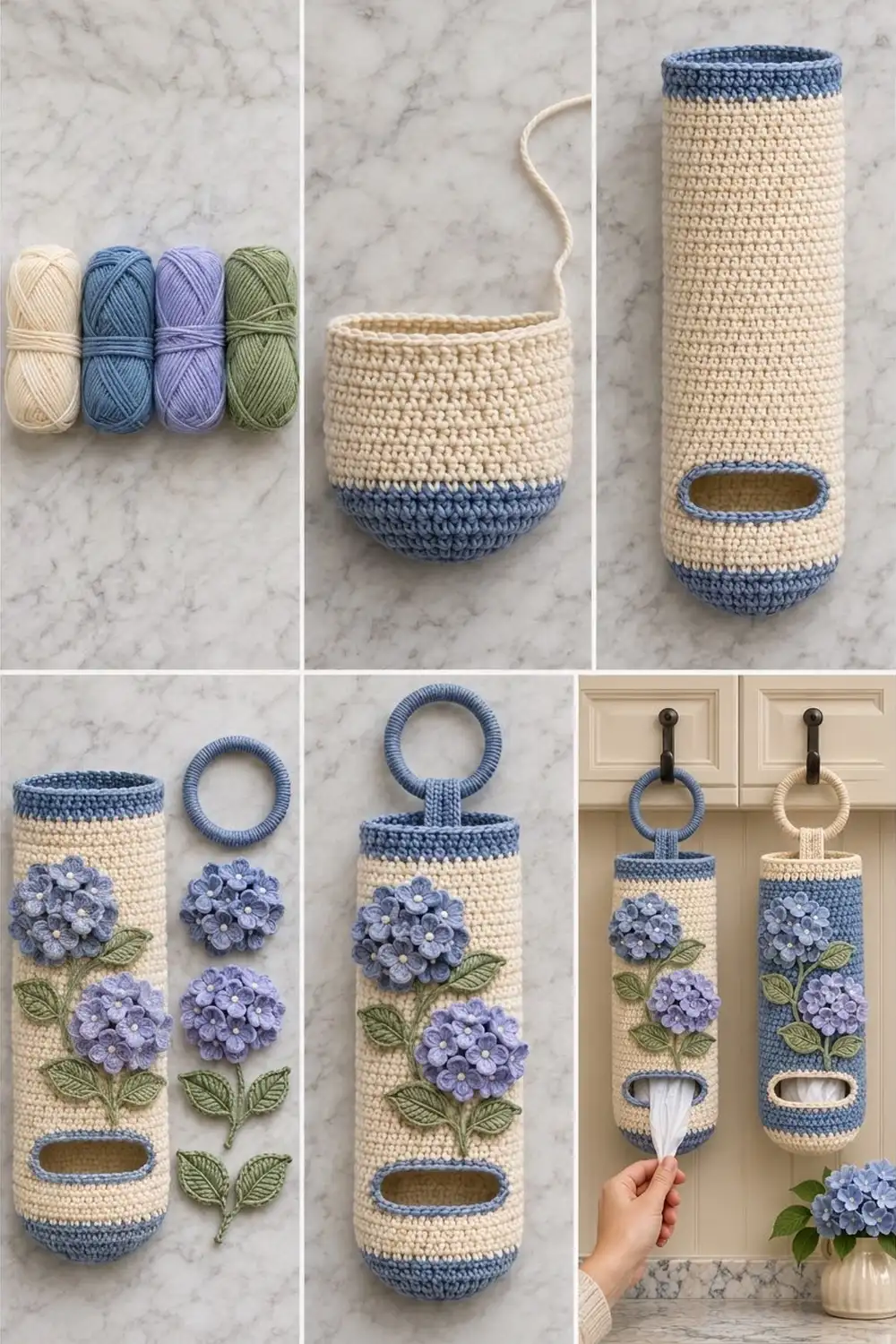
Each stage of this holder follows from the one before. Gauge sets the base at 42 sts, and 42 sts sets a 10.5 in (26.7 cm) circumference and 5.25 in (13.3 cm) flat width. The 14 skipped stitches set a 3.5 in (8.9 cm) slot. Sixty body rounds and the cupped base bring the tube to 15 in (38.1 cm), and the 42-stitch rim takes it to 16 in (40.6 cm). If you check each checkpoint as you go, the appliqués will sit exactly where they should.
Happy crocheting!