
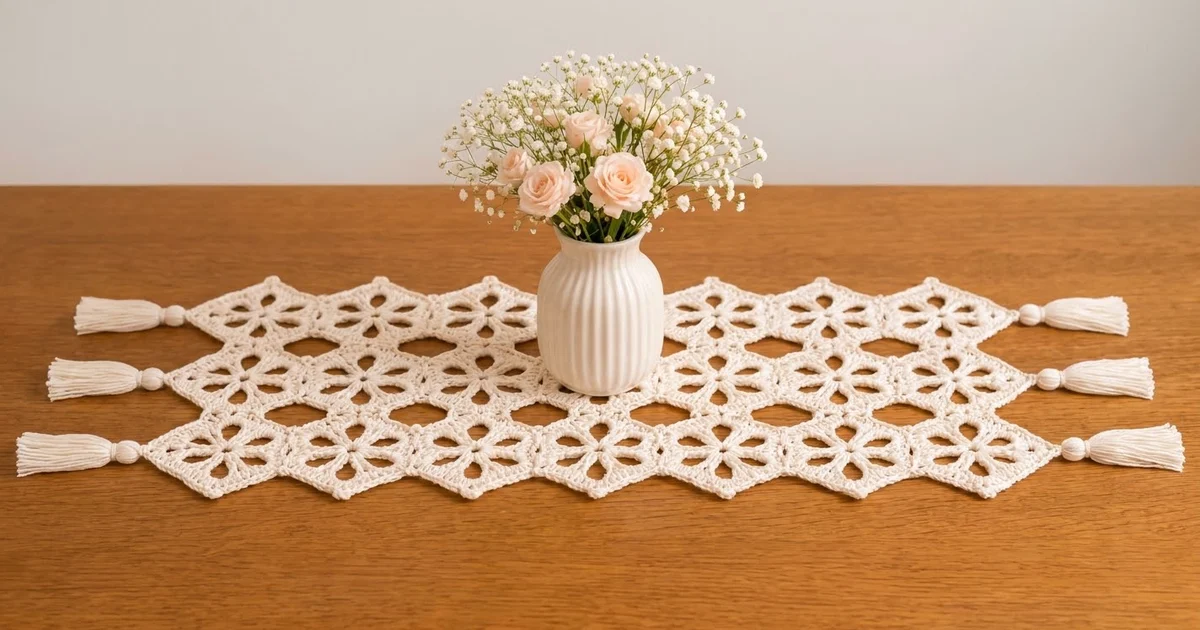
This runner is built from simple, airy hexagon motifs, each with an open six-petal flower at its center. The petals are chain loops covered in single crochet, so they stay open and lacy. A round of stitches that grow taller toward the middle of each side turns the round flower into a crisp hexagon.
The whole piece is worked in one color, soft ivory cotton. The look is light, romantic, and a little vintage, perfect under a vase of roses or baby’s breath. Three tassels hang from the pointed tips at each short end.
The pattern uses US crochet terms. The finished runner measures about 16.1 in (40.9 cm) wide and 42.5 in (108.0 cm) long before tassels, or 50.5 in (128.3 cm) long including tassels.
You will make 21 identical hexagons and join them in 7 rows of 3. Then you add a two-round edging that follows the zigzag outline, block the runner, and attach 6 tassels.
Finished Size and Construction
- Finished size: 16.1 in (40.9 cm) x 42.5 in (108.0 cm), plus 4 in (10.2 cm) tassels at each end
- Skill level: Intermediate
- Terminology: US crochet terms
- Yarn weight: Sport (CYC 2) cotton
- Hook: 3.0 mm (US C/2 or D/3)
- Number of pieces: 21 hexagon motifs
- Layout: 3 motifs across x 7 rows, pointed tips up and down
- Piece size: 6 in (15.2 cm) point to point, 5.2 in (13.2 cm) flat to flat, 3 in (7.6 cm) per side
- Size before border: 15.6 in (39.6 cm) x 42 in (106.7 cm)
- Border depth: 0.25 in (0.6 cm)
Motifs in the same row share their vertical edges. Rows touch only at their tips. This leaves small diamond-shaped openings between rows and a softly notched outline along both long sides.
Materials
Choose a smooth mercerized or combed cotton in sport weight. Cotton gives the best stitch definition and blocks flat. Avoid fuzzy or very stretchy yarn, because the petal loops lose their shape.
- Ivory (main and only color): 350 g, about 1050 m (1148 yd), based on a yarn with about 150 m (164 yd) per 50 g
Rough breakdown: about 10 g per motif (210 g total), 35 g for joining and the border, and 50 g for 6 tassels. The 350 g total includes a margin of about 55 g for gauge differences and a test motif.
Tools:
- 3.0 mm crochet hook
- Tapestry needle
- Scissors
- Stitch markers
- Stiff cardboard, 4.5 in (11.4 cm) tall, for tassels
- Blocking mats, rust-proof pins, and a spray bottle
- Tape measure
Abbreviations (US Terms)
- ch: chain
- sl st: slip stitch
- sc: single crochet
- hdc: half double crochet
- dc: double crochet
- tr: treble crochet (yarn over twice)
- dtr: double treble crochet (yarn over 3 times)
- sc2tog: single crochet 2 together
- sp: space
- st(s): stitch(es)
- RS / WS: right side / wrong side
Special stitch: dtr2tog. *Yarn over 3 times, insert hook in first indicated st, pull up a loop, (yarn over, pull through 2 loops) 3 times. Repeat from * in second indicated st. Yarn over and pull through all 3 loops on hook. This stitch joins two petals and anchors the center of each hexagon side.
Gauge and Checkpoints
Gauge is measured on the finished motif, not on a flat swatch. Make one complete hexagon, block it lightly, and measure it before you make the rest.
Target gauge: 19 sc on one Round 6 side measure 3 in (7.6 cm) from corner tip to corner tip. That is about 6.3 sc per inch.
Checkpoints for one motif:
- After Round 3: the flower measures 4 in (10.2 cm) from one petal tip to the opposite tip
- After Round 4: the hexagon measures 4.75 in (12.1 cm) point to point
- After Round 5: 5.5 in (14.0 cm) point to point
- After Round 6: 6 in (15.2 cm) point to point and 5.2 in (13.2 cm) flat to flat
If your motif is too big, go down 0.25 mm in hook size. If it is too small, go up 0.25 mm. A difference of only 0.25 in (0.6 cm) per motif adds up to 1.75 in (4.4 cm) over 7 rows, so it is worth checking.
If the petals look baggy but the outer size is right, keep the hook and work the Round 3 sc more snugly.
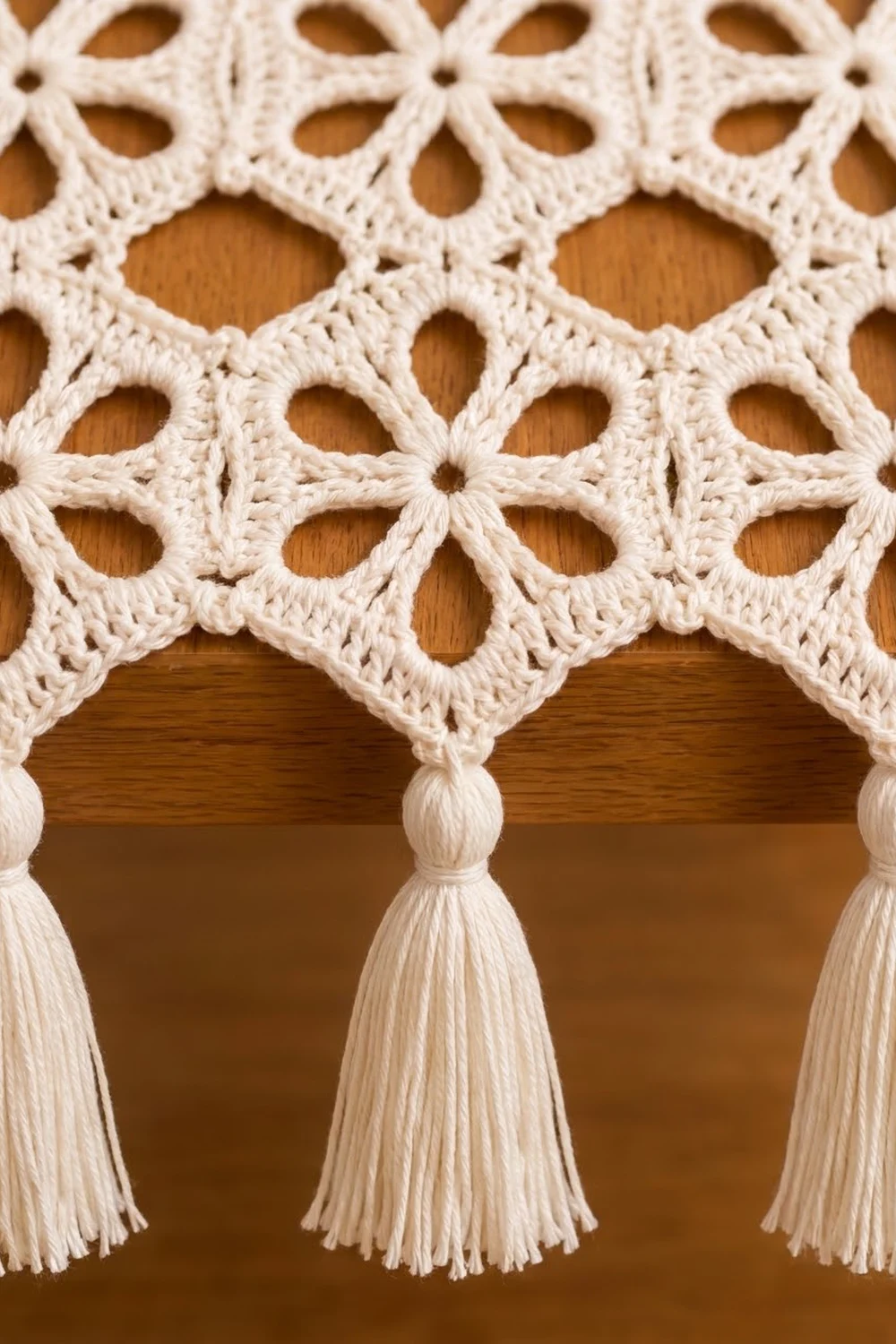
Hexagon Motif (Make 21)
Work each motif in the round with the RS facing. Do not turn.
Round 1: Make a magic ring. Ch 1, 12 sc in ring. Join with sl st to first sc. Pull the ring closed, leaving a small center hole. (12 sc)
Round 2 (petal loops): Ch 1, *sc in next sc, ch 18, sc in next sc; repeat from * 5 more times. Join with sl st to first sc. (12 sc, 6 ch-18 loops)
Each ch-18 loop sits between a pair of sc. There is no loop between the pairs. These gaps are the valleys between petals.
Round 3 (covering the petals): Sl st into first ch-18 loop. Ch 1, (10 sc, ch 3, 10 sc) in same loop, *(10 sc, ch 3, 10 sc) in next loop; repeat from * 4 more times. Join with sl st to first sc. (120 sc, 6 ch-3 tip sps)
Work the sc around the chain, not into it, and push them together so the chain is fully covered. Each petal now has an ascending side of 10 sc, a ch-3 tip, and a descending side of 10 sc. The petals stay open in the middle, forming teardrop shapes.
Round 4 (shaping the hexagon): Sl st in next 9 sc and into ch-3 tip sp. Ch 1.
*(Sc, ch 3, sc) in tip sp. Working down the descending side of the same petal: hdc in next sc, dc in next sc, dc in next sc, tr in next sc, tr in next sc, skip next sc. Dtr2tog with the first leg in the next sc (7th from the tip) and the second leg in the 4th sc of the next petal’s ascending side (also 7th from that petal’s tip). Skip next sc, tr in next sc, tr in next sc, dc in next sc, dc in next sc, hdc in next sc (last sc before tip). Repeat from * 5 more times. Join with sl st to first sc.
(78 sts: 13 per side, counted from the sc after one ch-3 corner to the sc before the next; plus 6 ch-3 corner sps)
The stitches rise from hdc near each corner to the dtr2tog at the center of each side. This fills the triangular gap between petals with a small fan of tall stitches and creates a straight edge. The 3 sc nearest each valley stay unworked.
Round 5: Sl st into next ch-3 sp. Ch 3 (counts as dc), (dc, ch 2, 2 dc) in same sp, *dc in each of next 13 sts, (2 dc, ch 2, 2 dc) in next ch-3 sp; repeat from * 4 more times, dc in each of next 13 sts. Join with sl st to top of beginning ch-3.
(102 dc: 17 per side, made of 2 corner dc + 13 dc + 2 corner dc; plus 6 ch-2 corner sps)
Round 6: Ch 1, sc in same st as join and in next dc, (sc, ch 2, sc) in ch-2 sp, *sc in each of next 17 dc, (sc, ch 2, sc) in next ch-2 sp; repeat from * 4 more times, sc in each of last 15 dc. Join with sl st to first sc. Fasten off and weave in ends.
(114 sc: 19 per side, made of 1 corner sc + 17 sc + 1 corner sc; plus 6 ch-2 corner sps)
Per-side definition: From here on, “19 sc per side” includes both corner sc of that side. The ch-2 corner spaces are counted separately.
Make All Pieces
Make 21 motifs in Ivory, all identical. Block them lightly as a stack (see Final Blocking) so every edge measures the same before joining.
Layout, with tips pointing toward the short ends (M = motif):
Row 1:  M  M  M
Row 2:  M  M  M
Row 3:  M  M  M
Row 4:  M  M  M
Row 5:  M  M  M
Row 6:  M  M  M
Row 7:  M  M  M
Each motif in a row shares its vertical left and right sides with its neighbors. Each row touches the next one only at the pointed tips.
Joining
Step 1: join within rows. Place two motifs WS together with one vertical side lined up. Working through the outer loops of both layers, sl st in the corner ch-2 sps, sl st in each of the 19 sc pairs, then sl st in the next corner ch-2 sps. (21 sl st per seam)
Both motifs have exactly 19 sc on that side, so you join stitch to stitch with no skipping and no doubling. Each row needs 2 seams, for 14 seams in total.
Step 2: join rows at the tips. Lay Row 1 above Row 2 so each bottom tip meets the top tip below it. Hold the two ch-2 tip sps together, sl st through both, ch 1, and sl st through both again. Fasten off. There are 3 tip joins between each pair of rows, for 18 in total.
Tension: Keep the sl st as loose as the sc beside them. If a seam puckers, use a hook 0.5 mm larger for joining only.
Size checkpoint: The joined runner should measure 15.6 in (39.6 cm) across the vertical edges and 42 in (106.7 cm) from top tip to bottom tip. Fix any uneven seams now, before the border.
Border
Border gauge: The same as the motifs, 19 sc per 3 in (7.6 cm) edge. The border uses every edge stitch once, so it adds no extra fullness.
Exposed edges:
- Each short end: 3 motifs x 2 sloped edges = 6 edges x 19 sc = 114 sc
- Each long side: 7 vertical edges + 12 sloped edges = 19 edges x 19 sc = 361 sc
No stitches are added at the seams. The decreases below take care of the seam corners.
Border Round 1: With RS facing, join yarn in any sc on a long side. Ch 1. Sc in each sc around. In each ch-2 corner sp that points outward, work (sc, ch 2, sc). At each inward notch where two motifs meet, work sc2tog with one leg in each motif’s ch-2 sp. Join with sl st to first sc.
- Each short end: 114 sc worked 1 per stitch + 6 sc added at 3 tips (2 each) + 2 sc2tog at seam notches = 122 sts
- Each long side: 361 sc worked 1 per stitch + 28 sc added at 14 outer corners (2 each) + 6 sc2tog at tip notches = 395 sts
- Total: 1034 sts and 34 ch-2 corner sps
Border Round 2: Sl st in each st around, working (sl st, ch 2, sl st) in each ch-2 corner sp. Join and fasten off.
- Each short end: 122 sl st worked 1 per stitch + 6 sl st added at 3 corners = 128 sl st
- Each long side: 395 sl st worked 1 per stitch + 28 sl st added at 14 corners = 423 sl st
- Total: 1102 sl st and 34 ch-2 corner sps
Why the math works: The border starts from the motifs’ own 19 sc per edge, so it matches the joined fabric exactly. Outward corners gain 2 sts so they can turn without cupping. Inward notches lose 1 st so they stay crisp instead of bunching. The sl st round firms the edge and adds the small picot bumps at each point.
Tassels (Make 6)
Wrap yarn 30 times around the 4.5 in (11.4 cm) cardboard. Slide a 12 in (30.5 cm) strand under the wraps at the top and tie it tightly. Cut the bottom loops. Wrap another strand 6 times around the bundle 0.75 in (1.9 cm) below the top to form a rounded head, and tie it off. Trim to 4 in (10.2 cm).
Tie one tassel to each outer tip ch-2 sp on both short ends, 3 per end.
Final Blocking
- Weave in all remaining ends along the seams, not through the open petals.
- Soak the runner in cool water for 10 minutes. Press out the water in a towel. Do not wring.
- Lay it flat on blocking mats, RS up.
- Pin the vertical edges first and check for a 16.1 in (40.9 cm) width.
- Pin all outer tips and check for a 42.5 in (108.0 cm) length.
- Pin each petal tip and the center of each diamond opening so the lace opens evenly.
- Let it dry completely. Fluff the tassels and trim them evenly.
Final Quality-Control Checklist
- All 21 motifs have 19 sc per side and 6 clean ch-2 corners.
- Every petal is open and fully covered with sc.
- The dtr2tog sits at the center of each hexagon side.
- Seams lie flat with no puckering.
- The diamond openings between rows are all the same size.
- Width is 16.1 in (40.9 cm) and length is 42.5 in (108.0 cm).
- All 6 tassels are the same length and tied securely.
Troubleshooting
Petals twist or flip. Make sure no Round 2 chain is twisted before you cover it in Round 3.
Hexagon sides curve inward. Your dtr2tog is too short or too tight. Pull up the loops a little taller.
Hexagon sides bulge outward. The tall stitches are too loose. Work them more snugly, or go down a hook size for Round 4 only.
Motif cups. Check the Round 5 and Round 6 counts per side. An extra stitch often hides at the corners.
Border ruffles at the points. Work only (sc, ch 2, sc) at outward corners, with no extra sc.
Notches pull tight. Loosen the sc2tog, or work it with a slightly larger hook.
Care
Hand wash in cool water with mild soap and dry flat, reshaping the petals while damp. Cotton can be steamed lightly if it needs refreshing.
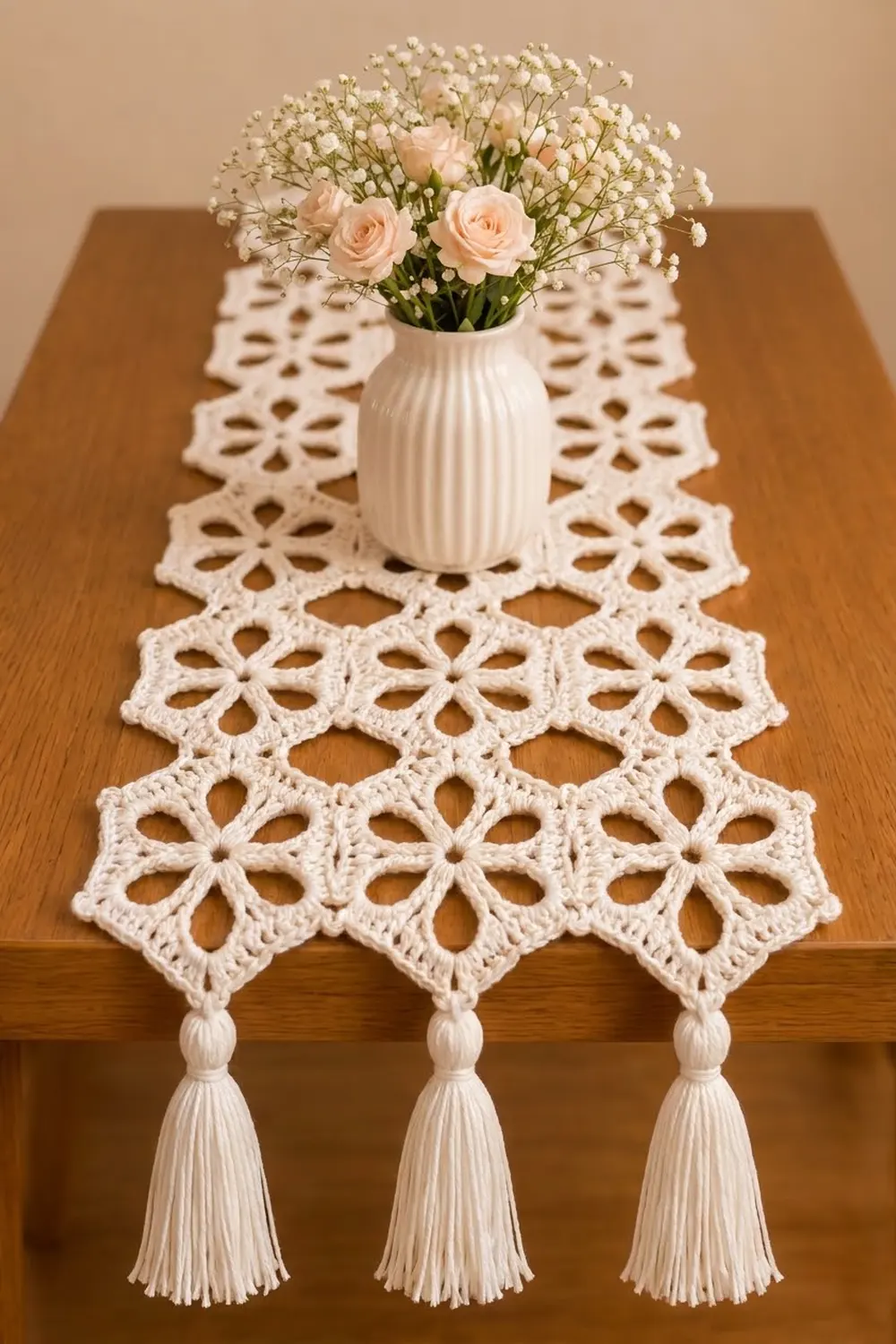
Final Notes
The whole runner rests on one chain of measurements. One motif blocks to 6 in (15.2 cm) point to point and 5.2 in (13.2 cm) flat to flat, with 19 sc per 3 in (7.6 cm) side. Three motifs across give 15.6 in (39.6 cm), and 7 rows give 42 in (106.7 cm). The 0.25 in (0.6 cm) border brings the runner to 16.1 in (40.9 cm) x 42.5 in (108.0 cm). The tassels add 4 in (10.2 cm) at each end, for 50.5 in (128.3 cm) overall.
Check the first motif carefully, and the rest will fall into place.
Happy crocheting!