

This runner is made from openwork diamond motifs. Each one holds a raised fleur-de-lis inside a lacy chain-mesh frame. The motifs are joined point to point, so you get a lattice of diamonds with open windows between them, and each window is crossed by two slim chain bars. Soft tassels hang from the pointed tips at both ends.
The whole piece uses one creamy ivory cotton. With a single color, all the attention goes to texture: the ridged center petal, the curled side petals, the wrapped band, and the eyelet frame. It looks formal enough for a holiday table and plain enough to leave out all year.
The pattern uses US crochet terms. The finished runner measures 18.8 x 42.8 in (47.8 x 108.7 cm) including the border, not counting tassels. The tassels add 5 in (12.7 cm) at each end.
Construction: crochet the three fleur-de-lis pieces, assemble them, and work the frame around them. Tie the lily to the frame with chain spokes. Join 21 motifs as you go at their corners, add the window bars, work a two-round border, and finish with six tassels.
Finished Size and Construction
- Finished size: 18.8 x 42.8 in (47.8 x 108.7 cm), plus 5 in (12.7 cm) tassels at each end
- Skill level: Intermediate
- Terminology: US
- Yarn weight: DK (3) cotton
- Hook: 3.5 mm (E-4)
- Number of pieces: 21 motifs
- Layout: 3 motifs wide x 7 motifs long, set on point
- Piece size: 4.25 in (10.8 cm) per side, 6 in (15.2 cm) tip to tip
- Size before border: 18 x 42 in (45.7 x 106.7 cm)
- Border depth: about 0.4 in (1.0 cm)
Materials
Yarn: Use a smooth mercerized DK cotton or a cotton blend. Cotton gives clear stitch definition and keeps the petals crisp after blocking. Stay away from fuzzy or very stretchy yarns, because they blur the eyelets and let the chain bars sag.
- Ivory/cream: 350 g, about 805 m (880 yd)
That total includes about a 15% margin for your gauge swatch, tension differences, and tassels. One motif uses about 11 g, the border about 25 g, and the six tassels about 30 g.
Tools:
– 3.5 mm (E-4) crochet hook
– Tapestry needle
– Stitch markers
– Scissors
– Stiff card, 5 in (12.7 cm) tall, for the tassels
– Blocking mats, rustproof pins, and a spray bottle
Abbreviations (US Terms)
- ch – chain
- sl st – slip stitch
- sc – single crochet
- hdc – half double crochet
- dc – double crochet
- sk – skip
- sp – space
- st(s) – stitch(es)
- BLO – back loop only
- sc2tog – single crochet 2 together
- rep – repeat
Corner join (CJ): Use this in place of the “ch 2” in a Round 3 corner. Ch 1, sl st into the matching ch-2 corner sp of the neighboring motif, then ch 1.
Gauge and Checkpoints
Gauge: 20 sc and 22 rows = 4 in (10.2 cm) with a 3.5 mm hook.
Make one complete motif before anything else and check it against these numbers:
- Center petal after Round 2: 3 in (7.6 cm) long, 1.25 in (3.2 cm) wide
- Side petal after Row 2: 2.25 in (5.7 cm) along the straight edge
- Band: 1.5 x 0.75 in (3.8 x 1.9 cm)
- Assembled lily: about 3 in (7.6 cm) tall and 3 in (7.6 cm) wide
- Frame after Round 1: about 3.5 in (8.9 cm) per side
- Frame after Round 3: 4.25 in (10.8 cm) per side, 6 in (15.2 cm) tip to tip
If the motif is too big, go down to a 3.25 mm hook. If it is too small, go up to a 3.75 mm hook. A difference of only 0.25 in (0.6 cm) per motif turns into 0.75 in (1.9 cm) across the width and 1.75 in (4.4 cm) along the length, so fix it now.
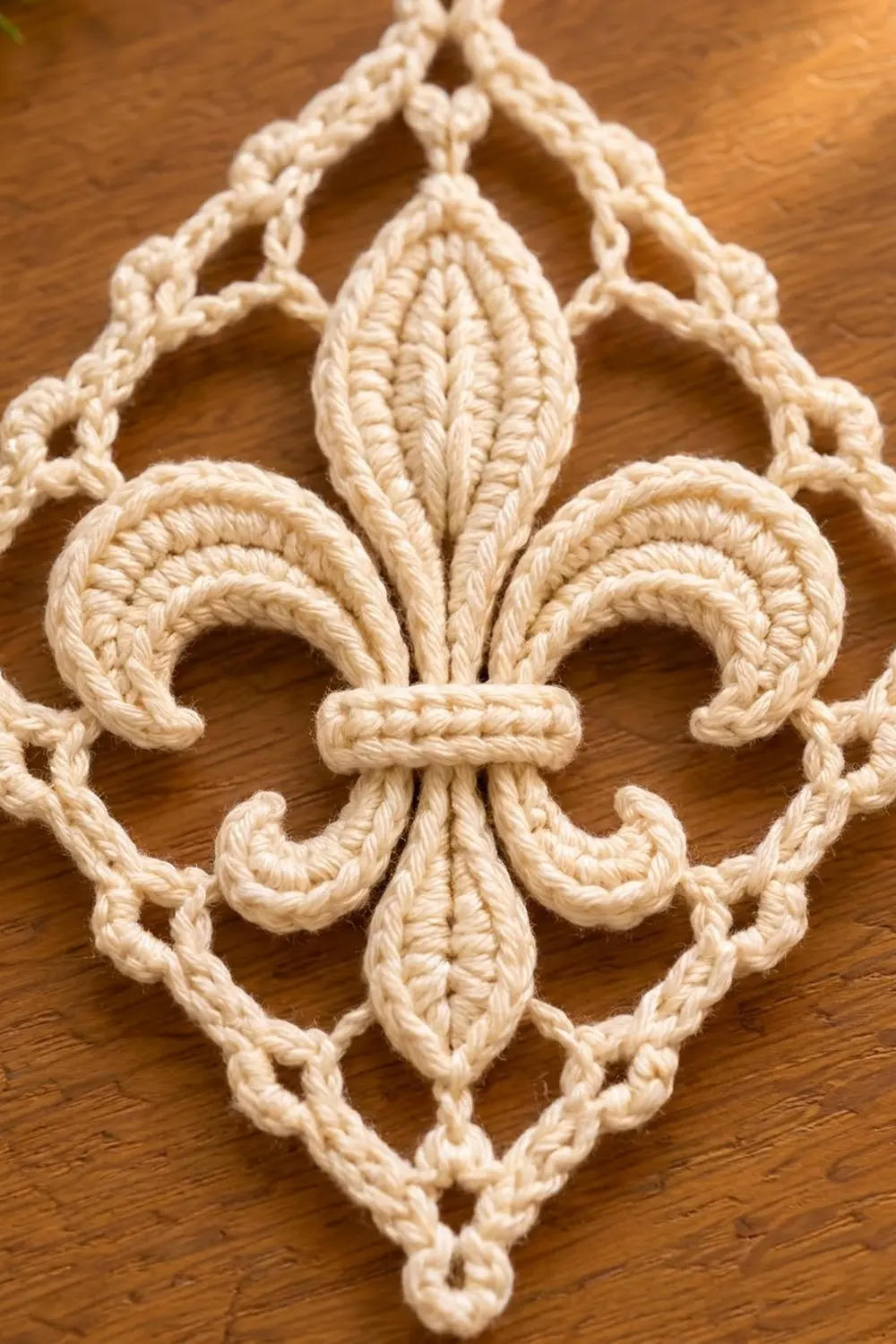
Fleur-de-Lis
Center Petal (make 1 per motif)
Ch 15.
Round 1: 3 sc in 2nd ch from hook (tip), sc in next 2 ch, hdc in next 3 ch, dc in next 5 ch, hdc in next 2 ch, 3 hdc in last ch (base). Now work along the other side of the foundation chain: hdc in next 2 ch, dc in next 5 ch, hdc in next 3 ch, sc in next 2 ch. Join with sl st to first sc. (30 sts)
Round 2 (BLO): Ch 1. Sc in each st around, with 3 sc in the center st of the tip and 3 sc in the center st of the base. Join. (30 sts worked 1 per st + 4 extra = 34 sc)
The unworked front loops leave a raised outline around the petal, and the foundation chain becomes the center spine. Fasten off with a 10 in (25.4 cm) tail.
Side Petals (make 2 per motif)
Ch 12.
Row 1: Sc in 2nd ch from hook and in next ch, hdc in next 2 ch, dc in next 3 ch, hdc in next 2 ch, sc in last 2 ch. (11 sts)
Row 2 (BLO): Ch 1, turn. Sc in next 2 sts, 2 sc in each of next 7 sts, sc in last 2 sts. (11 sts worked 1 per st + 7 extra = 18 sc)
The extra stitches crowd the outer edge, so it ruffles and curls on its own. Fasten off with an 8 in (20.3 cm) tail.
Band (make 1 per motif)
Ch 9.
Row 1: Sc in 2nd ch from hook and in each ch across. (8 sc)
Rows 2–3: Ch 1, turn, sc in each st across. (8 sc)
Fasten off with a 10 in (25.4 cm) tail.
Assemble the Lily
- Lay the center petal vertically with the tip at the top.
- Place one side petal on each side of it. The 2-sc starting end goes beside the petal base, with the first 3 sts extending 0.5 in (1.3 cm) below the base as a small foot. The ruffled edge faces outward and up.
- Roll the free end of each side petal down and outward into a curl, then tack it with 2 small stitches.
- Wrap the band horizontally around all three petals, 0.75 in (1.9 cm) above the center petal base. Whipstitch the short ends together at the back.
- Tack the side petals to the center petal behind the band. Weave in all ends.
Frame
Ch 64. Join with a sl st to the first ch, taking care not to twist the chain.
Round 1: Ch 1. 3 sc in next ch, sc in next 15 ch; rep from * 3 more times. Join to first sc. (4 x 18 = 72 sc)
Round 2: Sl st in next sc (corner center). Ch 1, (sc, ch 3, sc) in same st. [Ch 1, sk 1, sc in next st] 8 times, ch 1, sk 1, (sc, ch 3, sc) in next st (corner center); rep from * twice more. [Ch 1, sk 1, sc in next st] 8 times, ch 1, sk 1, join. (40 sc, 36 ch-1 sps, 4 ch-3 corner sps)
Each side now has 10 sc and 9 ch-1 eyelets between the corner spaces.
Round 3: Sl st into the corner ch-3 sp. Ch 1, (sc, ch 2, sc) in same sp. Sc in each sc and each ch-1 sp across (19 sc), (sc, ch 2, sc) in next corner sp; rep from * twice more, then sc across the last side and join. (84 sc + 4 ch-2 corner sps; 21 sc per side, including the 2 corner sc)
For the first motif, fasten off. For every other motif, use CJ in place of ch 2 at each corner that touches a motif you have already made (see Joining).
Spokes
Turn the frame so it sits on point and center the lily inside it. For each spoke, join yarn with a sl st into the foundation ch at the inner corner, ch 4, then sl st into the lily:
- Top: center sc of the center petal tip
- Bottom: center sc of the petal base
- Left and right: the outermost point of each side curl
Fasten off each spoke and weave in the ends. Checkpoint: the lily should hang flat with no pull on the frame.
Make All Pieces
Make 21 complete motifs in ivory, about 231 g total. Label them by row (A–G) and column (1–3):
 A1  A2  A3
 B1  B2  B3
 C1  C2  C3
 D1  D2  D3
 E1  E2  E3
 F1  F2  F3
 G1  G2  G3
Each motif sits as a diamond. Side tips touch the neighbor in the same row, and top/bottom tips touch the neighbor in the same column.
Joining
Method: Join as you go on Round 3, at the corners only. The sides stay free, which leaves a diamond-shaped window between every four motifs.
Stitch logic: A joined corner is worked as (sc, CJ, sc). CJ takes the place of the ch 2, so the sc count does not change. Every motif keeps 21 sc per side and 84 sc total.
Order: Work across each row from left to right. A motif joins at its left tip to the motif on its left and at its top tip to the motif above it. Each inside motif ends up with 4 joined corners.
Tension: Keep the CJ sl st snug but not tight. A tight join pulls the tips into the window and narrows the runner.
Window Bars
There are 12 fully enclosed windows (2 across x 6 down), with 2 bars in each, for 24 bars. On the upper-left motif’s lower-right side, count 7 sts from the tip junction. Join yarn there, ch 20, and sl st into the 7th st from the bottom junction on the lower-left motif. Then sl st into the back bump of each ch back up to the start and fasten off. Mirror this on the right-hand motifs. The bars end up 2 in (5.1 cm) apart.
Checkpoint: Each bar should measure 4 in (10.2 cm) and lie flat. Adjust the ch count if it sags or pulls. The joined piece should measure 18 x 42 in (45.7 x 106.7 cm).
Border
Border gauge: Same as the motifs, 5 sc per 1 in (2.5 cm). Two rounds add about 0.4 in (1.0 cm) on each side.
The perimeter has 36 exposed motif sides, 20 outer tips, and 16 inner valleys (joined corners).
- Long side: 7 motifs x 2 exposed sides x 21 sc = 294 sts, with 7 outer tips
- End: A1/G1 and A3/G3 contribute 1 side each and A2/G2 contributes 2, so 4 sides x 21 sc = 84 sts, with 3 outer tips
Round 1: Join in any outer tip ch-2 sp. Work 3 sc in each outer tip ch-2 sp and sc in each sc along every exposed side. At the valleys, skip the joined corner sps and go straight from the last corner sc of one motif to the first corner sc of the next.
- Long side: 294 + (7 x 3) = 315 sc
- End: 84 + (3 x 3) = 93 sc
- Total: (2 x 315) + (2 x 93) = 816 sc
Round 2: Ch 1. Sc in each sc, working 3 sc in the center sc of each outer tip and sc2tog over the 2 sc at each valley. Join.
- Long side: 315 + (7 x 2) − 6 = 323 sc
- End: 93 + (3 x 2) − 2 = 97 sc
- Total: (2 x 323) + (2 x 97) = 840 sc
Why the math works: The straight runs are worked 1 sc per st, so they stay flat. The increases at the tips give the outside of each point enough length to stay sharp. Each sc2tog removes the extra fabric at an inner angle so the valley does not ruffle. Nothing is added at the seams.
Tassels (make 6)
Wrap yarn 40 times around the 5 in (12.7 cm) card. Tie the loops at the top, cut through the bottom, and wrap the neck tightly 0.75 in (1.9 cm) below the top. Attach one tassel to the center sc of each of the 6 end tips (the top tips of A1–A3 and the bottom tips of G1–G3). Trim the ends even.
Final Blocking
- Weave in all ends before you block.
- Soak the runner in cool water for 15 minutes, then roll it in a towel and press out the water.
- Pin it out to 18.8 x 42.8 in (47.8 x 108.7 cm). Put a pin in every tip and every valley.
- Straighten each window bar and open up the frame eyelets.
- Shape the side curls with your fingers and let the band sit level.
- Leave it to dry completely before unpinning. Steam the tassels lightly and comb them straight.
Final Quality-Control Checklist
- All 21 motifs measure 4.25 in (10.8 cm) per side
- Every Round 3 side has 21 sc
- Every lily hangs centered on 4 spokes
- All 24 bars are 4 in (10.2 cm) long and flat
- Border Round 2 has 323 sc per long side and 97 per end
- The runner lies flat at 18.8 x 42.8 in (47.8 x 108.7 cm)
- The tassels are even and firmly attached
Troubleshooting
- Center petal cups: Your tension is tight. Loosen up on Round 2 or go up 0.25 mm.
- Side petal won’t curl: Check that Row 2 has 18 sc, then tack the roll more firmly.
- Frame twists: The foundation ring was twisted. Start over.
- Lily sags: Shorten the spokes to ch 3.
- Bars sag: Remove 2 ch.
- Valleys ruffle: Check the sc2tog at every valley.
- Tips curl under: Block harder and pin each tip right at the point.
Care
Hand wash in cool water with mild soap and dry flat, reshaping the curls and tips while damp. Do not tumble dry.
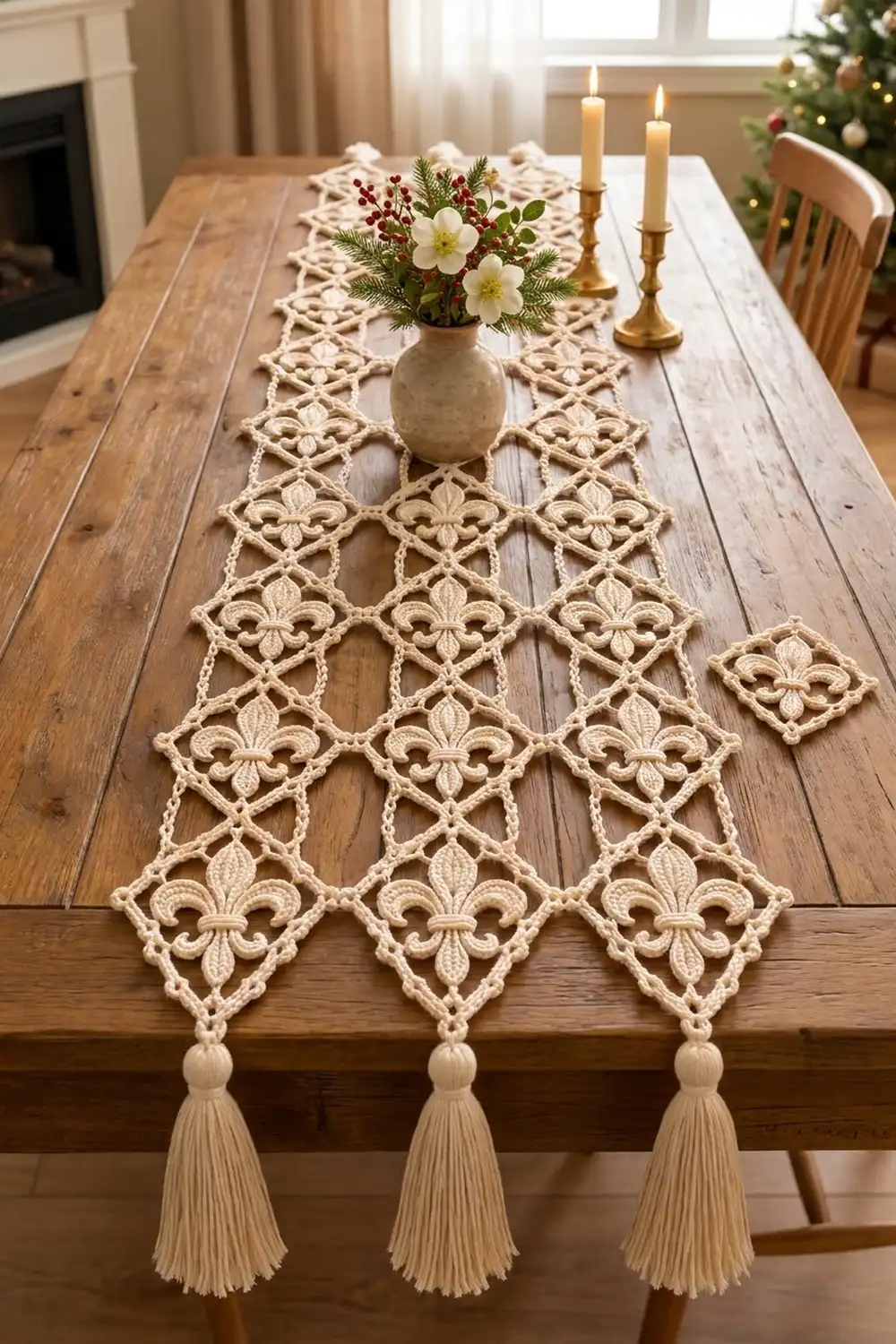
Final Notes
Everything in this runner depends on gauge. At 20 sc per 4 in (10.2 cm), a motif with 21 sc per side measures 4.25 in (10.8 cm) per side and 6 in (15.2 cm) tip to tip. Three motifs across give 18 in (45.7 cm), and seven down give 42 in (106.7 cm). Two border rounds bring the runner to 18.8 x 42.8 in (47.8 x 108.7 cm), and the 5 in (12.7 cm) tassels finish both ends. Measure at each checkpoint and the motifs will fit together into the full lattice.
Happy crocheting!