

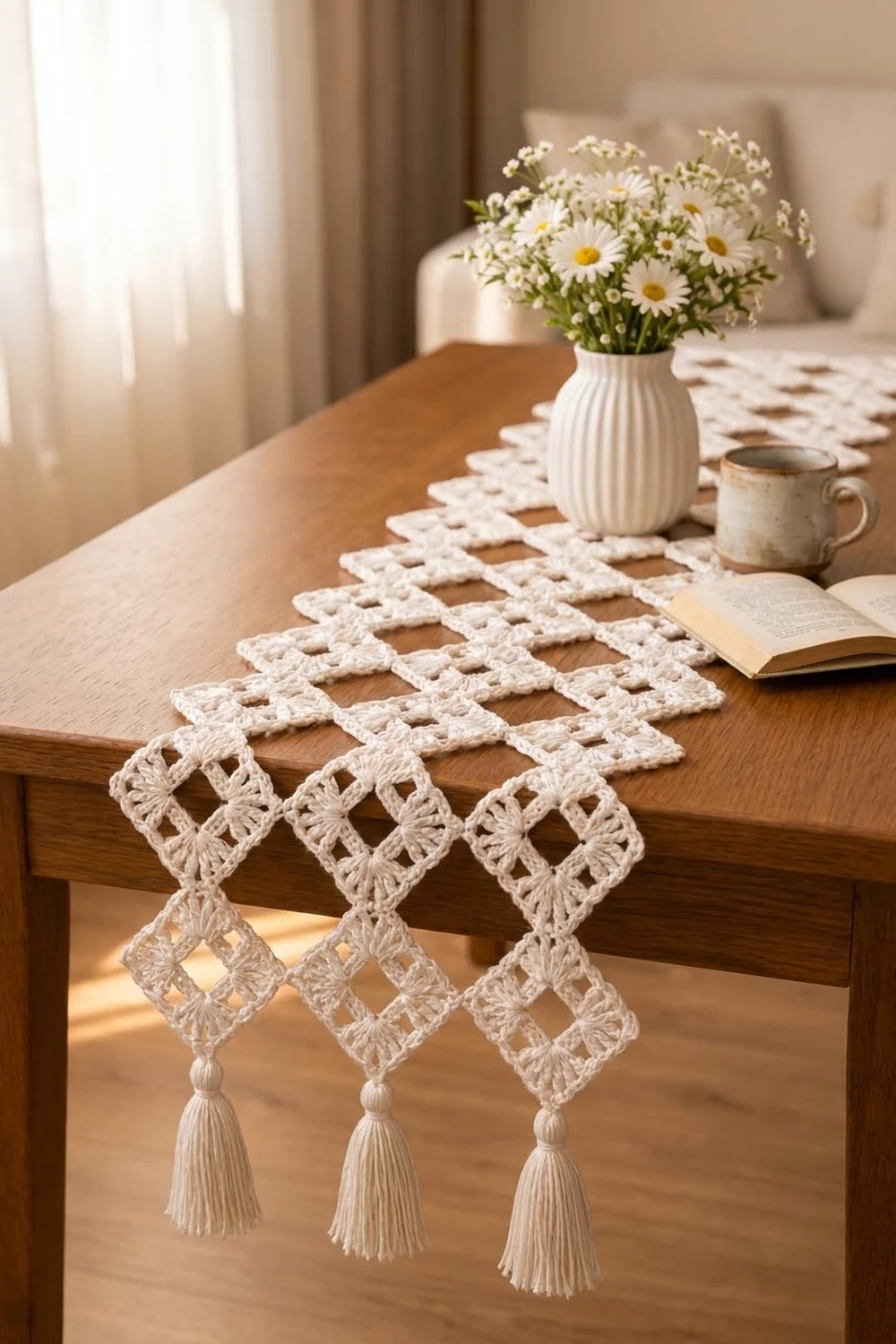
This runner is made of airy diamond motifs joined point to point, so the table shows through in a crisp lattice. Each diamond has an open square window in the middle, and a fan of double crochet grows from each corner of that window. A light edge of chain loops gives every motif a soft lace outline.
The sample is worked in one color, a clean white or ivory cotton. That keeps the look calm and traditional, so it suits farmhouse, cottage, and minimalist tables alike. Three tassels hang from the points at each short end.
The pattern uses US crochet terms. The finished runner measures about 17.9 x 57.8 in (45.5 x 146.8 cm), not counting the tassels, which add about 3.5 in (8.9 cm) at each end.
To make it, you’ll crochet 30 square motifs and join them as you go at their corner loops, three across and ten down, with each square turned on point. Then you’ll work a two-round border around the zigzag outer edge, block the runner, and add six tassels.
Finished Size and Construction
- Finished size: 17.9 x 57.8 in (45.5 x 146.8 cm), not counting tassels
- Skill level: Intermediate
- Terminology: US crochet terms
- Yarn weight: DK (#3) cotton
- Hook: 3.5 mm (E-4)
- Number of pieces: 30 identical motifs
- Layout: 3 motifs wide x 10 motifs long, turned on point and joined only at the points
- Motif size: 4 in (10.2 cm) per side, 5.7 in (14.5 cm) from point to point
- Size before border: 17.1 x 57 in (43.4 x 144.8 cm)
- Border depth: about 0.4 in (1.0 cm) on every edge
Materials
Yarn: Use a smooth, mercerized or combed DK cotton. Cotton keeps the fans crisp and blocks well, and it holds up to washing. Avoid fuzzy yarns, because they blur the open window and the chain loops.
- White / Ivory: 300 g, about 720 m (based on 50 g = 120 m)
- Motifs: about 180 g (432 m), or about 6 g (14 m) each
- Border: about 30 g (72 m)
- Tassels: about 24 g (58 m), or about 4 g each
These quantities include a safety margin of about 25 percent.
Tools:
– 3.5 mm (E-4) crochet hook
– Tapestry needle
– Scissors
– Stitch markers
– A piece of stiff card 4 in (10.2 cm) tall, for the tassels
– Blocking mats, rust-proof pins, and a spray bottle
Abbreviations (US Terms)
- ch – chain
- sl st – slip stitch
- sc – single crochet
- dc – double crochet
- sp(s) – space(s)
- st(s) – stitch(es)
- sc2tog – single crochet 2 together
- sc3tog – single crochet 3 together
- RS – right side
Special stitch – Fan: Work 9 dc into the same space. If you’re starting the round, begin with ch 3 (this counts as the first dc) and work 8 dc into the same space.
Valley sc2tog (border): Insert the hook into the first corner loop, yarn over, and pull up a loop. Insert the hook into the joined corner loop of the next motif, yarn over, and pull up a loop. Yarn over and pull through all 3 loops on the hook.
Gauge and Checkpoints
Gauge: 18 sc = 4 in (10.2 cm). This matches Round 3 of the motif, which has 16 sc per side plus the corner spaces.
Make one complete motif first and block it before you make the rest. Check it at each stage:
- After Round 1: about 2.25 in (5.7 cm) per side
- After Round 3: 3.5 in (8.9 cm) per side
- After Round 4: 4 in (10.2 cm) per side and 5.7 in (14.5 cm) from point to point
If your motif is too big, go down to a 3.25 mm hook. If it’s too small, go up to a 3.75 mm hook. Even a 0.25 in (0.6 cm) difference per motif adds up to about 2.5 in (6.4 cm) over the length of the runner, so test before you go on.
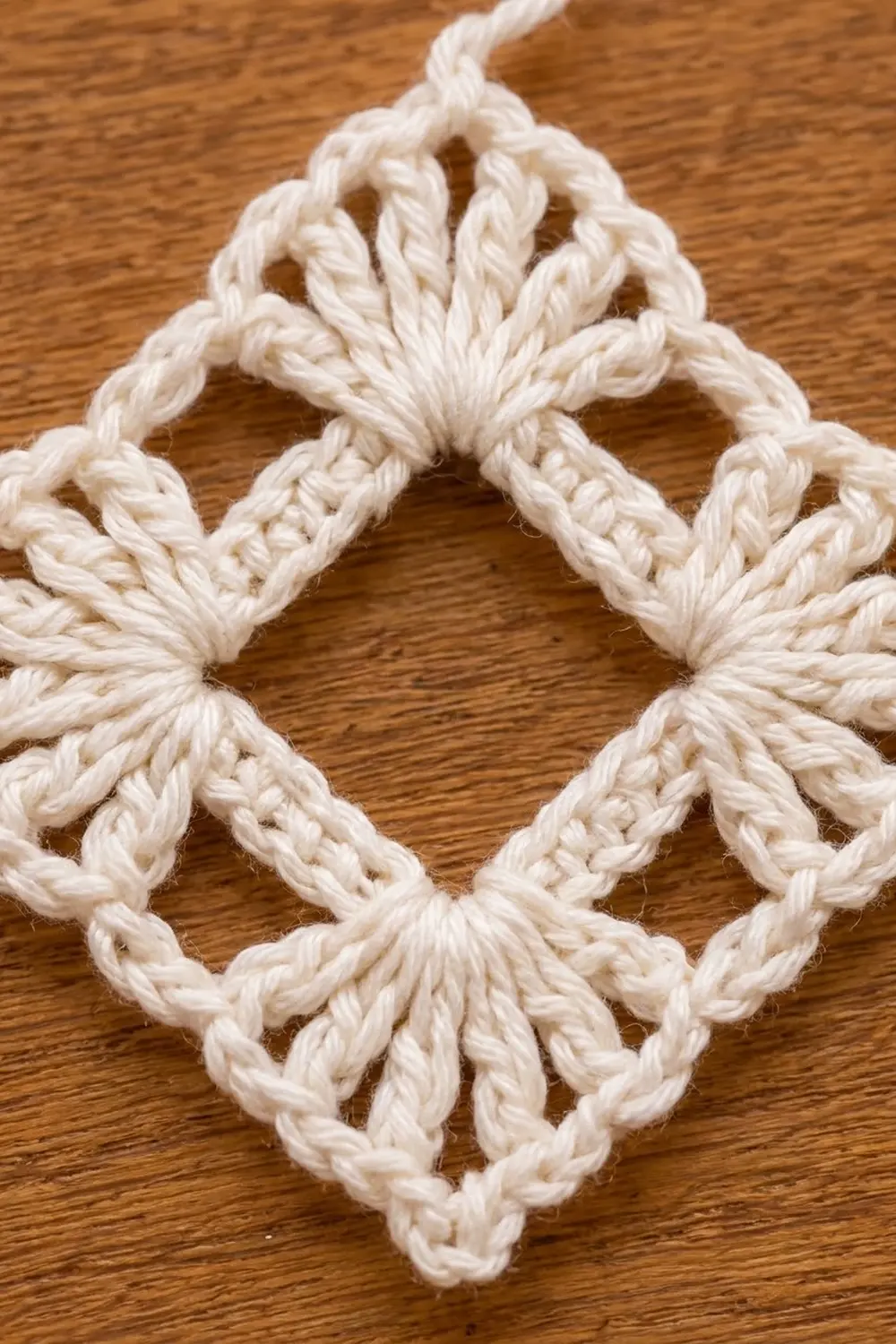
Motif (Make 30)
The motif is worked in the round with the RS facing, and you don’t turn. It’s a square that you’ll turn on point when you lay out the runner.
Foundation: Ch 36. Sl st into the first ch to form a ring, taking care not to twist the chain. This ring becomes the open center window.
Round 1 (center frame): Ch 1. Work [sc, ch 3, sc] in the next ch, then sc in each of the next 8 ch. Repeat from * 3 more times, then sl st into the first sc. You’ve used 9 ch per repeat, 36 in all.
Count: 40 sc and 4 corner ch-3 sps, with 10 sc along each side between the corner sps.
Round 2 (fans): Sl st into the first corner ch-3 sp. Ch 3 (counts as dc) and work 8 dc in the same sp to make the first Fan. Ch 3, skip 4 sc, sc in each of the next 2 sc, ch 3, skip 4 sc, then work a Fan (9 dc) in the next corner ch-3 sp. Repeat from * twice more. Ch 3, skip 4 sc, sc in each of the next 2 sc, ch 3, skip 4 sc, and sl st into the top of the beginning ch-3.
Count: 36 dc (4 Fans), 8 sc, and 8 ch-3 sps.
The ch-3 spaces leave the small openings along the middle of each side, and the Fans grow out from the corners of the window.
Round 3 (solid frame): Sl st in each of the next 4 dc to reach the 5th (center) dc of the Fan. Ch 1. Work [sc, ch 3, sc] in the center dc, sc in each of the next 4 dc, 2 sc in the ch-3 sp, sc in each of the next 2 sc, 2 sc in the ch-3 sp, then sc in each of the next 4 dc. Repeat from * 3 more times and sl st into the first sc.
Count: 64 sc and 4 corner ch-3 sps, with 16 sc per side (the 2 sc beside the corners included). This round is a conversion round: 36 dc + 8 sc + 8 ch-3 sps, worked as 1 sc per dc (36), 1 sc per sc (8), and 2 sc per space (16), plus 4 extra corner sc from the [sc, ch 3, sc] = 64.
Round 4 (lace edge): Sl st into the corner ch-3 sp. Ch 1 and work [sc, ch 3, sc] in the same sp. Along the side, ch 3, skip 2 sc, sc in the next sc; repeat 4 more times (5 sc placed). Ch 3, skip the last sc of the side, and work [sc, ch 3, sc] in the next corner sp. Repeat from * around, leaving out the last corner group, and sl st into the first sc. Fasten off and weave in the ends.
Count: 28 sc and 28 ch-3 loops. Each side has 6 side loops between the corner loops, which makes 8 loops per side including both corner loops.
Make All Pieces
Make 30 motifs in White/Ivory. Work the first motif complete, then join motifs 2 to 30 on Round 4 as you go (see Joining).
Layout (top view, each number is one motif turned on point):
Row 1:   1   2   3
Row 2:   4   5   6
Row 3:   7   8   9
Row 4:  10  11  12
Row 5:  13  14  15
Row 6:  16  17  18
Row 7:  19  20  21
Row 8:  22  23  24
Row 9:  25  26  27
Row 10: 28  29  30
Each motif touches its left and right neighbors at its side points, and the motifs above and below at its top and bottom points. Every join links exactly 2 motifs, and an open diamond gap forms between each group of four.
Joining
Method: Join as you go on Round 4, at the corner loops only.
Stitch-to-stitch logic: When you reach a corner that touches a finished motif, work it as [sc, ch 1, sl st into the matching corner ch-3 loop of the finished motif, ch 1, sc]. The joined loop still counts as that motif’s corner loop. Work all side loops as normal, with no joins.
- In Row 1, each new motif joins at 1 point (its left point).
- In the left column, each new motif joins at 1 point (its top point).
- Every other motif joins at 2 points (its left point and top point).
- Total: 20 side-to-side joins plus 27 top-to-bottom joins = 47 joins.
Tension: Keep the ch-1s at either side of the sl st the same tension as your other chains. If they’re too tight, the points pucker. If they’re too loose, the lattice sags.
Size checkpoint: After Row 2, lay the piece flat. It should be 17.1 in (43.4 cm) wide and 11.4 in (29.0 cm) long, with every diamond 5.7 in (14.5 cm) from point to point.
Border
Border gauge: 3 sc per side loop, which gives 18 sc for each 4 in (10.2 cm) motif side. That’s the same 4.5 sc per inch as the motif gauge.
The outer edge is a zigzag of 48 motif sides, 26 outer points, and 22 valleys (the joined corners along the edge). For counting, each long edge runs from the top point of its corner motif to the bottom point of the motif at the far end. Each short edge runs between those same corner points and includes them.
- Long edge: 10 motifs x 2 sides each x 6 side loops = 120 side loops, plus 10 point loops and 9 valleys.
- Short edge: 4 motif sides x 6 side loops = 24 side loops, plus 3 point loops and 2 valleys.
Round 1: With the RS facing, join yarn in the top point loop of motif 2. Ch 1.
– At each outer point: [2 sc, ch 2, 2 sc] in the point loop.
– In each side loop: 3 sc.
– At each valley: Valley sc2tog across the two joined corner loops.
Sl st into the first sc.
Count per long edge: 360 + 40 + 9 = 409 sc, plus 10 ch-2 sps.
Count per short edge: 72 + 12 + 2 = 86 sc, plus 3 ch-2 sps.
Total: 990 sc and 26 ch-2 sps.
Round 2: Ch 1.
– Sc in each sc.
– At each point ch-2 sp: [sc, ch 3, sc].
– At each valley: sc3tog over the sc before the valley st, the valley st, and the sc after it.
Sl st into the first sc and fasten off.
Count per long edge: 409 − 18 + 20 = 411 sc, plus 10 ch-3 loops.
Count per short edge: 86 − 4 + 6 = 88 sc, plus 3 ch-3 loops.
Total: 998 sc and 26 ch-3 loops.
Why the math works: Each 4 in (10.2 cm) side gets 18 sc, which is exactly the motif gauge, so the edges lie flat without ruffling or cupping. The outer points have to turn 90 degrees outward, so they get extra stitches and a chain space. The valleys turn inward, so they’re decreased to 1 st. The border adds about 0.4 in (1.0 cm) on every edge.
Tassels (Make 6)
- Wrap the yarn 30 times around the 4 in (10.2 cm) card.
- Slide a 10 in (25.4 cm) strand under the wraps at the top and tie it tightly.
- Cut the wraps at the bottom.
- Wrap a strand tightly around the tassel 0.5 in (1.3 cm) below the top and knot it.
- Trim the tassel to 3.5 in (8.9 cm).
- Tie one tassel to the ch-3 loop at each of the 3 points on each short end.
Final Blocking
- Weave in all the ends before you block.
- Soak the runner in cool water for 15 minutes, then press out the water in a towel. Don’t wring it.
- Lay it on the mats and pin it to 17.9 x 57.8 in (45.5 x 146.8 cm).
- Pin every outer point and every valley. Check that each diamond is 5.7 in (14.5 cm) from point to point.
- Shape each center window into a square and open out the Fans.
- Let it dry completely, then unpin it. Fluff the tassels last.
Final Quality-Control Checklist
- All 30 motifs measure 4 in (10.2 cm) per side.
- All 47 joins are secure, and none are missing.
- Each Round 4 has 28 ch-3 loops.
- Border Round 1 has 990 sc, and Round 2 has 998 sc.
- The runner measures 17.9 x 57.8 in (45.5 x 146.8 cm).
- The 6 tassels are the same length and tied firmly.
- No loose ends show on the RS.
Troubleshooting
- Center window ruffles: The foundation chain was too loose. Remake it with a tighter chain or a hook one size smaller.
- Fans cup upward: Your dc are too tight. Relax your tension or lengthen the ch-3 sps on Round 2.
- Motif comes out rectangular: You’ve miscounted a side. Check for 10 sc per side on Round 1 and 16 per side on Round 3.
- Points pucker at the joins: The ch-1s around the joining sl st are too tight.
- Border waves: You’re working more than 3 sc per side loop. Check the per-edge counts.
- Valleys pull open: Make sure each valley has exactly 1 sc2tog on Round 1 and 1 sc3tog on Round 2.
Care
Hand wash or machine wash on a gentle cool cycle in a mesh bag, then reshape the runner and dry it flat. Comb the tassels with your fingers while they’re damp.
Final Notes
Here’s the measurement chain:
– Round 1: 2.25 in (5.7 cm) per side
– Round 3: 3.5 in (8.9 cm) per side
– Round 4: 4 in (10.2 cm) per side, 5.7 in (14.5 cm) from point to point
– After joining 3 x 10 motifs: 17.1 x 57 in (43.4 x 144.8 cm)
– After the 0.4 in (1.0 cm) border: 17.9 x 57.8 in (45.5 x 146.8 cm)
If your first motif matches the gauge, every later measurement will follow.
Happy crocheting!