

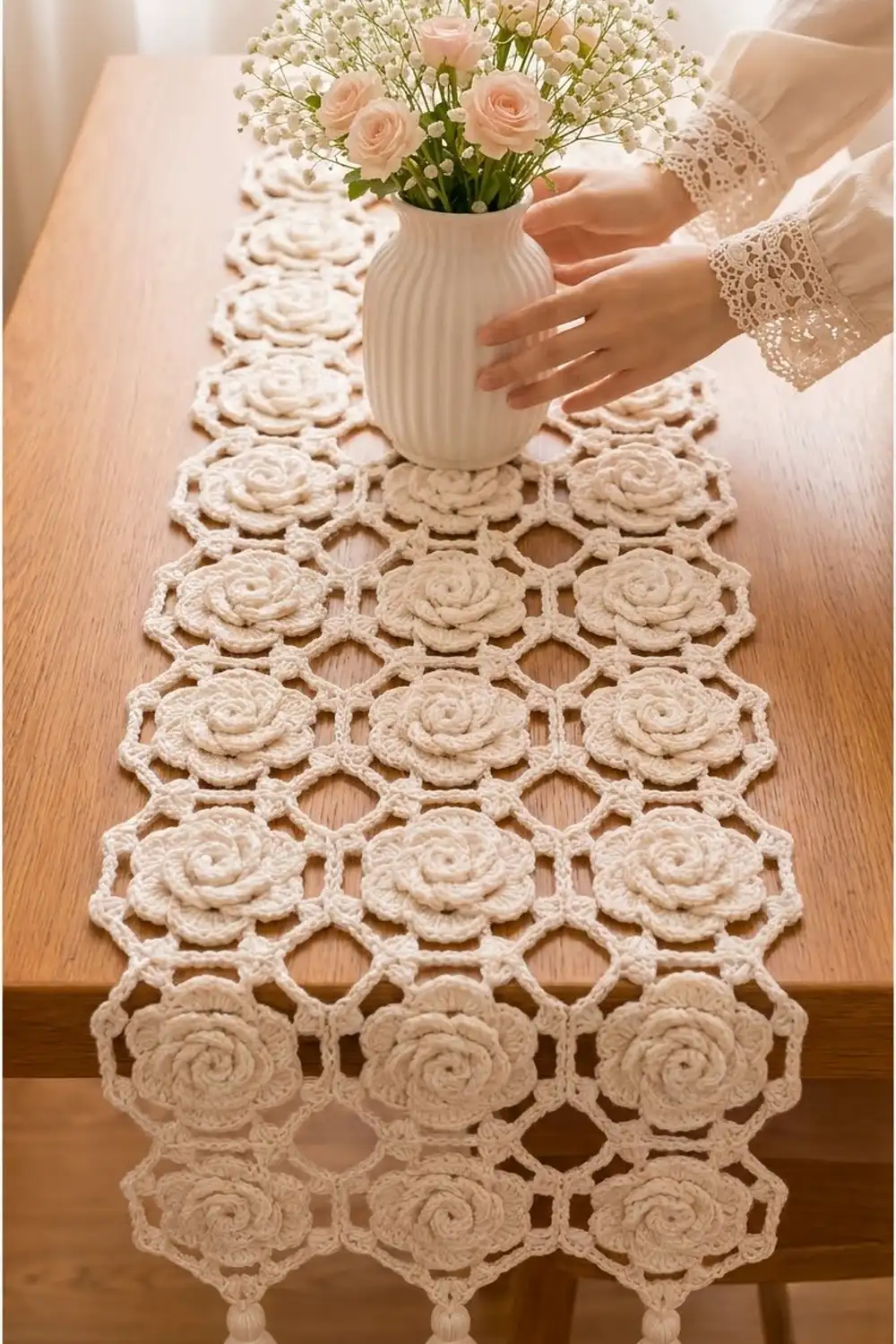
This runner is made from thirty octagon motifs, and each one has a raised, three-layer rose at its center. The rose sits inside an open lace frame of chain spokes, dc shell corners, and a slim chain outline. When the motifs are joined, small square windows open up between them, which gives the runner its lattice look.
The sample uses only one color, a soft ivory cotton, so the texture does all the work. It suits a wedding table, a spring centerpiece, or an everyday dining table with a simple vase of flowers.
All terms are US crochet terms. The finished runner measures about 14 x 45.5 in (35.6 x 115.6 cm) after the border, plus 4 in (10.2 cm) tassels at each short end.
You make one motif at a time in rounds: three rose layers, a flat ring behind them, then the octagon frame. From the second motif on, you join each motif while working its last round. One border round finishes the edge, and three tassels hang from each end.
Finished Size and Construction
- Finished size: 14 x 45.5 in (35.6 x 115.6 cm), tassels not included
- Skill level: Intermediate
- Terminology: US terms
- Yarn weight: Sport (#2) cotton
- Hook: 3.0 mm (US C/2 or D/3)
- Number of pieces: 30 octagon motifs, plus 6 tassels
- Layout: 3 motifs wide x 10 motifs long
- Motif size: 4.5 in (11.4 cm) from flat side to flat side
- Size before border: 13.5 x 45 in (34.3 x 114.3 cm)
- Border depth: about 0.25 in (0.6 cm)
- Tassel length: 4 in (10.2 cm)
Materials
Yarn: Use a smooth combed or mercerized sport-weight cotton with about 155 m (170 yd) per 50 g. Cotton gives the petals clean edges and holds the octagon shape. Avoid fuzzy or stretchy yarn because it blurs the lace.
- Ivory: 350 g (1,085 m / 1,187 yd), about 7 balls of 50 g
Each motif uses about 9 g (28 m / 31 yd). The border uses about 10 g (31 m / 34 yd), and the six tassels use about 18 g (56 m / 61 yd) together. The amount listed includes a margin of roughly 15 percent for swatching and dye-lot safety.
Tools:
- 3.0 mm crochet hook
- Tapestry needle and scissors
- Rust-proof pins, blocking mat, spray bottle
- Stiff card, 4.5 in (11.4 cm) tall, for tassels
- Measuring tape
Abbreviations (US Terms)
- ch – chain
- sl st – slip stitch
- sc – single crochet
- hdc – half double crochet
- dc – double crochet
- sp(s) – space(s)
- sk – skip
- rep – repeat
- st(s) – stitch(es)
Back post single crochet (bpsc): Insert the hook from back to front to back around the post of the stitch indicated, yarn over, pull up a loop, yarn over, pull through both loops. This puts each new round of chain loops behind the earlier petals.
Shell: (3 dc, ch 2, 3 dc) in the same space.
Corner tip: (sc, ch 3, sc) in the same space.
Gauge and Checkpoints
Thirty motifs multiply any small error, so make one complete motif first, block it, and measure it.
- After Round 3: the inner rose is about 1.5 in (3.8 cm) across.
- After Round 7: the full rose is about 2.75 in (7.0 cm) across.
- After Round 9: the flat ring is about 2.5 in (6.4 cm) across.
- After Round 11: the frame is about 4 in (10.2 cm) from flat side to flat side.
- After Round 12 and blocking: the motif is 4.5 in (11.4 cm) from flat side to flat side.
Too big: Go down to a 2.75 mm hook, or tighten your chains, which grow the most in the frame rounds.
Too small: Go up to a 3.25 mm hook, and check that the ch-8 spokes in Round 10 aren’t pulled tight.
An error of 0.25 in (0.6 cm) per motif becomes 2.5 in (6.4 cm) over the length of the runner, so fix it now.
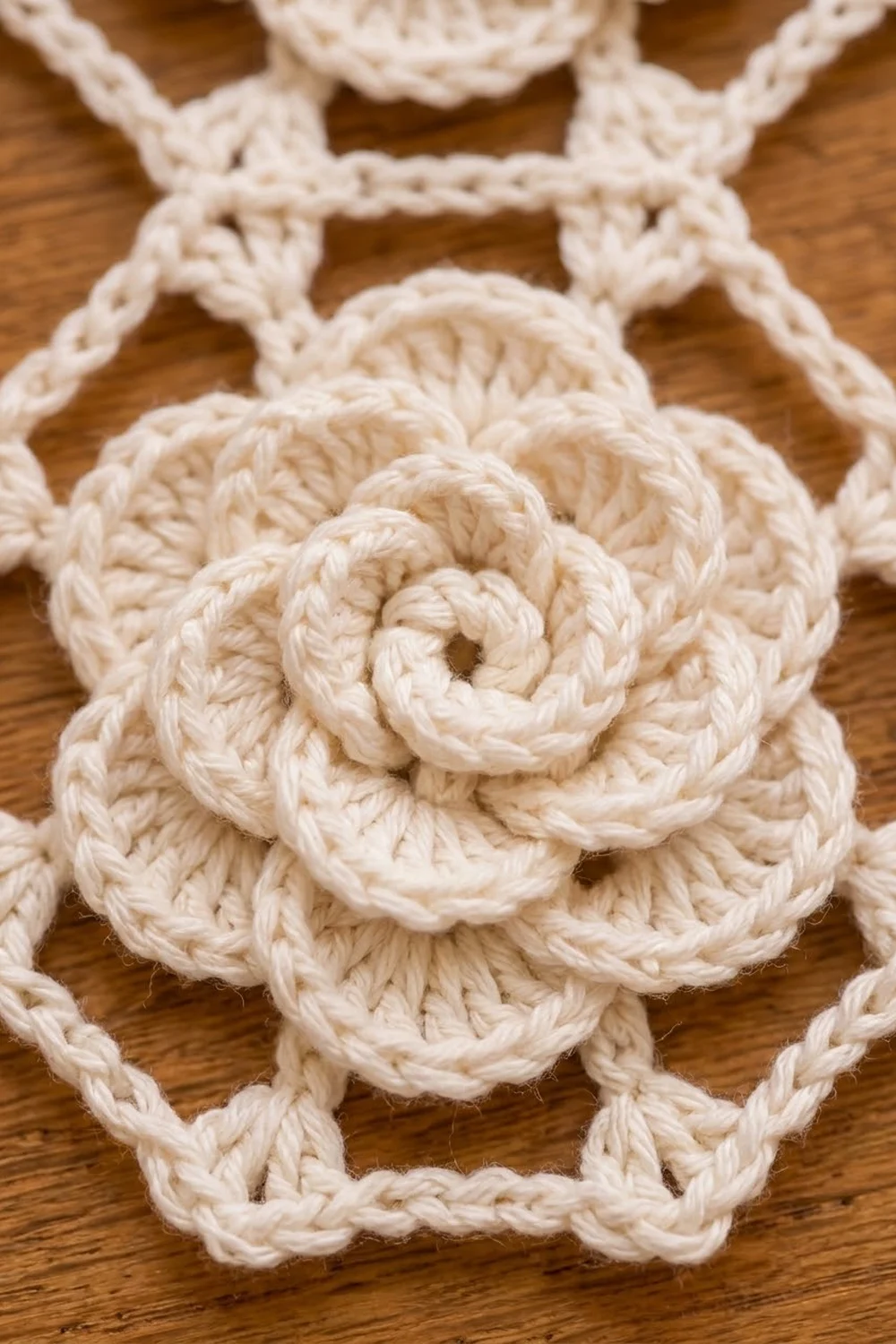
Rose Octagon Motif
Work in joined rounds with the right side facing. Do not turn.
Round 1: Make a magic ring, ch 1, 10 sc in ring, sl st to first sc. Pull the ring closed. (10 sc)
Round 2: Ch 1, sc in first sc, ch 3, sk next sc, *sc in next sc, ch 3, sk next sc; rep from * 3 more times, sl st to first sc. (5 sc, 5 ch-3 sps)
Round 3 (first petal layer): Sl st into first ch-3 sp, ch 1, (sc, hdc, 3 dc, hdc, sc) in each ch-3 sp around, sl st to first sc. (5 petals, 35 sts)
Round 4: Ch 1. Working behind the petals, bpsc around first sc of Round 2, ch 5, *bpsc around next sc of Round 2, ch 5; rep from * 3 more times, sl st to first bpsc. (5 bpsc, 5 ch-5 sps)
Round 5 (second petal layer): Sl st into first ch-5 sp, ch 1, (sc, hdc, 5 dc, hdc, sc) in each ch-5 sp around, sl st to first sc. (5 petals, 45 sts)
Round 6: Ch 1. Working behind, bpsc around first bpsc of Round 4, ch 6, *bpsc around next bpsc of Round 4, ch 6; rep from * 3 more times, sl st to first bpsc. (5 bpsc, 5 ch-6 sps)
Round 7 (third petal layer): Sl st into first ch-6 sp, ch 1, (sc, hdc, 7 dc, hdc, sc) in each ch-6 sp around, sl st to first sc. (5 petals, 55 sts)
Use your fingers to cup the first two petal layers toward the center. The small inner petals curl into each other and look like a rolled rose center.
Round 8: Ch 1. Working behind, bpsc around first bpsc of Round 6, ch 7, *bpsc around next bpsc of Round 6, ch 7; rep from * 3 more times, sl st to first bpsc. (5 bpsc, 5 ch-7 sps)
Round 9 (flat ring, conversion round): Sl st into first ch-7 sp, ch 1, 8 sc in each ch-7 sp around, sl st to first sc. (5 sps x 8 sc = 40 sc)
This round turns five petal sections into eight frame sections, because 40 sc divides into 8 repeats of 5.
Round 10 (spokes): Ch 1, sc in first sc, ch 8, sk next 4 sc, *sc in next sc, ch 8, sk next 4 sc; rep from * 6 more times, sl st to first sc. (8 sc, 8 ch-8 sps)
Round 11 (shell corners): Sl st in first 3 ch and into the ch-8 sp, ch 3 (counts as first dc), (2 dc, ch 2, 3 dc) in same sp, ch 3, *shell in next ch-8 sp, ch 3; rep from * 6 more times, sl st to top of beginning ch-3. (8 shells = 48 dc, 8 ch-2 corner sps, 8 ch-3 side sps)
Each shell becomes one corner of the octagon. Each ch-3 sits over a Round 10 sc and marks the middle of a side.
Round 12 (outline): Sl st in next 2 dc and into the ch-2 sp, ch 1, corner tip in same sp, *ch 5, sc in next ch-3 sp, ch 5, corner tip in next ch-2 sp; rep from * 6 more times, ch 5, sc in last ch-3 sp, ch 5, sl st to first sc. Fasten off. (8 corner tips, 16 ch-5 sps, 24 sc)
Per side count: Each of the 8 sides has 2 ch-5 sps with 1 sc between them. The corner tips sit at the ends of the sides, and each one is shared by two neighboring sides. Count each tip once per corner, not once per side.
Make All Pieces
Make 1 complete motif (Rounds 1–12) for A1. For the other 29, work Rounds 1–11, then join during Round 12.
- Ivory: 30 motifs total
Layout (3 wide x 10 long):
Row 1:  A1  B1  C1
Row 2:  A2  B2  C2
Row 3:  A3  B3  C3
Row 4:  A4  B4  C4
Row 5:  A5  B5  C5
Row 6:  A6  B6  C6
Row 7:  A7  B7  C7
Row 8:  A8  B8  C8
Row 9:  A9  B9  C9
Row 10: A10 B10 C10
Turn every motif so its flat sides face up (N), down (S), left (W), and right (E). The four diagonal sides (NW, NE, SW, SE) stay free.
Joining
Method: Join as you go on Round 12. Only the straight N, S, E, and W sides are joined. The free diagonal sides form small square windows wherever four motifs meet.
Stitch-to-stitch logic: Work Round 12 as written until you reach the first corner tip of the side you’re joining. Then:
- Joined corner tip: sc, ch 1, sl st into the matching ch-3 tip of the finished motif, ch 1, sc.
- Joined ch-5 sp: ch 2, sl st into the matching ch-5 sp of the finished motif, ch 2.
- Work the sc into the ch-3 sp between the two ch-5 sps as usual.
One joined side uses 2 joined tips and 2 joined ch-5 sps. Ch 1 + sl st + ch 1 replaces ch 3, and ch 2 + sl st + ch 2 replaces ch 5, so the join adds or loses no length.
Order:
- A1 is the complete motif.
- B1 joins its W side to A1’s E side. C1 joins its W side to B1’s E side.
- A2 joins its N side to A1’s S side.
- B2 joins its N side to B1’s S side and its W side to A2’s E side. The free NW diagonal separates these two sides, so they never share a tip.
- Keep going the same way to C10.
Every joined tip connects exactly two motifs.
Tension: Keep each joining sl st as loose as the chains around it. A tight sl st puckers the seam and pulls the windows out of shape.
Size checkpoint: Row 1 should be 13.5 in (34.3 cm) wide, which is 3 x 4.5 in (11.4 cm). After Row 4, the length should be 18 in (45.7 cm). The joined panel should measure 13.5 x 45 in (34.3 x 114.3 cm).
Border
The border is one round of sc worked over the outline chains. It turns the thin edge into a firm, rope-like edge and keeps the scalloped octagon shape.
Border gauge: 5 sc worked into one ch-5 sp should lie flat across about 0.75 in (1.9 cm), the same length as the chain underneath.
Border rules:
- Each free ch-5 sp: 5 sc.
- Each free corner tip: (sc, ch 3, sc) in the ch-3 tip.
- Each junction, where two motifs meet at the inner point of an edge notch: 1 sc in the joining sl st.
Border Round: With the right side facing, join yarn in the free tip between the N side and NW diagonal of A1. Work around the whole outer edge using the border rules, then sl st to first sc. Fasten off.
Long side, per motif (A column): NW diagonal (10 sc) + NW/W tip (2 sc) + W side (10 sc) + W/SW tip (2 sc) + SW diagonal (10 sc) = 34 sc and 2 ch-3 tips. The C column mirrors this on its E side.
Long side total: 10 motifs x 34 sc = 340 sc, plus 9 junctions x 1 sc = 9 sc, for a total of 349 sc and 20 ch-3 tips.
Short end, per motif: N/NW tip (2 sc) + N side (10 sc) + N/NE tip (2 sc) = 14 sc and 2 ch-3 tips. The bottom end mirrors this on the S sides.
Short end notches: inner diagonal of one motif (10 sc) + 1 junction sc + inner diagonal of the next motif (10 sc) = 21 sc. Each end has 2 notches.
Short end total: 3 x 14 sc = 42 sc, plus 2 x 21 sc = 42 sc, for a total of 84 sc and 6 ch-3 tips.
Full round: (2 x 349) + (2 x 84) = 866 sc and 52 ch-3 tips.
Why the math works: Each ch-5 sp gets exactly 5 sc, one per chain, so the edge doesn’t ruffle or pull in. The tips repeat the motif’s own (sc, ch 3, sc), so the corners stay pointed. Every part of the edge is counted only once: the outer diagonals belong to the long sides, and the N or S corner tips belong to the short ends.
Tassels (make 6): Wrap ivory 40 times around the 4.5 in (11.4 cm) card. Slide a 12 in (30.5 cm) strand under the top and knot it tightly. Cut the loops at the bottom. Wrap another strand 8 times around the bundle 0.5 in (1.3 cm) below the top, knot it, and bury the ends inside. Trim to 4 in (10.2 cm) below the neck.
Tie one tassel to the center of the N side of A1, B1, and C1, around the Round 12 sc between the two ch-5 sps. Do the same on the S side of A10, B10, and C10.
Final Blocking
- Weave in all ends through dc and sc, not along open chains.
- Soak the runner in cool water for 10 minutes. Press out the water and roll the runner in a towel.
- Lay it flat on blocking mats, right side up.
- Pin the long edges to 45.5 in (115.6 cm), then pin the short ends to 14 in (35.6 cm).
- Pin each corner tip so every motif is a crisp octagon and every window is open and even.
- Cup the petals forward and press each rose center inward.
- Let it dry completely, at least 24 hours.
- Unpin, comb out the tassels, and trim them to an even 4 in (10.2 cm).
Final Quality-Control Checklist
- All 30 motifs measure 4.5 in (11.4 cm) from flat side to flat side.
- Each rose has 3 layers of 5 petals.
- Every motif has 8 shell corners and 16 ch-5 sps.
- Only straight sides are joined, and all diagonals are free.
- Each square window has 4 free diagonal sides of equal length.
- The border has 349 sc on each long side and 84 sc on each short end.
- The runner measures 14 x 45.5 in (35.6 x 115.6 cm).
- Six 4 in (10.2 cm) tassels hang centered on the end motifs.
- No ends show on the front.
Troubleshooting
Petals look flat: Work the bpsc rounds from behind so the new loops sit behind the previous petals.
Rose crowds the frame: Loosen the ch-7 loops in Round 8 so Round 9 lies flat.
Octagon looks round: Make sure each shell has its ch-2 point, and pin the tips firmly.
Seams pucker: The joining sl st is too tight. Loosen it or redo the join on that side.
Uneven windows: One motif is a different size. Remake any motif that is off by more than 0.25 in (0.6 cm).
Border ruffles: Recount. Each ch-5 sp gets only 5 sc.
Border pulls in: Use a 3.25 mm hook for the border round only.
Care
Hand wash in cool water with mild soap, roll in a towel, and dry flat, pinning the tips if needed. Keep it out of the dryer, which crushes the roses and tangles the tassels.
Final Notes
The size of this runner follows one simple chain of measurements. The rose reaches 2.75 in (7.0 cm), the frame brings each motif to 4.5 in (11.4 cm), and 3 x 10 motifs make 13.5 x 45 in (34.3 x 114.3 cm). The border adds 0.25 in (0.6 cm) on every edge for a final size of 14 x 45.5 in (35.6 x 115.6 cm), and the tassels add 4 in (10.2 cm) at each end. Get the first motif right and the rest will follow.
Happy crocheting!