

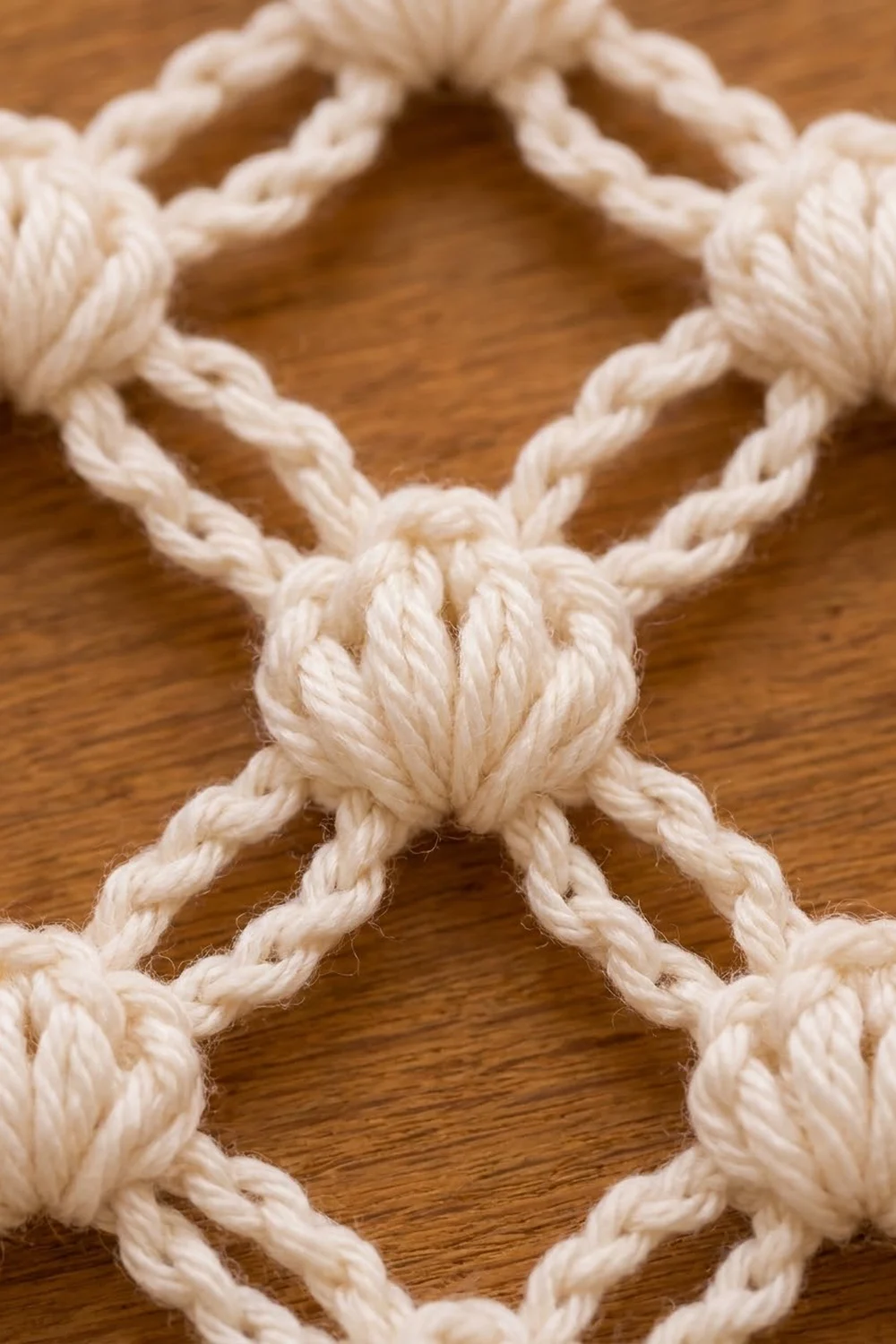
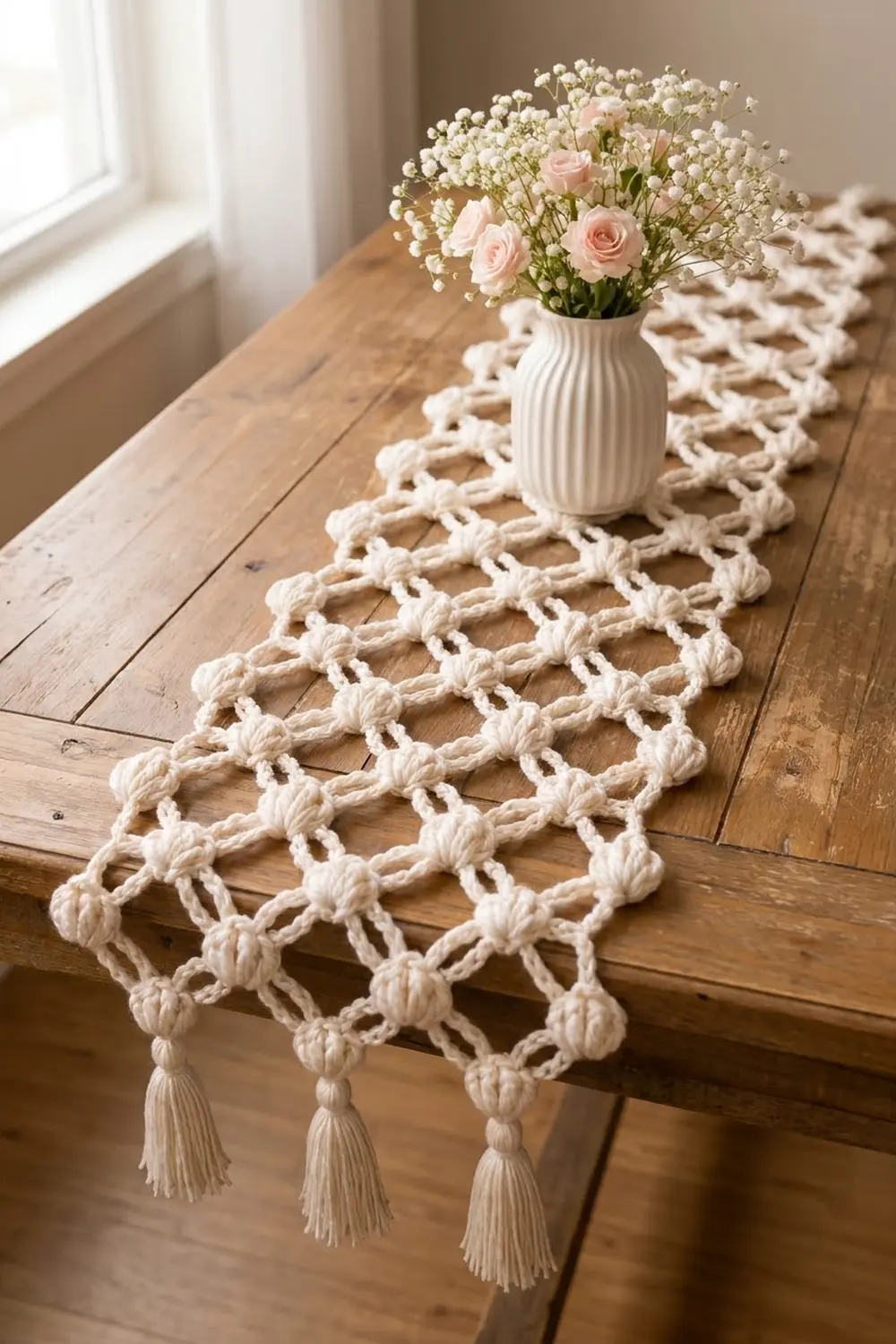
The Ivory Trellis Table Runner is an airy lattice of open diamonds, with a puffy, fan-ribbed shell node at every point where the lines cross. It’s worked in a single cream color, so the texture does all the work. The runner reads as soft and lacy without feeling fussy.
Each diamond side is a double chain cord, which looks like two parallel chain lines lying side by side. The long edges form a zigzag of half-diamonds, and each short end comes to three points finished with long, full tassels. This pattern uses US crochet terms throughout.
The finished runner measures about 13 in (33.0 cm) wide and 41 in (104.1 cm) long, plus 4 in (10.2 cm) tassels at each end, for 49 in (124.5 cm) overall.
The construction is unusual and very tidy. The runner is one continuous strand with no seams and no separate motifs. You zigzag back and forth up the length, making new nodes and joining to old ones. Then a single Left Edge Pass travels back down to close the left-hand half-diamonds. You only fasten off once.
Finished Size and Construction
- Finished size: 13 in x 41 in (33.0 cm x 104.1 cm), plus tassels
- Center-to-center lattice: 12 in x 40 in (30.5 cm x 101.6 cm)
- Skill level: Intermediate
- Terminology: US
- Yarn weight: Worsted (#4), cotton or cotton blend
- Hook: 5.0 mm (H-8)
- Number of pieces: 1 continuous piece, plus 6 tassels
- Layout: 3 diamonds across, 10 diamonds long in each column, with half-diamonds along both long sides
- Diamond size: 4 in (10.2 cm) wide and tall, node center to node center
- Size before border: 11 in x 41 in (27.9 cm x 104.1 cm)
- Border depth: the Left Edge Pass adds 2 in (5.1 cm) of width on the left side
Materials
Yarn: Use a smooth, firmly plied worsted cotton in cream or ivory. Cotton gives crisp nodes and blocks well. Avoid fuzzy yarns, because they blur the two lines of each cord.
- Cream: 100 g (about 170 m) total
- Lattice: about 55 g (94 m)
- Tassels: about 25 g (43 m)
These quantities include a margin of roughly 20 g (34 m) for the gauge swatch and trimming.
Tools:
- 5.0 mm (H-8) crochet hook
- Tapestry needle
- Sharp scissors
- Stiff card, 4.5 in (11.4 cm) tall, for tassels
- 4 locking stitch markers
- Blocking mats, rust-proof pins, and a spray bottle
- Measuring tape
Abbreviations (US Terms)
- ch: chain
- sl st: slip stitch
- dc: double crochet
- yo: yarn over
- st(s): stitch(es)
- dch: double chain (see below)
- SN: shell node (see below)
- J: join to an existing node (see below)
Double chain (dch): To start a cord, insert your hook into the stitch just made (a node’s lock chain or a join sl st), yo, pull up a loop (2 loops on hook), yo, and draw through both loops. For each following dch, insert the hook under the single left-hand strand of the dch just made, yo, pull up a loop, yo, and draw through both loops. This makes a flat cord with two parallel chain lines.
Shell node (SN): Ch 2, then work 5 dc under the two top strands of the last dch. Drop the loop, insert the hook front to back into the top of the first dc, pick up the dropped loop, and draw it through. Ch 1 to lock. The result is a puffy, fan-ribbed cluster about 1 in (2.5 cm) wide and 0.75 in (1.9 cm) tall.
Join (J): Insert the hook front to back through the lock ch of the existing node, yo, and draw through the node and the loop on your hook.
A note on direction: Keep the same side facing you throughout and never turn the work. The cord is free, so you simply lay it toward the next node. That keeps every node popping to the front.
Gauge and Checkpoints
Bar gauge: 7 dch = 1.75 in (4.4 cm), measured gently stretched.
Test diamond first: Make one SN as described in the Start section below. Then work [7 dch, SN] 3 times, followed by 7 dch and a J into the first SN. Fasten off.
Pin the diamond out lightly and mist it. Node center to node center should measure 4 in (10.2 cm) across and 4 in (10.2 cm) tall. Before blocking it usually relaxes to about 3.9 in (9.9 cm).
If it’s too big: Go down to a 4.5 mm hook, or work the cords more firmly.
If it’s too small: Go up to a 5.5 mm hook.
Don’t change the count of 7 dch per bar. Every measurement in this pattern is built on that number.
Checkpoints (node center to node center, lightly stretched):
- After Row 2: 4 in (10.2 cm) tall, 10 in (25.4 cm) wide
- After Row 10: 20 in (50.8 cm) tall
- After Row 20: 40 in (101.6 cm) tall
- After the Left Edge Pass: 12 in (30.5 cm) wide
The Lattice Map
Picture the nodes on a grid. Lines run across the runner and are numbered 1 to 21 from the bottom. Columns run lengthwise and are lettered A (left edge) through G (right edge).
- Odd lines (1, 3, … 21) have nodes in columns B, D, and F.
- Even lines (2, 4, … 20) have nodes in columns A, C, E, and G.
Each bar connects a node to a diagonal neighbor on the next line up or down. Lines 1 and 21 are the pointed ends, and their 3 nodes each get a tassel. Each line sits 2 in (5.1 cm) above the one below it, and neighboring columns are 2 in (5.1 cm) apart.
“Rows” are the crochet passes. Odd rows travel left to right, and even rows travel right to left.
Start
Make a slip knot and ch 3. Work 5 dc in the 3rd ch from the hook. Drop the loop, insert the hook into the top of the first dc, and draw the dropped loop through. Ch 1 to lock.
This is node B1, the bottom-left tip. Leave a 6 in (15.2 cm) tail. Place a marker in B1.
Rows
Row 1 (left to right):
- 7 dch, SN (C2)
- 7 dch, SN (D1, a tip)
- 7 dch, SN (E2)
- 7 dch, SN (F1, a tip)
- 7 dch, SN (G2, right edge)
Count: 35 dch, 5 new SN.
Row 2 (right to left):
- 7 dch, SN (F3)
- 7 dch, J to E2
- 7 dch, SN (D3)
- 7 dch, J to C2
- 7 dch, SN (B3)
Count: 35 dch, 3 new SN, 2 joins.
Row 3 (left to right):
- 7 dch, SN (C4)
- 7 dch, J to D3
- 7 dch, SN (E4)
- 7 dch, J to F3
- 7 dch, SN (G4)
Count: 35 dch, 3 new SN, 2 joins.
Row 4 (right to left):
- 7 dch, SN (F5)
- 7 dch, J to E4
- 7 dch, SN (D5)
- 7 dch, J to C4
- 7 dch, SN (B5)
Count: 35 dch, 3 new SN, 2 joins.
Rows 5–20: Repeat Rows 3 and 4 eight more times.
- Each odd row starts at column B on line r. It makes new nodes at C, E, and G on line r+1, and joins to D and F on line r.
- Each even row starts at column G on line r. It makes new nodes at F, D, and B on line r+1, and joins to E and C on line r.
Row 20 makes the three top tips, F21, D21, and B21, and ends at B21. Place a marker in B21.
Every row has 35 dch. Row 1 has 5 new SN. Rows 2–20 each have 3 new SN and 2 joins.
Totals after Row 20: 700 dch, 63 SN. All 10 right-edge nodes are done (G2 through G20), and the left side shows a straight run of B nodes.
Border: Left Edge Pass
The runner has no solid border. Its outline is the open zigzag itself, so the “border” is the pass that completes the left-hand half-diamonds.
Border gauge: Same as the body. Each pair of bars forms one tooth, which spans 4 in (10.2 cm) of length and sticks out 2 in (5.1 cm) sideways.
Edge Pass (top to bottom, from B21):
- [7 dch, SN (A20), 7 dch, J to B19]
- [7 dch, SN (A18), 7 dch, J to B17]
- Continue in this pattern down the left side.
- The last repeat is [7 dch, SN (A2), 7 dch, J to B1].
Count: 10 repeats, 20 bars, 140 dch, 10 new SN, 10 joins. Fasten off, leaving a 6 in (15.2 cm) tail.
Per-side counts:
- Right side (built during the rows): 10 edge nodes, 20 bars, 140 dch
- Left side (Edge Pass): 10 edge nodes, 20 bars, 140 dch
- Each end: 3 tips, 0 added stitches
Why the math works: Both long sides have exactly 10 teeth at 4 in (10.2 cm) each, which gives 40 in (101.6 cm). That matches the lattice from line 1 to line 21: 20 line spacings at 2 in (5.1 cm) each. The Edge Pass moves the left outline from column B to column A, one column spacing, or 2 in (5.1 cm). That takes the center-to-center width from 10 in (25.4 cm) to 12 in (30.5 cm). Half a node on each side adds about 1 in (2.5 cm) in total, for a finished width of 13 in (33.0 cm).
Final totals: 840 dch (120 bars x 7), 73 SN (33 on odd lines + 40 on even lines).
Tassels (make 6):
- Wrap yarn 30 times around the 4.5 in (11.4 cm) card.
- Slide a 10 in (25.4 cm) tie under the wraps at the top and knot it tightly.
- Cut the wraps at the bottom.
- Wrap a separate strand around the tassel 0.75 in (1.9 cm) below the top, 6 times, and knot it. Bury the ends inside.
- Thread the top ties through the base of a tip node (B1, D1, F1, B21, D21, or F21) and knot them securely on the back.
- Trim the tassel to 4 in (10.2 cm) below the node.
Final Blocking
- Weave in the start and end tails along the nearest cord, splitting the plies. Don’t trim them yet.
- Soak the runner in cool water for 10 minutes. Press out the water in a towel without wringing it.
- Lay the runner flat on the mats. Pin line 1 and line 21 so the tips are 40 in (101.6 cm) apart, center to center.
- Pin the A and G edge nodes 12 in (30.5 cm) apart, center to center.
- Pin every interior node so each diamond is 4 in (10.2 cm) square on its points. Check the columns with a straight edge.
- Pinch each node so it sits rounded and fan-shaped.
- Let it dry completely, then unpin it. Trim the tails.
- Mist the tassels, comb them straight, and trim them evenly to 4 in (10.2 cm).
Final Quality-Control Checklist
- Every bar has exactly 7 dch, for 120 bars in total.
- There are 73 nodes, and all of them pop to the front.
- Lines 1 and 21 each have 3 tips, and each tip has a tassel.
- Both long sides have 10 edge nodes and no vertical bars.
- Every join is tight, with no gaps where cords meet.
- The finished size is 13 in x 41 in (33.0 cm x 104.1 cm), plus tassels.
- The diamonds are even, at 4 in (10.2 cm) each.
Troubleshooting
Diamonds lean or skew: One bar probably has 6 or 8 dch. Count each leg of the faulty diamond and rework that bar.
A node pops to the back: You inserted the hook back to front when closing it. Redo that node, going front to back.
A wobbly cord: Make sure you always insert under the single left-hand strand. Picking up two strands thickens the cord and twists it.
Joins slide along the node: Work the J through the lock ch itself, not through the side of a dc.
The runner is narrower than 12 in (30.5 cm) between edge nodes: Your tension is tight. Block more firmly, or rework with a 5.5 mm hook.
The tassels splay: Tighten the neck wrap and steam them lightly.
Care
Hand wash cool and dry flat, reshaping the diamonds while damp. If needed, press lightly through a cloth with a warm iron, avoiding the nodes.
Final Notes
The whole runner rests on one measurement chain. Seven dch make a 1.75 in (4.4 cm) bar. A bar plus a 1 in (2.5 cm) node blocks to a 4 in (10.2 cm) diamond. Twenty line spacings give 40 in (101.6 cm) of length, and six column spacings give 12 in (30.5 cm) of width. Adding half a node all around brings the runner to 13 in x 41 in (33.0 cm x 104.1 cm), and the tassels bring it to 49 in (124.5 cm).
If your test diamond is right, everything that follows will be right too.
Happy crocheting!