
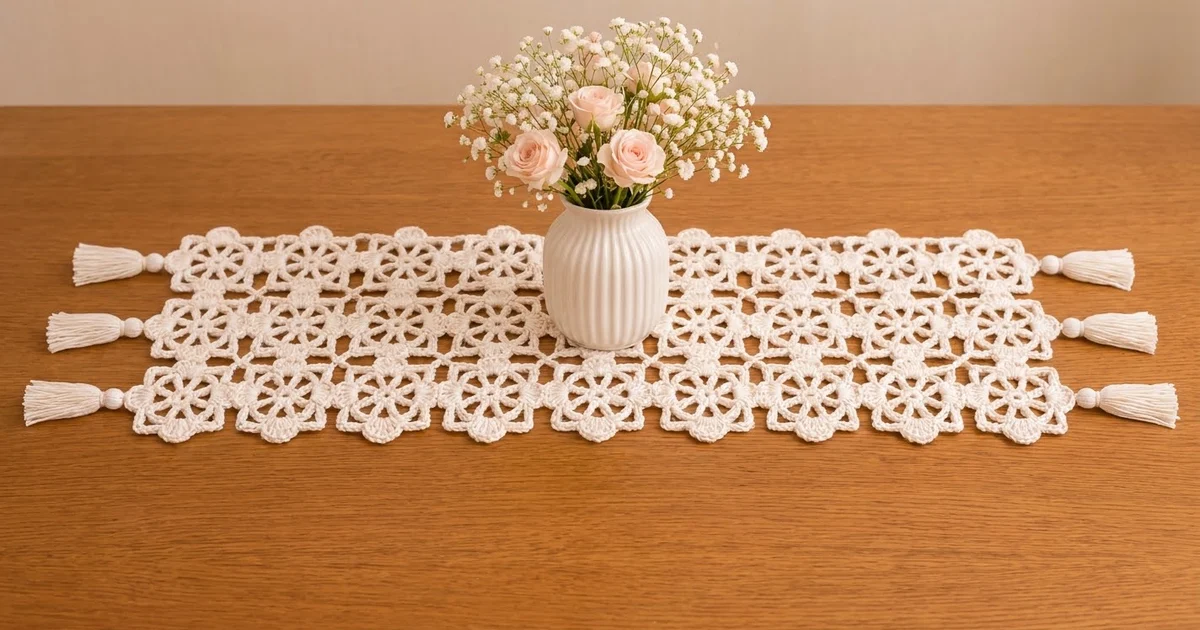
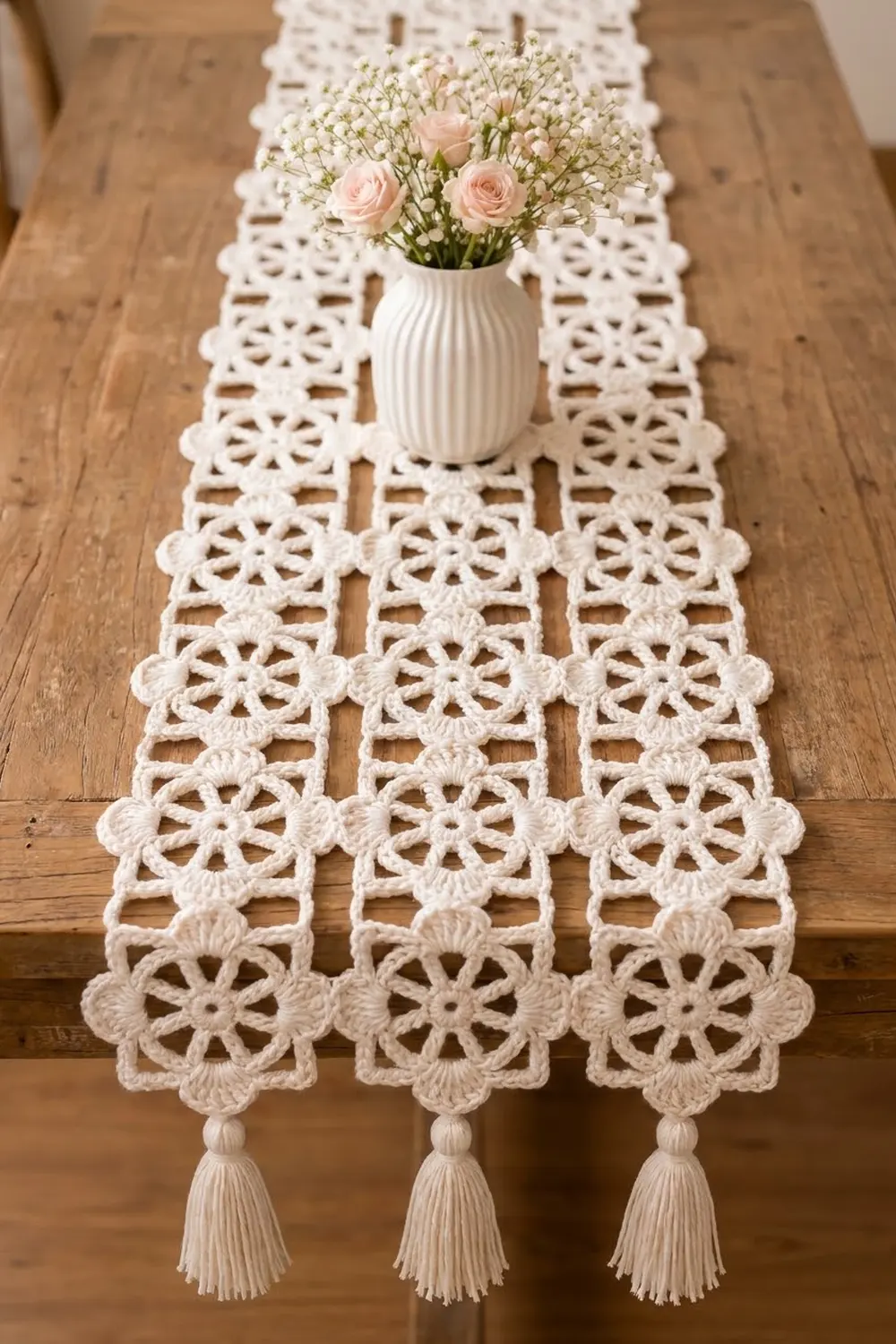
This airy runner is built from simple square lace motifs. Each one has a spoked wheel inside a crisp square frame, with a soft fan shell on each side. When the motifs are joined, small rectangular windows open up between them and the shells form a gentle scallop along the edges. A trio of plump tassels at each end finishes the look.
The sample is worked in a single ivory cotton, which shows off the lace and suits both rustic wood and formal tables. The style is vintage-inspired but clean, with no beads, picots, or color changes.
All instructions use US crochet terms. The finished runner measures 16.25 in (41.3 cm) wide by 54.75 in (139.1 cm) long, not counting the shell tips or the tassels. Each tassel adds 4 in (10.2 cm) at each end.
You make 30 motifs in rounds and join them as you go on the final round. Then you work one round of border around the whole runner and add six tassels.
Finished Size and Construction
- Finished size: 16.25 in x 54.75 in (41.3 cm x 139.1 cm) after the border
- Skill level: Intermediate
- Terminology: US
- Yarn weight: DK / light worsted (3), cotton
- Hook: 3.5 mm (E-4)
- Number of pieces: 30 motifs
- Layout: 3 motifs wide x 10 motifs long
- Motif size: 5 in (12.7 cm) square across the frame; 5.5 in (14.0 cm) from shell tip to shell tip
- Gap between frames: 0.5 in (1.3 cm), bridged by the joins
- Size before border: 16 in x 54.5 in (40.6 cm x 138.4 cm)
- Border depth: 0.125 in (0.3 cm) on each side
Materials
Use a smooth mercerized or combed cotton in DK weight. Cotton keeps the spokes straight and the frame lines crisp, and it washes well. Acrylic will work, but the lace will look softer and less defined.
- Ivory/off-white: 250 g, about 560 m (612 yd), for example five 50 g balls of 112 m each
These quantities include a margin of about 20% over the estimated use (roughly 390 m for the motifs, 25 m for the border, and 37 m for the tassels).
Tools
– 3.5 mm (E-4) crochet hook
– Tapestry needle
– Scissors
– Stitch markers
– A 4 in (10.2 cm) piece of stiff cardboard for the tassels
– Blocking mats, rust-proof pins, and a spray bottle
Abbreviations (US Terms)
- ch – chain
- sl st – slip stitch
- sc – single crochet
- dc – double crochet
- tr – treble crochet
- dtr – double treble crochet: yarn over 3 times, insert hook, pull up a loop, then [yarn over, pull through 2 loops] 4 times
- sk – skip
- sp – space
- st(s) – stitch(es)
Special technique: dropped-loop join (DLJ). Take the hook out of the working loop. Insert the hook from front to back into the stitch you are joining to on the neighboring motif. Pick up the dropped loop and pull it through. Then carry on with the next stitch.
Gauge and Checkpoints
Gauge: 5 sc = 1 in (2.5 cm) along the straight frame lines.
Make one complete motif and block it before you start the rest. Measure at each of these stages:
- After Round 1: the ring is 1.25 in (3.2 cm) across.
- After Round 3: the wheel is 3 in (7.6 cm) across.
- After Round 5: the square frame is 4.5 in (11.4 cm) per side.
- After Round 6: the frame is 5 in (12.7 cm) per side, and the shells reach 5.5 in (14.0 cm) tip to tip.
Too big? Go down to a 3.25 mm hook, or chain more tightly on Rounds 2 and 4.
Too small? Go up to a 3.75 mm hook.
Even 0.25 in (0.6 cm) of error per motif adds up to 2.5 in (6.4 cm) over the length of the runner, so fix the gauge before you go on.
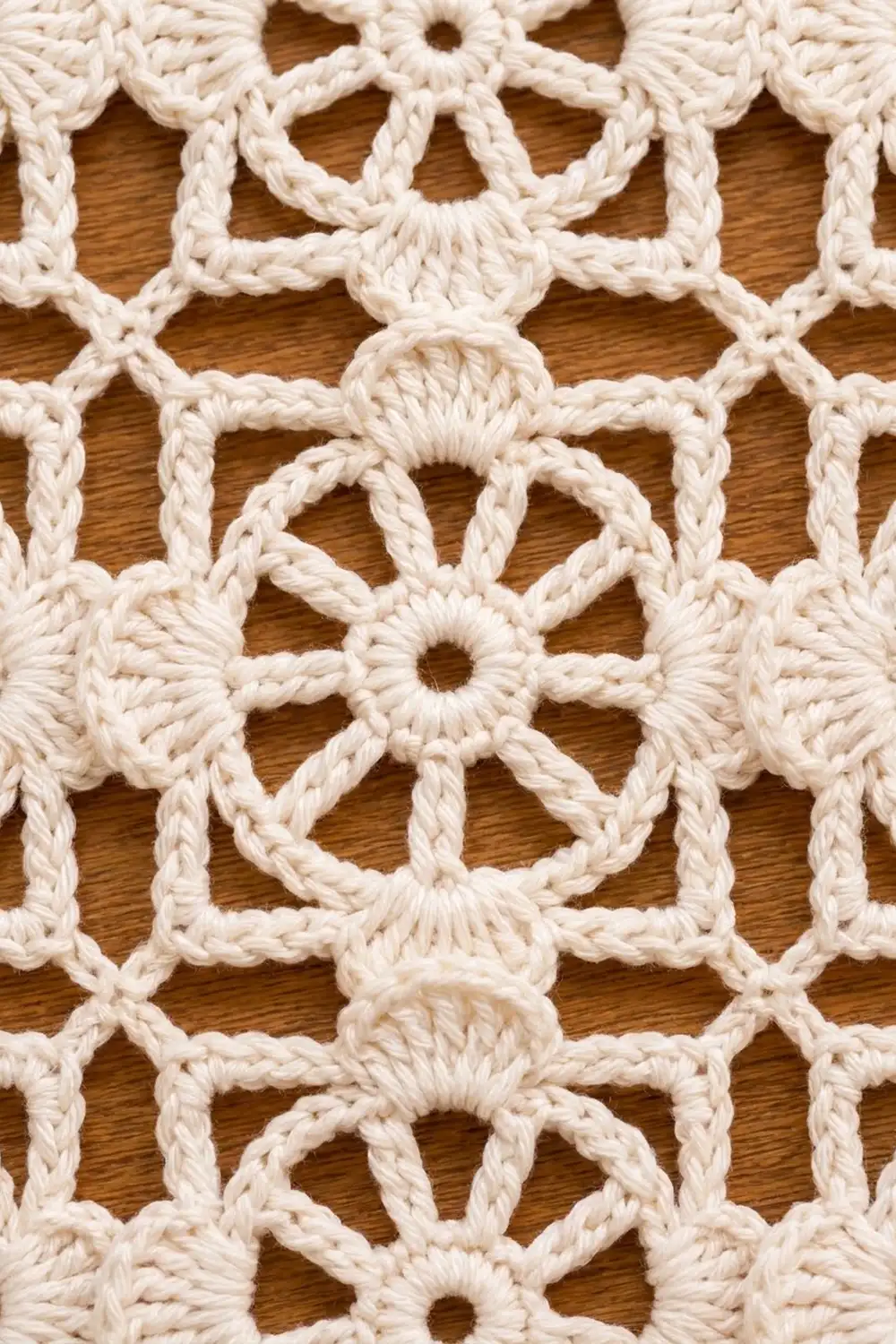
Motif Pattern
Round 1: Make a magic ring. Ch 3 (counts as dc), then work 15 dc into the ring. Pull the ring closed and leave a small hole. Sl st to the top of the ch-3. (16 dc)
Round 2 (spokes): Ch 5 (counts as dtr), ch 3, sk next dc. Dtr in next dc, ch 3, sk next dc. Repeat from * to * 6 more times. Sl st to the top of the ch-5. (8 dtr, 8 ch-3 sps)
Round 3 (wheel): Ch 1, sc in the same st, 5 sc in the next ch-3 sp. Sc in next dtr, 5 sc in next ch-3 sp. Repeat from * to * 6 more times. Sl st to the first sc. (48 sc)
The spokes should lie straight. If they bow, your chains are too loose.
Round 4 (frame posts): Ch 4 (counts as tr), ch 19, sk next 11 sc. Tr in next sc, ch 19, sk next 11 sc. Repeat from * to * 2 more times. Sl st to the top of the ch-4. (4 tr, 4 ch-19 sps)
Each tr sits 12 stitches from the next one, at the four midpoints of the wheel. Mark these four posts; they are the “midpoints” (M).
Round 5 (square frame): Ch 1, sc in the same st (M). Working into the chains themselves, not around the space: sc in each of the next 9 ch, 3 sc in the next ch (corner), sc in each of the next 9 ch, sc in the next tr (M). Repeat from * to * 3 more times, leaving out the last sc on the final repeat. Sl st to the first sc. (88 sc)
Each side now has 23 sts, counting the center corner sc at each end: 1 + 1 + 9 + 1 + 9 + 1 + 1. The total is 4 × 23 − 4 shared corners = 88.
Round 6 (shells and corner loops): Ch 3 (counts as dc), 10 dc in the same st, which is M. That gives an 11-dc shell. Sk next 2 sc, sc in each of the next 7 sc, sc in the next sc (first corner sc), then (sc, ch 3, sc) in the center corner sc. Sc in the next sc (third corner sc), sc in each of the next 7 sc, sk next 2 sc, 11 dc in the next M. Repeat from * to , leaving out the last shell on the final repeat. Sl st to the top of the ch-3. Fasten off and weave in the ends. (116 sts: 44 dc + 72 sc, plus 4 ch-3 corner sps)*
Per-side count: from one corner (sc, ch 3, sc) to the next, each side has 1 + 1 + 7 + 11 + 7 + 1 + 1 = 29 sts. That includes the two corner sc. The total is 4 × 29 = 116.
Each shell’s 6th dc is its tip. Skipping 2 sc on each side of the shell lets it fan out flat past the frame.
Make All Pieces
- Motif 1: work Rounds 1–6 in full.
- Motifs 2–30: work Rounds 1–5, then work Round 6 while joining to the motifs already in place.
- Total: 30 ivory motifs, about 13 m each.
Layout (numbers show the order you make and join the motifs):
[ 1][ 2][ 3]
[ 4][ 5][ 6]
[ 7][ 8][ 9]
[10][11][12]
[13][14][15]
[16][17][18]
[19][20][21]
[22][23][24]
[25][26][27]
[28][29][30]
Joining (Join-As-You-Go on Round 6)
Work Round 6 as written until you reach a side that touches a finished motif. Along that side, make these two changes.
At each joined corner: instead of (sc, ch 3, sc), work sc, ch 1, sl st into the neighbor’s ch-3 corner sp, ch 1, sc. Count this as the corner sp.
At each joined shell: work 5 dc, then work the 6th dc. Make a DLJ into the neighbor’s 6th dc (shell tip), then work the remaining 5 dc. The shell still has 11 dc.
Stitch logic: each joined side links 2 corners and 1 shell tip, and the motifs line up stitch for stitch. No stitches are added or lost, so every motif keeps 29 sts per side.
Four-way corners: where four motifs meet, sl st into the sl st of the earlier join, not into a corner sp. All four corners then meet at one point.
Tension: keep the ch-1s on each side of a corner join the same size as your normal chains. If they are too tight, the gap pinches and the windows turn into slits. If they are too loose, the runner sags.
Checkpoint: after row 2 (Motif 6), the width is 16 in (40.6 cm) and the length is 10.5 in (26.7 cm), frame edge to frame edge. That is 5 + 0.5 + 5 in. Each extra row adds 5.5 in (14.0 cm).
Border and Tassels
Border gauge: 5 sc = 1 in (2.5 cm), worked 1 sc per stitch. Because the round adds no stitches along the sides, it does not change the length of any edge. It only adds 0.125 in (0.3 cm) of depth.
Border Round: Join yarn in any outer corner ch-3 sp. Ch 1, then 3 sc in the same sp. Work along each edge as follows:
- Work 1 sc in each sc and each dc, including all 11 dc of every outer shell.
- At each seam along the edge, skip over the joined corner bridge (ch 1, sl st, ch 1) and go straight to the first sc of the next motif.
- At each of the four runner corners, work 3 sc in the ch-3 sp.
Sl st to the first sc and fasten off.
Counts:
– Each long side: 10 motifs × 29 = 290 sc
– Each short side: 3 motifs × 29 = 87 sc
– Corners: 4 × 3 = 12 sc
– Total: (290 + 290 + 87 + 87) worked 1 per existing stitch = 754, + 12 added at the corners = 766 sc
Why the math works: each side’s starting count is the number of motifs along it × 29. The seams add nothing, because the corner bridges are skipped and not worked into. Extra stitches go only into the four runner corners, which need them to turn flat.
Tassels (make 6): Wrap yarn 30 times around the 4 in (10.2 cm) cardboard. Tie the top with a 10 in (25.4 cm) strand and cut the bottom loops. Wrap a second strand tightly 0.75 in (1.9 cm) below the top, knot it, and bury the ends inside the tassel. Trim the bottom evenly. Use the top tie to sew one tassel to the shell tip on the short edge of each end motif: Motifs 1, 2, 3, 28, 29, and 30.
Final Blocking
- Weave in all remaining ends along the frame lines.
- Pin the runner to blocking mats, right side up, to 16.25 in x 54.75 in (41.3 cm x 139.1 cm).
- Pin each frame corner square, and keep the joined corners in straight lines.
- Pin each outer shell into a round fan.
- Spray until the runner is damp all over and pat the spokes straight.
- Leave it to dry completely, at least 12 hours.
- Unpin, then steam the tassels lightly and comb them straight.
Final Quality-Control Checklist
- 30 motifs, each with 8 straight spokes and 4 shells of 11 dc
- Each motif is 5 in (12.7 cm) per side
- All rectangular windows are the same size
- Every four-way corner meets at a single point
- Border has 290 / 87 / 290 / 87 sc plus 3 sc at each corner
- The runner lies flat with no ripples along the long edges
- 3 tassels at each end, all the same length and evenly spaced
- No ends showing on the right side
Troubleshooting
- The wheel cups: your chains are too tight on Round 2. Go up a hook size for that round only.
- The frame ruffles: your Round 4 chains are too loose. Check you have exactly 19 ch.
- Shells curl forward: make sure you skipped 2 sc on each side of every shell.
- The runner is getting narrower or wider: you probably miscounted a frame side. Count 29 sts per side before joining.
- The long edges wave after the border: you have added stitches at the seams. Take out the border and skip the bridges.
- Tassels look thin: use 35–40 wraps.
Care
Hand wash in cool water with a mild detergent. Roll the runner in a towel to remove water, then lay it flat and pin it back to size to dry.
Final Notes
The measurements build on each other. Gauge of 5 sc per inch gives 29 stitches per side and a 5 in (12.7 cm) motif. With 0.5 in (1.3 cm) gaps, the runner is 16 in x 54.5 in (40.6 cm x 138.4 cm) before the border and 16.25 in x 54.75 in (41.3 cm x 139.1 cm) after it. With the tassels, the total length is 62.75 in (159.4 cm). If you check your first motif carefully, the other 29 will fit together without trouble.
Happy crocheting!