
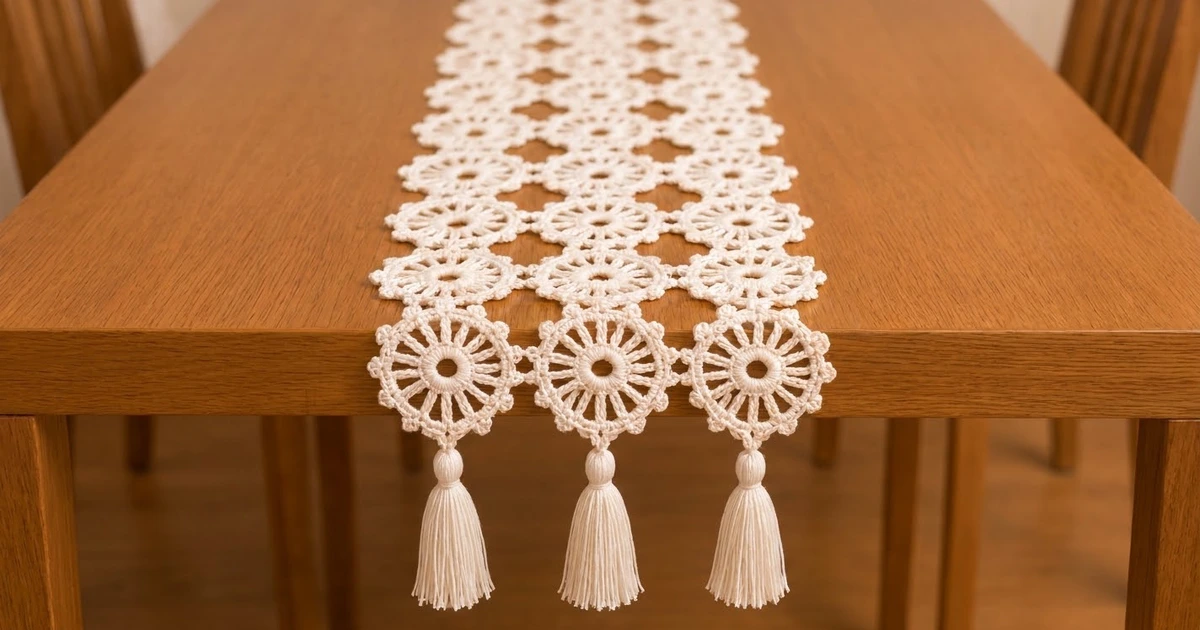
The Ivory Wheel Table Runner is a light, airy runner made of 30 round lace motifs. Each wheel has a padded center ring, eighteen tall spokes, a smooth outer ring, and a scalloped edge of tiny trefoil picots. The motifs connect only at their picot tips, so the wood of the table shows through every wheel and every gap between them.
It’s worked in a single shade of ivory cotton for a clean, vintage-cottage look that suits everyday dining and special occasions alike. A short tassel hangs from each end motif, three at each end, which gives the runner a soft, finished drop over the table edge.
This pattern uses US crochet terms. The runner measures 13.5 inches (34.3 cm) wide by 45 inches (114.3 cm) long. With the tassels it’s 53 inches (134.6 cm) end to end.
Construction is simple. You make the first motif completely. Every motif after that is joined to its neighbors while you work its final picot round (join-as-you-go). The tassels go on last, so there’s no sewing and no separate border.
Finished Size and Construction
- Finished size: 13.5 x 45 in (34.3 x 114.3 cm), plus 4 in (10.2 cm) tassels at each end
- Skill level: Easy intermediate
- Terminology: US crochet terms
- Yarn weight: Sport (#2) mercerized cotton
- Hook: 3.0 mm (US C/2 or D/3)
- Number of pieces: 30 identical motifs plus 6 tassels
- Layout: 3 motifs wide x 10 motifs long
- Piece size: 4.5 in (11.4 cm) across, trefoil tips included
- Size before border: 13.5 x 45 in (34.3 x 114.3 cm)
- Border depth: None. The trefoil round of each motif is the finished edge.
Materials
Yarn: Choose a smooth, mercerized sport-weight cotton, about 153 yd (140 m) per 50 g. Mercerized cotton shows the spokes crisply and holds its shape after blocking. Avoid fuzzy blends, which blur the open lace.
- Ivory (only color): 250 g, about 765 yd (700 m), or five 50 g balls
- Motifs: about 6 g each, 180 g total
- Tassels: about 5 g each, 30 g total
The quantities above include a margin of roughly 40 g for gauge swatching, joining tails and tassel trimming.
Tools:
– 3.0 mm crochet hook
– Tapestry needle
– Scissors
– Stiff card cut to 4.5 in (11.4 cm) tall, for the tassels
– Rustproof pins and a blocking mat at least 14 x 46 in (35.6 x 116.8 cm), or several mats side by side
– Spray bottle
– Measuring tape
Abbreviations (US Terms)
- ch: chain
- sl st: slip stitch
- sc: single crochet
- dtr: double treble crochet (yarn over 3 times, insert hook, pull up a loop, [yarn over, pull through 2 loops] 4 times)
- sp: space
- st(s): stitch(es)
- rep: repeat
Special stitches
Trefoil: Ch 5. Sl st in the 4th ch from the hook to make the first picot (1 stem ch remains below it). [Ch 3, sl st in the same ch] twice to make the center and third picots. Sl st in the remaining stem ch, then sl st in the top of the sc you just made.
Joined trefoil: Ch 5, sl st in the 4th ch from the hook (first picot). For the center picot, ch 1, sl st into the center picot of the matching trefoil on the finished motif, ch 1, sl st in the same ch as the first picot. Then ch 3, sl st in the same ch (third picot). Sl st in the remaining stem ch, then sl st in the top of the sc you just made.
Gauge and Checkpoints
Make one complete motif before anything else and block it lightly. It doubles as your gauge swatch.
Stitch gauge: 6 sc = 1 in (2.5 cm) in the motif’s outer ring.
Checkpoints, measured flat across the motif:
– After Round 1: 1.25 in (3.2 cm)
– After Round 2: 3.25 in (8.3 cm)
– After Round 3: 3.75 in (9.5 cm)
– After Round 4: 4.5 in (11.4 cm), tip to tip of opposite trefoils
A tolerance of 1/8 in (0.3 cm) per motif is fine. Across 10 motifs, though, 1/8 in (0.3 cm) adds up to 1.25 in (3.2 cm) on the runner’s length, so check carefully.
If your motif is too big: go down to a 2.75 mm hook. Also check that your dtr spokes aren’t loose at the top, because long stitches stretch easily.
If your motif is too small: go up to a 3.25 mm hook. Also check that Round 3 isn’t cupping, which makes the motif measure small.
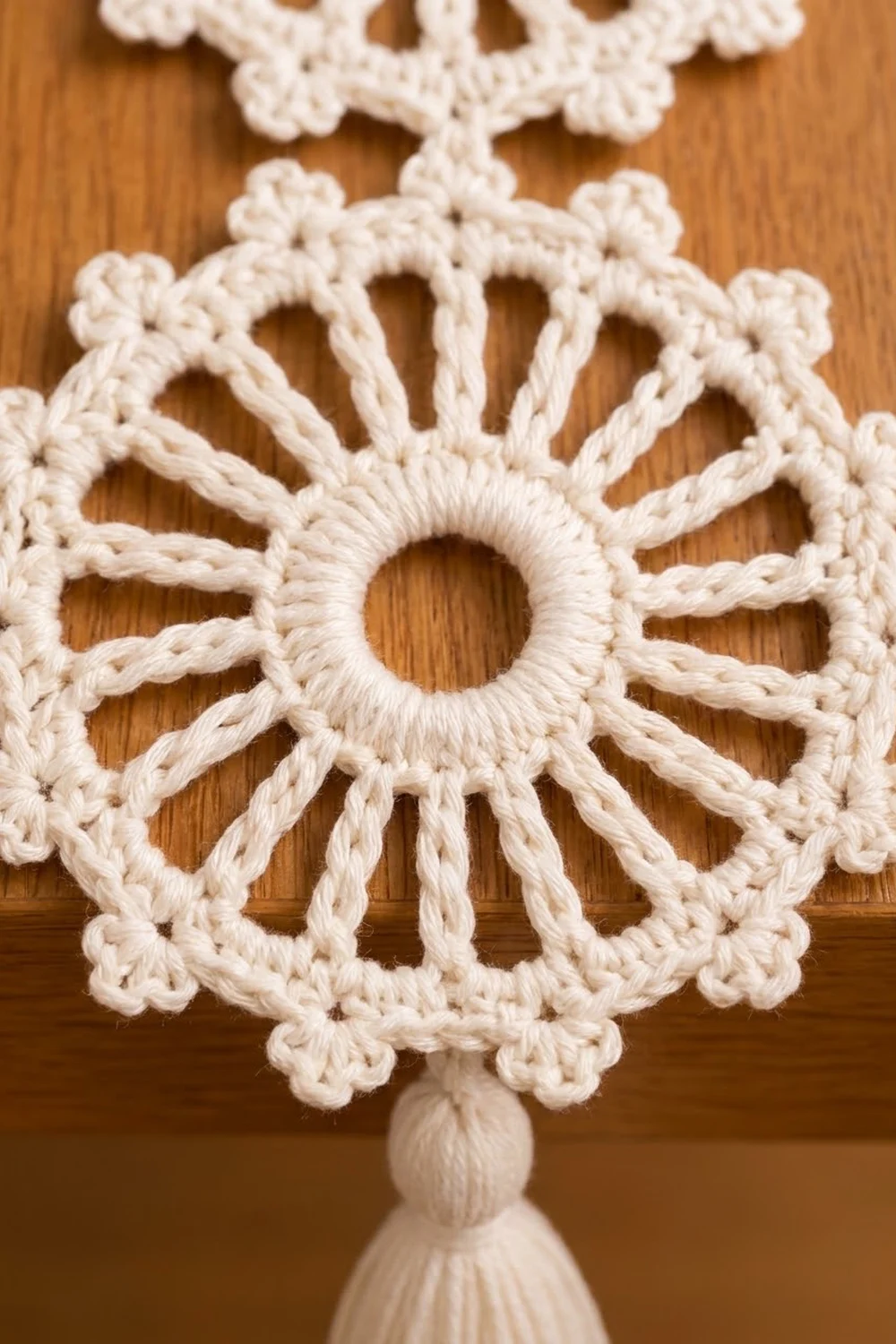
Motif (make 30)
Round 1: Ch 8, sl st in the first ch to form a ring. Ch 1, work 18 sc in the ring, sl st in the first sc. (18 sc)
Push the stitches together around the ring as you go. Packing 18 sc onto a small ring gives the thick, padded center.
Round 2: Ch 5 (counts as the first dtr), ch 3. Dtr in the next sc, ch 3; rep from * 16 more times. Sl st in the 5th ch of the beginning ch-5. (18 dtr, 18 ch-3 sps)*
These are the eighteen spokes. Keep every dtr the same height so the wheel stays round.
Round 3 (conversion round): Ch 1, sc in the same st as the join, 3 sc in the next ch-3 sp. Sc in the next dtr, 3 sc in the next ch-3 sp; rep from * 16 more times. Sl st in the first sc.
(18 sc worked one per dtr + 54 sc worked in spaces = 72 sc)*
This round makes the solid outer ring. Lay the motif flat at this point. It should measure 3.75 in (9.5 cm) across with no ruffling and no cupping.
Round 4, first motif only: Ch 1. Sc in each of the next 6 sc, trefoil; rep from * 11 more times. Sl st in the first sc and fasten off. (72 sc, 12 trefoils)*
Each trefoil sits on top of every 6th sc, which puts the twelve clusters exactly 30 degrees apart. Weave in the ends.
Round 4, joined motifs: Work Round 4 the same way, but swap in joined trefoils where the motif meets a neighbor. The joining section below explains exactly which ones.
Make All Pieces
- Ivory: 30 motifs. Motif 1 is finished on its own. Motifs 2 to 30 are worked through Round 3 and then joined as you complete Round 4.
Layout, working row by row from one short end:
Row 1:   M1   M2   M3
Row 2:   M4   M5   M6
Row 3:   M7   M8   M9
Row 4:   M10  M11  M12
Row 5:   M13  M14  M15
Row 6:   M16  M17  M18
Row 7:   M19  M20  M21
Row 8:   M22  M23  M24
Row 9:   M25  M26  M27
Row 10:  M28  M29  M30
Joining
Method: Join as you go on Round 4, center picot to center picot.
Stitch-to-stitch logic: Each motif has 12 trefoils. Each side that touches a neighbor uses 2 consecutive trefoils. Exactly 1 free trefoil sits between the pairs used for adjacent sides, which points diagonally into the gap. So going around the motif you get: pair, free, pair, free, pair, free, pair, free. That’s 4 x 2 + 4 x 1 = 12 trefoils.
Both motifs are worked in the same direction, so facing pairs mirror each other. The first trefoil of your new pair joins to the second trefoil of the neighbor’s pair, and the second joins to the first. Lay both motifs right side up before joining and check that nothing is twisted.
Order:
1. M2: join one pair to the right side of M1.
2. M3: join one pair to M2.
3. M4: join one pair to the bottom of M1.
4. M5: join one pair to M4 (left side) and one pair to M2 (top), with 1 free trefoil between those two pairs.
5. M6: join to M5 and M3 the same way.
6. Repeat Rows 2 and 3 of this order through M30.
Count around each new motif before you start Round 4 so the joined pairs land where you need them. Work the unjoined trefoils as normal trefoils.
Tension advice: Pull the joining sl st snug, but don’t tighten it so much that it draws the two motifs together. The two ch-1 stitches on either side of the joining sl st are what let the circles sit flat side by side.
Size checkpoint: After Row 2 (M6), the piece should measure 13.5 in (34.3 cm) wide by 9 in (22.9 cm) long. When all 10 rows are done, it should measure 13.5 x 45 in (34.3 x 114.3 cm), from 3 x 4.5 in (11.4 cm) and 10 x 4.5 in (11.4 cm).
Border
Border gauge: There are no border rounds. The edge is made up of the motifs’ own free trefoils, so the size before the border equals the finished size: 13.5 x 45 in (34.3 x 114.3 cm).
Edge trefoil counts:
– Each long side: 10 motifs x 4 outward trefoils = 40 trefoils
– Each short end: 3 motifs x 4 outward trefoils = 12 trefoils
– Corners: each corner motif has 1 diagonal trefoil that’s included in both its long-side count and its short-end count, so count it only once.
– Total edge trefoils: 40 + 40 + 12 + 12 – 4 shared corner trefoils = 100
Why the math works: The 30 motifs have 360 trefoils in total. Horizontal joins: 10 rows x 2 = 20. Vertical joins: 3 columns x 9 = 27. That’s 47 shared edges x 2 pairs each = 94 joins, which use 188 trefoils, leaving 172 free.
The runner has 18 interior points where four motifs meet (2 across x 9 down). Each one holds 4 diagonal trefoils, for 72 in total. 172 – 72 = 100 edge trefoils, which matches the count above.
Tassel bars (6 total): Each end motif has 2 outward-facing trefoils at its bottom center, the pair that would have joined a next row. Join yarn with a sl st in the center picot of the first one. Ch 5, sl st in the center picot of the second, and fasten off. Make 3 bars at each short end.
Tassels (make 6): Wrap yarn 60 times around the 4.5 in (11.4 cm) card. Slide a 10 in (25.4 cm) strand under the wraps at the top and tie it tightly. Cut the loops at the bottom. Wrap a second strand around the bundle 0.5 in (1.3 cm) below the top, tie it, and bury its ends inside the tassel. Trim the tassel to 4 in (10.2 cm). Use the top tie strand to knot each tassel around the center of a tassel bar, then hide those ends inside the tassel head.
Final Blocking
- Wet the runner in cool water, press out the water gently and roll it in a towel. Keep the tassels as dry as you can.
- Lay it flat on the mats and pin the four corners to a 13.5 x 45 in (34.3 x 114.3 cm) rectangle.
- Pin straight down each long side, putting a pin in each outward trefoil.
- Push the center of every wheel into a round shape and check that it measures 4.5 in (11.4 cm).
- Open each picot of the trefoils with a pin tip.
- Straighten the spokes so the gaps between them are even.
- Leave it to dry completely, at least 12 hours, before unpinning.
- Steam the tassels lightly and comb them straight, then trim any uneven ends.
Final Quality-Control Checklist
- All 30 motifs have 18 spokes, 72 sc in Round 3 and 12 trefoils.
- Every joined edge has exactly 2 joined trefoils, with 1 free trefoil between pairs.
- Each interior meeting point has 4 free diagonal trefoils facing a small, even gap.
- The runner measures 13.5 x 45 in (34.3 x 114.3 cm).
- There are 40 edge trefoils on each long side and 12 on each short end.
- There are 6 tassel bars, all the same length, and 6 tassels at 4 in (10.2 cm).
- All ends are woven in, and no knots show on the right side.
Troubleshooting
The motif ruffles at Round 3: You probably put 4 sc in some spaces. Count again: you need exactly 72 sc.
The motif cups at Round 3: Your sc are too tight. Loosen up or go up a hook size for that round only.
Spokes are uneven: Pull up the first loop of each dtr to the same height every time.
The center hole closes up: Your starting ring is too short or too tight. Chain loosely, or chain 9 instead of 8.
The runner puckers at a join: The joining sl st is too tight. Undo it and rework it with relaxed ch-1 stitches.
A motif is joined at the wrong trefoils: Count from the last joined pair. There should be 1 free trefoil between pairs on adjacent sides.
Tassels flare out: Wrap the neck tie tighter and steam the tassels.
Care
Wash by hand in cool water with a mild detergent and dry flat. If needed, re-block to 13.5 x 45 in (34.3 x 114.3 cm).
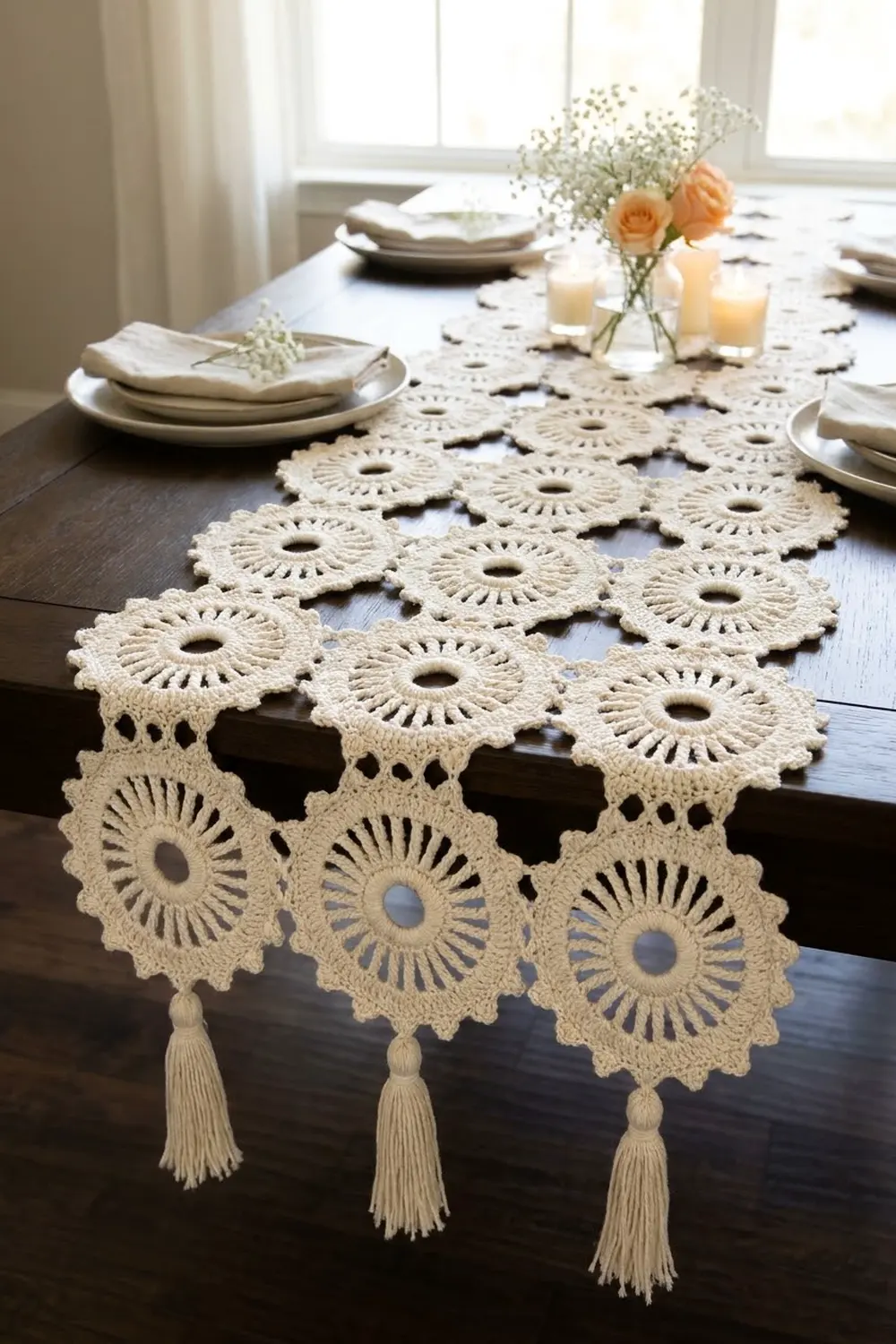
Final Notes
The measurement chain runs like this:
– Round 1: 1.25 in (3.2 cm)
– Round 2: 3.25 in (8.3 cm)
– Round 3: 3.75 in (9.5 cm)
– Finished motif: 4.5 in (11.4 cm)
– Three motifs across: 13.5 in (34.3 cm)
– Ten motifs down: 45 in (114.3 cm)
– Tassels: 4 in (10.2 cm) at each end
If your first motif hits its checkpoints, the rest of the runner falls into place.
Happy crocheting!