

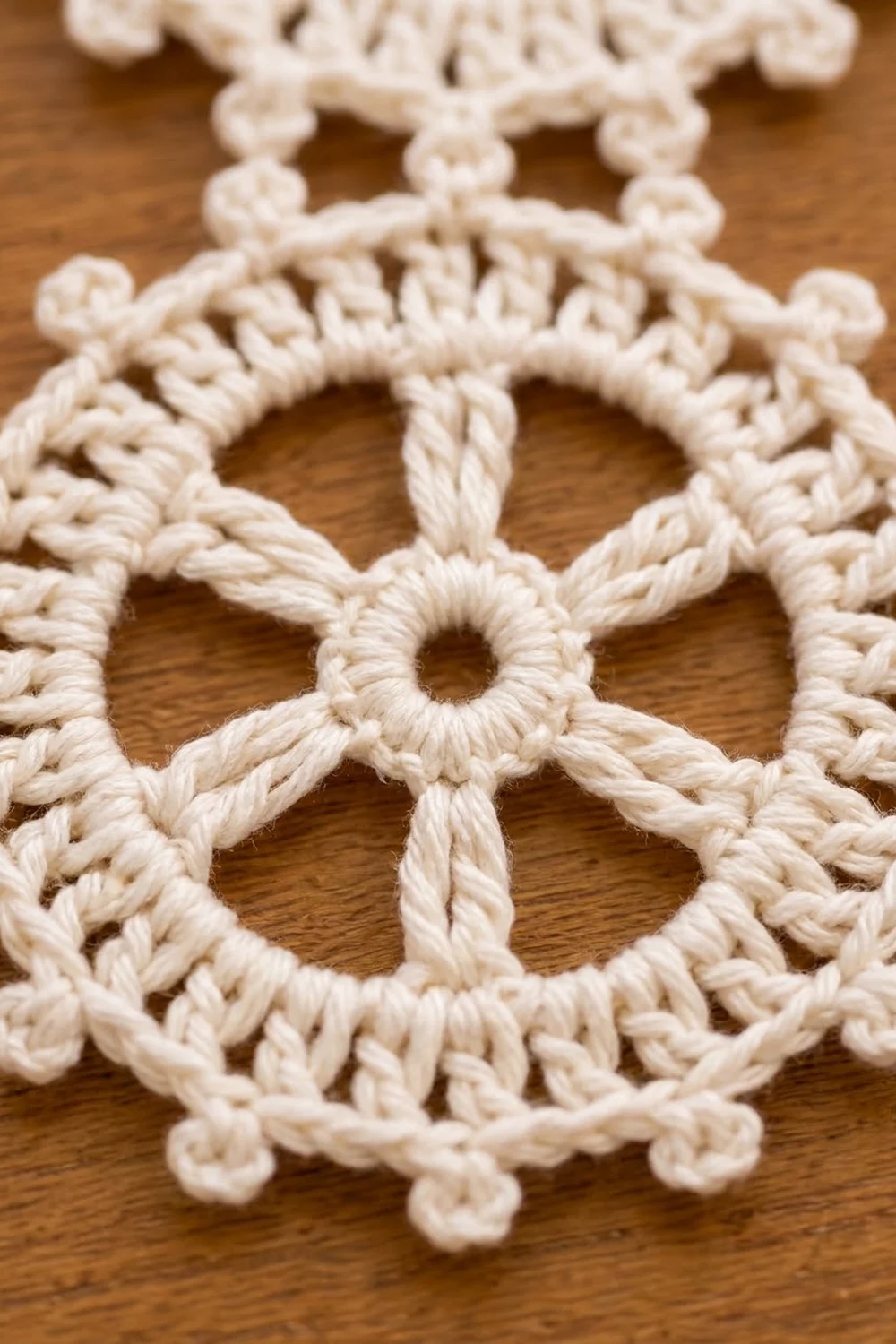
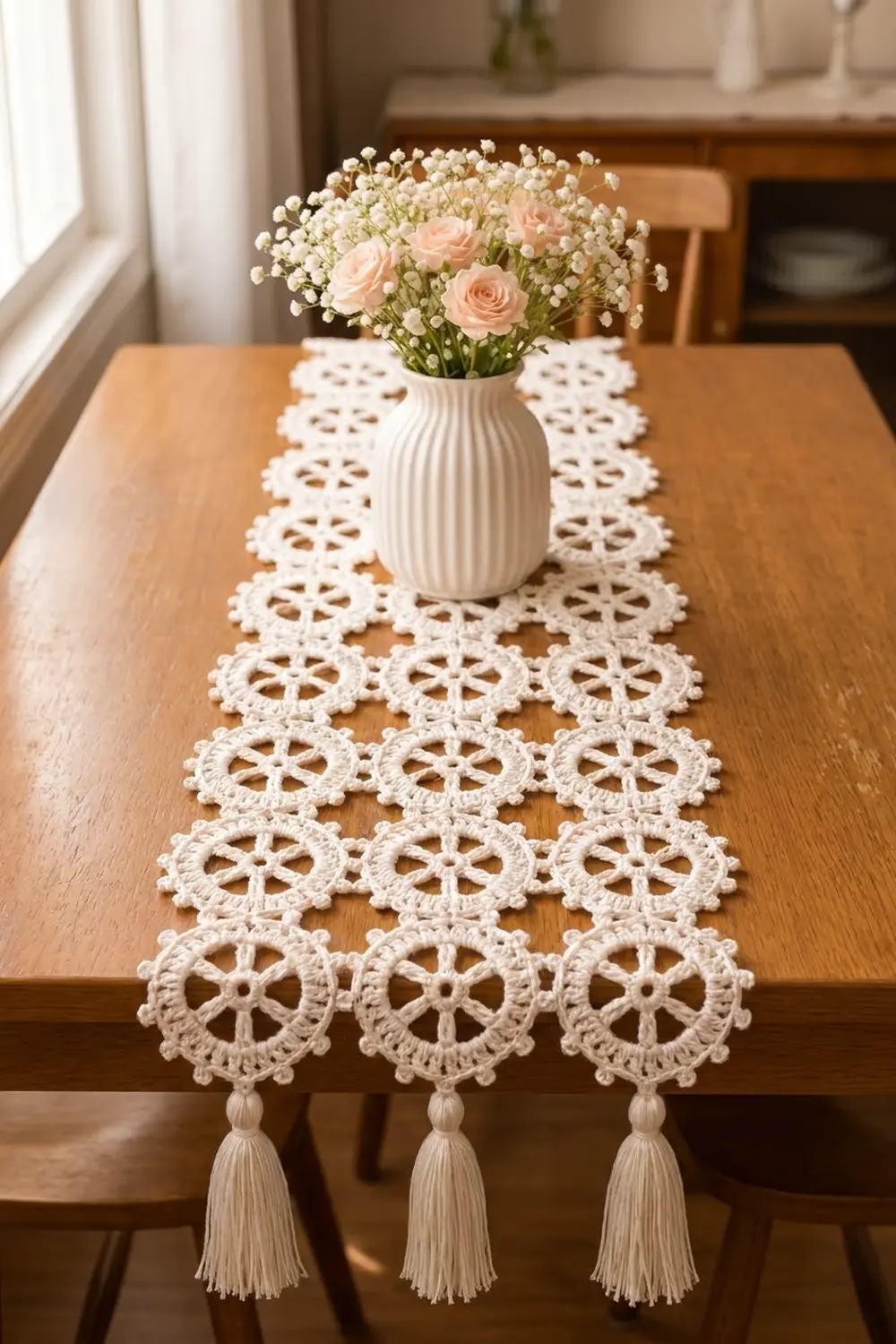
This runner is made of airy wagon-wheel motifs in crisp white cotton. Each wheel has a small center ring, six straight spokes and a solid rim, and is finished with a round of picots. Joined in a grid of 3 by 8, the wheels make a light, lacy runner with open diamond-shaped windows between them. A soft tassel hangs from each motif at both short ends.
The look is classic and quiet. It works on a farmhouse table, a vintage sideboard or a wedding display. Because the whole runner is one color, the texture of the spokes and picots stands out.
This pattern uses US crochet terms. The finished runner measures 13.5 in (34.3 cm) wide by 36 in (91.4 cm) long, not counting tassels. With 4 in (10.2 cm) tassels at each end, the overall length is 44 in (111.8 cm).
Construction is simple. You make the first motif in five rounds, and then join each new motif to its neighbors on the last round (join-as-you-go) through pairs of picots. The picot edge is the finished edge, so there is no separate border. Tassels go on last.
Finished Size and Construction
- Finished size: 13.5 in × 36 in (34.3 cm × 91.4 cm), plus 4 in (10.2 cm) tassels at each end
- Skill level: Intermediate (easy repeats, join-as-you-go technique)
- Terminology: US crochet terms
- Yarn weight: DK / light worsted (#3) cotton
- Hook: 3.5 mm (E-4)
- Number of pieces: 24 motifs, plus 6 tassels
- Layout: 3 motifs wide × 8 motifs long
- Piece size: 4.5 in (11.4 cm) across from picot tip to picot tip
- Size before border: 13.5 in × 36 in (34.3 cm × 91.4 cm)
- Border depth: 0 in (0 cm). The picot round of each motif is the edge.
Materials
Yarn: Use a smooth mercerized or combed cotton in DK weight, about 220 m per 100 g. Cotton keeps the spokes straight and the picots crisp, and it blocks well. Avoid fuzzy or very stretchy yarns, because the open centers will sag.
- Color A, White: 150 g / 330 m total
- Motifs: about 4 g / 8 m each, or 96 g / 192 m for all 24
- Tassels: about 20 g / 45 m for 6 tassels
These quantities include a margin of about 25% for gauge differences and test swatches.
Tools:
– 3.5 mm (E-4) crochet hook
– Tapestry needle
– Scissors
– Stiff card 5 in (12.7 cm) tall for winding the tassels
– Rust-proof pins and a blocking mat
– Spray bottle
– Measuring tape
Abbreviations (US Terms)
- ch – chain
- sl st – slip stitch
- sc – single crochet
- dc – double crochet
- dtr – double treble crochet (yarn over 3 times, insert hook, pull up a loop, [yarn over, pull through 2 loops] 4 times)
- sp – space
- st(s) – stitch(es)
- rep – repeat
Special stitches:
– Picot: Ch 4, sl st in the 1st ch made (the ch at the base of the picot).
– Joining picot: Ch 2, sl st in the matching picot of the finished neighbor motif, ch 2, sl st in the 1st ch made.
Gauge and Checkpoints
Make one complete motif before you start the runner. The size of the motif sets the size of everything else.
Motif gauge: One motif = 4.5 in (11.4 cm) across from picot tip to picot tip, after blocking.
Checkpoints for one motif (measure flat, lightly pressed):
– After Rnd 1: 1 in (2.5 cm) across
– After Rnd 2: 2.75 in (7.0 cm) across from the top of one spoke to the opposite spoke
– After Rnd 3: 3.25 in (8.3 cm) across
– After Rnd 4: 4 in (10.2 cm) across
– After Rnd 5: 4.5 in (11.4 cm) across the picot tips
If your motif is too big (more than 4.75 in / 12.1 cm), go down to a 3.25 mm hook. If it is too small (less than 4.25 in / 10.8 cm), go up to a 3.75 mm hook. A difference of 0.25 in (0.6 cm) per motif adds up to 2 in (5.1 cm) over the 8-motif length, so it is worth fixing now.
If it cups: Your dtr spokes are probably short. Pull the first loop up a little taller. If it ruffles: Your ch-7 rim chains are loose. Chain a little more firmly.
Motif Pattern
Work in continuous joined rounds with the right side facing. Do not turn.
Rnd 1 (center ring): Ch 6, sl st in the first ch to form a ring. Ch 1, work 18 sc in the ring, sl st in the first sc. (18 sc)
This makes the small, firm ring at the center of the wheel.
Rnd 2 (spokes): Ch 5 (counts as the first dtr), ch 7, skip next 2 sc. Dtr in next sc, ch 7, skip next 2 sc. Rep from * 4 more times. Sl st in the 5th ch of the beginning ch-5. (6 dtr spokes, 6 ch-7 spaces)*
Each dtr stands straight out as a spoke. The ch-7 lengths between the spoke tops form the inner rim.
Rnd 3 (solid rim): Sl st into the next ch-7 sp. Ch 3 (counts as dc), work 8 more dc in the same sp. Dc in the top of the next dtr, 9 dc in the next ch-7 sp. Rep from * 4 more times. Dc in the top of the last dtr (the beginning ch-5). Sl st in the top of the beginning ch-3. (60 dc)*
Check: 6 spaces × 9 dc = 54, plus 6 dc on the spokes = 60.
Rnd 4 (outer band, growth round): Ch 3 (counts as dc). Dc in the next 4 sts, 2 dc in the next st. Dc in the next 4 sts, 2 dc in the next st. Rep from * 10 more times. Sl st in the top of the beginning ch-3. (72 dc)*
This round adds 12 stitches evenly to the 60 so the band lies flat.
Rnd 5 (picot edge, conversion round): Ch 1. Sc in the first 3 sts, picot. Sc in the next 6 sts, picot. Rep from * 10 more times. Sc in the last 3 sts. Sl st in the first sc. Fasten off. (72 sc + 12 picots)*
Stitch count check: 3 + (11 × 6) + 3 = 72 sc, with 12 picots sitting 6 sc apart.
Numbering the picots: For joining, number the picots 1 to 12 clockwise. Picots 1–2 face east, 4–5 face north, 7–8 face west and 10–11 face south. Picots 3, 6, 9 and 12 point diagonally and stay free.
Make All Pieces
Make 24 motifs in Color A (White). Work Motif 1 completely. Make Motifs 2–24 through Rnd 4, then join them on Rnd 5 as described below.
Layout grid (3 wide × 8 long):
Row 1:  [ 1] [ 2] [ 3]
Row 2:  [ 4] [ 5] [ 6]
Row 3:  [ 7] [ 8] [ 9]
Row 4:  [10] [11] [12]
Row 5:  [13] [14] [15]
Row 6:  [16] [17] [18]
Row 7:  [19] [20] [21]
Row 8:  [22] [23] [24]
Work across each row from left to right, then start the next row.
Joining
Method: Join as you go on Rnd 5. Each join uses 2 picots per side, which makes the small bridge seen between the wheels.
Stitch-to-stitch logic: Work Rnd 5 as written. When you reach a picot that faces a finished neighbor, replace it with a joining picot. Join the matching picots in mirror order:
– Joining to the left neighbor: The new motif’s picot 7 joins the neighbor’s picot 2, and picot 8 joins picot 1.
– Joining to the neighbor above: The new motif’s picot 4 joins the upper motif’s picot 11, and picot 5 joins picot 10.
Every other picot is worked as a normal picot. The sc count stays at 72 per motif. Joining picots replace normal picots, so no stitches are added at the seams.
Join counts:
– Motif 1: no joins
– Motifs 2–3: 1 join each, to the left
– Motifs 4, 7, 10, 13, 16, 19, 22: 1 join each, upward
– All other motifs: 2 joins, left and upward
That makes 16 horizontal joins (8 rows × 2) and 21 vertical joins (7 rows × 3), or 37 joins in total.
Tension advice: Keep the 2 ch on each side of a joining picot the same tension as a normal ch-4 picot. Joins that are too tight pucker the diamond gaps. Joins that are too loose let the wheels drift out of line.
Size checkpoint: After Row 1 (3 motifs), the strip should measure 13.5 in (34.3 cm). After 4 rows, the length should be 18 in (45.7 cm). After all 8 rows, the length should be 36 in (91.4 cm).
Border
This runner has no added border. The picot round of the outer motifs is the finished edge, which keeps the scalloped wheel outline seen on the finished piece.
Edge gauge: 2 outward-facing picots per 4.5 in (11.4 cm) motif along each side, plus the free diagonal picots.
Outward picot counts per side:
– Each long side: 8 motifs × 2 picots = 16 outward picots
– Each short end: 3 motifs × 2 picots = 6 outward picots
Why the math works: Every motif has exactly 2 picots facing each direction. Along an outer side, those 2 picots are free instead of joined, so the edge count is always (motifs on that side) × 2, with nothing added at seams. That even spacing is also why the tassels hang evenly.
Tassels (make 6):
1. Wind yarn 30 times around the 5 in (12.7 cm) card.
2. Slip a 9 in (22.9 cm) strand under the wraps at the top and tie it tightly.
3. Cut the wraps at the bottom.
4. Wrap a 15 in (38.1 cm) strand around the tassel 0.75 in (1.9 cm) below the top, 6 times, and knot it. Bury the ends inside the tassel.
5. Trim the tassel to 4 in (10.2 cm) long.
Attaching: Thread the top tie of each tassel through both south-facing picots (10 and 11) of Motifs 22, 23 and 24. Knot it securely and bury the ends. Repeat at the other end through the north-facing picots (4 and 5) of Motifs 1, 2 and 3.
Final Blocking
- Weave in all ends along the back of the dc rounds, not through the picots.
- Wet the runner in cool water and press out the excess in a towel. Do not wring it.
- Lay it face up on the blocking mat and measure it to 13.5 in × 36 in (34.3 cm × 91.4 cm).
- Pin the center of each motif so the wheels line up in straight rows and columns.
- Pin each free picot outward so it stands about 0.25 in (0.6 cm) from the sc round.
- Straighten each spoke with your fingers so all 6 point evenly at 60° intervals.
- Comb the tassels straight and let them hang off the edge of the mat.
- Let it dry completely, then unpin.
Final Quality-Control Checklist
- 24 motifs, each with 6 spokes, 72 sc and 12 picots
- 37 joins, each made through 2 picots
- Every diamond gap is the same size and shape
- Width is 13.5 in (34.3 cm) and length is 36 in (91.4 cm)
- 16 outward picots on each long side and 6 on each short end
- 6 tassels, each 4 in (10.2 cm), 3 at each end
- No visible tails, and all knots are hidden
Troubleshooting
- Center of the wheel bulges: Rnd 1 has too many sc. Recount it to 18.
- Spokes lean or curve: Your ch-7 spaces are uneven. Count the chains, and keep the dtr loops tall.
- Rnd 3 ripples: Work 8 dc per space instead of 9 only if every motif does the same. It’s better to fix this with a smaller hook.
- Picots don’t line up with the neighbor: Recount the 6 sc between picots. A miscount shifts every join after it.
- Runner skews into a parallelogram: You joined a top picot to the wrong side. Check the picot numbering and the mirror order.
- Tassels flare: Wrap the neck tighter and trim again after blocking.
Care
Hand wash in cool water with mild soap and dry flat, reshaping the wheels while damp. A light steam press from the back refreshes the picots.
Final Notes
The measurement chain is simple. The 18-sc center ring supports 6 spokes. The 60-dc rim grows to 72 dc, which gives a 4.5 in (11.4 cm) motif with 12 picots. With 3 motifs across and 8 down, the runner measures 13.5 in × 36 in (34.3 cm × 91.4 cm). Each side carries 2 picots per motif, and tassels finish both ends. Check the first motif carefully, and the rest of the runner will fall into place.
Happy crocheting!