

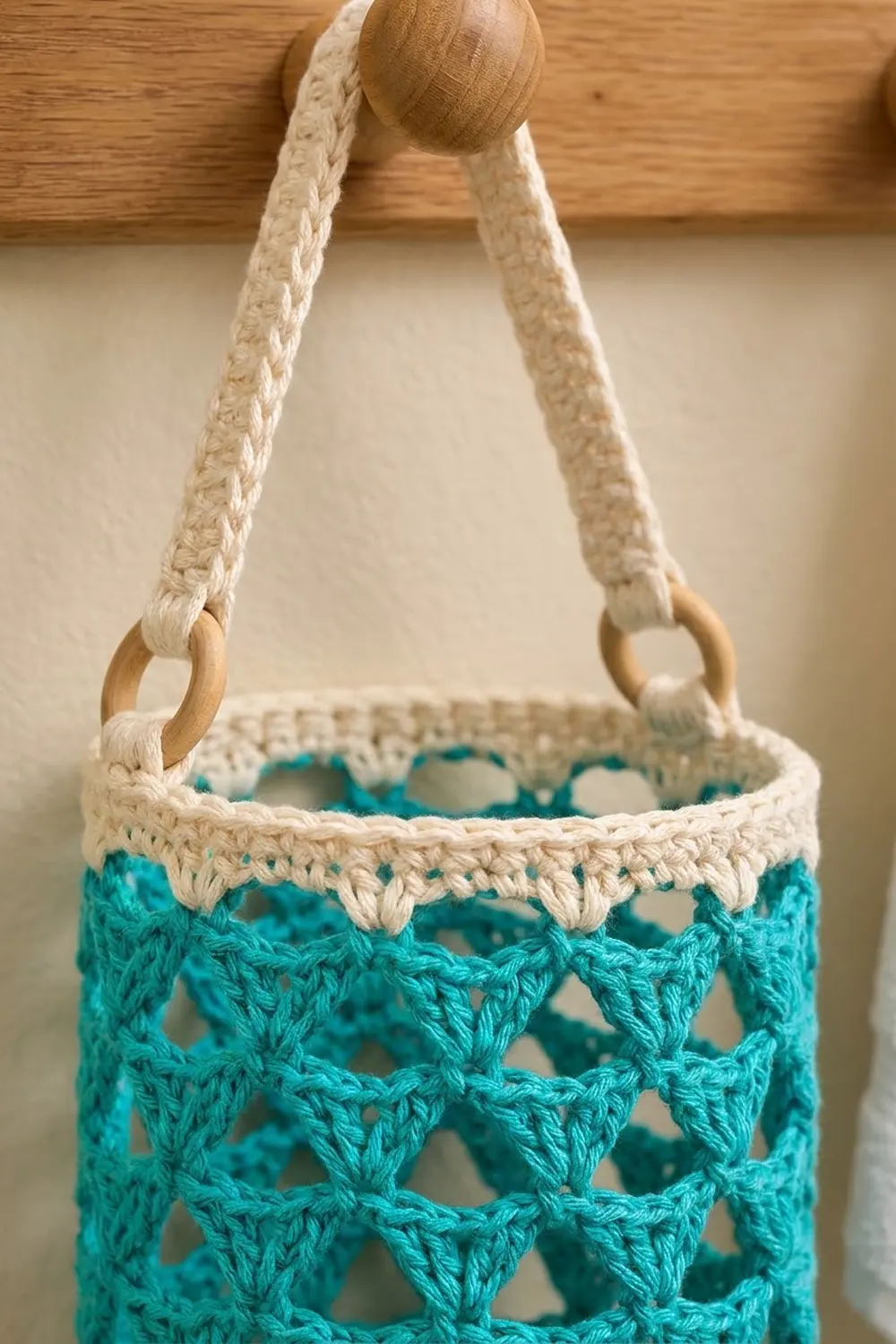
The Lagoon Lattice holder is a tall, airy tube that hangs from a hook or peg and holds three spare toilet paper rolls. Bright turquoise cotton forms an open lattice of small V-stitch triangles. Cream accents add a fresh, coastal look: one band across the middle, a solid rim at the top, and two looped straps fixed to the rim with natural wooden rings.
This pattern uses US crochet terms. The finished holder is 5.25 in (13.3 cm) across and 13.5 in (34.3 cm) tall. Flattened, the tube is 8.25 in (21.0 cm) wide.
Construction is simple and almost seamless. You start with a flat circle at the bottom and turn it up into a short solid wall. The lattice is worked in joined rounds, and a cream border finishes the top. The two straps are made separately, each with a wooden ring trapped in its bottom loop. In the last border round, the rings are crocheted straight into the rim, so you don’t need to sew anything.
The lattice uses only one repeat that switches back and forth between two rounds. After the first few rounds, you can work it almost without looking.
Finished Size and Construction
- Finished size: 5.25 in (13.3 cm) diameter x 13.5 in (34.3 cm) tall
- Skill level: Easy-intermediate
- Terminology: US crochet terms
- Yarn weight: Worsted (#4 medium) cotton
- Hook: 5.0 mm (H-8)
- Number of pieces: 3 crocheted pieces (1 body, 2 straps) plus 2 wooden rings
- Layout: Straps hang from rings on opposite sides of the rim, and their top loops meet on one peg
- Body size before border: 12.5 in (31.8 cm) tall
- Border depth: 1 in (2.5 cm), 4 rounds
- Strap size: 0.5 in (1.3 cm) wide x 10 in (25.4 cm), plus a loop at each end, for about 12.5 in (31.8 cm) total
Materials
Use a smooth, mercerized or combed cotton in worsted weight. Cotton holds its shape well, doesn’t stretch much under the weight of the rolls, and washes well in a bathroom setting. Avoid acrylic, because it lets the tube sag.
- Color A, turquoise: 75 g, about 130 m (142 yd)
- Color B, cream: 25 g, about 40 m (44 yd)
- 2 wooden rings, 1.25 in (3.2 cm) outside diameter
- 5.0 mm (H-8) crochet hook
- Stitch markers (at least 3)
- Tapestry needle
- Scissors and a measuring tape
These amounts include a margin of about 15%, enough for a gauge piece and one frogged round.
Abbreviations (US Terms)
- ch – chain
- sc – single crochet
- dc – double crochet
- sl st – slip stitch
- st(s) – stitch(es)
- sp(s) – space(s)
- BLO – back loop only
- rep – repeat
Special stitch – V-st (V-stitch): (dc, ch 1, dc) in the same st or sp. The ch-1 in the center is the “V sp.”
Gauge and Checkpoints
Gauge: 16 sc and 18 rounds = 4 in (10.2 cm). Lattice: 1 repeat (V-st to V-st) = 1.5 in (3.8 cm) wide, and 5 lattice rounds = 3 in (7.6 cm) tall.
Make the base first, as your test piece. Work Rounds 1–11 and lay the circle flat.
Checkpoints:
– After Round 6: diameter 2.75 in (7.0 cm)
– After Round 11: diameter 5.25 in (13.3 cm), circumference 16.5 in (41.9 cm)
– After Round 13: solid wall 0.5 in (1.3 cm) tall
– After Round 23: wall 6.5 in (16.5 cm) tall from the base edge
– After Round 33: wall 12.5 in (31.8 cm) tall
– After Round 37: wall 13.5 in (34.3 cm) tall
If your base is too big (over 5.5 in / 14.0 cm), change to a hook one size smaller. If it’s too small (under 5 in / 12.7 cm), change to a hook one size larger. A standard roll is about 4.5 in (11.4 cm) wide, so the base must be at least that wide plus a little ease.
Body
Base
With Color A, make a magic ring. Work in joined rounds: join each round with a sl st to the first sc, and start each round with ch 1, which does not count as a stitch.
Round 1: 6 sc in ring, join. (6 sts)
Round 2: 2 sc in each st around. (12 sts)
Round 3: sc in next st, 2 sc in next st; rep 6 times. (18 sts)
Round 4: sc in next 2 sts, 2 sc in next st; rep 6 times. (24 sts)
Round 5: sc in next 3 sts, 2 sc in next st; rep 6 times. (30 sts)
Round 6: sc in next 4 sts, 2 sc in next st; rep 6 times. (36 sts)
Round 7: sc in next 5 sts, 2 sc in next st; rep 6 times. (42 sts)
Round 8: sc in next 6 sts, 2 sc in next st; rep 6 times. (48 sts)
Round 9: sc in next 7 sts, 2 sc in next st; rep 6 times. (54 sts)
Round 10: sc in next 8 sts, 2 sc in next st; rep 6 times. (60 sts)
Round 11: sc in next 9 sts, 2 sc in next st; rep 6 times. (66 sts)
Check the diameter: 5.25 in (13.3 cm).
Solid Wall
Round 12: Ch 1, sc in BLO of each st around, join. (66 sts) The unused front loops make a sharp fold, so the base sits flat and the wall stands up.
Round 13: Ch 1, sc in each st around, join. (66 sts)
Lattice
The lattice repeat is 6 stitches wide, so 66 sts give 11 repeats. Each lattice round has 11 V-sts, 11 sc and 22 ch-2 sps.
Round 14 (setup): Ch 1, sc in first st, ch 2, skip 2 sts, V-st in next st, ch 2, skip 2 sts, sc in next st; rep from * 10 more times, ending last rep at *. Join to first sc. (11 V-sts, 11 sc, 22 ch-2 sps)
Each repeat uses 6 base stitches: sc (1) + skipped (2) + V-st (1) + skipped (2) = 6, and 6 x 11 = 66.
Round 15 (Round A): Ch 4 (counts as dc and ch 1), dc in same st as join (first V-st made), ch 2, sc in V sp of next V-st, ch 2, V-st in next sc; rep from * 10 more times, ending last rep at *. Join to 3rd ch of beginning ch-4. (11 V-sts, 11 sc, 22 ch-2 sps)
Round 16 (Round B): Sl st in first V sp, ch 1, sc in same sp, ch 2, V-st in next sc, ch 2, sc in next V sp; rep from * 10 more times, ending last rep at *. Join to first sc. (11 V-sts, 11 sc, 22 ch-2 sps)
Each round places V-sts on top of the previous round’s sc and sc in the previous round’s V sps. This alternation staggers the triangles and opens the diamond holes.
Rounds 17–23: Work Round A on odd rounds and Round B on even rounds, ending with Round A (Round 23). Change to Color B in the final join of Round 23.
Checkpoint: 6.5 in (16.5 cm) from the base edge.
Round 24 (Color B): Work Round B. Change to Color A in the final join. Carry the unused yarn up inside, or cut and weave in later.
Rounds 25–33 (Color A): Continue alternating, starting with Round A (Round 25) and ending with Round A (Round 33). Fasten off Color A.
Checkpoint: 12.5 in (31.8 cm) tall, 20 lattice rounds.
Straps (Make 2)
With Color B:
Row 1: Ch 41, sc in 2nd ch from hook and in each ch across. (40 sc)
Row 2: Ch 1, turn, sc in each st across. (40 sc)
Bottom loop: Ch 10. Slide the chain through one wooden ring, then sl st in the last sc of Row 2 to close the loop. Work 14 sc into the loop, over the ring’s chain, and sl st into the strap end. Fasten off.
Top loop: Join Color B with a sl st at the other short end. Ch 10, sl st in the same st to close, work 14 sc into the loop, and sl st into the strap end. Fasten off.
Strap check: 10 in (25.4 cm) of flat strip, about 12.5 in (31.8 cm) including loops. The ring sits loose in the bottom loop, and each top loop has a 1 in (2.5 cm) opening.
Make All Pieces
- Color A: 1 body (Rounds 1–23 and 25–33)
- Color B: Round 24 of the body, the border (Rounds 34–37), 2 straps
- Hardware: 2 rings, one trapped in each strap’s bottom loop
Layout as hung, viewed from the front:
          [peg]
          /    \
     strap 1   strap 2
        |         |
     (ring)    (ring)
  ==[ cream rim, R34-37 ]==
  |  turquoise lattice    |
  |  R25-33               |
  |==[ cream band, R24 ]==|
  |  turquoise lattice    |
  |  R14-23               |
  |  solid wall R12-13    |
  \____ base R1-11 ______/
Joining
The rings are attached in the last border round. You catch each ring’s lower edge inside 3 sc of the rim, so no sewing is needed.
Position math: the rim has 66 sts. Opposite points are 66 ÷ 2 = 33 sts apart. Ring 1 is caught in sts 1–3, and Ring 2 in sts 34–36. Between them are 30 plain sts on each side: sts 4–33 and sts 37–66. 3 + 30 + 3 + 30 = 66.
Stitch logic: To catch a ring, hold it upright just above the rim, behind your work. Insert the hook into the next stitch, then pass it through the center of the ring as well. Complete the sc so that it wraps around the bottom of the ring. The stitch count does not change, because each catching sc replaces a regular sc.
Tension: Keep the catching sc snug but not tight. If they’re tight, the rim puckers on either side of the ring. Before you go on, make sure both straps are untwisted and lie flat.
Size checkpoint: When the holder hangs empty, both rings sit level and the rim stays round, about 5.25 in (13.3 cm) across.
Border
Border gauge: 16 sc = 4 in (10.2 cm), and 4 rounds = 1 in (2.5 cm). Use Color B throughout.
Round 34 (conversion): Join Color B in the V sp of any V-st. Ch 1, sc in V sp, 2 sc in next ch-2 sp, sc in next sc, 2 sc in next ch-2 sp; rep 11 times. Join. 22 sc worked one into each V sp and each sc, + 44 sc worked two into each of the 22 ch-2 sps = 66 sts.
Round 35: Ch 1, sc in each st around, join. (66 sts)
Round 36 (eyelet): Ch 1, sc in next st, ch 1, skip 1 st; rep 33 times. Join. (33 sc and 33 ch-1 sps)
Round 37 (ring round): Ch 1. Catching Ring 1, sc in each of the first 3 sts (the first sc, the ch-1 sp, the next sc). Sc in each sc and each ch-1 sp across the next 30 sts. Catching Ring 2, sc in the next 3 sts. Sc in each of the remaining 30 sts. Join. 33 sc in sc + 33 sc in ch-1 sps = 66 sts. Fasten off.
Why the math works: The lattice repeat is 6 stitches, and the conversion round puts exactly 6 sc back into each repeat (1 + 2 + 1 + 2). That means the rim has 66 sts, the same as the base. 66 sts at 4 sts per inch is 16.5 in (41.9 cm) around, which matches a 5.25 in (13.3 cm) base. The eyelet round gives 33 pairs, which split evenly into the two 33-st halves for the rings.
Final Blocking
- Weave in all ends on the inside, following the stitch direction.
- Wet the body thoroughly in cool water and gently squeeze out the excess. Don’t wring it.
- Roll it in a towel and press to remove more water.
- Slide a 5 in (12.7 cm) wide cylinder inside, such as a tall jar or a rolled towel, to shape the tube.
- Pull the lattice lengthwise to 12.5 in (31.8 cm) above the base, and set the rim at 13.5 in (34.3 cm) total.
- Open each diamond hole evenly with your fingers. Line up the V-st triangles in straight vertical columns.
- Lay the straps flat and pin them to 10 in (25.4 cm), plus the loops.
- Let everything dry completely before hanging.
Final Quality-Control Checklist
- The base is flat, measures 5.25 in (13.3 cm), and has a crisp fold at Round 12
- Every lattice round has 11 V-sts, 11 sc and 22 ch-2 sps
- The triangles alternate cleanly and the holes are even diamonds
- The cream band (Round 24) sits about halfway up
- Rounds 34, 35 and 37 each have 66 sts, and Round 36 has 33 sc + 33 ch-1 sps
- The rings are exactly opposite each other (sts 1–3 and 34–36)
- Both straps are the same length, untwisted, with firm loops
- The total height is 13.5 in (34.3 cm)
- All ends are secured on the inside
Troubleshooting
Base ruffles: your tension is loose or your hook is too big. Go down a hook size, or tighten your sc.
Base cups: your hook is too small, or you missed increases. Count each round against the totals above.
Lattice leans in a spiral: you joined to the wrong stitch. Always join to the top of the beginning ch-4 (Round A) or to the first sc (Round B).
Repeat count is off: check the setup round first. Every repeat has to use exactly 6 base stitches.
Tube is too narrow for rolls: your dc are short. Use the next hook size up only for the lattice.
Rim puckers at the rings: loosen the 3 catching sc, or catch only 2 sts per ring.
Holder stretches when full: cotton relaxes over time. Re-block it, or remove a lattice round pair (one Round A + one Round B) for a firmer fit.
Care
Hand wash or machine wash on a gentle cycle in cool water, then reshape and dry flat. Remove the wooden rings first if you machine wash, or put the holder in a mesh laundry bag.

Final Notes
Every measurement depends on the one before it. The base of 66 sc measures 5.25 in (13.3 cm) across and 16.5 in (41.9 cm) around. Eleven 6-stitch lattice repeats keep that circumference all the way up the tube, and 20 lattice rounds add 12 in (30.5 cm). The conversion round brings the count back to 66 stitches, and the 1 in (2.5 cm) border brings the holder to 13.5 in (34.3 cm), with the rings exactly 33 stitches apart. Check your base and the rest will follow.
Happy crocheting!