

This valance brings a soft, vintage look to a sunny window. Three large lace fans sit across a brown filet-mesh panel. A row of lavender shells crowns the top edge, and a brown scalloped hem runs along the bottom. Below the hem, sixteen flower-strung drops end in full tassels at two staggered lengths.
The palette is two colors only: lavender and a warm chocolate brown. Inside each fan, the colors alternate by layer. Lavender spokes are framed by a brown arch, a brown crossed-stitch lattice, small brown shells that form wedges, and an outer row of lavender scallops.
The pattern uses US crochet terms. The finished heading measures 32.25 in (81.9 cm) wide by 8.75 in (22.2 cm) deep. With drops, the overall length is 27.25 in (69.2 cm) at the short drops and 29.25 in (74.3 cm) at the long drops.
You’ll crochet three fans in turned rows, then a separate mesh panel. Next, you appliqué the fans onto the lower part of the mesh and join their straight edges to the panel with the first hem row. You finish with the top and bottom edgings, then add the drops and tassels.
Finished Size and Construction
- Finished heading: 32.25 in × 8.75 in (81.9 cm × 22.2 cm)
- Overall length: 27.25 in (69.2 cm) short drops; 29.25 in (74.3 cm) long drops
- Skill level: Intermediate
- Terminology: US
- Yarn weight: Worsted (#4) cotton
- Hook: 4.5 mm (US 7)
- Number of pieces: 3 fans, 1 mesh panel, 96 flowers, 16 tassels
- Layout: 3 fans in a single row across the lower panel
- Fan size: 10.75 in (27.3 cm) wide × 5.5 in (14.0 cm) tall
- Size before border: 32.25 in × 7.25 in (81.9 cm × 18.4 cm)
- Border depth: 0.75 in (1.9 cm) each at top and bottom
Materials
Use a smooth, mercerized worsted-weight cotton at about 85 m per 50 g. Cotton keeps the stitch definition crisp and hangs straight without stretching in the sun.
- Lavender: 150 g (about 255 m)
- Chocolate brown: 200 g (about 340 m)
These quantities include a margin of about 20% for swatching and tassel trimming.
Tools:
– 4.5 mm (US 7) crochet hook
– Tapestry needle
– Stitch markers
– A 4 in (10.2 cm) piece of stiff card for the tassels
– Rust-proof pins and a blocking surface
– 9 clip-style curtain rings
– Scissors and a measuring tape
Abbreviations (US Terms)
- ch – chain
- sl st – slip stitch
- sc – single crochet
- dc – double crochet
- tr – treble crochet
- sk – skip
- sp(s) – space(s)
- st(s) – stitch(es)
- beg – beginning
Special stitch: X-st (crossed treble). Sk 1 st, tr in next st, ch 1, then tr in the skipped st, working in front of the tr you just made. Each X-st uses 2 sts and has a ch-1 sp at its center top.
Gauge and Checkpoints
Gauge: 16 sc = 4 in (10.2 cm). In the mesh, 8 squares (16 sts) × 8 rows = 4 in × 4 in (10.2 cm × 10.2 cm).
Make one fan first and measure it before you commit to the whole project.
Fan checkpoints (measured across the straight base):
– After Row 1: 1.5 in (3.8 cm)
– After Row 4: 5.5 in (14.0 cm)
– After Row 6: 8.75 in (22.2 cm)
– After Row 9: 10.75 in (27.3 cm) wide and 5.5 in (14.0 cm) tall at the scallop peaks
If your fan is too big, go down to a 4.0 mm hook. If it’s too small, go up to a 5.0 mm hook. The fans must total the panel width exactly, so match the 10.75 in (27.3 cm) base before moving on.
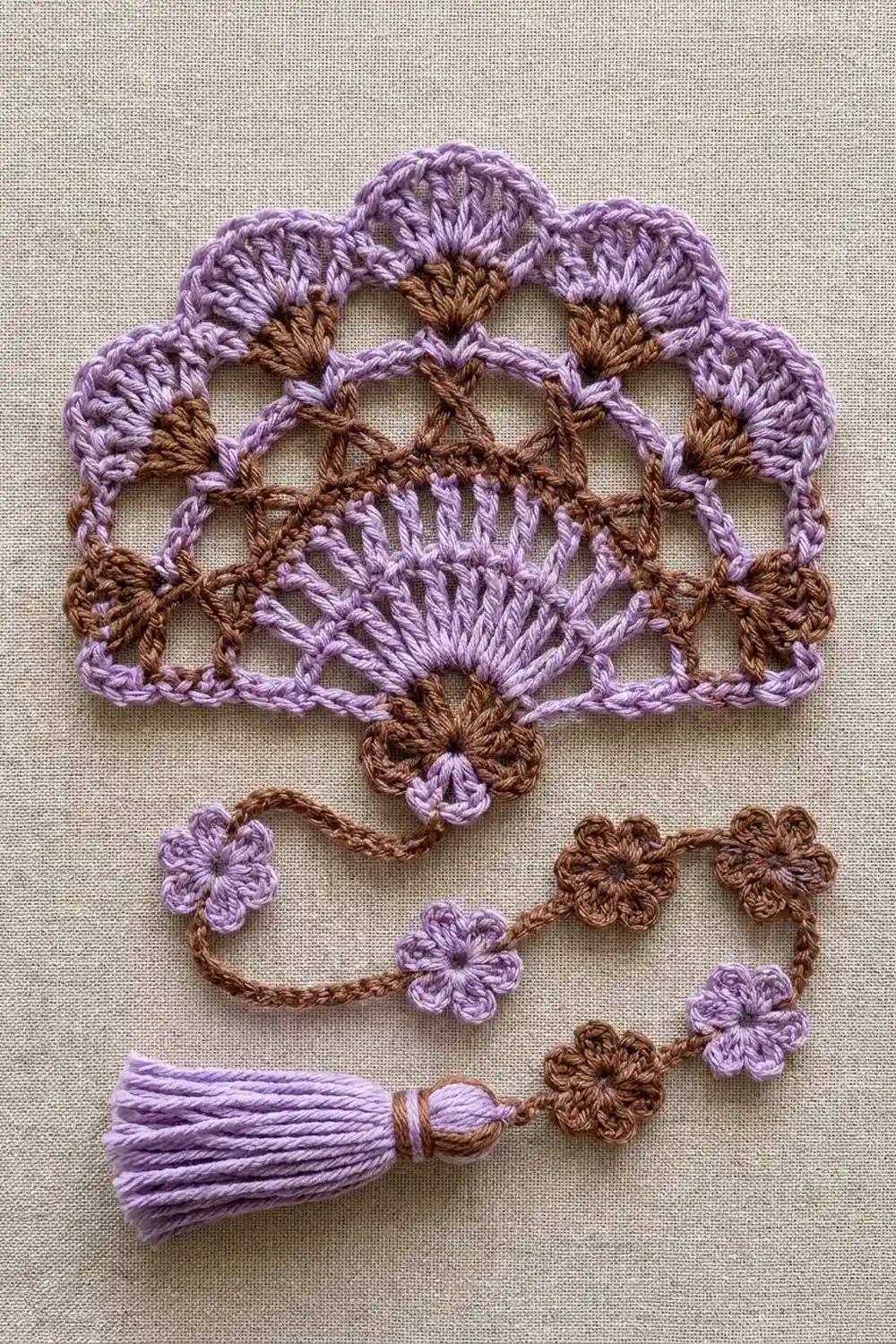
Fan Motif (Make 3)
Fasten off at each color change. Join the new color with a standing stitch at the start of the next row, and work over the tails as you go.
Row 1 (brown): Ch 4, sl st in first ch to form a ring. Ch 3 (counts as dc), 9 dc in ring. Turn. (10 dc)
The dc fill only the upper half of the ring. The lower half stays open for the base edge.
Row 2 (lavender): Ch 3 (counts as dc), dc in same st, 2 dc in each st across. Turn. (20 dc)
Row 3 (lavender): Ch 4 (counts as dc + ch 1), dc in next st, ch 1, dc in next st; repeat from * across. Turn. (20 dc, 19 ch-1 sps)
This row makes the long lavender spokes.
Row 4 (brown): Ch 3 (counts as dc), dc in each ch-1 sp and each dc across. Turn. (39 dc: 20 dc into dc + 19 dc into sps)
This is the solid brown arch.
Row 5 (brown): Ch 4 (counts as tr), ch 3, sk 1 st, X-st over next 2 sts; repeat from * 11 more times, ch 3, sk 1 st, tr in last st. Turn. (12 X-sts, 13 ch-3 sps, 2 tr)
Check: 1 + (12 × 3) + 1 + 1 = 39 sts used.
Row 6 (lavender): Ch 4 (counts as tr), ch 6, sc in center ch-1 sp of next X-st; repeat from * 11 more times, ch 6, tr in last tr. Turn. (13 ch-6 loops, 12 sc, 2 tr)
Row 7 (brown): Ch 3 (counts as dc), 7 dc in next loop, sc in next sc, 5 sc in next loop, sc in next sc; repeat from * 5 more times, 7 dc in last loop, dc in last tr. Turn. (93 sts: 7 shells of 7 dc)
Check: 1 + (6 × 14) + 7 + 1 = 93. The seven shells form the brown wedges.
Row 8 (lavender): Ch 3 (counts as dc), sk 1 dc, 2 dc in each of next 5 dc, sk 1 dc, sc in each of next 7 sc; repeat from * 5 more times, sk 1 dc, 2 dc in each of next 5 dc, sk 1 dc, dc in top of beg ch-3. (114 sts: 7 scallops of 10 dc)
Check: 1 + (6 × 17) + 10 + 1 = 114. Each lavender scallop sits over a brown shell.
Row 9 (lavender, straight base): Don’t turn. Ch 1 and rotate the fan so you can work down the row ends. Work the base in this order:
- 16 sc down the Row 8–2 ends (2 per dc row, 3 per tr row).
- 2 sc over the Row 1 end.
- 7 sc around the open lower half of the brown ring.
- 2 sc over the Row 1 end on the other side.
- 16 sc up the Row 2–8 ends.
(43 sc) Fasten off.
Row-end breakdown per side: Row 8 = 2, Row 7 = 2, Row 6 = 3, Row 5 = 3, Rows 4–2 = 2 each, for 16.
Mesh Panel (Make 1)
With brown: Ch 130.
Row 1: Sc in 2nd ch from hook and in each ch across. Turn. (129 sc)
Row 2: Ch 4 (counts as dc + ch 1), sk next st, dc in next st, ch 1, sk 1, dc in next st; repeat from * across. Turn. (65 dc, 64 ch-1 sps = 129 sts)
Rows 3–15: Ch 4 (counts as dc + ch 1), dc in next dc, ch 1, dc in next dc; repeat from * across, ending with dc in 3rd ch of turning ch. Turn. (129 sts per row)
Don’t fasten off yet; you’ll work the side edging next. The panel should measure 32.25 in × 7.25 in (81.9 cm × 18.4 cm). That’s 1 sc row plus 14 mesh rows at 2 rows per inch.
Side edging: Working loosely down one side, sl st 29 times over the row ends: 1 over Row 1 and 2 over each mesh row. Fasten off. Rejoin and repeat on the other side. This tidies the edge without adding width.
Flowers and Tassels
Flower (make 48 lavender, 48 brown):
- Ch 4, sl st to form a ring.
- Rnd 1: Ch 1, 6 sc in ring, join. (6 sc)
- Rnd 2: (Sl st, ch 2, 2 dc, ch 2, sl st) in each sc around. (6 petals)
Fasten off. Each flower is 1.25 in (3.2 cm) across.
Tassel (make 8 brown, 8 lavender): Wrap yarn 25 times around the 4 in (10.2 cm) card. Slide a 12 in (30.5 cm) tie strand under the top loops and knot it. Cut the bottom loops. Wrap the neck tightly 0.75 in (1.9 cm) below the top, using the same color, and hide the ends inside. Trim the tassel to 4 in (10.2 cm).
Make All Pieces
| Piece | Lavender | Brown | Total |
|---|---|---|---|
| Fans (two-color) | 3 | 3 | 3 |
| Mesh panel | — | 1 | 1 |
| Flowers | 48 | 48 | 96 |
| Tassels | 8 | 8 | 16 |
Layout grid (front view):
[ Top edge: 16 lavender shells, 9 ring points       ]
[ Brown mesh panel, 129 sts x 15 rows               ]
[   Fan 1 (sts 1-43) ][ Fan 2 (44-86) ][ Fan 3 (87-129) ]
[ Brown hem: 129 sc + 16 shells                     ]
  A  B  A  B  A  B  A  B  A  B  A  B  A  B  A  B   <- 16 drops
- Drop A: short drop with a brown tassel.
- Drop B: long drop with a lavender tassel.
Joining
Step 1: Place the fans. Lay the panel flat with Row 1 at the bottom. Set the three fans on top with their straight bases on the bottom edge and their scallops pointing up.
The fans line up stitch for stitch with the panel’s foundation chain. Fan 1 covers sts 1–43, Fan 2 covers sts 44–86, and Fan 3 covers sts 87–129. Neighboring base corners touch exactly, because 3 × 43 = 129.
Step 2: Tack the corners. Where two fans meet, join their touching base corners with 3 lavender whipstitches.
Step 3: Appliqué the fans. With lavender and a tapestry needle, whipstitch the outer edge (Row 8) of each fan to the mesh behind it. Catch every second stitch, plus every scallop peak and every sc valley. Keep the stitches relaxed so the mesh doesn’t gather. Pin first and check that the panel still lies flat.
Size checkpoint: The base of the three fans should measure 32.25 in (81.9 cm), the same as the panel width.
The final join, through both layers at the base, happens in Hem Row 1.
Border
Border gauge: 4 sc per inch, so 129 sc = 32.25 in (81.9 cm).
Hem Row 1 (brown): With the front facing you, join at the bottom right corner. Insert the hook through each fan base sc and the matching free loop of the panel’s foundation chain together, and sc in each. (129 sc)
Starting count check: 3 fans × 43 sc = 129, and the foundation has 129 free loops. No seam stitches are added.
Hem Row 2 (brown): Ch 1, turn. Sc in first sc, sk 3, 7 dc in next sc, sk 3, sc in next sc; repeat from * 15 more times. (16 shells, 17 sc) Fasten off.
Top Row 1 (lavender): Join in the first st of Row 15. Sc in each dc and each ch-1 sp across. (129 sc: 65 sc into dc + 64 sc into sps)
Top Row 2 (lavender): Work the same as Hem Row 2. (16 shells, 17 sc) Fasten off.
Why the math works: Each shell repeat uses 8 sts. 129 = (16 × 8) + 1, so both edges begin and end with an sc and the repeat stays symmetrical. Each edging adds 0.75 in (1.9 cm), which brings the heading from 7.25 in (18.4 cm) to 8.75 in (22.2 cm).
Ring points: Clip the 9 rings into alternate sc valleys of Top Row 2: the 1st, 3rd, 5th, and so on through the 17th. That spaces them 4 in (10.2 cm) apart.
Attaching the drops: Each drop hangs from the center (4th) dc of a hem shell. That gives 16 drops spaced 2 in (5.1 cm) apart.
- With brown, sl st into the center dc of the first shell.
- Ch 5, then sl st through the back of the top sc of a flower’s Rnd 1. Ch 3 behind the flower, then sl st in the bottom sc of Rnd 1 (the 4th sc). Repeat from * 5 more times, using 6 flowers per drop and alternating colors, starting with lavender.
- For Drop A, ch 5 more. For Drop B, ch 15 more.
- Fasten off. Knot the tassel’s tie strand to the last chain.
Drop lengths, measured from the hem:
– To the last flower: 13.5 in (34.3 cm), since each ch-5 is about 1 in (2.5 cm)
– To the top of the tassel: 14.5 in (36.8 cm) for Drop A, 16.5 in (41.9 cm) for Drop B
– Including the tassel: 18.5 in (47.0 cm) for Drop A, 20.5 in (52.1 cm) for Drop B
Alternate Drop A and Drop B across the hem, starting with A.
Final Blocking
- Weave in all remaining ends before you wet the piece.
- Soak the valance in cool water for 10 minutes, then press out the water in a towel. Don’t wring it.
- Lay it face up and pin the heading to 32.25 in × 8.75 in (81.9 cm × 22.2 cm).
- Pin each fan scallop and each hem shell to a smooth curve. Open up the X-st lattice with pins in each chain arch.
- Lay the drops out straight and smooth the tassels with damp fingers.
- Let it dry completely, at least 24 hours, before you hang it.
Final Quality-Control Checklist
- [ ] Each fan has 7 lavender scallops, 7 brown shells, and 12 X-sts.
- [ ] Each fan base measures 10.75 in (27.3 cm) with 43 sc.
- [ ] The panel is 129 sts wide and 15 rows tall.
- [ ] The fan corners meet exactly and the edges sit square with the panel.
- [ ] Hem Row 1 has 129 sc; both shell rows have 16 shells.
- [ ] There are 16 drops with 6 flowers each, in A/B order.
- [ ] Tassel tops hang at 14.5 in (36.8 cm) and 16.5 in (41.9 cm).
- [ ] All ends are secured and hidden.
Troubleshooting
The fan cups or curls. Your chains are too tight. Loosen the ch-3 and ch-6 sections, or go up a hook size for Rows 5–6 only.
The fan ruffles. Your chains are too loose. Work the ch-6 loops as ch-5.
The fans are wider than the panel. Rework Row 9 more firmly, or go down a hook size for all three fans.
The mesh puckers behind the fans. Your appliqué stitches are too tight. Snip them, re-pin, and sew more loosely.
The drops twist. Re-block them with a small weight on each tassel.
The shell count is off. Recount Hem Row 1. It must be exactly 129 sc.
Care
Hand wash in cool water with mild soap and dry flat. Avoid long, direct afternoon sun if you want the lavender to stay true.
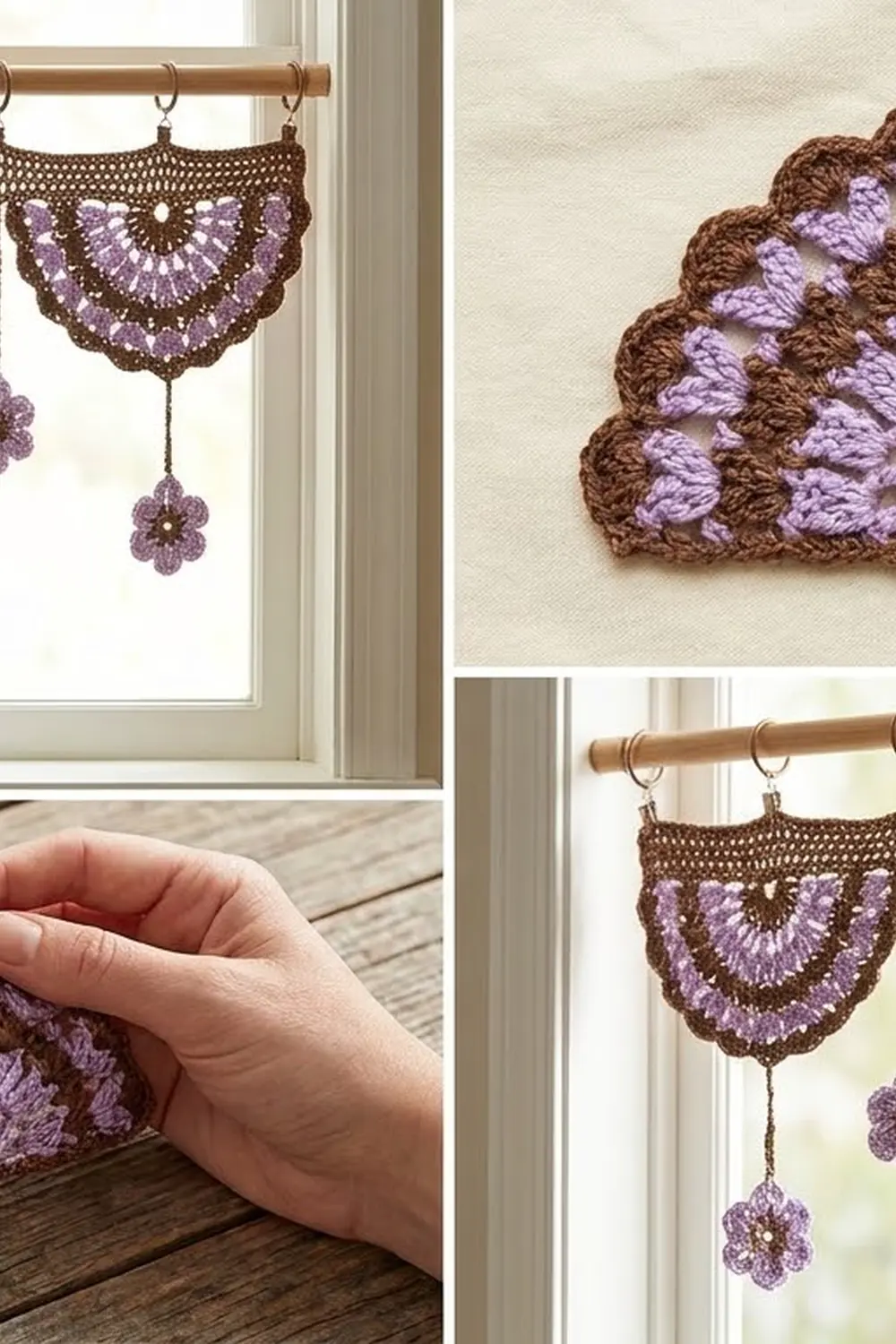
Final Notes
Here’s how the measurements build on each other:
- Each fan’s 43-stitch base gives 10.75 in (27.3 cm).
- Three fans give 129 stitches, or 32.25 in (81.9 cm), the same as the panel.
- The 15-row panel is 7.25 in (18.4 cm) deep. Two 0.75 in (1.9 cm) edgings bring the heading to 8.75 in (22.2 cm).
- The drops add 18.5 in (47.0 cm) or 20.5 in (52.1 cm), for an overall length of 27.25 in (69.2 cm) or 29.25 in (74.3 cm).
Check each of those numbers as you reach it, and the valance will come out right. Happy crocheting!