

This curtain panel is made from flower squares. Each motif has a plum ring at the center, eight long lilac petals with a raised spine, and an open plum chain lattice that turns the round flower into a square. Once joined, the lattice forms a light grid, and the flowers seem to float when daylight comes through.
There are two colors. Soft lilac is used for the petals, and deep plum is used for the ring, lattice, border, and tabs. The style is airy and slightly vintage, so it gives privacy without blocking the light.
The pattern uses US crochet terms. One panel is 31 in x 85 in (78.7 cm x 215.9 cm) without tabs, and about 88 in (223.5 cm) from the top of the tab loops to the lower edge. The photo shows a pair, so make two panels.
To build a panel, crochet the first motif, then join each later motif to its neighbors on its last round (join-as-you-go). The grid gets two rounds of plum single crochet border. Six tabs are worked off the top edge, folded to the back, and sewn down.
Finished Size and Construction
- Finished size (one panel): 31 in x 85 in (78.7 cm x 215.9 cm), plus 3 in (7.6 cm) tab loops
- Skill level: Intermediate
- Terminology: US crochet terms
- Yarn weight: DK (#3) cotton
- Hook: 4 mm (US G-6)
- Number of pieces: 70 motifs per panel (140 for a pair), plus 6 tabs per panel
- Layout: 5 motifs wide x 14 motifs tall
- Motif size: 6 in x 6 in (15.2 cm x 15.2 cm), blocked
- Size before border: 30 in x 84 in (76.2 cm x 213.4 cm)
- Border depth: 0.5 in (1.3 cm), 2 rounds
Materials
Choose a smooth mercerized or combed DK cotton. It keeps the petal ridges crisp, blocks well, and doesn’t stretch much when hanging. Avoid fuzzy yarns, because they blur the lattice. The amounts below assume 50 g balls of about 115 m (126 yd).
One panel:
– Color A, Plum (ring, lattice, border, tabs): 200 g, about 460 m (503 yd)
– Color B, Lilac (petals): 300 g, about 690 m (755 yd)
Pair of panels:
– Color A, Plum: 400 g, about 920 m (1,006 yd)
– Color B, Lilac: 600 g, about 1,380 m (1,509 yd)
These quantities include a margin of about 15% for swatching, tails, and differences in tension.
Tools:
– 4 mm (US G-6) crochet hook
– Tapestry needle
– Locking stitch markers
– Measuring tape
– Blocking mats and rust-proof pins
– Curtain rod, 1 in (2.5 cm) diameter or thinner
Abbreviations (US Terms)
- ch – chain
- sl st – slip stitch
- sc – single crochet
- hdc – half double crochet
- dc – double crochet
- tr – treble crochet
- blo – back loop only
- sp(s) – space(s)
- st(s) – stitch(es)
- RS / WS – right side / wrong side
Special technique – Join-as-you-go (JAYG):
– In a ch-5 space: ch 2, sl st into the matching ch-5 sp of the finished neighbor, ch 2.
– In a ch-3 corner: ch 1, sl st into the neighbor’s corner ch-3 sp, ch 1.
A joined space still counts as one ch-5 or ch-3 space.
Gauge and Checkpoints
Make one complete motif and block it before you start the rest. This motif is your gauge swatch.
- Border gauge: 29 sc = 6 in (15.2 cm), about 19.3 sc per 4 in (10.2 cm)
- Row gauge: 4 rows of sc = 1 in (2.5 cm)
Test motif checkpoints:
– After Round 1: the ring is about 1.1 in (2.8 cm) across.
– After Round 2: each petal is about 2 in (5.1 cm) long, and the flower is about 5 in (12.7 cm) from tip to opposite tip.
– After Round 3: the octagon is about 5.5 in (14.0 cm) across.
– After Round 4 and blocking: 6 in x 6 in (15.2 cm x 15.2 cm), measured side to side.
If the motif is bigger than this, use a 3.75 mm hook. If it is smaller, use a 4.5 mm hook. A 0.25 in (0.6 cm) error per motif adds up to 3.5 in (8.9 cm) over 14 motifs.
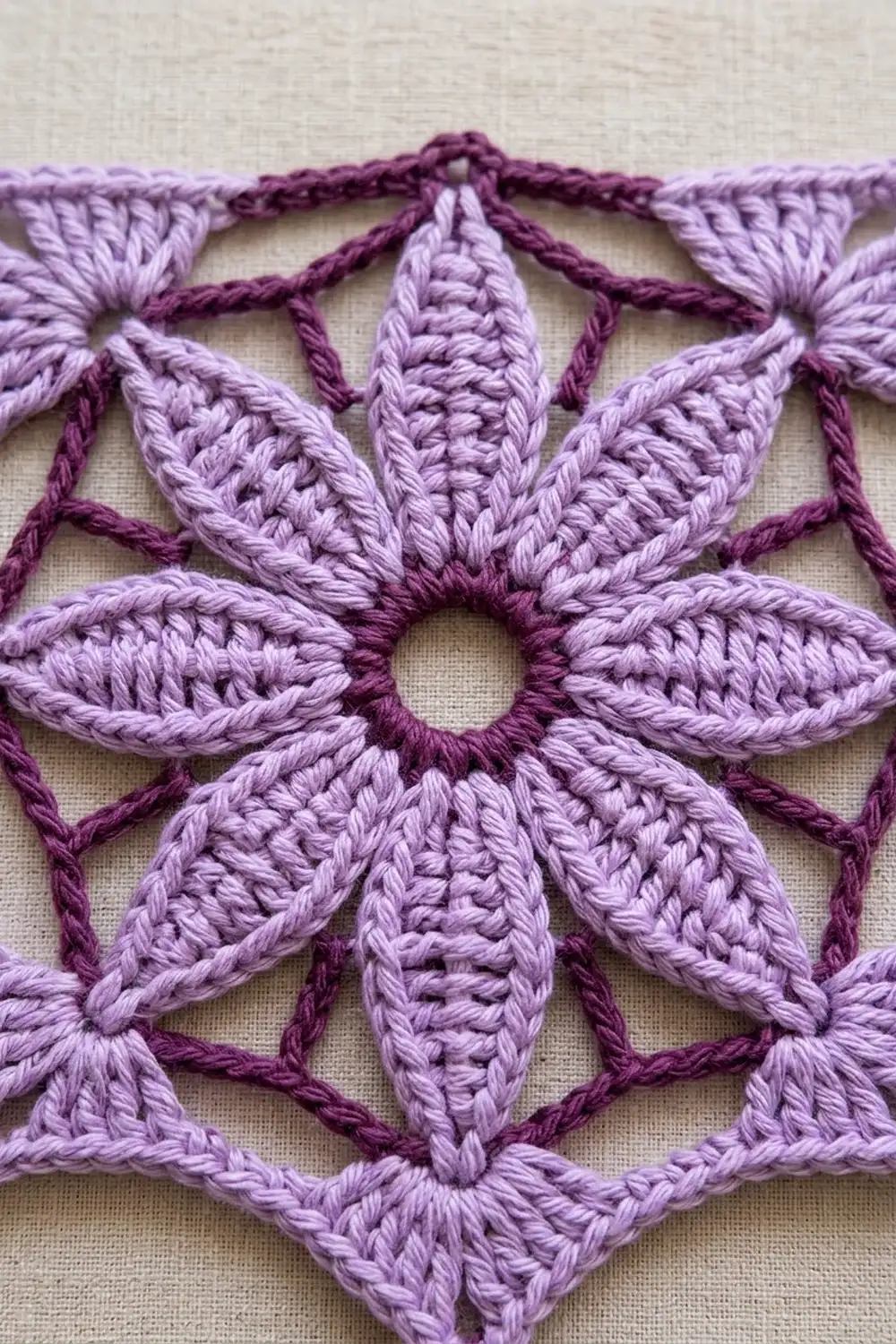
Motif Pattern
Round 1 (Color A, Plum) – Center Ring
With A, ch 8 and sl st in the first ch to form a ring.
Round 1: Ch 1, 16 sc in ring, sl st in first sc. Fasten off A. (16 sc)
Round 2 (Color B, Lilac) – Eight Petals
Join B with a sl st in any sc of Round 1. This is the base of Petal 1.
Petal:
1. Ch 10.
2. Side A (tip to base): Skip the first ch from the hook (this is the tip ch). Working in the back bumps: sc in next ch, hdc in next ch, dc in next ch, tr in each of next 3 ch, dc in next ch, hdc in next ch, sc in last ch. (9 sts)
3. Sl st in the next sc of Round 1 to anchor the base.
4. Side B (base to tip): Rotate the petal. Working in the free loops on the other side of the same 9 chains: sc, hdc, dc, tr in each of next 3, dc, hdc, sc. (9 sts)
5. Tip: (sc, ch 2, sc) in the skipped tip ch.
6. Return: Sl st in the blo of each of the 9 Side B sts, working back toward the ring.
7. Sl st in the next sc of Round 1. This is the base of the next petal.
Repeat the petal 7 more times. On the last petal, make the final sl st in the sc where you joined B. Fasten off B. (8 petals, each with 9 + 9 sts, 2 tip sc, and a ch-2 tip; 160 sts plus 8 ch-2 tip sps)
Each petal uses 2 ring sc, and 8 x 2 = 16. The tall stitches on both sides of the foundation chain make the raised spine and the ribbed bars.
Round 3 (Color A) – Octagon Frame
Round 3: Join A with a sc in any ch-2 tip sp, ch 9, sc in next ch-2 tip sp, ch 9; rep from * 6 more times, sl st in first sc. Don’t fasten off. (8 sc and 8 ch-9 sps; 80 sts including chains)*
Mark the tip sc you joined into as a corner tip. Going around, the tips alternate between corner tips and side tips, so there are 4 of each.
Round 4 (Color A) – Square Lattice
Round 4: Ch 4 (counts as tr), (ch 3, tr) in the same sc, ch 5, sc in next ch-9 sp, ch 5, sc in next side tip sc, ch 5, sc in next ch-9 sp, ch 5, (tr, ch 3, tr) in next corner tip sc; rep from * 2 more times, then from * to ** once, sl st in top of beginning ch-4. Fasten off. (8 tr, 12 sc, 4 ch-3 corner sps, 16 ch-5 sps)*
The tr pairs push the corners out into points. The sc in the ch-9 spaces pull the sides straight. Between its two ch-3 corners, each side has 1 tr, 4 ch-5 sps with 3 sc between them, and 1 tr.
Make All Pieces
Each motif uses about 7.5 m (8.2 yd) of Lilac and 3.3 m (3.6 yd) of Plum, including tails.
- One panel: 70 motifs. Work Rounds 1–3 on all of them, then work Round 4 while joining.
- Pair: 140 motifs.
Layout for one panel (5 wide x 14 tall, joining order):
Row  1:  1   2   3   4   5
Row  2:  6   7   8   9  10
Row  3: 11  12  13  14  15
 ...
Row 13: 61  62  63  64  65
Row 14: 66  67  68  69  70
Row 1 is the top edge, where the tabs go.
Joining
Work Motif 1 as written. Join each later motif during its Round 4. For example, Motif 2 joins Motif 1, Motif 6 joins Motif 1, and Motif 7 joins both Motif 2 and Motif 6.
Joining one side:
1. At the first corner of the side, work tr, ch 1, sl st into the neighbor’s corner ch-3 sp, ch 1, tr.
2. For each of the 4 ch-5 sps on that side, work ch 2, sl st into the neighbor’s matching ch-5 sp, ch 2, then work the sc as usual.
3. At the next corner, join again with ch 1, sl st, ch 1.
Each joined side is linked at 6 points: 2 corners and 4 ch-5 sps.
Stitch-to-stitch logic: Every side has the same structure, so space always meets space and corner meets corner.
Where four motifs meet: At the fourth corner, sl st into the corner sp of the diagonal motif, so all four corners lock at one point.
Tension: Make the joining chains the same length as your regular chains. Tight joins make the grid pucker and the panel come out short.
Size checkpoint: After Row 2 is joined, the strip should measure 30 in (76.2 cm) wide and 12 in (30.5 cm) tall when lightly pinned. The full grid is 30 in x 84 in (76.2 cm x 213.4 cm).
Border
Border gauge: 29 sc = 6 in (15.2 cm).
Border Round 1: Join A in any panel-corner ch-3 sp.
– Panel corners: Work (2 sc, ch 2, 2 sc) in each of the 4 panel-corner ch-3 sps.
– Each motif side along the edge: 2 sc in its corner ch-3 sp, 1 sc in the tr, 5 sc in each of the 4 ch-5 sps (20 sc), 1 sc in each of the 3 sc between them, 1 sc in the next tr, then 2 sc in the next corner ch-3 sp.
– Seams: Where two motifs meet, each motif’s corner sp gets its own 2 sc. Nothing extra is added at seams.
Sl st in first sc.
Per motif side: 2 + 1 + 20 + 3 + 1 + 2 = 29 sc.
- Top and bottom: 5 x 29 = 145 sc each
- Long sides: 14 x 29 = 406 sc each
- Total: 145 + 145 + 406 + 406 = 1,102 sc, plus 4 ch-2 corner sps
The 2 sc on each side of a panel-corner ch-2 are already counted in these per-side totals.
Border Round 2: Ch 1, sc in each sc around, (sc, ch 2, sc) in each ch-2 corner sp, sl st in first sc.
– Top and bottom: 145 + 2 = 147 sc each
– Long sides: 406 + 2 = 408 sc each
– Total: 1,110 sc, plus 4 ch-2 corner sps
Why the math works: A motif side is 6 in (15.2 cm), and 29 sc at border gauge is also 6 in (15.2 cm). So 145 sc equals 30 in (76.2 cm), and 406 sc equals 84 in (213.4 cm). The two rounds add 0.5 in (1.3 cm) on every side, which makes the panel 31 in x 85 in (78.7 cm x 215.9 cm).
Tabs
With the RS facing and the top edge up, there are 147 sc across the top. You’ll make 6 tabs of 9 sts each.
Placement: Skip 4 sts, make a tab over 9 sts, skip 17 sts, make a tab over 9 sts. Repeat from * 4 more times, then skip the last 4 sts.
Check: 4 + 9 + 5 x (17 + 9) + 4 = 147. Mark the positions before you start. The tabs are about 5.4 in (13.7 cm) apart, center to center.
Each tab:
– Row 1: Join A in the first marked st, ch 1, sc in the same st and in the next 8 sts, turn. (9 sc)
– Rows 2–24: Ch 1, sc in each st, turn. (9 sc)
The tab is about 1.9 in (4.8 cm) wide and 6 in (15.2 cm) long. Fasten off, leaving a 12 in (30.5 cm) tail. Fold the tab to the WS and sew Row 24 to the base of Border Round 1. This makes a 3 in (7.6 cm) loop.
Final Blocking
- Weave all tails into the lattice chains, not into the petals.
- Lay the panel flat, working in sections if needed, and mist it until damp.
- Pin the top edge straight at 31 in (78.7 cm).
- Pin each motif corner so the grid squares measure 6 in (15.2 cm).
- Ease each petal so the spine runs straight and the tip points at the frame.
- Let it dry completely, then unpin it and hang it for a day before you judge the final length.
Final Quality-Control Checklist
- Every motif has 8 petals and an open center ring.
- Every Round 4 side has 4 ch-5 sps and 1 tr at each end.
- All four-way junctions lock at one point.
- The grid is 5 motifs across and 14 down.
- Border Round 2 has 147 sc on the top and bottom edges and 408 sc on each long side.
- After blocking, the panel measures 31 in x 85 in (78.7 cm x 215.9 cm).
- All 6 tabs are evenly spaced and the same length.
Troubleshooting
Petals twist: Loosen your tr stitches. Make sure Side A goes into the back bumps and Side B into the free loops.
Ring closes up: Make the ch-8 looser, or use ch 9.
Corners aren’t square: Make the corner tr taller and pin the corners firmly when blocking.
Panel is narrower than 30 in (76.2 cm): Your joining chains are too tight. Redo the joins more loosely.
Border ripples or pulls in: Change the hook half a size for the border only, smaller for ripples or larger for pulling. Never change the stitch counts.
Care
Hand wash in cool water with mild detergent, roll in a towel, and dry flat. Re-pin the corners if the grid loses its shape.

Final Notes
Every measurement depends on the one before it. A blocked motif is 6 in (15.2 cm) square, and 29 border sc measure the same. Five motifs give 145 sc and 30 in (76.2 cm), and fourteen motifs give 406 sc and 84 in (213.4 cm). Two border rounds bring the panel to 31 in x 85 in (78.7 cm x 215.9 cm), and the tabs add 3 in (7.6 cm) loops. If the first motif is right, the rest will be too.
Happy crocheting!