
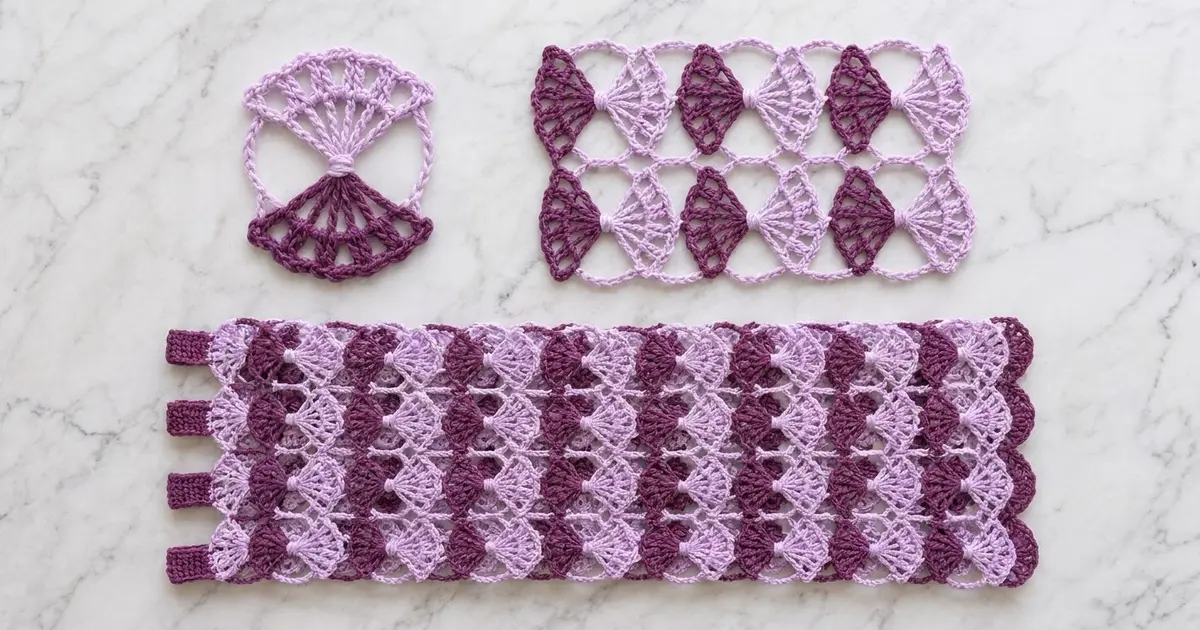
This lace curtain is made from small two-color motifs. In each motif, two fans meet at a wrapped center ring like a bow tie. The top fan is deep plum and the bottom fan is soft lavender. Two thin lavender chain loops curve around the sides, so each motif reads as an open circle.
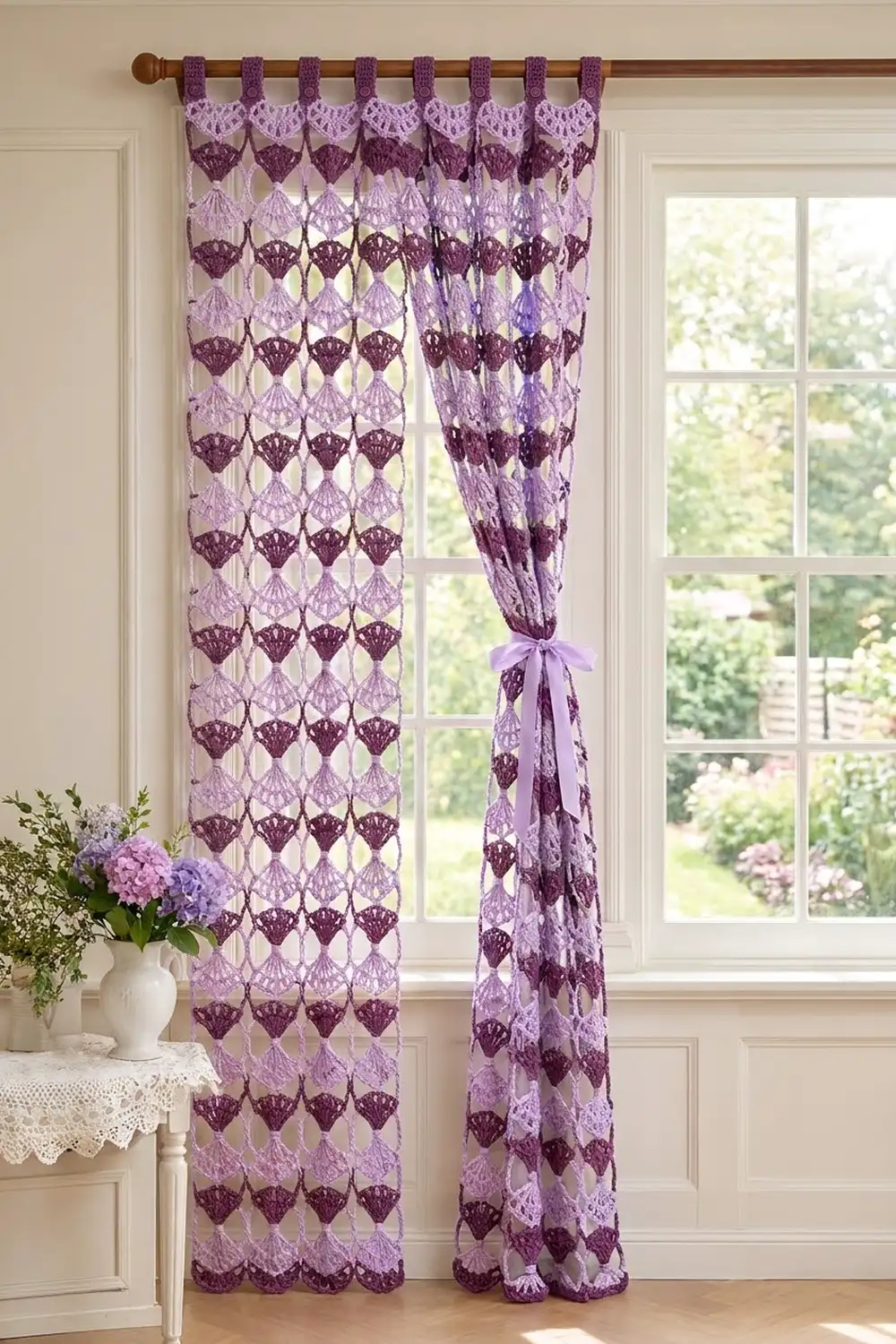
Once the motifs are joined, the plum and lavender fans alternate down every column. Light passes through the side loops and the spaces between the spokes, so the panel looks airy but still has strong color.
The pattern uses US crochet terms. The finished panel measures 42.5 in (108.0 cm) wide by 84.8 in (215.4 cm) long, not counting the tabs. The bottom edge is left as open fan scallops.
You make 98 motifs, 7 across and 14 down, and join each one as you go on the last row of its top fan and on its side loops. Then you add a solid header band with 7 tabs and one row of sc edging down each side.
Finished Size and Construction
- Finished size: 42.5 in x 84.8 in (108.0 cm x 215.4 cm), tabs not included
- Skill level: Intermediate
- Terminology: US crochet terms
- Yarn weight: Worsted (#4) cotton or cotton blend
- Hook: 5.0 mm (H-8)
- Number of pieces: 98 motifs plus 7 tabs
- Layout: 7 motifs across x 14 motifs down
- Motif size: 6 in x 6 in (15.2 cm x 15.2 cm)
- Size before border: 42 in x 84 in (106.7 cm x 213.4 cm)
- Border depth: 0.8 in (2.0 cm) header at the top; about 0.25 in (0.6 cm) sc edging on each side; no border at the bottom
Materials
Use a smooth worsted-weight cotton with about 170 m per 100 g. Cotton holds the fan shapes and hangs straight. It also stands up to sunlight and washing better than most acrylics.
- Color A, deep plum: 250 g (425 m), for the top fans
- Color B, lavender: 500 g (850 m), for the rings, bottom fans, side loops, header, tabs, and edging
These amounts include a margin of about 10–15%. Buy each color from a single dye lot, because a dye-lot change shows clearly against window light.
Tools:
– 5.0 mm (H-8) hook
– Tapestry needle
– Stitch markers
– Scissors
– Measuring tape
– Rust-proof pins and blocking mats or a padded floor area
Abbreviations (US Terms)
- ch: chain
- sl st: slip stitch
- sc: single crochet
- hdc: half double crochet
- dc: double crochet
- tr: treble crochet (yarn over twice)
- sp(s): space(s)
- st(s): stitch(es)
- RS: right side
- [ ]: repeat the steps in brackets as many times as stated
Special technique, loop join: Work half of the chain, sl st into the neighbor’s loop or its center ch, then work the rest of the chain. The sl st takes the place of one chain, so the loop length doesn’t change.
Gauge and Checkpoints
Make one complete motif before you start the curtain. Lay it flat, pat it into shape, and measure it without stretching.
- Ring after Rnd 1: 1.25 in (3.2 cm) across
- One fan, from the ring edge to the top of the arches: 2.375 in (6.0 cm)
- Fan tip to fan tip: 5.5 in (14.0 cm)
- Finished motif: 6 in x 6 in (15.2 cm x 15.2 cm)
Border gauge: 25 sts = 6 in (15.2 cm), about 4.2 sts per inch. 5 rows of sc = 1 in (2.5 cm).
If your motif is too big, go down 0.5 mm in hook size. If it is too small, go up 0.5 mm. Small errors add up: if each motif is 0.25 in (0.6 cm) off, the panel ends up 1.75 in (4.4 cm) off in width and 3.5 in (8.9 cm) off in length.
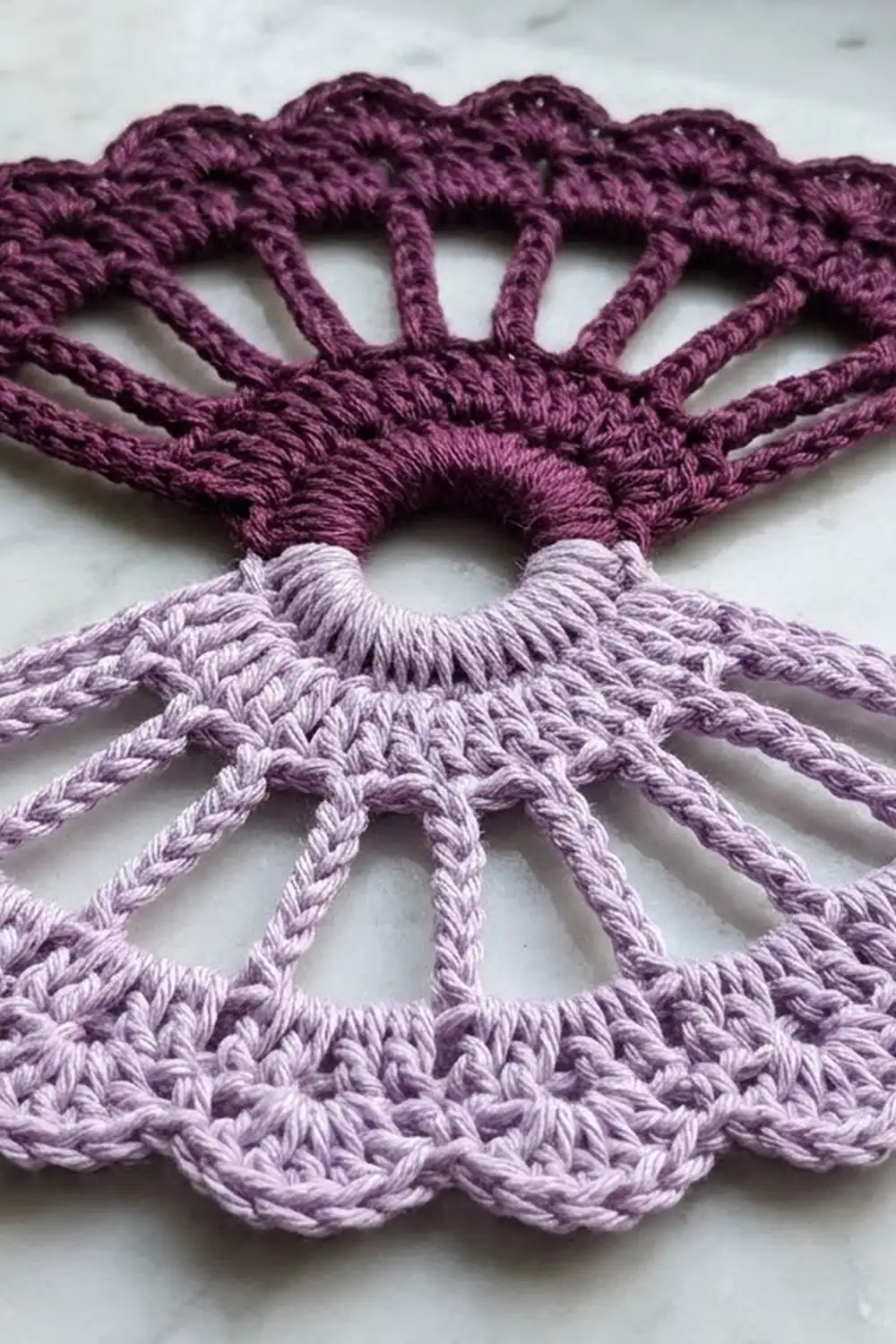
Motif
Center Ring (Color B)
Ch 6, then sl st in the first ch to form a ring.
Rnd 1: Ch 1, work 16 sc in the ring, then sl st in the first sc to join. (16 sc)
Do not fasten off. Number the sc from 1 to 16, starting with the sc you joined into. Sc 1–7 hold the bottom fan and sc 9–15 hold the top fan. Sc 8 and sc 16 stay bare under the side loops.
Bottom Fan (Color B)
Row 1: Ch 4 (counts as tr), [ch 1, tr in next sc] 6 times, working into sc 2–7. (7 tr, 6 ch-1 sps)
Row 2: Turn. Ch 6 (counts as dc + ch 3), [dc in next tr, ch 3] 5 times, dc in 4th ch of turning ch-4. (7 dc, 6 ch-3 sps)
Row 3: Turn. Ch 1, sc in first dc, [ch 4, sc in next ch-3 sp, ch 4, sc in next dc] 6 times, working the last sc in the 3rd ch of turning ch-6. (13 sc, 12 ch-4 loops)
Do not fasten off. Enlarge the loop on your hook, take the hook out, and put a marker through the loop to hold it. The first and last sc of Row 3 are the fan tips.
Top Fan (Color A)
Row 1: Join A with sl st in sc 9. Ch 4 (counts as tr), [ch 1, tr in next sc] 6 times, working into sc 10–15. (7 tr, 6 ch-1 sps)
Row 2: Work as Bottom Fan Row 2. (7 dc, 6 ch-3 sps)
Row 3: Work as Bottom Fan Row 3. (13 sc, 12 ch-4 loops) Fasten off A.
The two fans now sit on opposite sides of the ring, with their narrow ends meeting at the center.
Side Loops (Color B)
Side Loop 1: Put the held B loop back on your hook. Ch 15, then sl st in the first sc of Top Fan Row 3, which is the tip on the same side. Fasten off. (15 ch)
Side Loop 2: Join B with sl st in the last sc of Top Fan Row 3. Ch 15, then sl st in the first sc of Bottom Fan Row 3. Fasten off. (15 ch)
Each loop runs from tip to tip and passes over sc 8 or sc 16. Weave the 6 ends into the spokes so they don’t show in the open spaces. Check that the motif measures 6 in x 6 in (15.2 cm x 15.2 cm).
Make All Motifs
Make 98 motifs, all in the same colors and all placed plum fan up.
- Color A: 98 top fans
- Color B: 98 rings, 98 bottom fans, and 196 side loops
Finish the first motif on its own. Join every motif after that while you make it. Work each row of motifs from right to left.
Columns:     C1   C2   C3   C4   C5   C6   C7
Row 1  (top) [M]  [M]  [M]  [M]  [M]  [M]  [M]
Row 2        [M]  [M]  [M]  [M]  [M]  [M]  [M]
 ...         (same row repeated)
Row 14 (bot) [M]  [M]  [M]  [M]  [M]  [M]  [M]

[M] = one motif, plum fan up
7 x 14 = 98 motifs
Joining
Each new motif joins in two places. Its top fan joins to the bottom fan of the motif above, and its side loop joins to the side loop of the motif next to it.
Joined Top Fan Row 3: Ch 1, sc in first dc, [ch 2, sl st in matching ch-4 loop of motif above, ch 2, sc in next ch-3 sp, ch 2, sl st in next ch-4 loop of motif above, ch 2, sc in next dc] 6 times. (13 sc, 12 joined loops)
Start with the loop above that is closest to your starting tip, and join one loop to one loop all the way across. The two fans then meet edge to edge, with their tips lined up.
Joined Side Loop: On the loop that faces a finished neighbor, ch 7, sl st in the center (8th) ch of the neighbor’s facing loop, then ch 7 and finish the loop as written. (15 sts: 14 ch + 1 sl st)
Motifs in Row 1 join only at the side. Motifs in Column 1 join only to the motif above. Every other motif joins in both places.
Tension: Make the sl st joins at the same tension as your chains. Tight joins cup the fans and narrow the panel. Loose joins leave gaps.
Size checkpoint: After Row 1, the strip measures 42 in (106.7 cm) across. After Row 2, it measures 12 in (30.5 cm) from top to bottom. After all 14 rows, the panel measures 42 in x 84 in (106.7 cm x 213.4 cm).
Border
The border has two parts: a header band with tabs across the top, and a row of sc down each side. The bottom stays as open lavender fans to form the scalloped hem.
Border gauge: 25 sts = 6 in (15.2 cm).
Header Band (Color B)
Each top fan in Row 1 has 13 sc and 12 ch-4 loops along its edge. You work 1 st into each sc and 1 st into each loop, so each motif gives 13 + 12 = 25 sts. The taller sts at the tips fill the small V where two fans meet, so the top edge comes out straight.
Row 1 (RS): Join B with sl st in the right tip of the top-right motif. For each motif: ch 3 (counts as dc; on later motifs, work a dc instead) in the tip sc, hdc in next loop, hdc in next sc, sc in next loop, [sc in next sc, sc in next loop] 9 times, hdc in next sc, hdc in next loop, dc in last sc. Repeat this for all 7 motifs.
Per motif: 1 dc + 2 hdc + 19 sc + 2 hdc + 1 dc = 25. Total: 7 x 25 = 175 sts.
Rows 2–4: Ch 1, turn, sc in each st across. (175 sc)
The header is now 0.8 in (2.0 cm) deep.
Tabs (Color B)
Each column has 25 header sts. A tab uses the center 13 sts, with 6 sts left on each side (6 + 13 + 6 = 25). That centers one tab over each column.
Row 1: With RS facing, skip the first 6 sts of the column. Join B in the 7th st, ch 1, then sc in the same st and the next 12 sts. (13 sc)
Rows 2–25: Ch 1, turn, sc in each st across. (13 sc)
Fasten off, leaving a 12 in (30.5 cm) tail. Each tab is about 3.1 in (7.9 cm) wide and 5 in (12.7 cm) long. Fold the tab to the back and whipstitch Row 25 to the back of header Row 1 over the same 13 sts. Make all 7 tabs. The tabs fit a rod up to 1.5 in (3.8 cm) thick.
Side Edging (Color B)
On each motif, work 1 sc in the top-fan tip, 17 sc in the ch-15 side loop, and 1 sc in the bottom-fan tip, for 19 sc per motif. The 2 sc beyond the loop’s 15 ch keep the curve flat without pulling it in.
Right side: With RS facing, join B at the end of header Row 4. Work 4 sc down the header row ends, 1 per row. Then, on each motif going down, sc in the top-fan tip, work 17 sc in the side loop, and sc in the bottom-fan tip. Fasten off.
Total: 4 + (14 x 19) = 4 + 266 = 270 sc.
Left side: With RS facing, join B at the bottom-fan tip of the bottom-left motif. On each motif going up, sc in the bottom-fan tip, work 17 sc in the side loop, and sc in the top-fan tip. Then work 4 sc up the header row ends. Fasten off.
Total: (14 x 19) + 4 = 270 sc.
The edging adds 0.25 in (0.6 cm) on each side, so the width becomes 42.5 in (108.0 cm). The header adds 0.8 in (2.0 cm), so the length becomes 84.8 in (215.4 cm).
Final Blocking
- Weave in any remaining ends, then soak the panel in cool water for 15 minutes.
- Roll it in towels to press out the water. Do not wring it.
- Lay it flat, working in sections if you need to.
- Pin the header straight at 42.5 in (108.0 cm).
- Pin each side to 84.8 in (215.4 cm), checking that each column is 6 in (15.2 cm) wide.
- Pin the fan tips and the center of each arch. Shape the side loops into curves.
- Let it dry completely. For a softer drape, hang it on the rod while it is still slightly damp.
Final Quality-Control Checklist
- All 98 motifs are placed plum fan up.
- Each fan edge has 13 sc and 12 loops.
- All 12 loops are joined on every fan-to-fan seam.
- Each side loop is joined at its center ch.
- The header has 175 sts in every row.
- There are 7 tabs, each 13 sts wide and centered over a column.
- Each side edge has 270 sc.
- The panel measures 42.5 in x 84.8 in (108.0 cm x 215.4 cm).
Troubleshooting
- Fans ruffle: Check that you have 7 tr and 7 dc. If the counts are right, your chains are too loose, so chain more tightly.
- Motif is taller than it is wide: Your tr are too tall. Pull up shorter loops.
- Side loops sag: Recount to 15 ch and make the join sl st snug.
- Header waves: Recount to 175 sts. Extra sts at the tips are the usual cause.
- Panel slants: You started a row join at the wrong loop. Undo that fan’s Row 3 and join it again.
Care
Hand wash in cool water, or machine wash on a gentle cycle in a mesh bag. Reshape the panel and dry it flat or on the rod, out of direct sun, so the plum doesn’t fade.
Final Notes
One motif is 6 in (15.2 cm) square. Seven motifs make 42 in (106.7 cm) across, and 14 rows make 84 in (213.4 cm) down. The header gives 25 sts per column, for 175 sts in all, and adds 0.8 in (2.0 cm). The side edging uses 19 sc per motif and adds 0.25 in (0.6 cm) on each side. The finished panel is 42.5 in x 84.8 in (108.0 cm x 215.4 cm). If your first motif measures correctly, the rest of the measurements will come out right.
Happy crocheting!