

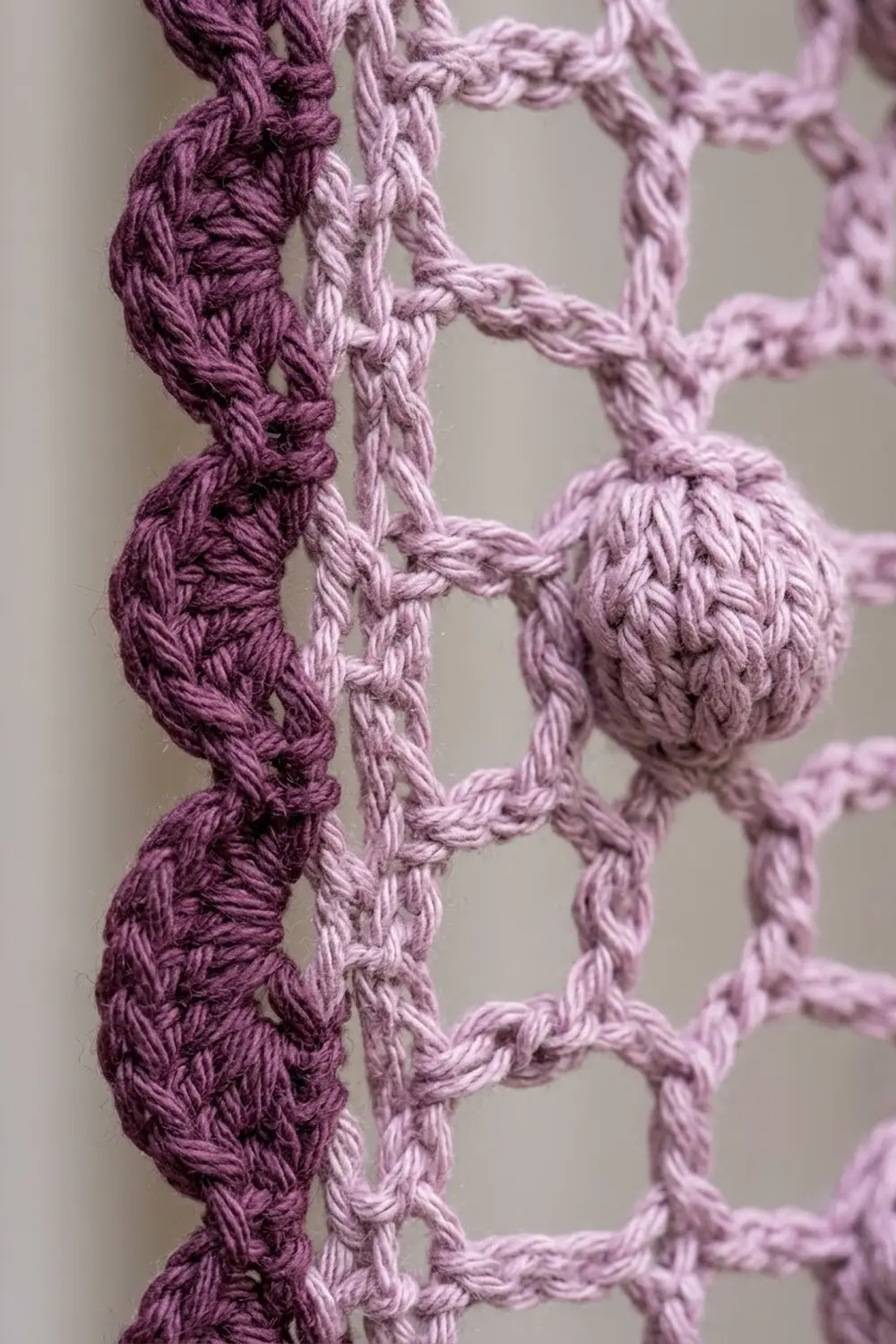
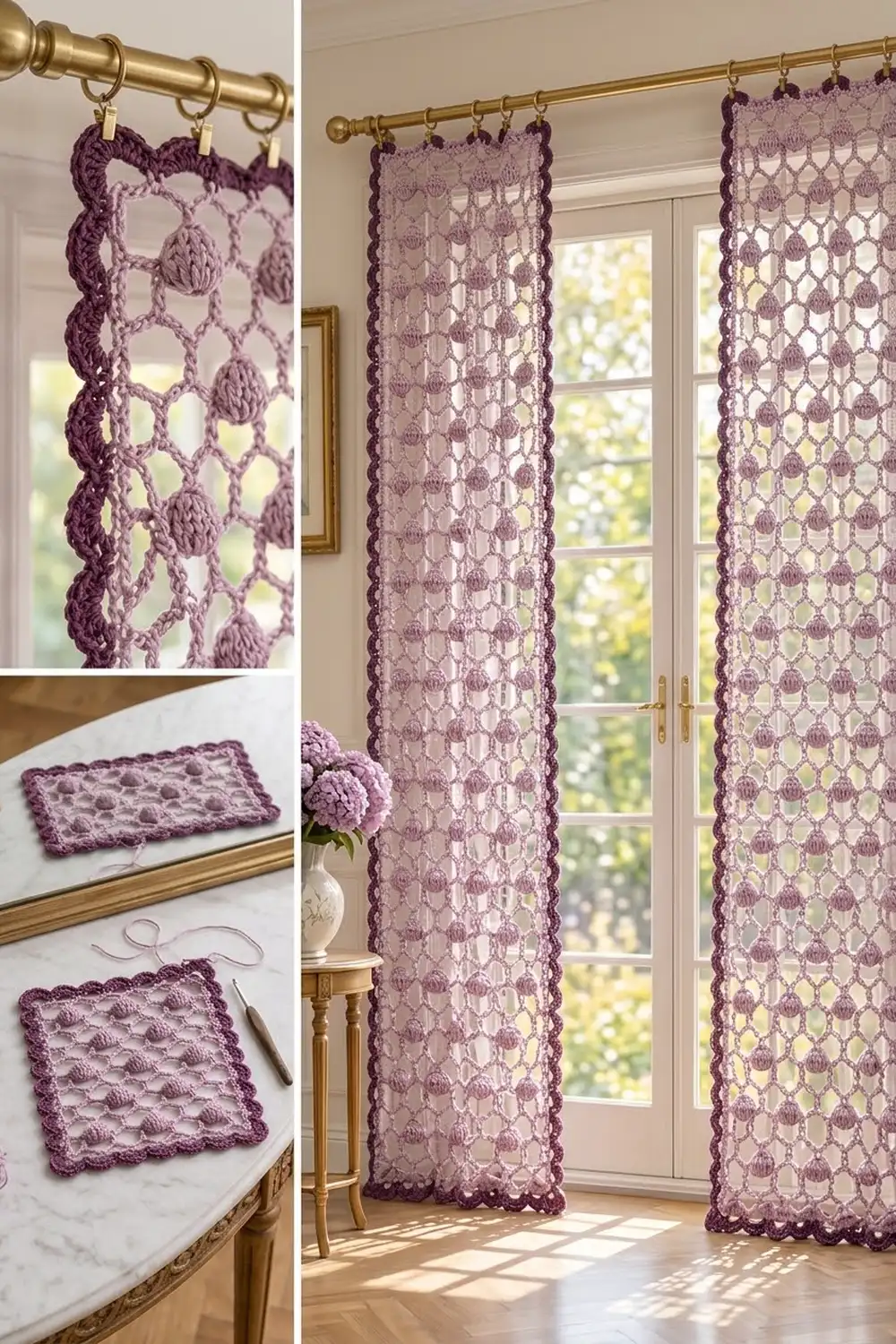
The Lilac Dewdrop Curtain Panel is an open chain-loop mesh scattered with round, puffy bobbles. Each bobble sits at a point in the mesh, so the panel looks like a lattice of tiny lilac buds. A deep plum scalloped border frames all four sides and gives the airy fabric a clean edge.
The body is soft lilac and the border is dark plum. The look is light, romantic, and a little vintage. Daylight comes through, and the room still gets soft color and texture.
This pattern uses US crochet terms. One finished panel measures 30 in wide x 81.5 in long (76.2 cm x 207.0 cm) after blocking. The photo shows a matching pair, so make two identical panels for a standard window.
Each panel is one piece. You work the mesh flat in rows from the bottom up, adding bobbles on alternating rows in a staggered layout. Then you work a two-round border all the way around. Nothing is joined.
Finished Size and Construction
- Finished size: 30 in x 81.5 in (76.2 cm x 207.0 cm) per panel
- Skill level: Easy+ / confident beginner
- Terminology: US terms
- Yarn weight: DK (#3), cotton or cotton blend
- Hook: 4.5 mm (US 7)
- Number of pieces: 1 per panel (make 2 for a pair)
- Layout: one rectangle worked in rows, not motifs
- Piece size before border: 28 in x 79.5 in (71.1 cm x 201.9 cm)
- Border depth: 1 in (2.5 cm) on every side
- Hanging: curtain clip rings clipped into the top border
Materials
Choose a smooth cotton DK, either mercerized or matte. In a long hanging piece, cotton keeps the bobbles round and stretches less than acrylic. The amounts below assume about 120 m per 50 g, so check your label and adjust.
Per panel:
- Lilac (body): 300 g / 720 m
- Plum (border): 50 g / 120 m
For a pair: double the amounts (600 g / 1,440 m Lilac, 100 g / 240 m Plum).
These quantities include a margin of about 15% for swatching and gauge differences.
Tools:
- 4.5 mm (US 7) hook
- 5.0 mm (US H-8) hook for the foundation chain (optional)
- Stitch markers
- Tapestry needle
- Measuring tape
- Blocking space large enough for a long panel, plus pins and a spray bottle
- 10–12 curtain clip rings per panel
Abbreviations (US Terms)
- ch – chain
- sc – single crochet
- dc – double crochet
- sl st – slip stitch
- sk – skip
- sp – space
- st(s) – stitch(es)
- yo – yarn over
- RS – right side
Bobble: (yo, insert hook in the indicated ch-5 sp, yo and pull up a loop, yo and draw through 2 loops) 5 times, then yo and draw through all 6 loops on the hook. Ch 1 to close. The closing ch 1 is not a separate stitch. Push each bobble toward you as you go; that side becomes the RS.
Full loop: a ch-5 space with an sc or bobble at each end.
Half loop: the ch-2 + dc at the end of a mesh row, or the ch-5 turning chain at its start.
Gauge and Checkpoints
Mesh gauge: 4 full loops = 4 in (10.2 cm) wide, measured sc to sc, and 8 rows = 4 in (10.2 cm) tall. Measure blocked and flat.
Border gauge: 4 sc = 1 in (2.5 cm).
Make a test swatch first. Ch 34 and work Rows 1–9 below at 8 loops wide:
- Work Row 1’s repeat 8 times.
- On every later row, work the bracketed repeat 7 times instead of 27.
- On bobble A rows, put bobbles in full loops 2 and 6.
- On bobble B rows, put a bobble in full loop 4.
Block the swatch. It should measure 8 in x 4.5 in (20.3 cm x 11.4 cm).
- Too big: go down 0.5 mm in hook size.
- Too small: go up 0.5 mm in hook size.
- Width correct but rows short: your chains are tight. Loosen your chain tension instead of changing hooks.
Panel checkpoints (measured flat):
- After Row 1: 28 in (71.1 cm) wide
- After Row 9: 4.5 in (11.4 cm) tall
- After Row 41: 20.5 in (52.1 cm) tall
- After Row 81: 40.5 in (102.9 cm) tall
- After Row 121: 60.5 in (153.7 cm) tall
- After Row 159: 79.5 in (201.9 cm) tall
Always measure on a table, never while the panel hangs off your lap. Mesh stretches lengthwise under its own weight.
Body Pattern
The body uses three row types:
- Mesh rows (all even rows) start and end with half loops: ch 5 at the start, ch 2 + dc at the end.
- Bobble rows (odd rows from Row 3 to Row 157) start and end with an sc. Every point between them is either an sc or a bobble.
- Plain rows (Rows 1 and 159) are shaped like bobble rows but have no bobbles.
Every odd row has 28 ch-5 loops and 29 points. Every even row has 27 full loops, 2 half loops, and 28 sc.
Foundation
With Lilac, ch 114. If your chains run tight, use the larger hook for the chain, then switch back to the 4.5 mm (US 7).
Row 1 (plain row): Sc in 2nd ch from hook, [ch 5, sk 3 ch, sc in next ch] 28 times. Turn. (28 ch-5 loops, 29 sc)
Chain check: the first sc uses 2 chains and each of the 28 repeats uses 4. That makes 2 + 112 = 114.
Pattern Rows
Row 2 (mesh): Ch 5 (counts as dc + ch 2), sc in first ch-5 loop, [ch 5, sc in next ch-5 loop] 27 times, ch 2, dc in last sc. Turn. (27 full loops, 2 half loops, 28 sc)
Row 3 (bobble A): Ch 1, sc in first dc. Number the 27 full loops of Row 2 from 1 to 27. [Ch 5, then work into the next full loop: a bobble in loops 2, 6, 10, 14, 18, 22, and 26, and an sc in all other loops] 27 times. Ch 5, sc in 3rd ch of turning ch-5. Turn. (28 ch-5 loops; 22 sc + 7 bobbles = 29 points)
Row 4 (mesh): Work as Row 2. Each sc goes into a ch-5 loop, so the bobbles stay at the points between loops. (27 full loops, 2 half loops, 28 sc)
Row 5 (bobble B): Work as Row 3, but put bobbles only in full loops 4, 8, 12, 16, 20, and 24. Work an sc in every other full loop. (28 ch-5 loops; 23 sc + 6 bobbles = 29 points)
Rows 2–5 make up the 4-row repeat. Each row shifts the mesh by half a loop, so the B bobbles land centered between the A bobbles. This creates the staggered 7–6–7 diamond layout.
Rows 6–157: Repeat Rows 2–5 another 38 times. (39 repeats in total for Rows 2–157)
Row 158 (mesh): Work as Row 2.
Row 159 (plain row): Ch 1, sc in first dc, [ch 5, sc in next full loop] 27 times, ch 5, sc in 3rd ch of turning ch-5. (28 ch-5 loops, 29 sc) Fasten off.
Bobble total: 39 repeats x 13 bobbles = 507 bobbles per panel.
Weave in ends along the side edges, where the border will hide them.
Border
Work the border in Plum with the RS facing you (bobbles toward you).
Border gauge: 4 sc = 1 in (2.5 cm). The top and bottom edges each have 113 sc between corners, spanning the 28 in (71.1 cm) width. Each long side has 317 sc between corners, spanning the 79.5 in (201.9 cm) length.
Corner rule: Each corner gets 3 sc worked into one stitch. The middle sc of the three is the corner stitch. The two outer sc belong to the sides on either side of the corner. All side counts below are between corner stitches and do not include them.
Round 1 (sc)
Join Plum in the last sc of Row 159.
Top edge: Ch 1, 3 sc in same sc (first corner). [3 sc in next ch-5 loop, sc in next sc] 27 times. Then 3 sc in the last ch-5 loop and 3 sc in the last sc of the row (second corner).
Between corners: 1 + 108 + 3 + 1 = 113 sc.
First side: Work down the row ends. Work 3 sc around the end of each mesh row (around the dc or the ch-5 turning chain). Work 1 sc in the end sc of each bobble row. Stop when you reach Row 1.
79 mesh rows x 3 = 237, plus 78 bobble rows x 1 = 78. Adding the outer sc from each corner group: 1 + 237 + 78 + 1 = 317 sc.
Bottom edge: 3 sc in the foundation ch at the base of Row 1’s end sc (third corner). Sc in each of the next 111 foundation chains, working into the free loops. 3 sc in the last foundation ch (fourth corner).
Between corners: 1 + 111 + 1 = 113 sc.
Second side: Work as the first side, ending back at the first corner. (317 sc)
Join with a sl st to the first sc. Sl st into the next sc, which is the first corner stitch.
Round 1 total: (2 x 113) + (2 x 317) + 4 corner sts = 864 sc.
Round 2 (scallops)
Corner: Ch 3 (counts as dc), 6 dc in the corner stitch. (7-dc corner shell)
Each side: Sk 2, sc in next st, then [sk 2, 5 dc in next st, sk 2, sc in next st]. Repeat the brackets 18 times on the top and bottom edges or 52 times on the long sides. Sk 2, then work 7 dc in the next corner stitch.
Continue around and end with a sl st in the 3rd ch of the beginning ch-3. Fasten off.
Why the math works: each side uses 2 + 1 + (6 x k) + 2 = 6k + 5 stitches, where k is the number of side scallops.
- Top and bottom: 6 x 18 + 5 = 113
- Long sides: 6 x 52 + 5 = 317
Every side ends exactly at its corner stitch, with no extra or missing stitches. Round 2 has 140 side scallops plus 4 corner shells, which makes the continuous rounded edge on all four sides.
Border depth: Round 1 adds about 0.25 in (0.6 cm) and Round 2 about 0.75 in (1.9 cm), for 1 in (2.5 cm) on each side.
Final Blocking
- Weave in all remaining ends, following the mesh chains so they stay hidden.
- Soak the panel in cool water for 15 minutes, then press the water out. Do not wring it.
- Roll the panel in towels to remove extra water.
- Lay it flat on a clean floor or on blocking mats, using several mats in a row for the length.
- Ease it to 30 in x 81.5 in (76.2 cm x 207.0 cm). Open each ch-5 loop into an even diamond.
- Pin each corner shell, then pin every 6 in (15.2 cm) along the edges. Fan each scallop open.
- Plump each bobble from behind with a fingertip.
- Let the panel dry completely before you hang it.
Final Quality-Control Checklist
- Odd rows have 28 ch-5 loops; even rows have 28 sc.
- Bobble rows alternate between 7 and 6 bobbles and stagger cleanly.
- All bobbles face the RS.
- The body measures 28 in x 79.5 in (71.1 cm x 201.9 cm) before the border.
- Round 1 has 113 / 317 / 113 / 317 sc between corners, 864 sc in total.
- Each side of Round 2 ends with sk 2 just before a corner shell.
- The finished panel measures 30 in x 81.5 in (76.2 cm x 207.0 cm).
- The two panels of a pair match within 0.5 in (1.3 cm).
Troubleshooting
The foundation edge puckers. The chain is too tight. Restart and use the larger hook for the chain only.
Bobbles flatten or slip through to the back. Close each bobble with a firm ch 1 and push it to the RS before you work the next ch 5.
The bobble layout drifts sideways. A full loop was skipped or worked twice. Count 27 full loops on every mesh row and put a marker in loop 1.
The panel will be longer than 79.5 in (201.9 cm). Your rows are taller than gauge. Leave out full repeats in groups of 3 (12 rows, about 6 in / 15.2 cm), and always finish with Rows 158–159. Then recount each side for the border: 3 sc per mesh row, plus 1 sc per bobble row, plus 2. This keeps each side at 6k + 5.
The border ripples. Your sc are looser than 4 per inch. Go down one hook size for Round 1 only.
The border cups. Your sc are too tight. Go up one hook size.
The side edges lean. Your turning chains vary in size. Make every ch-5 turning chain the same size, and always end mesh rows with a dc.
Care
Hand wash in cool water, or machine wash on a delicate cycle inside a mesh bag. Reshape and dry flat; do not tumble dry or hang it wet, because the weight will stretch the mesh.
Final Notes
Here is how each stage leads to the next:
- Swatch: 8 in x 4.5 in (20.3 cm x 11.4 cm) confirms the mesh gauge.
- Body: 28 loops and 159 rows make 28 in x 79.5 in (71.1 cm x 201.9 cm).
- Round 1: at 4 sc per inch, the width takes 113 sc between corners and each long side takes 317.
- Round 2: both counts fit the 6k + 5 scallop formula.
- Finished panel: 30 in x 81.5 in (76.2 cm x 207.0 cm).
Check your gauge at each stage and the panel will hang straight, with a crisp plum frame around a soft field of lilac buds. Clip the rings evenly into the top scallops and let the light come through.
Happy crocheting!