

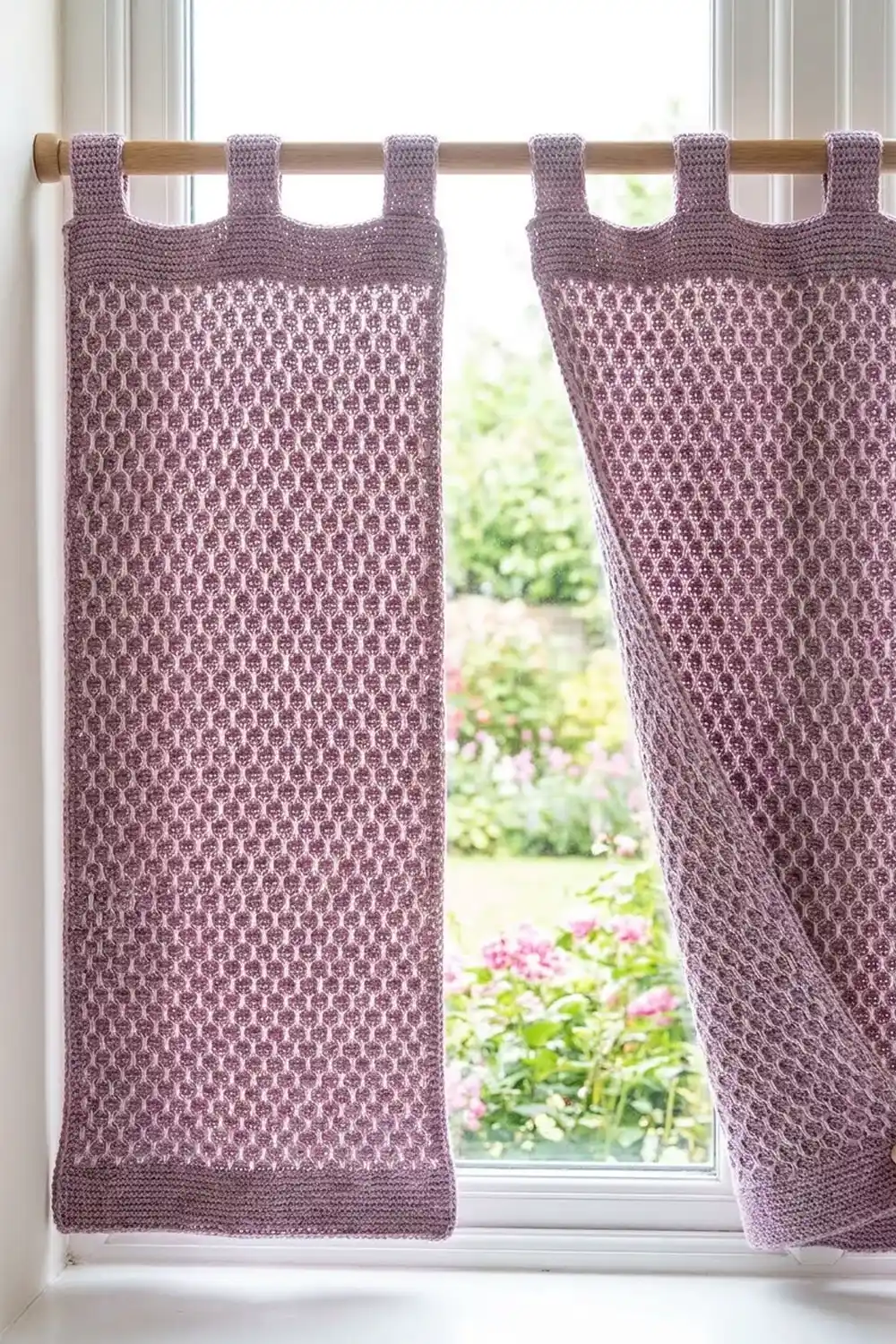
This pair of café curtains is worked in Tunisian honeycomb stitch, a simple two-stitch texture that looks like a woven cable lattice. In a soft dusty mauve it reads as calm and vintage, and the small open cells let daylight through without showing the whole room.
The set is two separate panels in one color, both made from the same instructions. The panels are never seamed together. Each one hangs from its own four tabs, so you can push one panel aside and leave the other in place.
All terms are US crochet terms. Each finished panel measures 14 in (35.6 cm) wide by 29 in (73.7 cm) long. The tabs add a loop about 2 in (5.1 cm) tall above the top edge.
To build each panel, you work the Tunisian body flat from the bottom up, add two rounds of single crochet border, crochet four tabs directly off the top border, then fold the tabs to the back and sew them down.
Finished Size and Construction
- Finished panel size: 14 in × 29 in (35.6 cm × 73.7 cm)
- Skill level: Intermediate (basic Tunisian crochet experience helpful)
- Terminology: US crochet terms
- Yarn weight: Worsted (#4)
- Hooks: 6.5 mm (K-10.5) Tunisian hook, at least 14 in (35.6 cm) long or cabled; 5.0 mm (H-8) standard hook
- Number of pieces: 2 identical panels, not joined to each other
- Layout: 2 panels side by side on one rod
- Panel body before border: 13 in × 28 in (33.0 cm × 71.1 cm)
- Border depth: 0.5 in (1.3 cm) on every side
- Tabs: 4 per panel, each 1.5 in (3.8 cm) wide, forming a loop about 2 in (5.1 cm) tall
Materials
Yarn: Use a smooth worsted-weight yarn with good stitch definition. A wool blend or cotton-acrylic blend works well. Very fuzzy yarns will blur the honeycomb. Pick a yarn with about 200 yd (182.9 m) per 100 g.
- Dusty Mauve: 600 g, about 1,200 yd (1,097.3 m) total for both panels. Each panel uses about 250 g, or 500 yd (457.2 m).
These quantities include a margin of roughly 20 percent for your gauge swatch, blocking tests, and small differences in tension.
Tools:
– 6.5 mm (K-10.5) Tunisian hook, 14 in (35.6 cm) or longer, or a cabled Tunisian hook
– 5.0 mm (H-8) standard crochet hook
– Tapestry needle
– Stitch markers (at least 8)
– Tape measure
– Blocking mats and rust-proof pins
– Spray bottle
– Café rod up to 1 in (2.5 cm) in diameter
Abbreviations (US Terms)
- ch – chain
- sc – single crochet
- sl st – slip stitch
- st(s) – stitch(es)
- FwP – forward pass (picking up loops from right to left)
- RetP – return pass
- Tss – Tunisian simple stitch
- Tps – Tunisian purl stitch
- EST – end stitch
Special stitches:
- Standard RetP: Yo, pull through 1 loop. *Yo, pull through 2 loops; repeat from * until 1 loop remains on the hook. This last loop counts as the first stitch of the next row.
- Tss: Insert the hook from right to left behind the next vertical bar, yo, and pull up a loop.
- Tps: Bring the yarn to the front of the work, insert the hook behind the next vertical bar, take the yarn to the back, yo, and pull up a loop.
- EST: Insert the hook under both strands of the last vertical bar at the left edge, yo, and pull up a loop. This gives a firm edge.
- Tunisian bind-off: *Insert the hook as for Tss, yo, and pull through the stitch and the loop on the hook; repeat from * across.
Gauge and Checkpoints
Tunisian honeycomb gauge (6.5 mm hook, after blocking): 16 sts and 14 rows = 4 in (10.2 cm).
Border gauge (5.0 mm hook): 16 sc and 16 rows = 4 in (10.2 cm).
Swatch first: Ch 20 and work 14 rows following the panel pattern, using the same 2-stitch repeat. Block the swatch. It should measure 5 in (12.7 cm) wide and 4 in (10.2 cm) tall. Then work one more row of sc along the top edge with the 5.0 mm hook. Those 20 sc should lie flat at 5 in (12.7 cm).
Checkpoints while working:
– After Row 14: piece measures 4 in (10.2 cm) tall and 13 in (33.0 cm) wide.
– After Row 49: piece measures 14 in (35.6 cm) tall.
– After Row 98 (bind-off): piece measures 28 in (71.1 cm) tall.
– After the border: panel measures 14 in × 29 in (35.6 cm × 73.7 cm).
If your swatch is too big (fewer than 16 sts per 4 in), go down one hook size. If it is too small (more than 16 sts per 4 in), go up one hook size. Tunisian crochet often comes out short in height, so check rows too. If your row gauge is off but your stitch gauge is correct, keep the stitch count and simply work rows until you reach the checkpoint height. Then adjust the border’s side counts as described in the Troubleshooting section.
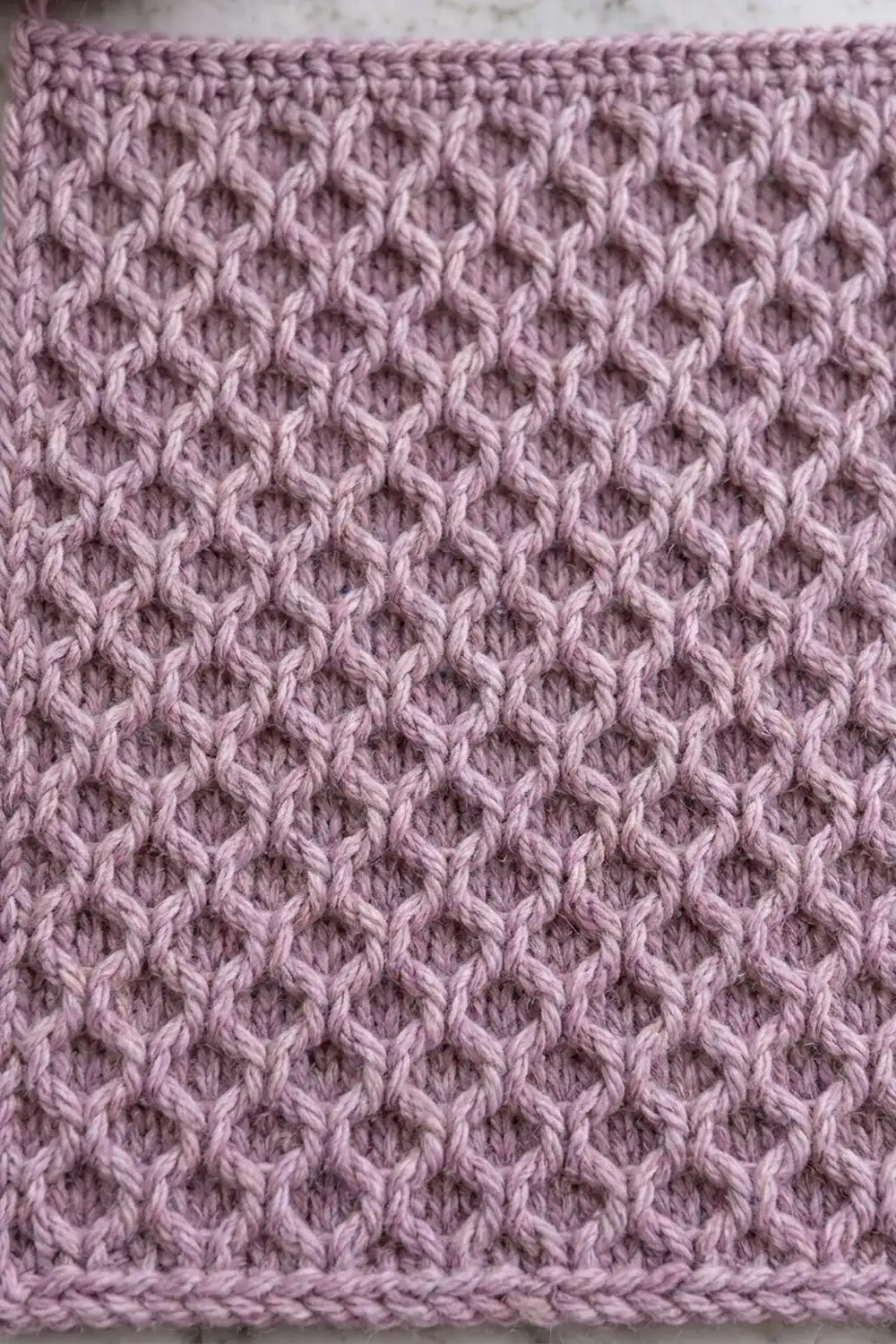
Panel Body (Make 2)
With the 6.5 mm Tunisian hook, ch 52.
Row 1 (foundation): FwP: Skip the first ch from the hook. Pull up a loop in the back bump of each ch across (52 loops on hook). RetP: standard. (52 sts)
Rows 2–3 (bottom band): FwP: Skip the first vertical bar (the loop on the hook counts as st 1). Tss in each of the next 50 sts, EST. RetP: standard. (52 sts)
The two plain rows above the foundation make the smooth narrow band at the bottom.
Row 4 (honeycomb A): FwP: Skip the first bar. Tps in next st, Tss in next st; repeat from * 25 times, EST. RetP: standard. (52 sts)*
Row 5 (honeycomb B): FwP: Skip the first bar. Tss in next st, Tps in next st; repeat from * 25 times, EST. RetP: standard. (52 sts)*
Rows 6–94: Repeat Rows 4–5. All even rows follow Row 4 and all odd rows follow Row 5, finishing with Row 94 (an A row). (52 sts in every row)
Moving the Tss/Tps pairs over by one stitch on every row is what forms the honeycomb. Each Tss bar sits on top of a purl bump from the row below, so the Tss bars bend into the slanted cell walls and the purl bumps settle into the cell centers.
Rows 95–97 (top band): FwP: Skip the first bar, Tss in each of the next 50 sts, EST. RetP: standard. (52 sts)
Row 98 (bind-off): Using the Tunisian bind-off, sl st across all 51 remaining bars. Including the first edge stitch, this gives 52 sts across the top. Do not fasten off.
Checkpoint: The panel body measures 13 in × 28 in (33.0 cm × 71.1 cm). Tunisian fabric curls toward the front. This is normal, and the border and blocking will flatten it.
Make All Pieces
Make 2 panels in Dusty Mauve, using about 250 g, or 500 yd (457.2 m), per panel.
Layout on the rod, seen from the front:
 ==[T]==[T]==[T]==[T]=====[T]==[T]==[T]==[T]== rod
   |    Panel A    |     |    Panel B    |
   |  14 × 29 in   |     |  14 × 29 in   |
   |(35.6×73.7 cm) |     |(35.6×73.7 cm) |
Both panels are identical, so either panel can hang on either side.
Joining
The two panels are not joined to each other. This lets one panel slide open on its own, as shown in the window. The only sewn seam is on each tab: once the tabs are crocheted (see Border and Tabs), each one folds over to the back and is sewn down.
Stitch-to-stitch logic: Each tab is 6 sts wide. Its last row is whipstitched, one stitch at a time, to the back loops of the same 6 sts of Border Round 1 directly below the tab. That is 6 tab sts to 6 border sts, so the tab stays square and does not twist.
Tension: Pull the yarn just snug. If the seam is too tight, it puckers the top band. If it is too loose, the tab sags. Keep the stitches on the back so nothing shows from the front.
Size checkpoint: Two panels side by side cover 28 in (71.1 cm) of rod when hanging flat. They suit a window about 24–28 in (61.0–71.1 cm) wide with gentle gathering.
Border and Tabs
Border gauge: 16 sc = 4 in (10.2 cm), and 2 rounds = 0.5 in (1.3 cm).
Change to the 5.0 mm hook. Keep the loop from the bind-off on the hook. You are at the top-left corner with the front facing you.
In this border, “per side” counts the sc between corners only. The corners are ch-2 spaces and are listed separately.
Round 1:
– Ch 2 for the corner.
– Left side: work down the row ends. Work 1 sc in each row end, plus 1 extra sc in every 7th row end (14 extra). That gives 98 + 14 = 112 sc.
– Ch 2.
– Bottom: work 1 sc in the free loop of each of the 52 foundation chains. 52 sc.
– Ch 2.
– Right side: work up the row ends the same way as the left side. 112 sc.
– Ch 2.
– Top: work 1 sc in each of the 52 bind-off sts. 52 sc.
– Join with a sl st to the first sc of the left side.
(328 sc + 4 ch-2 corner spaces)
Round 2:
– Ch 1. Sc in each sc around.
– In each ch-2 corner space, work (sc, ch 2, sc).
– Join.
Each side gains 1 sc at each end, for 2 per side: top 54 sc, bottom 54 sc, each long side 114 sc. (336 sc + 4 ch-2 corner spaces)
Why the math works: The body is 52 sts across at 16 sts per 4 in, which is 13 in (33.0 cm). The border uses the same 16 sc per 4 in, so 52 sc across the top and bottom match exactly and lie flat. The long sides are 28 in (71.1 cm), and 28 in × 4 sc per in = 112 sc. Spreading those 112 sc over 98 row ends means adding 14 sc, which is 1 extra every 7 rows. The two border rounds add 0.5 in (1.3 cm) on every side, giving 13 + 1 = 14 in (35.6 cm) wide and 28 + 1 = 29 in (73.7 cm) long.
Tabs: Place markers on the 54 top sc of Round 2, counting from the right:
Tab | gap | Tab | gap | Tab | gap | Tab
 6  | 10  |  6  | 10  |  6  | 10  |  6   = 54 sc
Tabs sit on sts 1–6, 17–22, 33–38, and 49–54. Each tab is 1.5 in (3.8 cm) wide, and each gap is 2.5 in (6.4 cm). The outer tabs are flush with the side edges.
Each tab: With the front facing you, join the yarn in the first st of the tab.
- Row 1: Ch 1, sc in each of the 6 marked sts, turn. (6 sc)
- Rows 2–16: Ch 1, sc in each sc across, turn. (6 sc)
The tab measures 4 in (10.2 cm). Fasten off, leaving a 10 in (25.4 cm) tail. Repeat for the other three tabs.
Finishing the tabs: Fold each tab to the back. Whipstitch Row 16 to the back loops of the 6 sts of Round 1 directly behind the tab, as described in Joining. This makes a loop about 2 in (5.1 cm) tall that fits a rod up to 1 in (2.5 cm) in diameter.
Final Blocking
- Weave in all ends along the border or tab seams, never through the open honeycomb cells.
- Pin a 14 in × 29 in (35.6 cm × 73.7 cm) rectangle on your blocking mats.
- Lay the panel face up. Pin the four corners first, then the midpoint of each side, then every 2 in (5.1 cm) along the edges.
- Spray the panel evenly until it is damp all through. For wool blends, you can wet-block instead.
- Gently smooth the bottom and top bands flat to remove the Tunisian curl.
- Pin the tabs flat, straight up from the top edge.
- Let the panel dry completely, usually 24 hours, before unpinning.
- Block the second panel to exactly the same outline.
Final Quality-Control Checklist
- [ ] Both panels measure 14 in × 29 in (35.6 cm × 73.7 cm).
- [ ] The honeycomb pattern alternates cleanly, with no rows where the stitches sit straight above each other.
- [ ] Every Tunisian row has 52 sts.
- [ ] Border Round 2 counts are 54 / 114 / 54 / 114 sc.
- [ ] There are 4 tabs per panel, each 6 sc wide, in the same positions on both panels.
- [ ] Each tab is sewn stitch-for-stitch with no twist.
- [ ] No yarn ends show from the front.
- [ ] The two panels hang at the same length.
Troubleshooting
The panel curls badly. Tunisian fabric curls naturally. Check that you used the 6.5 mm hook rather than a smaller one, then wet-block firmly. The border also helps it lie flat.
The honeycomb looks like vertical ribs. You repeated the same row instead of alternating. Rows 4 and 5 must start with different stitches.
The stitch count drifts. You probably missed the end stitch or worked into the first bar. Always skip the first bar, and always finish with EST.
The panel is too short at Row 94. Your row gauge is tight. Add pairs of honeycomb rows until you reach 26.9 in (68.3 cm), then work the top band. For the long sides of Round 1, work 4 sc per inch of panel length.
The side border ripples. You have too many sc. Remove a few of the extra row-end sc.
The side border pulls in. You have too few sc. Add more of the extra row-end sc.
The tabs lean. The tab was sewn to the wrong stitches. Re-sew it to the 6 sts directly behind the tab.
Care
Hand wash cold, or machine wash on gentle in a mesh bag if your yarn allows it. Reshape and dry flat. Do not hang the panels to dry while wet, because they will stretch.
Final Notes
The measurement chain is simple. Fifty-two stitches at 16 sts per 4 in give 13 in (33.0 cm). Ninety-eight rows at 14 rows per 4 in give 28 in (71.1 cm). The 0.5 in (1.3 cm) border brings each panel to 14 in × 29 in (35.6 cm × 73.7 cm), and four 6-stitch tabs on the 54-stitch top edge hang it neatly from the rod. Check your gauge, count your stitches at each checkpoint, and your two panels will match.
Happy crocheting!