
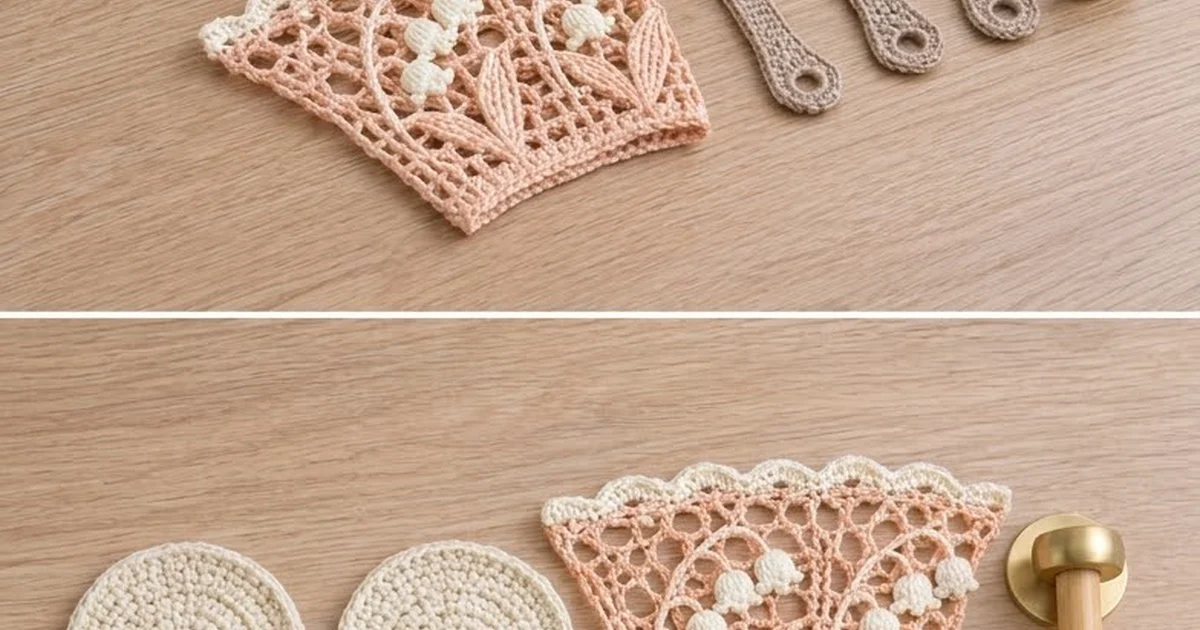
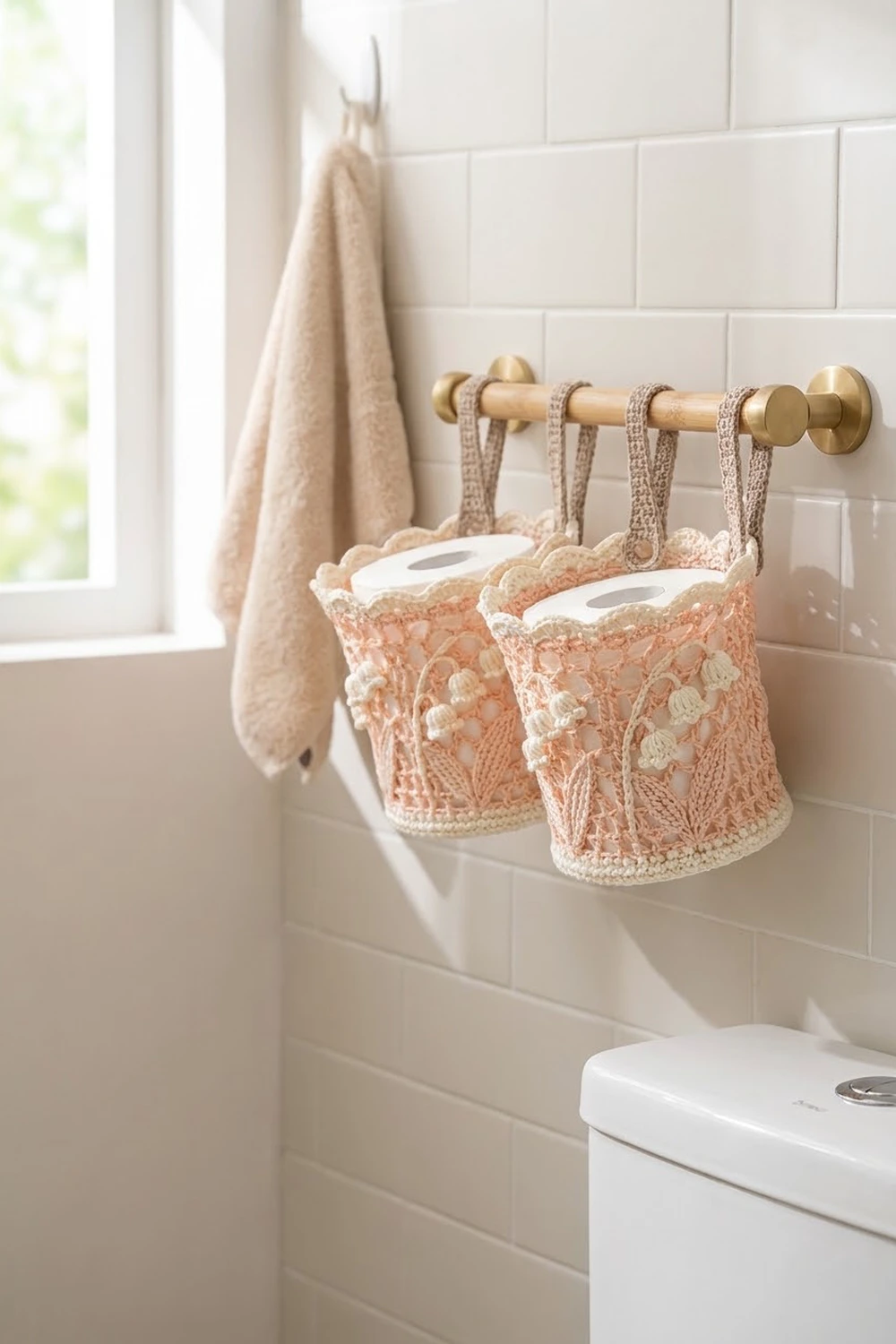
These small hanging baskets bring a soft cottage-garden look to a bathroom wall. Each basket is a flared peach mesh cup. A lily-of-the-valley spray repeats around the wall: two solid filet leaves, a raised stem, and three small ivory bells hanging from an arch.
The palette is peach, ivory and taupe. The peach mesh carries the design, ivory frames it with a solid base band and a scalloped rim, and taupe straps hang each basket from a wall rod. The set shown has two baskets, and each one holds a standard toilet roll about 4.5 in (11.4 cm) across.
This pattern uses US crochet terms. Each finished basket is about 5.5 in (14.0 cm) across the base, about 7 in (17.8 cm) across the scalloped rim, and about 5.75 in (14.6 cm) tall.
Construction is simple and modular. You crochet a flat ivory base disc with a short turned-up wall, then a flat peach panel in rows. The panel is seamed into a tube and joined to the base, and you finish with an ivory scalloped edging. Bells and stems go on last, and two taupe straps are sewn to the back of each basket.
Finished Size and Construction
- Finished size (one basket): 5.5 in (14.0 cm) base diameter, 7 in (17.8 cm) rim diameter, 5.75 in (14.6 cm) tall
- Skill level: Intermediate
- Terminology: US
- Yarn weight: Sport (#2) cotton
- Hook: 3.25 mm (US D/3)
- Number of pieces: 2 baskets. Each basket has 1 base, 1 body panel, 12 bells and 2 straps, so the set has 2 bases, 2 panels, 24 bells and 4 straps.
- Layout: 2 baskets hung side by side from one rod, 2 straps per basket
- Body panel size, flat: 17.6 in (44.7 cm) wide x 4.5 in (11.4 cm) tall
- Size before border: 5.5 in (14.0 cm) base, 5.25 in (13.3 cm) tall
- Border depth: 0.5 in (1.3 cm)
- Strap size: 9.5 in (24.1 cm) x 1.25 in (3.2 cm)
Materials
Choose a smooth mercerized or combed cotton. It shows the mesh clearly, holds the flared shape, and stands up to a damp bathroom. Avoid fuzzy, splitty or very stretchy yarns, because they blur the leaves and let the baskets sag under a roll’s weight.
- Peach (body panels, stems): 80 g, about 240 m
- Ivory (bases, bells, rims): 80 g, about 240 m
- Taupe (straps): 30 g, about 90 m
Quantities cover both baskets and include a margin of roughly 15 percent for gauge swatches and differences in tension.
Tools:
– 3.25 mm (US D/3) hook
– Tapestry needle
– 4 stitch markers
– Scissors
– Rust-proof pins
– Spray bottle and a towel
– A cylinder about 5.5 in (14.0 cm) across for blocking, such as a jar or a rolled towel
Abbreviations (US Terms)
- ch: chain
- sl st: slip stitch
- sc: single crochet
- dc: double crochet
- BLO: back loop only
- MR: magic ring
- sp: space
- st(s): stitch(es)
- RS: right side
Special stitches:
– Mesh square: ch 1, skip 1 st (or the ch-1 sp), dc in the next dc.
– Block: dc in the ch-1 sp (or the skipped st), dc in the next dc. It replaces one mesh square and keeps the same stitch count.
Gauge and Checkpoints
- Sc gauge: 22 sts x 24 rows = 4 in (10.2 cm)
- Mesh gauge: 11 mesh squares x 9 rows = 4 in (10.2 cm)
The two gauges match on purpose. One mesh square covers 2 sc widths, so the panel keeps the same width from the solid rows to the mesh.
Make one complete base and one complete panel before you start the second basket. Use these checkpoints:
- Base Rnd 6: about 2 in (5.1 cm) across
- Base Rnd 12: about 4.25 in (10.8 cm) across
- Base Rnd 16: about 5.5 in (14.0 cm) across
- Panel Row 3: 17.6 in (44.7 cm) wide, 0.5 in (1.3 cm) tall
- Panel Row 12: 4.5 in (11.4 cm) tall
If your pieces come out too big, go down 0.25 mm. If they’re too small, go up 0.25 mm. Keep the base and panel on the same hook, because both edges must carry 96 stitches at the same tension. If the base matches but the mesh rows come out short, add a slightly longer pull-up on each dc instead of changing hooks.
Base (make 2, ivory)
Work in continuous rounds and move a marker up each round.
Rnd 1: In a MR, ch 1, work 6 sc. (6)
Rnd 2: 2 sc in each st. (12)
Rnd 3: Sc in next st, 2 sc in next st around. (18)
Rnd 4: Sc in next 2 sts, 2 sc in next st around. (24)
Rnds 5-16: Each round, work 1 more plain sc before every increase than in the round before. Stagger the increase spots so the disc stays round. Rnd 5 has 30 sts, Rnd 6 has 36, Rnd 8 has 48, Rnd 12 has 72, and Rnd 16 has 96.
Rnd 17: Sc in BLO of each st. (96) This turns the edge up into a wall.
Rnds 18-19: Sc in each st. (96)
Sl st to the next st and fasten off. The wall is about 0.5 in (1.3 cm) tall.
Body Panel (make 2, peach)
Work flat in rows and turn at the end of each row. The turning ch-4 or ch-5 counts as a dc plus its chain.
Foundation: Ch 98.
Row 1: Sc in 2nd ch from hook and in each ch across. (97)
Rows 2-3: Ch 1, sc in each st. (97)
Row 4: Ch 4, skip next sc, dc in next sc. Ch 1, skip next sc, dc in next sc across. (49 dc + 48 ch = 97 sts, 48 mesh squares)
The 48 squares form 4 repeats of 12 squares. Number the squares 1-12 inside each repeat. The leaf pattern is symmetrical (square 6 mirrors 7, 5 mirrors 8, and so on), so it reads the same in both directions.
For Rows 5-10, start each row with ch 4. Work the listed squares as blocks and all other squares as mesh. End each row with a dc in the 3rd ch of the turning ch.
Row 5: Blocks at squares 6 and 7. (97)
Row 6: Blocks at 5, 6, 7 and 8. (97)
Row 7: Blocks at 4, 5, 8 and 9. (97)
Row 8: Blocks at 3, 4, 9 and 10. (97)
Row 9: Blocks at 3 and 10. (97)
Row 10: All mesh. (97)
The blocks form two pointed leaves that grow out from the center of each repeat in a V. Place a marker at the start of each repeat on Row 5 so you can count squares quickly.
Row 11 (flare conversion): Ch 5, skip ch sp, dc in next dc. Ch 2, dc in next dc across. (49 dc worked 1 per dc + 96 ch = 145 sts)
Row 12: Repeat Row 11. (145)
The longer chains open the mesh and flare the upper wall without changing the dc count.
Fasten off and leave a 20 in (50.8 cm) tail for seaming.
Stems and Bells
Bells (make 24, ivory):
Rnd 1: In a MR, ch 1, work 5 sc. (5)
Rnd 2: 2 sc in each st. (10)
Rnd 3: Sc in each st. (10)
Rnd 4: Sl st in next st, ch 2, skip 1 st 5 times. (5 sl st + 5 ch-2 points)
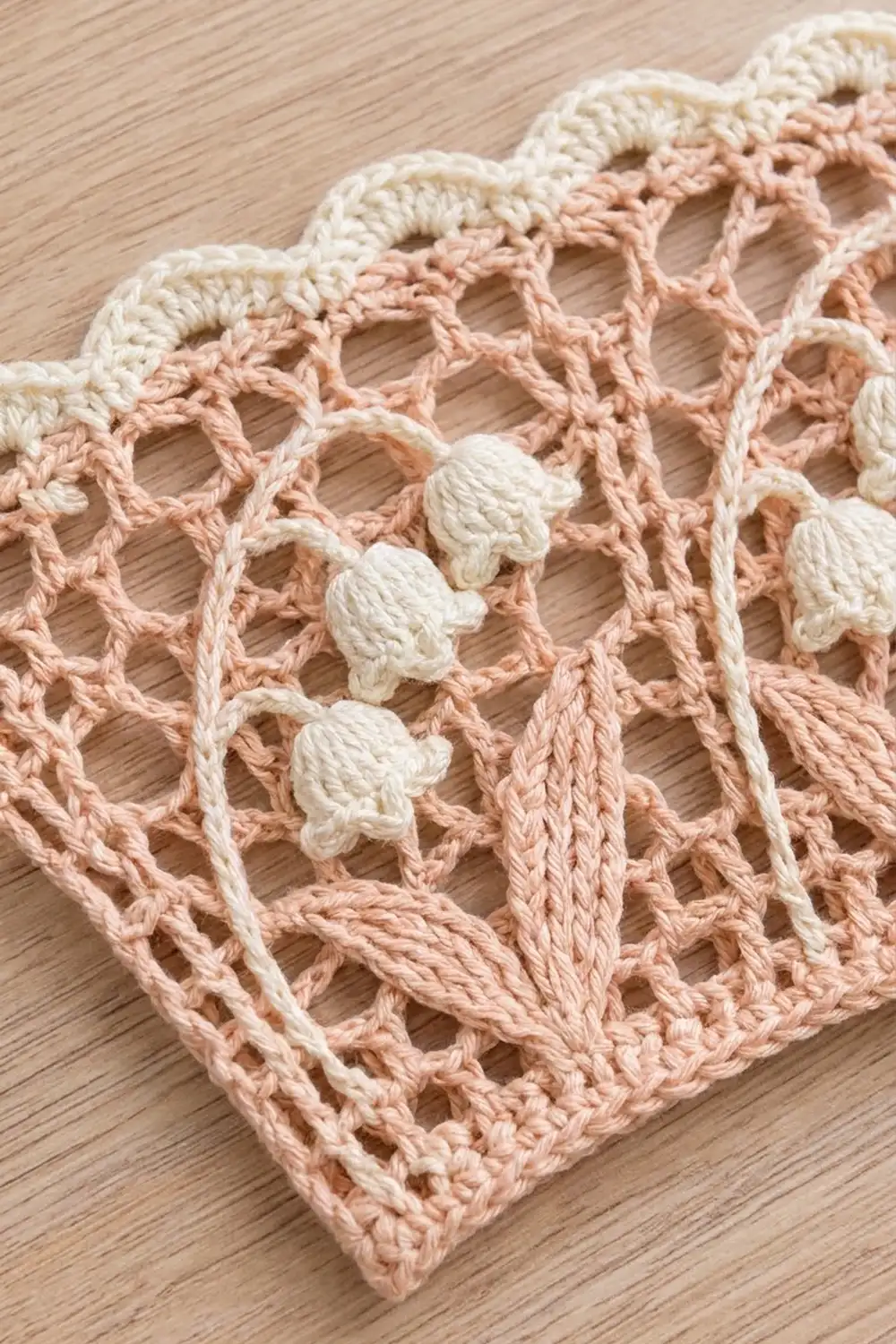
Fasten off and leave a 6 in (15.2 cm) tail. Each bell is about 0.5 in (1.3 cm) long, and the ch-2 points give it a scalloped lip.
Stems (peach, after seaming): Hold the yarn behind the work. Start at the point of the leaf V, between squares 6 and 7 at Row 5, and surface sl st straight up the center line to Row 11. Then arch to the right across 3 squares and stop at Row 10.
Hang 3 bells along the arch, one per square. Use the bell tail to make a ch-3 stalk, then sew the stalk to the stem so the bell hangs open side down.
Make All Pieces
- Peach: 2 body panels and 8 stems
- Ivory: 2 bases and 24 bells
- Taupe: 4 straps
Strap (make 4, taupe):
Foundation: Ch 6.
Row 1: Sc in 2nd ch from hook and across. (5)
Rows 2-4: Ch 1, sc across. (5)
Row 5: Ch 1, sc 1, ch 3, skip 3, sc 1. (5)
Row 6: Ch 1, sc 1, 3 sc in ch-3 sp, sc 1. (5) This makes the eyelet.
Rows 7-34: Ch 1, sc across. (5)
Rows 35-52: Ch 1 and work the first 2 sts only for 18 rows. (2) Rejoin in the 4th st of Row 34 and work 18 rows on the last 2 sts. (2) The middle st stays unworked, which opens a 3 in (7.6 cm) slot.
Row 53: Ch 1, sc 2, ch 1, sc 2 across both sides. (5)
Rows 54-56: Ch 1, sc across. (5)
Edging: Sc evenly around the whole strap, with 3 sc in each corner.
Layout on the rod:
 ===[S]====[S]========[S]====[S]===   <- rod through strap slots
    |  Basket 1 |      |  Basket 2 |
     \_________/        \_________/
Joining
Side seam: With RS together, whipstitch the side edges of the panel together with peach. Go through 1 edge stitch on each side and keep the rows level. Turn the tube RS out.
At the bottom edge, Row 1’s first and last sc now sit side by side. Count them as one position, so the bottom edge has 96 positions. At the top, the first and last dc also sit together, which leaves 48 dc positions and 48 ch-2 spaces.
Base to body: Set the panel’s bottom edge on top of the base wall, wrong sides together, with the seam at the back. Join ivory and work 1 sc through each of the 96 base sts and the matching panel position. (96) This is a one-to-one join with no extra stitches, so the base stays flat. Clip markers at the quarter points of both pieces (every 24 sts) before you start, so neither edge drifts.
Keep your tension even. A tight join makes the base cup, and a loose join makes it ripple.
Size checkpoint: The basket should measure 5.5 in (14.0 cm) across the base and 5.25 in (13.3 cm) tall.
Straps: Sew the eyelet end of each strap flat inside the back wall, just below the rim. Sew around the eyelet and through Rows 1-8. Space the 2 straps 3 in (7.6 cm) apart, centered on the seam. The slots slide onto a rod up to 1 in (2.5 cm) thick.
Border (Scalloped Rim, ivory)
Border gauge: 144 sc around the rim, which is 36 sc per spray repeat (4 repeats x 36 = 144).
Rnd 1 (conversion): Join at the seam, ch 1. Work 1 sc in each dc and 2 sc in each ch-2 sp. Sl st to the first sc. (48 sc + 96 sc = 144)
Rnd 2: Sc in next st, skip 3 sts, 9 dc in next st, skip 3 sts 18 times. Sl st to the first sc. (18 sc + 162 dc = 180 sts)
Why the math works: Each scallop uses exactly 8 base stitches (1 + 3 + 1 + 3), and 144 / 8 = 18 scallops with nothing left over. That gives 4.5 scallops per spray. Fitting 9 dc into the space of 8 stitches makes the rim ruffle slightly into soft waves.
Final Blocking
- Weave in all ends along solid stitches.
- Spritz the basket until it is evenly damp.
- Slide it over a cylinder about 5.5 in (14.0 cm) across.
- Pull the upper mesh outward and pin the rim so it measures 7 in (17.8 cm) across.
- Pin each scallop into a rounded point.
- Pinch each bell into shape and let it hang downward.
- Leave it to dry completely, then remove the pins.
Final Quality-Control Checklist
- The base lies flat and measures 5.5 in (14.0 cm) across.
- The base-to-body join has exactly 96 sc.
- All 4 spray repeats line up, with the same leaf shape in each.
- Each spray has 3 bells.
- The rim has 18 even scallops.
- The side seam is straight and sits at the back.
- Both straps are level and 3 in (7.6 cm) apart.
- The basket stands 5.75 in (14.6 cm) tall.
Troubleshooting
- Base is cupping: Add a round, or re-space the increases so they don’t stack.
- Base is rippling: Go down a hook size for the base.
- Leaves look lopsided: Recount the squares from the start of each repeat.
- Rim flares too much: Work 7 dc per scallop instead of 9 (same 8-st repeat).
- Mesh is slanting: Count the turning chain as a stitch every row.
- Basket leans: The straps are uneven. Re-sew them at the same height.
- Slot is too tight for the rod: Add 4 rows on each side of the slot.
Care
Hand wash in cool water with mild soap. Press out the water, reshape the basket over a jar, and let it air dry.
Final Notes
The measurement chain is simple. A 96-stitch base, about 5.5 in (14.0 cm) across, matches a 96-position panel edge. The 48 mesh squares hold 4 spray repeats. The ch-2 rows flare the top, and 144 rim stitches become 18 scallops at 7 in (17.8 cm) across. If each checkpoint matches, the finished basket stands 5.75 in (14.6 cm) tall and holds a standard roll. Happy crocheting!