
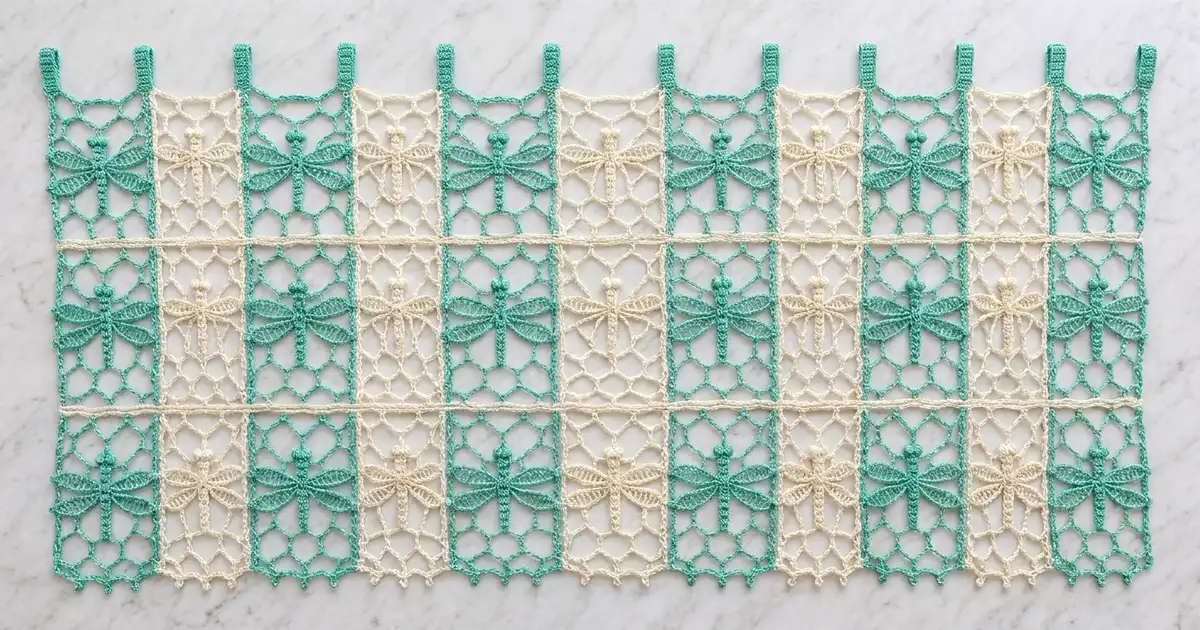
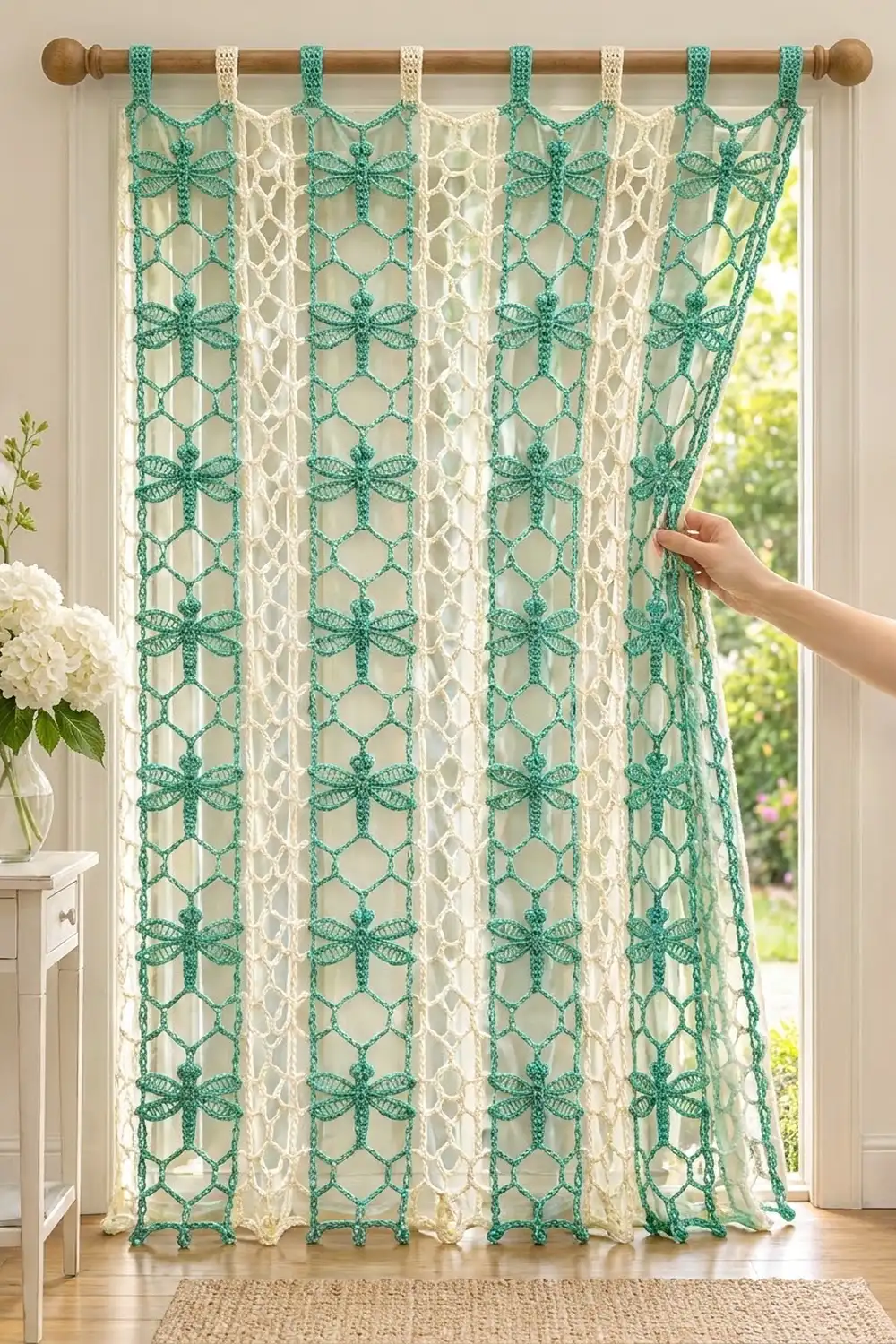
This airy curtain pairs teal dragonflies with soft cream net lace. Vertical columns of teal blocks alternate with plain cream mesh columns, and each teal block carries one raised dragonfly. In daylight the curtain reads as bright stripes, with dragonflies floating down every teal column.
Only two colors are used: a clear teal-green and a warm cream. The style is light, summery cottage lace. The open mesh lets light through while still softening the view. All instructions use US crochet terms.
The curtain body measures 46.5 x 65.5 in (118.1 x 166.4 cm). A row of drop picots hangs 0.5 in (1.3 cm) below the bottom edge. Five tab loops rise about 2 in (5.1 cm) above the top edge to hold the rod.
The construction is modular. You crochet 72 identical net-mesh blocks, 40 in teal and 32 in cream, then make 40 dragonfly appliqués and sew one onto each teal block. You whipstitch the blocks into a 9 x 8 grid, add a three-round teal border, and finish with five tabs.
Finished Size and Construction
- Finished size: 46.5 x 65.5 in (118.1 x 166.4 cm), plus 0.5 in (1.3 cm) picots and 2 in (5.1 cm) tab loops
- Skill level: Intermediate
- Terminology: US
- Yarn weight: Worsted (#4) cotton
- Hook: US 7 (4.5 mm)
- Number of pieces: 72 mesh blocks + 40 dragonfly appliqués; tabs are worked onto the border
- Layout: 9 columns x 8 rows; teal columns 1, 3, 5, 7, 9; cream columns 2, 4, 6, 8
- Block size: 5 x 8 in (12.7 x 20.3 cm)
- Size before border: 45 x 64 in (114.3 x 162.6 cm)
- Border depth: 0.75 in (1.9 cm) per side
Materials
Choose a smooth, mercerized or combed worsted cotton with good stitch definition. Cotton holds the lace shape, stretches very little when hanging, and stands up well to sunlight. Avoid fuzzy or loosely plied yarn, which blurs the chain loops.
These quantities assume about 170 m per 100 g:
- Teal: 1,600 g / 2,720 m (40 blocks, 40 dragonflies, border, tabs, teal seams)
- Cream: 600 g / 1,020 m (32 blocks, cream seams)
The quantities include a margin of about 10% for swatching and seaming.
Tools:
- US 7 (4.5 mm) crochet hook
- Tapestry needle
- Stitch markers
- Rustproof pins and foam blocking mats
- Spray bottle
- Measuring tape
- Scissors
Abbreviations (US Terms)
- ch – chain
- sl st – slip stitch
- sc – single crochet
- dc – double crochet
- sk – skip
- sp(s) – space(s)
- st(s) – stitch(es)
- Rnd – round
Bobble: (Yarn over, insert hook in st, pull up a loop, yarn over, draw through 2 loops) 5 times in the same st, then yarn over and draw through all 6 loops on hook.
Picot: Ch 5, sl st in 5th ch from hook.
Gauge and Checkpoints
Sc gauge: 20 sc and 16 rows = 4 in (10.2 cm), which is 5 sc per inch.
Mesh gauge: 6 ch-5 loops across = 5 in (12.7 cm); 2 mesh rows = 1 in (2.5 cm).
Make and measure one complete teal block before you commit to all 72. Check it at these points:
- After Row 1: 25 sc = 5 in (12.7 cm) wide.
- After Row 8: the block is 3.75 in (9.5 cm) tall.
- After Row 16: the block is 7.75 in (19.7 cm) tall.
- After Row 17: the block is 5 x 8 in (12.7 x 20.3 cm), lightly pinned.
If the block is too big, go down one hook size. If it’s too small, go up one hook size. If only the height is off, change how tightly you work the ch-5 loops instead of changing hooks, because loose chains add height quickly.
Mesh Block (Make 72: 40 Teal, 32 Cream)
Work the block in rows from the bottom up. The turning stitches form the straight chain side bars.
Ch 26.
Row 1: Sc in 2nd ch from hook and in each ch across. Turn. (25 sc)
Row 2: Ch 1, sc in first sc, *ch 5, sk 3 sc, sc in next sc; repeat from * 5 more times. Turn. (7 sc, 6 ch-5 loops)
Row 3: Ch 5 (counts as dc + ch 2), sc in first ch-5 loop, *ch 5, sc in next ch-5 loop; repeat from * 4 more times, ch 2, dc in last sc. Turn. (6 sc, 5 ch-5 loops, 2 half-loops)
Row 4: Ch 1, sc in first dc, *ch 5, sc in next ch-5 loop; repeat from * 4 more times, ch 5, sc in 3rd ch of turning ch. Turn. (7 sc, 6 ch-5 loops)
Rows 5–16: Repeat Rows 3–4 six more times. Row 16 ends like Row 4. (7 sc, 6 ch-5 loops)
Row 17 (conversion row): Ch 1, sc in first sc, *3 sc in next ch-5 loop, sc in next sc; repeat from * 5 more times. (25 sc = 7 sc worked 1-per-existing sc + 18 sc added in loops)
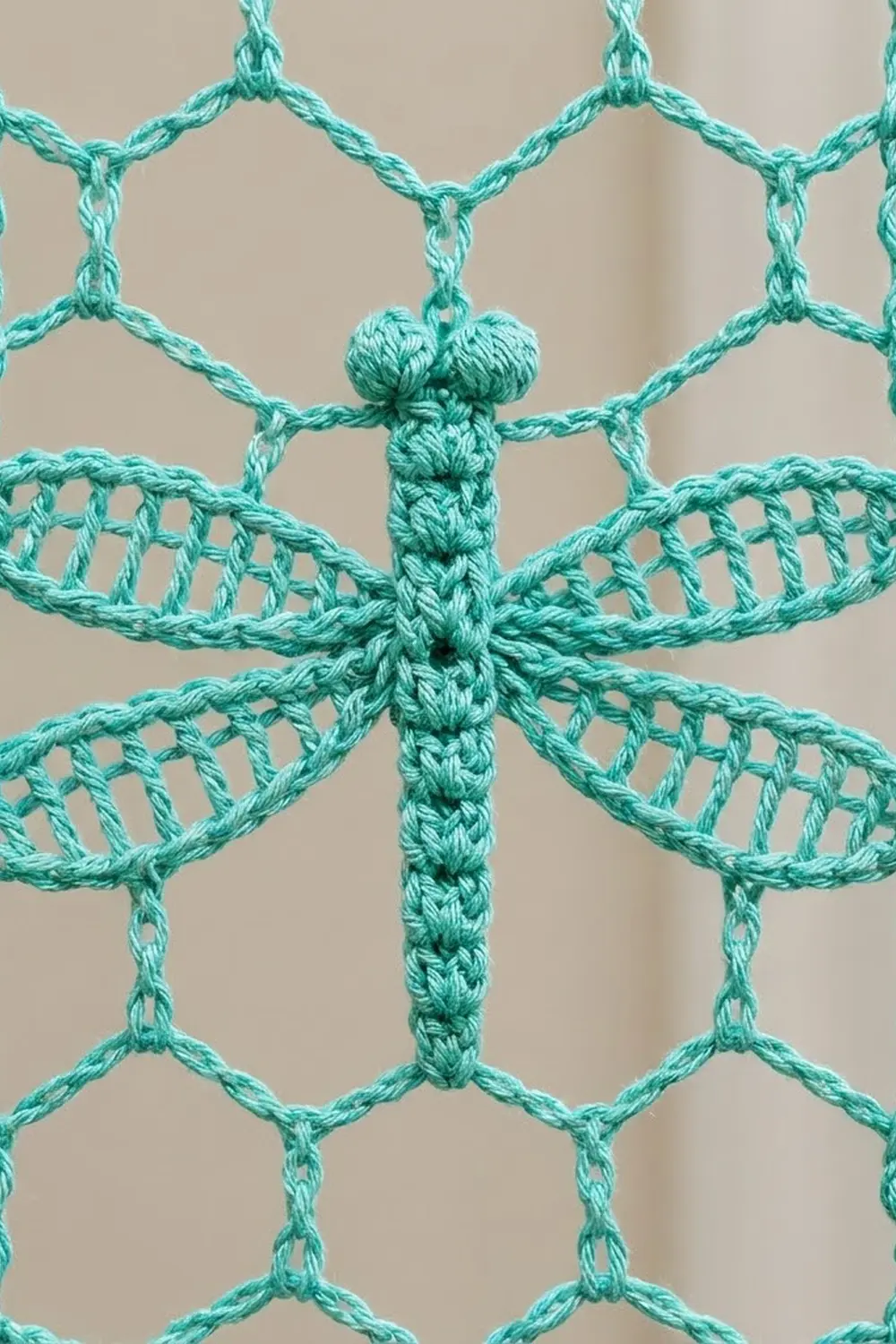
Fasten off and weave in the ends. Because each row’s loops are offset from the row below, the mesh forms the honeycomb-like net.
Dragonfly Appliqué (Make 40, Teal)
Each dragonfly has a body, two eyes, two forewings, and two hindwings.
Body
Ch 21.
Rnd 1: Sc in 2nd ch from hook and in next 18 ch, 3 sc in last ch. Working along the opposite side of the foundation, sc in next 18 ch, then 2 sc in the same ch as the first sc. Join with sl st to first sc. (42 sc)
The body measures about 4 x 0.5 in (10.2 x 1.3 cm). Fasten off and leave a 12 in (30.5 cm) tail for sewing.
Eyes
The 3-sc group at one end of the body is the head. Join teal in the first sc of that group and work a bobble. Sl st in the middle sc, work a bobble in the third sc, then sl st in the next sc. Fasten off. (2 bobbles)
Forewing (Make 2)
Ch 10.
Rnd 1: Sc in 2nd ch from hook, ch 1, dc in next ch; repeat from * 6 more times, ch 1, (sc, ch 1, sc) in last ch. Working along the opposite side, ch 1, dc in next ch; repeat from * 6 more times, ch 1, sl st to first sc. (17 sts and 17 ch-1 sps)
The dc posts with ch-1 gaps between them form the ribbed veins.
Rnd 2 (outline): Ch 1, sc in each st and each ch-1 sp around, working 3 sc in the ch-1 sp at the tip. Join. (36 sc = 34 sc worked 1-per-st-or-sp + 2 sc added at tip)
The forewing is about 2.25 in (5.7 cm) long.
Hindwing (Make 2)
Ch 9.
Rnd 1: Sc in 2nd ch from hook, ch 1, dc in next ch; repeat from * 5 more times, ch 1, (sc, ch 1, sc) in last ch. Working along the opposite side, ch 1, dc in next ch; repeat from * 5 more times, ch 1, sl st to first sc. (15 sts and 15 ch-1 sps)
Rnd 2 (outline): Ch 1, sc in each st and each ch-1 sp around, working 3 sc in the tip ch-1 sp. Join. (32 sc = 30 sc worked 1-per-st-or-sp + 2 sc added at tip)
The hindwing is about 2 in (5.1 cm) long.
Sewing the Dragonfly On
- Lay a teal block with Row 17 at the top.
- Center the body vertically over sc 13, with the eyes up and 1.5 in (3.8 cm) below the top edge.
- Sew the forewing bases just below the eyes, angled slightly upward. The span is 2.25 + 0.5 + 2.25 = 5 in (12.7 cm), so each tip reaches a side bar. Tack the tips there.
- Sew the hindwings directly below the forewings, angled slightly downward. Their 4.5 in (11.4 cm) span keeps the tips just inside the edges.
- Stitch only along the body outline and the wing bases, so the wings stay raised.
Sew a dragonfly onto every teal block before you start joining.
Make All Pieces
- Teal: 40 mesh blocks + 40 dragonflies (5 columns x 8 blocks)
- Cream: 32 mesh blocks (4 columns x 8 blocks)
Layout (T = teal dragonfly block, C = cream block):
Row 1:  T C T C T C T C T
Row 2:  T C T C T C T C T
Row 3:  T C T C T C T C T
Row 4:  T C T C T C T C T
Row 5:  T C T C T C T C T
Row 6:  T C T C T C T C T
Row 7:  T C T C T C T C T
Row 8:  T C T C T C T C T
Joining
Join with a whipstitch and a tapestry needle. Use teal for teal-to-teal seams and cream for cream-to-cream seams. Also use cream for the long seams between teal and cream columns; this creates the thin pale lines between the columns.
Step 1 – Columns: Join 8 blocks into each column. Place the Row 17 edge of one block against the foundation edge of the block above it, and whipstitch 25 sts to 25 sts, one stitch to one stitch.
Step 2 – Column to column: Join the 9 columns side by side, matching row ends. Make 1 whipstitch per sc row end and 2 per mesh row end, so every row meets its partner. Keep the horizontal seams aligned.
Tension: Pull each stitch just snug enough to close the gap. Tight seams pucker the mesh, and loose seams sag once the curtain hangs.
Size checkpoint: The joined panel should measure 45 x 64 in (114.3 x 162.6 cm). Seams add no stitches to the border counts.
Border
Border gauge: 5 sc per inch, the same as the block’s sc gauge.
Along the top or bottom edge, each block contributes 25 sts. Along each side, each block contributes 39 sc worked into its row ends:
- 1 sc in each of Rows 1 and 17 (2 sc)
- 2 sc in each of the 8 sc-ended mesh rows (16 sc)
- 3 sc in each of the 7 dc-ended mesh rows (21 sc)
Corner ch-2 sps are not stitches and are not included in the side counts.
Rnd 1: With teal, join at the top right corner. Ch 1, then sc along each edge as listed below, working ch 2 at each corner. Join. (1,074 sc)
- Top: 9 x 25 = 225 sc
- Each side: 8 x 39 = 312 sc
- Bottom: 9 x 25 = 225 sc
- 4 corner ch-2 sps
Rnd 2: Ch 1, sc in each sc around, working (sc, ch 2, sc) in each corner ch-2 sp. Join. (1,082 sc, 4 corner ch-2 sps)
- Top and bottom: 225 + 2 = 227 sc each
- Each side: 312 + 2 = 314 sc
Rnd 3 (picot round): Ch 1, work (sc, ch 2, sc) in each corner sp, and sc in each sc along the top and both sides. Along the bottom, after the corner sc, sc in the first 3 sts, *picot, sc in next 4 sts; repeat from * 55 more times, then work the next corner. Join. (1,090 sc, 56 picots)
- Top: 1 + 227 + 1 = 229 sc
- Each side: 1 + 314 + 1 = 316 sc
- Bottom: 1 + 227 + 1 = 229 sc, with 56 picots (3 + 56 x 4 = 227)
Why the math works: The top edge runs at exactly 5 sc per inch (225 sc across 45 in). The sides have 312 sc over 64 in, about 4.9 sc per inch, which keeps the long edges from flaring. Each later round adds only the 2 corner sc per side.
Tabs (Make 5, Teal)
Number the 229 top sts of Rnd 3 starting from the right corner sc. Block column 1 sits on sts 3–27. Each tab is centered over a teal column, with 7 sts left free on each side.
Work the tabs on sts 10–20, 60–70, 110–120, 160–170, and 210–220.
Row 1: Join teal in the first st of the tab, ch 1, sc in the same st and in the next 10 sts. Turn. (11 sc)
Rows 2–16: Ch 1, sc in each sc across. Turn. (11 sc)
Each tab measures 2.2 x 4 in (5.6 x 10.2 cm). Fold it to the back and sew Row 16 to the base of Row 1. This forms a 2 in (5.1 cm) loop that fits rods up to 1.25 in (3.2 cm) across.
Final Blocking
- Weave in all remaining ends along the seams.
- Lay the curtain flat on foam mats, working in sections if needed.
- Mist evenly until the curtain is damp.
- Pin the corners to 46.5 x 65.5 in (118.1 x 166.4 cm).
- Pin along each edge every 3 in (7.6 cm), keeping the edges straight.
- Open each picot and pin it pointing downward.
- Shape the wings so the ribs lie flat and the forewing tips touch the side bars.
- Let the curtain dry completely before unpinning.
Final Quality-Control Checklist
- 72 blocks, each 5 x 8 in (12.7 x 20.3 cm)
- 40 dragonflies, all with the eyes facing up
- Columns alternate, with teal on both outer edges
- Horizontal seams line up across all 9 columns
- Border counts per side (top/side): 225/312, 227/314, 229/316
- 56 evenly spaced picots along the bottom
- 5 tabs, each centered over a teal column
- Finished body is 46.5 x 65.5 in (118.1 x 166.4 cm)
Troubleshooting
The mesh looks square instead of honeycomb: Work each sc into the center of a loop, not into a stitch.
The block is too tall: Your chains are loose. Tighten the ch-5 loops.
The wings ruffle: Work the ch-1 gaps more snugly, or block the wings flat before sewing.
The border waves: Recount the stitches. Each side should have 312 sc in Rnd 1.
The curtain twists when hung: Re-block it and let it dry fully flat.
Care
Hand wash in cool water, or machine wash on a gentle cycle in a mesh bag. Reshape and dry flat; hanging the curtain while wet can stretch it.
Final Notes
Here is the measurement chain. 25 sc at 5 sc per inch gives a 5 in (12.7 cm) block width, and 17 rows give 8 in (20.3 cm) of height. Nine columns make 45 in (114.3 cm), and eight rows make 64 in (162.6 cm). Three border rounds add 0.75 in (1.9 cm) per side, for a 46.5 x 65.5 in (118.1 x 166.4 cm) curtain. If your first block measures true, the rest will follow.
Happy crocheting!