
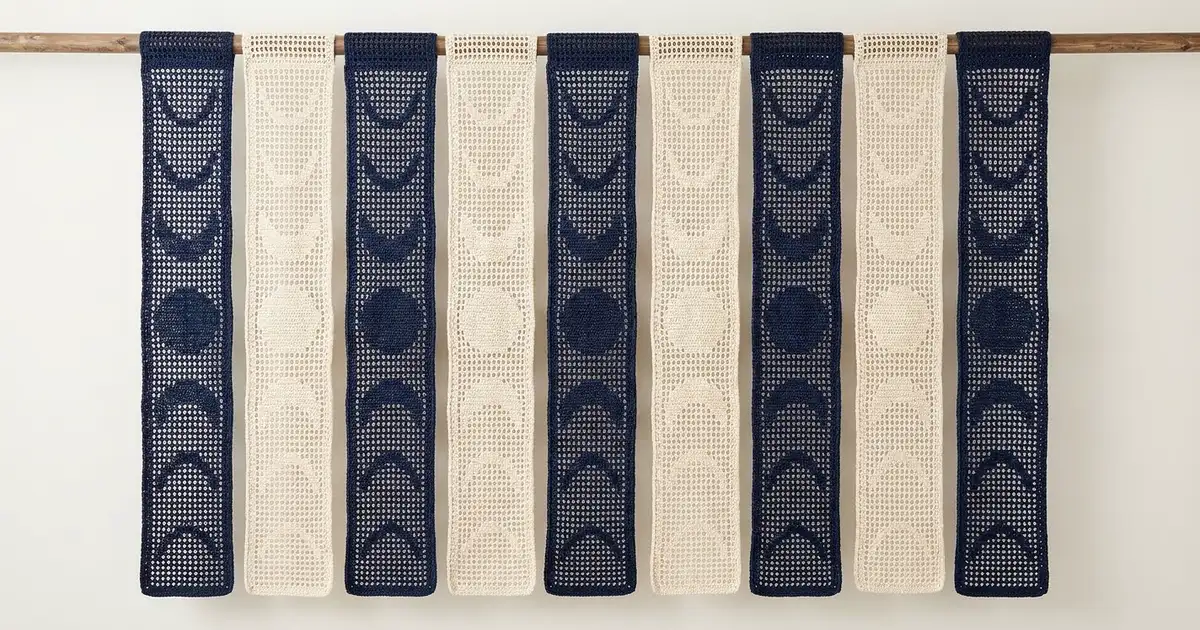
This doorway curtain is made of nine slim filet crochet strips that hang side by side from one rod. Each strip is an open grid of squares with crescent moons worked in solid blocks, stacked from top to bottom. The strips hang free, so you can walk through them and push them aside like a beaded curtain.
The colors alternate between deep navy and soft cream. Each strip uses one color only, so the moons show up through texture and light, not color changes. That means no yarn carrying, no bobbins, and no wrong-side strands to hide. When the light comes from behind, the solid moons stand out clearly against the open mesh.
The pattern uses US crochet terms. Each finished strip is 4.5 in (11.4 cm) wide and 65 in (165.1 cm) long, not counting the rod pocket. Hung edge to edge, the nine strips cover about 40.5 in (102.9 cm).
You’ll crochet each strip from the bottom up in rows of filet mesh, with eight crescent moons. Then you’ll add one round of single crochet as a border and a short flap at the top that folds over to make a rod pocket. Repeat that nine times, block the strips, and hang them up.
Finished Size and Construction
- Finished strip size: 4.5 in x 65 in (11.4 cm x 165.1 cm)
- Skill level: Intermediate (lots of repetition, easy shaping)
- Terminology: US crochet terms
- Yarn weight: DK (#3) cotton or cotton blend
- Hook: 4.0 mm (G-6)
- Number of pieces: 9 separate strips (5 navy, 4 cream)
- Layout: strips hang side by side and are not joined
- Strip body before border: 4 in x 64.5 in (10.2 cm x 163.8 cm), 8 meshes wide and 129 rows tall
- Border depth: 0.25 in (0.6 cm) on every side
- Rod pocket: 2 in (5.1 cm) flap, folded to the back
- Total hanging width: 40.5 in (102.9 cm)
Materials
Use a smooth, tightly twisted mercerized cotton. It gives the crisp mesh and rope-like edges you see in the photos, and it hangs straight without much stretch. Avoid fuzzy or very stretchy yarns, because the open squares will blur and the strips will grow in length.
The amounts below assume DK cotton with about 120 m (131 yd) per 50 g ball. Each strip uses roughly 55 g.
- Navy: 350 g, about 840 m (919 yd), for 5 strips
- Cream: 300 g, about 720 m (787 yd), for 4 strips
These amounts include a margin of 25 percent or more for your gauge swatch and small differences in tension.
Tools:
– 4.0 mm (G-6) crochet hook
– Tapestry needle
– Stitch markers
– Measuring tape
– Rust-proof pins and a long blocking surface (foam mats or a carpet covered with a towel)
– Spray bottle
– Curtain rod no thicker than 1 in (2.5 cm) and at least 44 in (111.8 cm) long
Abbreviations (US Terms)
- ch – chain
- sc – single crochet
- dc – double crochet
- sk – skip
- sp(s) – space(s)
- st(s) – stitch(es)
- RS / WS – right side / wrong side
Special stitches:
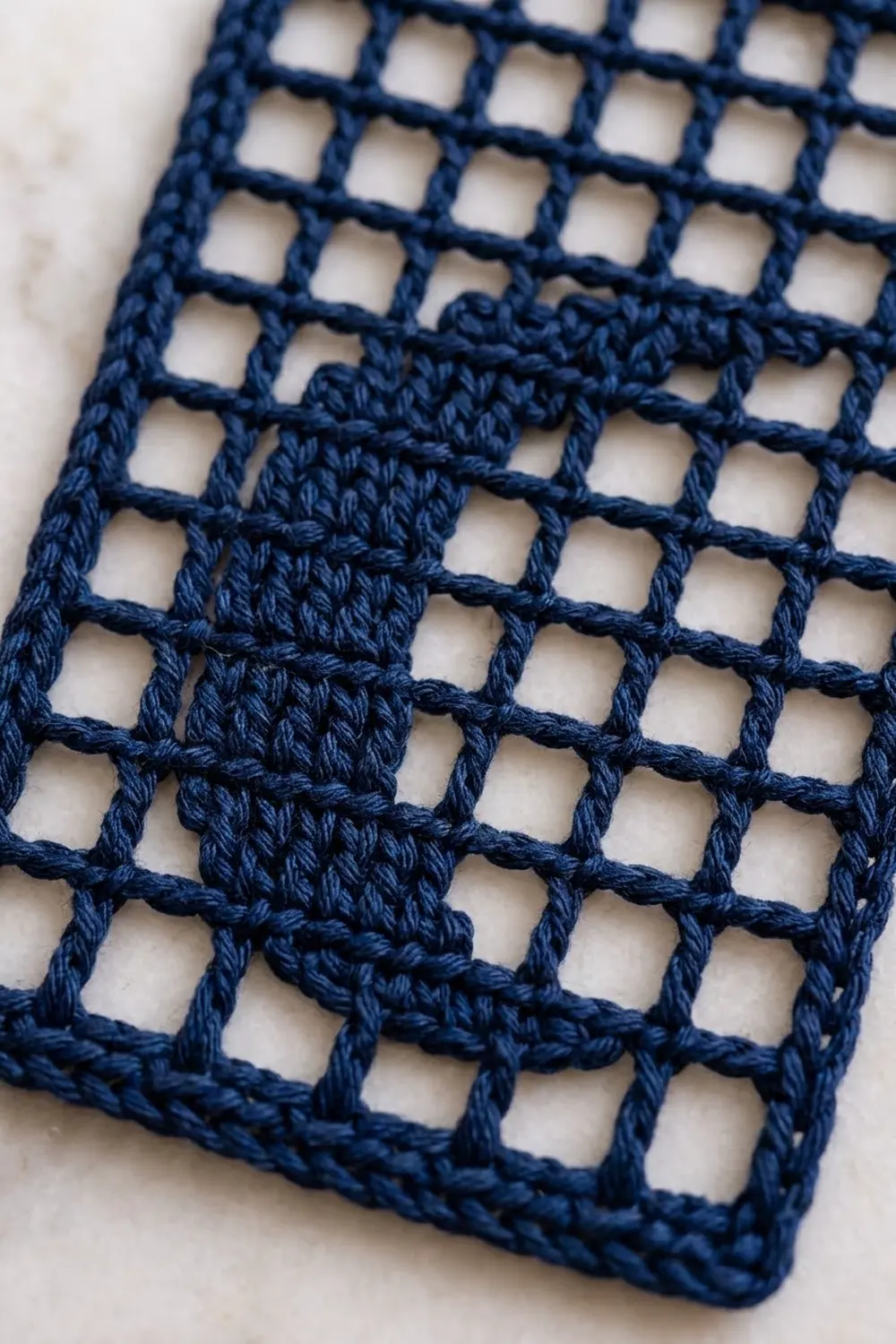
- Mesh: ch 2, sk 2 sts (or the ch-2 sp), dc in next dc.
- Block: 2 dc in the ch-2 sp below (or dc in each of the next 2 dc), then dc in next dc.
Each mesh or block uses 3 stitches. Every row has 1 starting dc plus 8 units of 3, which makes 25 stitches in total (9 dc posts and 8 ch-2 spaces in a plain mesh row).
Column numbering: With the RS facing you, the columns are numbered 1 to 8 from right to left. RS rows are worked from column 1 to column 8, and WS rows from column 8 to column 1.
Gauge and Checkpoints
Gauge: 2 meshes and 2 rows = 1 in (2.5 cm) in filet mesh, after blocking. One mesh is a 0.5 in (1.3 cm) square.
Make one complete strip before you start the others. It is your real gauge test, and it shows you how the cotton hangs.
Checkpoints for each strip:
– After Row 8: 4 in (10.2 cm) wide x 4 in (10.2 cm) tall
– After Row 20 (first moon and the gap after it): 10 in (25.4 cm) tall
– After Row 64: 32 in (81.3 cm) tall
– After Row 129: 64.5 in (163.8 cm) tall
If your piece is too big, go down to a 3.75 mm hook. If it’s too small, go up to a 4.5 mm hook. If the width is right but the rows are too tall, wrap the yarn less loosely around the hook when you work each dc. Small errors add up over 129 rows: being off by 0.05 in (0.1 cm) per row changes the strip length by more than 6 in (15.2 cm).
Strip Pattern (Make 9)
Foundation and Row 1 (RS): Ch 29. Dc in 8th ch from hook. The 7 skipped chains count as the first dc, the bottom of the first space, and its ch-2. Ch 2, sk 2 ch, dc in next ch 7 times. Turn. (8 meshes; 25 sts)
Plain mesh row: Ch 5 (counts as dc + ch 2), dc in next dc, ch 2, dc in next dc across, ending with the last dc in the 3rd ch of the turning ch-5. Turn. (8 meshes; 25 sts)
Rows 2–4: Work a plain mesh row 3 times.
Every moon row below starts with ch 5 (counts as dc + ch 2) and then dc in next dc. That completes the first mesh, which is included in the count. Columns 1 and 8 are always meshes, so every row starts and ends with a mesh.
Moon (9 rows)
Each moon is 3 blocks wide and 9 rows tall, so it measures 1.5 in x 4.5 in (3.8 cm x 11.4 cm).
Row 5 (RS; blocks in columns 3–4): 2 meshes, 2 blocks, 4 meshes. Turn. (25 sts)
Row 6 (WS; blocks in columns 6–4): 2 meshes, 3 blocks, 3 meshes. Turn. (25 sts)
Row 7 (RS; blocks in columns 5–7): 4 meshes, 3 blocks, 1 mesh. Turn. (25 sts)
Row 8 (WS; blocks in columns 7–6): 1 mesh, 2 blocks, 5 meshes. Turn. (25 sts)
Row 9 (RS; blocks in columns 6–7): 5 meshes, 2 blocks, 1 mesh. Turn. (25 sts)
Row 10 (WS): Repeat Row 8.
Row 11 (RS): Repeat Row 7.
Row 12 (WS): Repeat Row 6.
Row 13 (RS): Repeat Row 5.
The blocks move from columns 3–4 out to the thick belly in columns 6–7 and then back again. That makes a crescent with the curved belly on the left and the two horns pointing right, as seen from the RS. Columns 1 and 2 stay open on the right, and column 8 stays open on the left, so the moon sits a little left of center, as in the photo.
Gap (7 rows)
Rows 14–20: Work a plain mesh row 7 times. (25 sts each row)
Because a moon and its gap take 16 rows (an even number), every moon starts on a RS row. That means Rows 5–13 work exactly as written each time.
Remaining Moons
Rows 21–116: Work the moon (as in Rows 5–13) and then the gap (as in Rows 14–20) 6 more times. Moons start on Rows 21, 37, 53, 69, 85, and 101.
Rows 117–125: Work the eighth moon one last time.
Rows 126–129: Work a plain mesh row 4 times. Don’t fasten off.
The strip now has 4 plain rows at the bottom, 8 moons with 7 gaps between them, and 4 plain rows at the top: 4 + 72 + 49 + 4 = 129 rows.
Make All Pieces
- Navy: 5 strips
- Cream: 4 strips
Hang order, from left to right:
| N | C | N | C | N | C | N | C | N |
N = navy, C = cream. A navy strip sits at each outer edge, as in the photo.
Joining
These strips are not joined to each other. They hang separately, so they move and part when someone walks through. Each strip gets its own rod pocket (see the Border section), and you put the strips on the rod in the order shown above.
Space the strips evenly so they almost touch. A gap of about 0.25 in (0.6 cm) or less between strips looks like the photo. On a 1 in (2.5 cm) rod, the pocket should slide easily but not twist.
Size checkpoint: With the strips pushed together, the curtain should measure 40.5 in (102.9 cm) across.
Border
Border gauge: On the short edges, work 1 sc per stitch (25 sts over 4 in, or 10.2 cm). On the long edges, work 2 sc per dc row end. Each row is 0.5 in (1.3 cm) tall, so 2 sc fill it without ruffling or pulling.
Border Round: Ch 1, turn. You’re now working back across the top of Row 129. The border looks the same from both sides, so it doesn’t matter which side faces you.
- Top edge: 3 sc in the first st (corner), sc in each of the next 23 sts, 3 sc in the last st (corner). (29 sc, including both corner groups)
- First long edge: 2 sc in each row end down the side. (129 x 2 = 258 sc)
- Bottom edge: Work into the 25 foundation chains. 3 sc in the first ch (corner), sc in each of the next 23 ch, 3 sc in the last ch (corner). (29 sc)
- Second long edge: 2 sc in each row end. (258 sc)
Sl st to the first sc. Total: 29 + 258 + 29 + 258 = 574 sc. Fasten off.
Why the math works: The 25 stitches of each short edge become 25 sc. The 2 extra sc in each corner stitch (2 corners per edge) bring that edge to 25 + 4 = 29. The long edges don’t include corner stitches, because the corners belong to the short-edge counts. This round adds 0.25 in (0.6 cm) on every side, so the strip becomes 4 + 0.5 = 4.5 in (11.4 cm) wide and 64.5 + 0.5 = 65 in (165.1 cm) long.
Rod Pocket
With the RS facing, join the yarn in the center sc of the top-right corner group.
Pocket Row 1: Ch 1, sc in the same st and in each sc across the top edge to the center sc of the opposite corner group. Turn. (27 sc: 1 + 1 + 23 + 1 + 1)
Pocket Rows 2–8: Ch 1, sc in each sc across. Turn. (27 sc)
The flap measures about 2 in (5.1 cm). Fasten off and leave a 24 in (61.0 cm) tail. Fold the flap to the WS and whipstitch the last row to the base of Pocket Row 1. Leave the sides open for the rod.
Final Blocking
- Weave in all ends along the border sc, never through the open mesh.
- Soak each strip in cool water for 10 minutes. Press out the water gently without wringing, then roll the strip in a towel.
- Pin the strip flat to 4.5 in x 65 in (11.4 cm x 165.1 cm). Put a pin every 4 in (10.2 cm) along both long edges.
- Push the mesh into square holes with your fingertips, keeping the dc posts vertical.
- Smooth each moon so its blocks lie flat.
- Let the strip dry completely, for at least 24 hours. Then block the next strip.
- Measure all strips together. They should match within 0.5 in (1.3 cm) in length.
Final Quality-Control Checklist
- Every row has 25 stitches, with no extra or missing meshes along the sides.
- There are 8 moons per strip, all facing the same way (belly on the left from the RS).
- Each strip has 4 plain rows at the top and 4 at the bottom.
- There are 574 sc in the border, with 3 sc in each corner stitch.
- The rod pocket is 27 sc wide and folded to the WS.
- All strips measure 4.5 in x 65 in (11.4 cm x 165.1 cm).
- The hanging order is N, C, N, C, N, C, N, C, N.
Troubleshooting
Moon faces the wrong way: You probably counted columns from the wrong edge on a WS row. Remember that RS rows go from column 1 to column 8 and WS rows go from column 8 to column 1.
Mesh squares look like tall rectangles: Your dc are too tall. Shorten the yarn-overs, or try a hook 0.25 mm smaller.
Strip twists as it hangs: Block it again and pin it straighter, or make sure the pocket is sewn evenly along its whole length.
Long edges ruffle: Work 2 sc into each row end, not 3. Check that you’re working around the dc post, not into the turning chain twice.
Strips are different lengths: Count rows before you add the border. Undo or add plain mesh rows at the top so every strip has 129 rows.
Top edge flares at the pocket: Make the pocket with a 3.75 mm hook.
Care
Hand wash in cool water with mild soap and dry flat, pinning the strip back to 65 in (165.1 cm) if needed. Don’t tumble dry, because the long strips may tangle and grow.

Final Notes
The measurement chain is simple. Each strip is 8 meshes of 0.5 in (1.3 cm), which gives 4 in (10.2 cm) of mesh. 129 rows at 0.5 in (1.3 cm) give 64.5 in (163.8 cm) of length. The border adds 0.25 in (0.6 cm) on each side, so each strip finishes at 4.5 in x 65 in (11.4 cm x 165.1 cm). Nine strips hang side by side to cover 40.5 in (102.9 cm). If your first strip matches its checkpoints, the other eight will follow.
Happy crocheting!