

The Olive Grove Lattice Curtain is a tab-top lace panel made from on-point diamond motifs. Each diamond is an airy cream mesh with a loop at every point. On top of each one sits an olive-green sprig: five textured leaves, a slim stem and two ridged olives.
There are only two colors, cream and olive green, so the panel looks like a soft, natural lattice in a sunny window. The pattern uses US crochet terms throughout.
One finished panel measures 36.2 in (91.9 cm) wide and 84.6 in (214.9 cm) long to the tips of the pointed hem, not counting the tabs. The pair shown is two identical panels.
Construction is modular. You crochet 63 diamonds from the center out and sew a sprig to each. Then you make 22 half-diamond triangles to straighten the edges, join everything, and finish with a two-round border and five tabs.
Finished Size and Construction
- Finished size (one panel): 36.2 x 84.6 in (91.9 x 214.9 cm), plus 1.75 in (4.4 cm) tab loops
- Skill level: Intermediate
- Terminology: US
- Yarn weight: Worsted (#4) cotton
- Hook: 5.0 mm (H-8)
- Pieces per panel: 63 diamond motifs, 63 sprigs, 18 side triangles, 4 top triangles
- Layout: Diamonds on point. Rows alternate between 3 diamonds plus 2 side triangles, and 4 diamonds, with 9 rows of each type
- Motif size: 6.25 in (15.9 cm) per side; 8.8 in (22.4 cm) point to point
- Size before border: 35.2 x 83.6 in (89.4 x 212.3 cm)
- Border depth: 0.5 in (1.3 cm)
Materials
Use a smooth mercerized or combed cotton in worsted weight, about 85 m per 50 g. Cotton keeps the lattice crisp and hangs well.
- Cream (MC): 450 g, about 765 m
- Olive green (CC): 400 g, about 680 m
Quantities are for one panel, so double them for a pair. They include a margin of about 10%.
Tools: 5.0 mm hook, tapestry needle, stitch markers, scrap cream yarn for stuffing, rust-proof pins, blocking mats, spray bottle, measuring tape.
Abbreviations (US Terms)
- ch – chain
- sl st – slip stitch
- sc – single crochet
- hdc – half double crochet
- dc – double crochet
- sp – space
- st(s) – stitch(es)
- BLO – back loop only
- rep – repeat
- RS / WS – right side / wrong side
- sc2tog – single crochet 2 together
- sc3tog (special stitch) – [insert hook in next st, yarn over, pull up a loop] 3 times, yarn over, pull through all 4 loops on hook.
Gauge and Checkpoints
Gauge: 16 sc = 4 in (10.2 cm), measured along one side of Round 5.
Make one complete motif first, block it lightly, and measure:
- After Round 1: the ring is about 1.25 in (3.2 cm) across.
- After Round 3: each side is about 3.5 in (8.9 cm).
- After Round 5: each side is 6.25 in (15.9 cm), and point to point is 8.8 in (22.4 cm).
If the motif is too big, go down 0.5 mm. If it is too small, go up 0.5 mm. An error of 0.25 in (0.6 cm) per motif adds up to more than 2 in (5.1 cm) over the length of the panel.
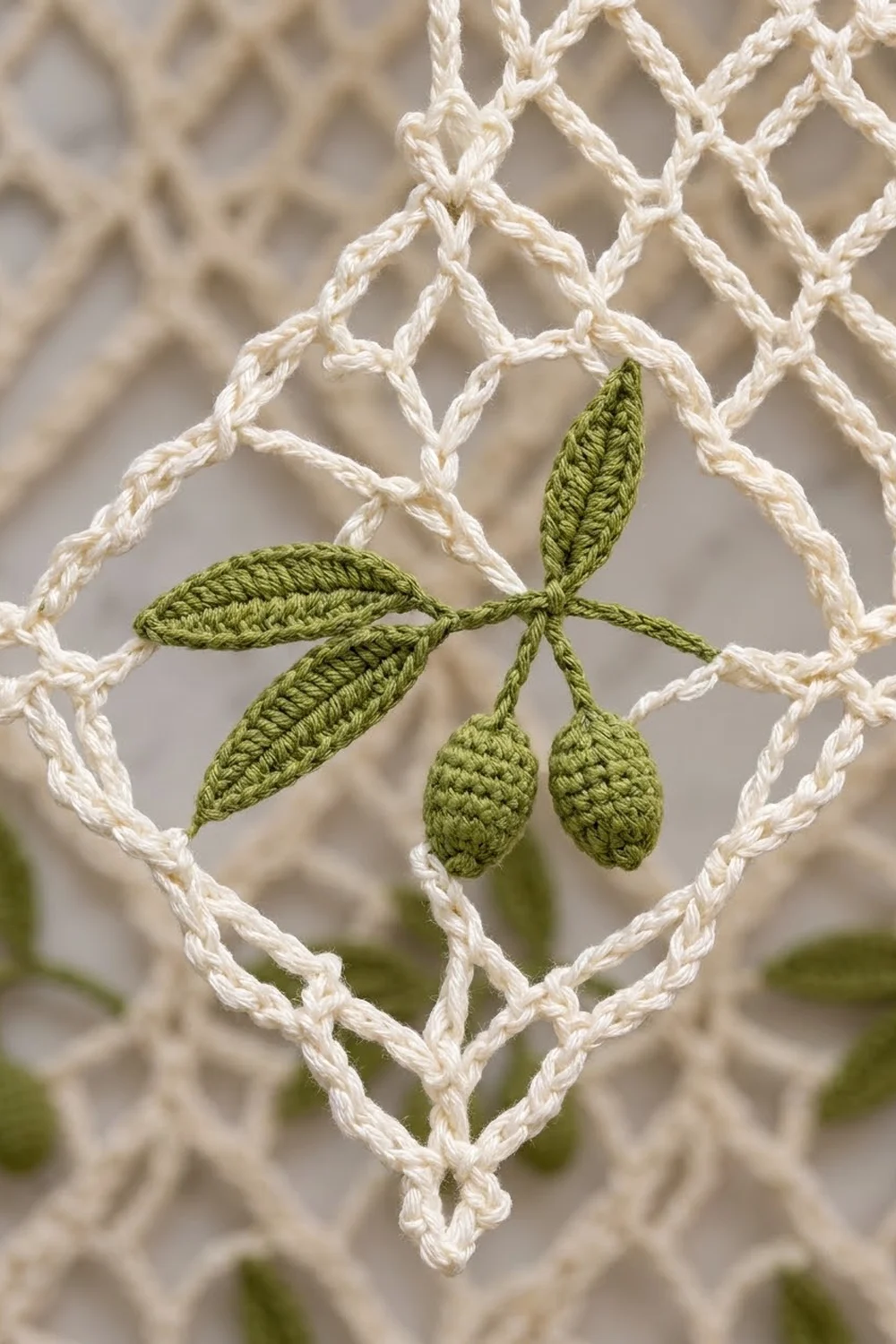
Diamond Motif (Make 63, Cream)
You work the motif as a square in the round and display it on point. Rounds 2–4 build the open lattice. Round 5 is the solid frame.
Round 1: Ch 6, sl st to first ch to form a ring. Ch 1, 12 sc in ring, sl st to first sc. (12 sc)
Round 2: Ch 1, sc in same st, ch 5, skip 1 st, sc in next st, ch 7, sc in next st, ch 5, skip 1 st, sc in next st, ch 7; rep from * 2 more times, sl st to first sc. (8 sc, 4 ch-5 sps, 4 ch-7 corner sps)*
Round 3: Sl st into next ch-5 sp, ch 1, sc in same sp, ch 5, (sc, ch 7, sc) in next ch-7 sp, ch 5, sc in next ch-5 sp, ch 5, (sc, ch 7, sc) in next ch-7 sp; rep from * 2 more times, ch 5, sl st to first sc. (12 sc, 8 ch-5 sps, 4 ch-7 corner sps; 2 ch-5 sps per side)*
Round 4: Sl st into next ch-5 sp, ch 1, sc in same sp, ch 5, (sc, ch 7, sc) in next ch-7 sp, [ch 5, sc in next ch-5 sp] 2 times, ch 5, (sc, ch 7, sc) in next ch-7 sp; rep from * 2 more times, ch 5, sc in next ch-5 sp, ch 5, sl st to first sc. (16 sc, 12 ch-5 sps, 4 ch-7 corner sps; 3 ch-5 sps per side)*
Round 5 (frame): Ch 1, sc in same st, 5 sc in next ch-5 sp, sc in next sc, (3 sc, ch 5, 3 sc) in next ch-7 sp, [sc in next sc, 5 sc in next ch-5 sp] 3 times, sc in next sc, (3 sc, ch 5, 3 sc) in next ch-7 sp; rep from * 2 more times, [sc in next sc, 5 sc in next ch-5 sp] 2 times, sl st to first sc. Fasten off. (100 sc, plus 4 ch-5 corner loops)*
Side count: Each side has 25 sc: 3 corner sc + 4 sc worked into the Round 4 sc + 15 sc in three ch-5 sps + 3 corner sc. The ch-5 corner loops are extra and are not part of the 25.
Olive Sprig Appliqué (Make 63, Olive Green)
Each sprig spans about 4.5 in (11.4 cm) and lies diagonally across the center of a diamond.
Leaf (make 5 per sprig): Ch 10. Sc in 2nd ch from hook, hdc in next ch, dc in next 4 ch, hdc in next ch, sc in next ch, 3 sc in last ch. Working along the other side of the foundation chain: sc in next ch, hdc in next ch, dc in next 4 ch, hdc in next ch, sc in next ch, ch 2, sl st to first sc. Leave a 10 in (25.4 cm) tail. (19 sts plus a ch-2 tip) Each leaf is about 2.25 in (5.7 cm) long. Use the tail to surface sl st along the foundation chain from base to tip; this raises the center vein.
Olive (make 2 per sprig):
– Rnd 1: Magic ring, 6 sc in ring. (6 sc)
– Rnd 2: 2 sc in each st. (12 sc)
– Rnds 3–4: Sc in BLO of each st. (12 sc) These rounds make the ridges.
– Rnd 5: Sc2tog 6 times. (6 sc) Stuff with scrap yarn and close the opening.
Each olive is about 1 in (2.5 cm) long.
Stems:
– Main stem: Ch 16, sl st in back bump of 2nd ch from hook and in each ch across. (15 sl st)
– Olive stems (make 2): Ch 5, sl st in back bump of 2nd ch from hook and in each ch across. (4 sl st)
Assembly: Lay the main stem diagonally across the center of the motif. Sew one leaf at the upper tip, two leaves fanning left near the base, and two angling right and down. Attach both olive stems at the midpoint of the main stem so the olives hang side by side. Tack the sprig on the WS to the frame and the lattice chains, keeping the mesh flat.
Half-Diamond Triangles (Make 22, Cream)
Each triangle is a motif cut along its diagonal. You work it in rows, starting at the center of the long edge. The two short legs match a motif side, and the long edge (the hypotenuse) becomes the straight curtain edge. All 22 triangles are identical: 18 go on the sides and 4 along the top.
Row 1: Ch 6, sl st to form a ring. Ch 1, 6 sc in ring, turn. (6 sc)
Row 2: Ch 1, sc in first st, ch 5, skip 1 st, sc in next st, ch 7, sc in next st, ch 5, skip 1 st, sc in last st, turn. (4 sc, 2 ch-5 sps, 1 ch-7 sp)
Row 3: Ch 1, sc in first sc, ch 5, sc in next ch-5 sp, ch 5, (sc, ch 7, sc) in ch-7 sp, ch 5, sc in next ch-5 sp, ch 5, sc in last sc, turn. (6 sc, 4 ch-5 sps, 1 ch-7 sp)
Row 4: Ch 1, sc in first sc, [ch 5, sc in next ch-5 sp] 2 times, ch 5, (sc, ch 7, sc) in ch-7 sp, [ch 5, sc in next ch-5 sp] 2 times, ch 5, sc in last sc, turn. (8 sc, 6 ch-5 sps, 1 ch-7 sp)
Row 5 (frame): Ch 1, 4 sc in first sc, [5 sc in next ch-5 sp, sc in next sc] 2 times, 5 sc in next ch-5 sp, sc in next sc, (3 sc, ch 5, 3 sc) in ch-7 sp, sc in next sc, [5 sc in next ch-5 sp, sc in next sc] 2 times, 5 sc in last ch-5 sp, 4 sc in last sc. Do not turn. (50 sc and 1 ch-5 loop; 25 sc per leg)
Row 6 (hypotenuse): Ch 1 and rotate to work along the row ends. Work 4 sc in each row end of Rows 5 to 2, then 2 sc across the base of the ring, then 4 sc in each row end of Rows 2 to 5. Fasten off. (34 sc, about 8.5 in / 21.6 cm)
Make All Pieces
- Cream: 63 diamond motifs and 22 triangles
- Olive green: 63 sprigs (315 leaves, 126 olives, 63 main stems, 126 olive stems)
Sew a sprig to every diamond before you join anything, and weave in all ends.
Layout grid (M = motif, S = side triangle, T = top triangle):
 T    T    T    T        <- top edge
S  M    M    M  S        row A
 M    M    M    M        row B
S  M    M    M  S        A
 M    M    M    M        B
 ... 9 A rows and 9 B rows in total ...
S  M    M    M  S        A (9th)
 M    M    M    M        B (9th) <- pointed hem
Totals: 27 + 36 = 63 diamonds, 18 side triangles and 4 top triangles.
Joining
Lay all the pieces out RS up in the grid. Whipstitch them together in cream through the outer loops of matching sc, 25 sc to 25 sc, on every diamond side and every triangle leg. Match the stitches one to one, so every seam is the same length.
At each interior junction, four ch-5 loops meet (a triangle’s corner loop counts as one). Draw them together and tack through all four. On the outer edges, two triangle tips meet one diamond corner loop; tack these together the same way.
Keep your tension relaxed so the seams stay flat. Work from the top down.
Size checkpoint: A full row measures 35.2 in (89.4 cm) wide. Each A + B pair of rows adds 8.8 in (22.4 cm), so 9 pairs give 79.2 in (201.2 cm) of straight side. The hem points add 4.4 in (11.2 cm), for a total of 83.6 in (212.3 cm).
Border
Border gauge: the same as the motifs, 16 sc = 4 in (10.2 cm). Work with RS facing.
Round 1: Join cream at the top right corner and sc around as follows:
- Top: 34 sc across each top triangle, plus 1 sc in each of the 3 diamond tips between them: (4 x 34) + 3 = 139 sc.
- Top corners: ch 2. These chains don’t count toward either edge.
- Each side: 34 sc per side triangle, plus 1 sc in each of the 8 diamond loops between them: (9 x 34) + 8 = 314 sc.
- Bottom corners: (sc, ch 2, sc) in the outer loop of the last diamond. The first sc belongs to the side, the second to the bottom.
- Bottom: For each of the 4 hem diamonds, work 25 sc along one side, (2 sc, ch 3, 2 sc) in the tip loop, then 25 sc along the other side. Add 1 sc in each of the 3 valleys: 4 x (25 + 4 + 25) + 3 = 219 sc.
Sl st to first sc. (990 sc = 139 + 314 + 314 + 219 + 4 bottom-corner sc)
Round 2: Ch 1, sc in each sc. Work (sc, ch 2, sc) in each ch-2 corner and (sc, ch 3, sc) in each ch-3 tip. At each valley, work sc3tog centered on the valley sc. Sl st to first sc.
- Top: 139 + 2 = 141 sc
- Each side: 314 + 1 (Round 1 corner sc) + 2 = 317 sc
- Bottom: 219 + 2 + 2 + 8 (tips) – 6 (valleys) = 225 sc
(1,000 sc total)
Why the math works: A diagonal is 1.414 times a side, so a 25-sc side needs about 35 sc along the diagonal. Each edge unit is 34 hypotenuse sc + 1 junction sc = 35 sc = 8.75 in (22.2 cm), which matches the 8.8 in (22.4 cm) span. The hem uses the motifs’ own 25-sc sides, and the sc3tog keeps the valleys sharp.
Tabs (make 5): Skip the first 4 sc of the top edge. Join cream, ch 1, sc in next 9 sts, turn. Rows 2–14: ch 1, sc in each st, turn. (9 sc) Fasten off. [Skip 22 sc, work a tab over the next 9 sc] 4 times, which leaves 4 sc at the end. Check: 4 + 9 + 4 x (22 + 9) + 4 = 141.
Each tab is 3.5 in (8.9 cm) long and 2.25 in (5.7 cm) wide. Fold each one to the WS and sew it down to make a 1.75 in (4.4 cm) loop.
Final Blocking
- Weave in any remaining ends along the seams.
- Soak the panel in cool water, then press it in towels. Do not wring it.
- Lay it flat on mats, RS up.
- Pin it to 36.2 x 84.6 in (91.9 x 214.9 cm).
- Pin each hem tip and valley evenly.
- Straighten the lattice and shape the leaves and olives with your fingers.
- Let it dry completely before unpinning.
Final Quality-Control Checklist
- Every diamond has 25 sc per side and 4 corner loops.
- Every triangle has 25 sc per leg and 34 sc on the hypotenuse.
- All 63 sprigs are secure and face the same direction.
- All junctions are tacked, with no gaps.
- Border counts are 141 top, 317 per side and 225 bottom.
- The five tabs are evenly spaced.
- The panel measures 36.2 x 84.6 in (91.9 x 214.9 cm).
Troubleshooting
- Motif ruffles: Your chains are too loose. Tighten them.
- Motif cups: Round 5 is too tight. Loosen the 5-sc groups.
- Edge waves after the border: Recount against 139 / 314 / 219.
- Sprig puckers the mesh: Re-tack it with looser stitches.
- Valleys look rounded: Center the sc3tog on the valley sc.
Care
Hand wash in cool water with a mild detergent and dry flat. Never hang the panel wet, because the weight will stretch the lattice.

Final Notes
Here is the measurement chain. A gauge of 16 sc = 4 in (10.2 cm) gives a 25-sc side of 6.25 in (15.9 cm) and a point-to-point span of 8.8 in (22.4 cm). Joining gives a panel of 35.2 x 83.6 in (89.4 x 212.3 cm), and the border brings it to 36.2 x 84.6 in (91.9 x 214.9 cm). Get the first motif right and everything else follows.
Happy crocheting!