

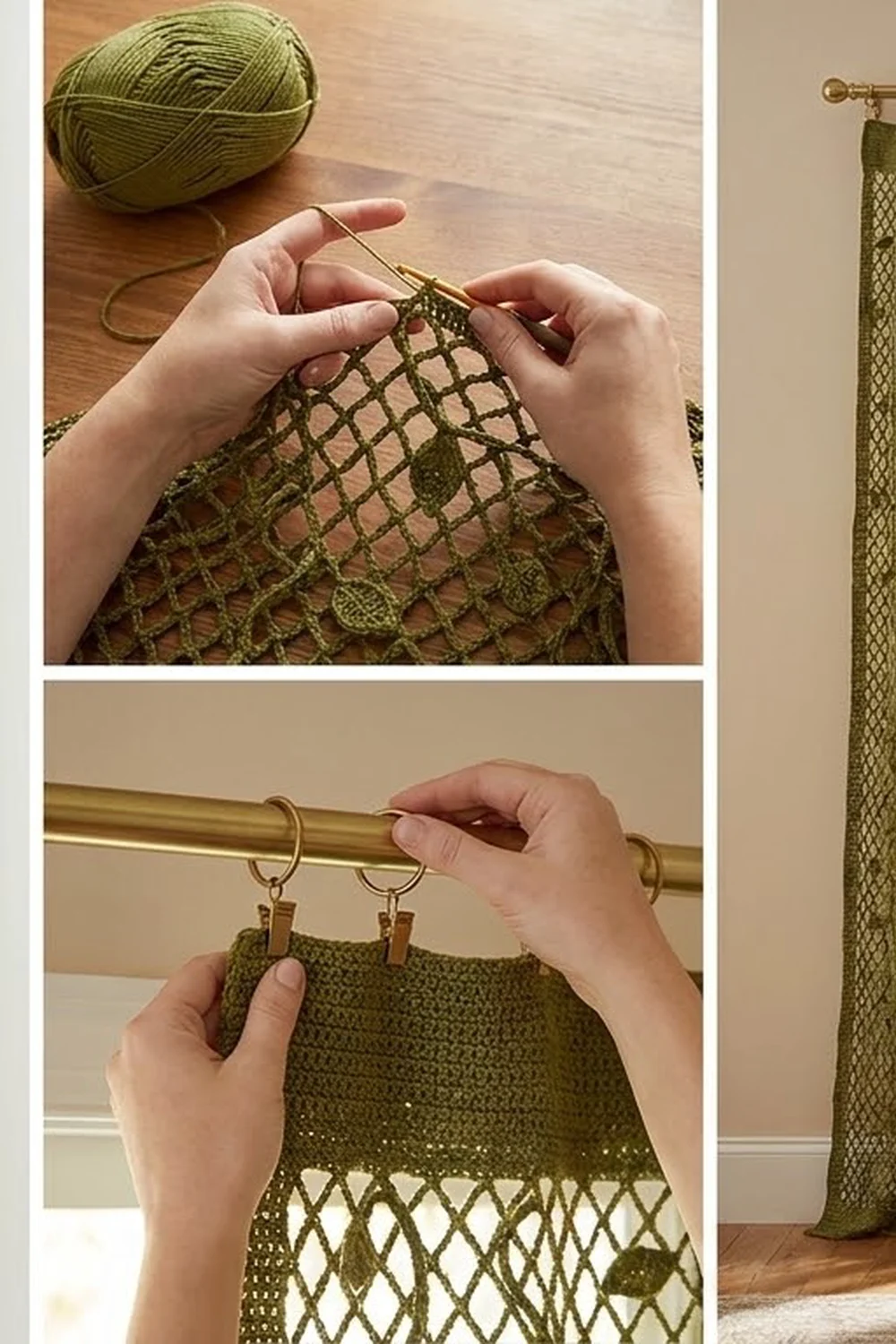
This curtain panel is a light, airy diamond mesh with climbing vines and small leaves on top. The olive green cotton lets daylight through while the leafy lines add texture, so the window looks softly screened instead of covered.
The look is cottage and botanical, worked in one color. The mesh is made of chain loops anchored with single crochet, which gives the open diamond trellis. Four wavy cords run from bottom to top, and 18 small leaves are sewn to each vine on alternating sides. A narrow single crochet border frames the mesh, and a solid double crochet heading at the top holds the curtain clips.
The pattern uses US crochet terms. One finished panel measures 31.5 in (80.0 cm) wide by 73.5 in (186.7 cm) long after blocking. For a pair like the one in the photos, make two identical panels. They are never joined. Each one hangs separately.
Construction is simple and linear. You crochet the mesh in rows, work three rounds of border, add the heading across the top, then make the vines and leaves and sew them on. Every stage has a measurement checkpoint, so you always know you are on track.
Finished Size and Construction
- Finished size (one panel): 31.5 in (80.0 cm) wide x 73.5 in (186.7 cm) long
- Skill level: Intermediate
- Terminology: US crochet terms
- Yarn weight: DK / light worsted (#3), cotton
- Hook: 4.0 mm (G-6)
- Number of pieces: 1 mesh panel per curtain, plus 4 vine cords and 72 leaves sewn on; make 2 panels for a pair
- Layout: single rectangle, 20 mesh loops wide x 80 mesh rows tall
- Mesh size before border: 30 in (76.2 cm) wide x 70 in (177.8 cm) long
- Border depth: 3 rounds, 0.75 in (1.9 cm) on every side
- Heading: 4 rows of dc, 2 in (5.1 cm) deep, across the top only
Materials
Yarn: Choose a smooth mercerized or matte cotton in DK weight. Cotton holds the mesh shape, resists sun and washes well. Avoid fuzzy fibers, which blur the diamond lines. The amounts below assume skeins of about 50 g / 115 m (126 yd).
- Olive green: 300 g / 690 m (755 yd) per panel, about 6 skeins
- For a pair: 600 g / 1,380 m (1,509 yd), about 12 skeins
All quantities include a margin of about 15 to 20 percent for the gauge swatch and small tension differences. Buy all skeins from the same dye lot.
Tools:
- 4.0 mm (G-6) crochet hook
- Tapestry needle
- Rust-proof pins (lots of them for blocking and vine placement)
- Stitch markers
- Measuring tape
- Blocking surface large enough for 31.5 x 73.5 in (80.0 x 186.7 cm), or a clean floor with towels
- 8 curtain clip rings per panel and a rod
Abbreviations (US Terms)
- ch = chain
- sl st = slip stitch
- sc = single crochet
- hdc = half double crochet
- dc = double crochet
- tr = treble crochet
- sp = space
- RS = right side
Special stitch: mesh loop. A mesh loop is ch 7 followed by sc. The 4th ch of every ch-7 is its center. On the next row, you work your sc into that center ch, not around the whole loop. This is what pulls the loops into diamonds.
Gauge and Checkpoints
Mesh gauge: 4 mesh loops = 6 in (15.2 cm) wide and 8 rows = 7 in (17.8 cm) tall, measured flat after light blocking. Each loop is 1.5 in (3.8 cm) wide and each row is 0.875 in (2.2 cm) tall.
Border gauge: 16 sc and 16 sc rows = 4 in (10.2 cm), so 4 sc per inch.
Chain gauge: 4 ch = 1 in (2.5 cm).
Test piece first: Ch 26 and work Rows 1 to 3 below with 4 loops instead of 20, then repeat Rows 2 and 3 until you have 8 rows. Wet it, pin it flat without stretching and let it dry. It should measure 6 x 7 in (15.2 x 17.8 cm).
- Too big: go down to a 3.75 mm hook, or use ch-6 loops if only the height is off.
- Too small: go up to a 4.5 mm hook.
Mesh gauge matters most. If the mesh matches, the border math works automatically because both are built on 4 stitches per inch.
Checkpoints:
- Foundation chain (122 ch): about 30.5 in (77.5 cm) long
- After Row 8: 30 in x 7 in (76.2 x 17.8 cm)
- After Row 40: 30 in x 35 in (76.2 x 88.9 cm)
- After Row 80: 30 in x 70 in (76.2 x 177.8 cm)
- After border: 31.5 in x 71.5 in (80.0 x 181.6 cm)
- After heading: 31.5 in x 73.5 in (80.0 x 186.7 cm)
- One leaf: 2 in long x 1 in wide (5.1 x 2.5 cm)

Mesh Panel
Foundation: Ch 122. (The formula is 6 ch per loop plus 2: 6 x 20 + 2 = 122.)
Row 1 (RS): Sc in 2nd ch from hook, ch 7, skip next 5 ch, sc in next ch; repeat from * 19 more times. Turn. (20 ch-7 loops, 21 sc.)
Row 2: Ch 4 (counts as tr), ch 3, sc in center ch of first ch-7 loop, ch 7, sc in center ch of next ch-7 loop; repeat from * 18 more times, ch 3, tr in last sc. Turn. (19 ch-7 loops, 2 ch-3 half loops, 20 sc, 2 tr.)
The ch-3 half loops and tr at each end keep the side edges straight instead of scalloped.
Row 3: Ch 1, sc in first tr, ch 7, sc in center ch of next ch-7 loop; repeat from * 18 more times, ch 7, sc in 4th ch of turning ch-4. Turn. (20 ch-7 loops, 21 sc.)
The first and last ch-7 of Row 3 bridge over the ch-3 half loops. Row 3 has the same counts as Row 1.
Rows 4 to 80: Repeat Rows 2 and 3 alternately, ending after a Row 2 repeat. Row 80 is an even row: tr, ch-3, 20 sc with 19 ch-7 loops between, ch-3, tr. Do not fasten off.
Check the measurement at Rows 8, 40 and 80. Lay the work flat to measure. Do not measure it hanging, since mesh lengthens under its own weight.
Border
The border is worked in rounds around all four sides. Corners are ch-2 spaces. In this border, each side count is the number of sc between two corner ch-2 spaces. The corner spaces are not included in the side counts.
Border gauge: 4 sc per inch, matching the chain gauge.
Rnd 1: Ch 1, turn so the top of Row 80 is facing you. Work the top edge: 3 sc in the ch-3 sp, 6 sc in each of the 19 ch-7 loops, 3 sc in the last ch-3 sp (3 + 114 + 3 = 120 sc). Ch 2 for the corner.
Work down the side edge: 4 sc around the post of each tr row end and 3 sc over each sc row end. There are 40 tr rows and 40 sc rows, so 160 + 120 = 280 sc. Ch 2 for the corner.
Work across the bottom, into the free loops of the foundation chain: 1 sc in each of the 5 skipped ch, 1 sc at the base of the next sc; repeat from * 19 more times (6 x 20 = 120 sc). Ch 2 for the corner.
Work up the second side the same way as the first side (280 sc). Ch 2, sl st to first sc. (Counts: 120 top, 280 per side, 120 bottom, 800 sc total, plus 4 corner ch-2 sps.)
Rnd 2: Ch 1, sc in each sc around, working (sc, ch 2, sc) in each corner ch-2 sp. Sl st to first sc. (Counts: 122 top, 282 per side, 122 bottom, 808 sc total.)
Rnd 3: Repeat Rnd 2. (Counts: 124 top, 284 per side, 124 bottom, 816 sc total.) Fasten off.
Why the math works: The mesh is 30 in (76.2 cm) wide. At 4 sc per inch, that needs 120 sc. Each loop is 1.5 in (3.8 cm), and 6 sc x 0.25 in (0.6 cm) is 1.5 in (3.8 cm), so 6 sc per loop fits exactly. Each row is 0.875 in (2.2 cm), so two rows need 3.5 sc, and 3 sc plus 4 sc over each pair of rows fits. 280 sc / 4 = 70 in (177.8 cm), which matches the mesh length. Each round after that adds 1 sc to both ends of every side and 0.25 in (0.6 cm) of depth all around.
Checkpoint: 31.5 x 71.5 in (80.0 x 181.6 cm).
Heading
Row 1: With RS facing, join yarn in the top right corner ch-2 sp. Ch 3 (counts as dc), dc in each of the 124 sc across the top, dc in the next corner ch-2 sp. Turn. (126 dc.)
Rows 2 to 4: Ch 3 (counts as dc), dc in each dc across, dc in top of turning ch. Turn. (126 dc.) Fasten off after Row 4.
The heading is 126 / 4 = 31.5 in (80.0 cm) wide, which matches the bordered width. It is 4 rows x 0.5 in (1.3 cm) = 2 in (5.1 cm) deep.
Vines
Make 4 per panel.
Cord: Ch 313. Sl st in 2nd ch from hook and in the back bump of each ch across. (312 sl st.) Fasten off, leaving a 12 in (30.5 cm) tail.
Each cord measures about 78 in (198.1 cm). This allows for a gentle wave over the 70 in (177.8 cm) mesh.
Placement: The vines run along the centers of mesh loops 3, 8, 13 and 18, counted from the left edge. Their center lines are 3.75 in (9.5 cm), 11.25 in (28.6 cm), 18.75 in (47.6 cm) and 26.25 in (66.7 cm) from the left edge of the mesh. Lay the panel flat. Pin each cord so it waves 0.75 in (1.9 cm) to each side of its center line, with one full wave every 8 rows, or 7 in (17.8 cm). That gives 10 waves from the bottom border to the heading.
Pin the whole cord before you sew anything. If it is too long, undo a few sl st and chains at the top end. If it is too short, add ch and sl st back. Tuck both ends under the border and heading. Tack the cord to the mesh with the tail yarn or a separate strand of the same yarn at every sc junction it crosses, about every 1 in (2.5 cm).
Leaves
Make 18 per vine, 72 per panel.
Leaf: Ch 9. Sc in 2nd ch from hook, hdc in next ch, dc in next 3 ch, hdc in next ch, sc in next ch, 3 sc in last ch. Rotate to work along the other side of the foundation chain: sc in next ch, hdc in next ch, dc in next 3 ch, hdc in next ch, sc in next ch, ch 2, sl st in first sc. (17 sts plus a ch-2 tip.) Fasten off, leaving an 8 in (20.3 cm) tail.
The ch-2 makes the pointed tip. The 3-sc end is the rounded base, and the foundation chain down the middle forms the visible center vein. Each leaf should measure 2 x 1 in (5.1 x 2.5 cm).
Placement: Start 1 in (2.5 cm) above the bottom of the mesh. Place one leaf every 4 in (10.2 cm) along the vine, alternating left and right, with the last leaf at 69 in (175.3 cm). Sew the base to the cord with the tip angled upward and outward. Then tack the tip lightly to the mesh so it doesn’t flop.
Final Blocking
- Weave in all ends along the border or inside the vine cords.
- Soak the panel in cool water with a little wool wash for 15 minutes.
- Press out the water gently and roll the panel in towels. Do not wring it.
- Lay it flat and pin the outer edges to 31.5 x 73.5 in (80.0 x 186.7 cm).
- Pin the side edges every 3 in (7.6 cm) so they stay straight.
- Smooth the diamonds so they are even. Each loop should be 1.5 in (3.8 cm) wide.
- Flatten each leaf with your fingers and pin its tip.
- Let it dry completely before you unpin it.
Final Quality-Control Checklist
- Mesh is 20 loops wide and 80 rows tall
- Border Rnd 3 counts: 124 top, 284 per side, 124 bottom
- Heading has 126 dc in every row
- Panel measures 31.5 x 73.5 in (80.0 x 186.7 cm)
- 4 vines are evenly spaced and wave smoothly
- 18 leaves per vine, 72 total, alternating sides
- No loose ends and no puckering along the border
- Both panels of the pair match in length within 0.5 in (1.3 cm)
Troubleshooting
- Side edges curve inward: Your border is too tight. Check that you worked 4 sc on each tr row end.
- Mesh is longer than 70 in (177.8 cm) when hanging: This is normal stretch, so always measure flat. If it’s still too long when flat, stop at an earlier even row, such as Row 76.
- Diamonds lean to one side: You are working into the side of the loop instead of the center ch. Count to the 4th ch every time.
- Border ripples: You have too many stitches. Work 3 sc on every row end and block again.
- Vine pulls the mesh into gathers: The cord is too short. Add chains so it lies flat.
- Leaves curl: Wet-block them pinned flat, or go up a hook size for the leaves only.
Care
Hand wash, or machine wash on a gentle cold cycle in a mesh bag. Lay the panel flat to dry and re-pin the edges, and don’t hang it while it’s wet, because the mesh will stretch.
Final Notes
The whole curtain follows one chain of measurements. Your swatch gives 1.5 in (3.8 cm) per loop and 0.875 in (2.2 cm) per row. Twenty loops and 80 rows give a 30 x 70 in (76.2 x 177.8 cm) mesh. A border at 4 sc per inch adds 0.75 in (1.9 cm) on every side, for 31.5 x 71.5 in (80.0 x 181.6 cm). The 2 in (5.1 cm) heading brings the panel to 31.5 x 73.5 in (80.0 x 186.7 cm). Clip 8 rings across the heading, spaced 4.5 in (11.4 cm) apart, and hang the second panel beside the first.
Happy crocheting!