

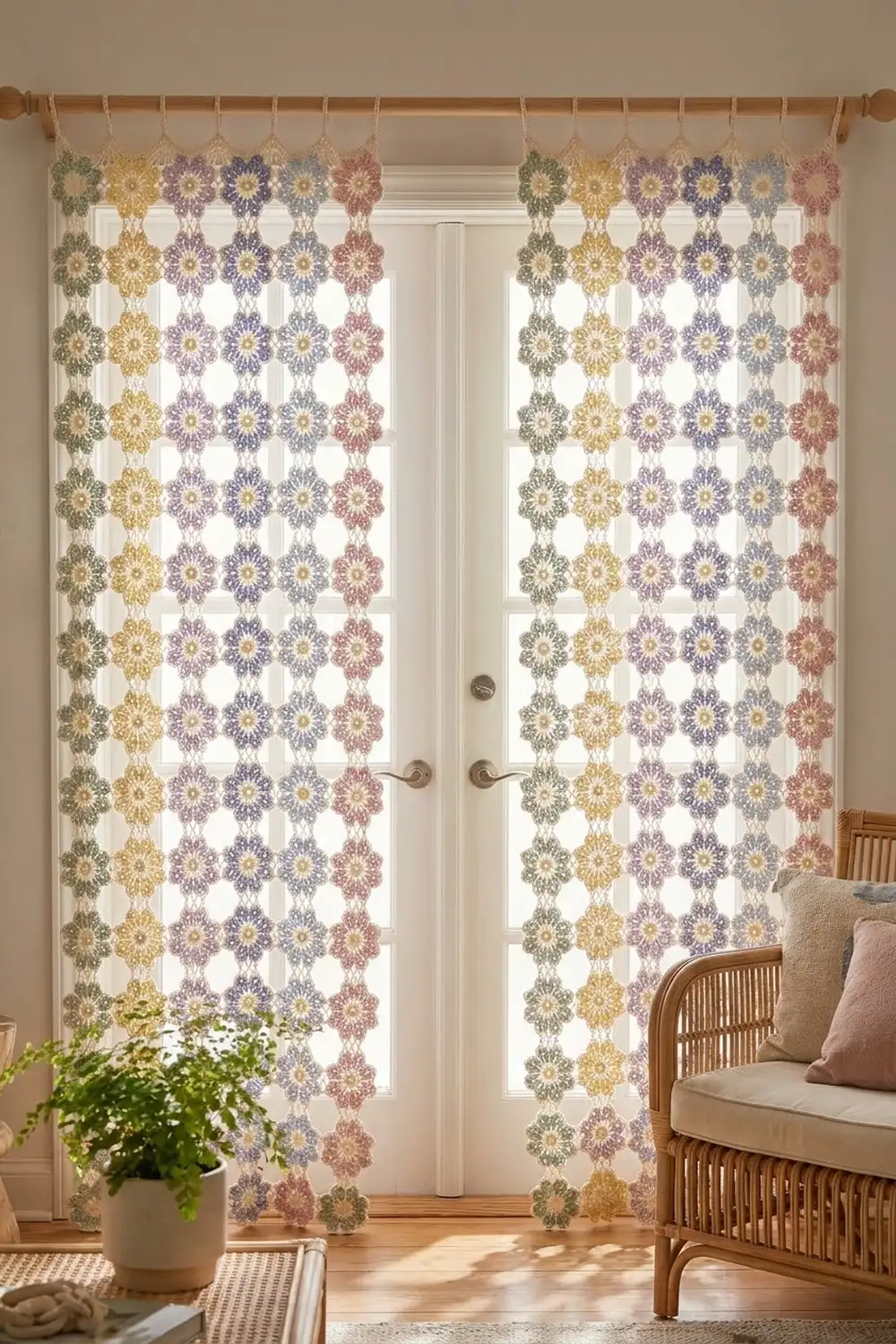
The Pastel Bloom Curtain is made from soft six-petal flower motifs linked into long hanging strands. Each flower has an open cream ring at the center, thin cream spokes, and six rounded petals, each in its own pastel shade. Daylight comes through the lace, so the window stays bright and the curtain throws pretty flower shadows across the floor.
The palette is gentle: cream at the center, then sage, pink, pale blue, periwinkle, lavender, and butter yellow around the petals. Each petal has a V-shaped pair of puff stitches near its base and a scalloped edge of small chain loops. The style is cottage-garden and light, and it fits a bedroom, sunroom, or French door.
This pattern uses US crochet terms. One motif measures 5.5 in (14.0 cm) from top petal tip to bottom petal tip and 5 in (12.7 cm) from side to side. Each finished strand is 79 in (200.7 cm) long including its hanging loop. Each of the two panels has 8 strands and hangs 40 in (101.6 cm) wide on the rod.
Construction is simple. You crochet the cream center in two rounds. Then you work each petal separately in short rows onto the spokes, joining it to the petal next to it as you go. After blocking, you link the motifs top to bottom with firm slip-stitched chain links and add a sturdy loop at the top of each strand for the rod.
Finished Size and Construction
- Finished size: two panels, each 40 in (101.6 cm) wide x 79 in (200.7 cm) long
- Skill level: Intermediate
- Terminology: US crochet terms
- Yarn weight: DK (light / 3) cotton
- Hook: 4 mm (G-6)
- Number of pieces: 192 flower motifs (96 per panel)
- Layout: each panel has 8 strands of 12 motifs, linked vertically
- Piece size: 5.5 in (14.0 cm) tip to tip x 5 in (12.7 cm) side to side
- Size before border: one strand without its hanging loop is 77 in (195.6 cm)
- Border depth: the hanging loop adds 2 in (5.1 cm) at the top of each strand
Materials
Use a smooth mercerized or matte cotton in DK weight, around 110 m per 50 g (2.2 m per gram). Cotton gives you crisp stitch definition, blocks flat, and won’t stretch much while it hangs. Stay away from fuzzy yarns, because they blur the puff stitches and the chain-loop edge.
- Color A, Cream: 400 g (880 m), for centers, spokes, links, and hanging loops
- Color B, Sage: 160 g (352 m)
- Color C, Pink: 160 g (352 m)
- Color D, Pale Blue: 160 g (352 m)
- Color E, Periwinkle: 160 g (352 m)
- Color F, Lavender: 160 g (352 m)
- Color G, Butter Yellow: 160 g (352 m)
Buy each color from a single dye lot if you can. A shade change halfway down a sunlit curtain is easy to see.
Tools:
- 4 mm (G-6) crochet hook
- Tapestry needle
- Stitch markers
- Blocking mats and rustproof pins
- Spray bottle
- Measuring tape
- Curtain rod, up to 1.5 in (3.8 cm) in diameter
All quantities include a margin of about 10% for swatching, joining, and weaving in ends. One motif uses about 1.5 g of Cream and 0.75 g of each petal color.
Abbreviations (US Terms)
- ch – chain
- sl st – slip stitch
- sc – single crochet
- dc – double crochet
- sp(s) – space(s)
- tch – turning chain
- RS / WS – right side / wrong side
- puff – puff stitch (see below)
Puff stitch: (Yo, insert hook in the stitch or space you’re told to, yo, and pull up a loop to about 0.25 in (0.6 cm)) 3 times. You now have 7 loops on the hook. Yo, pull through all 7 loops, then ch 1 to close. The closing ch-1 is the “top” of the puff.
Gauge and Checkpoints
Gauge: 18 dc and 10 rows = 4 in (10.2 cm). Because the motif is lacy, it’s more useful to make one full motif first and check it against the measurements below than to rely on a flat swatch.
- After Rnd 1: the ring measures 1.75 in (4.4 cm) across.
- After Rnd 2: the spokes measure 2.75 in (7.0 cm) across.
- After all six petals, blocked: 5.5 in (14.0 cm) tip to tip and 5 in (12.7 cm) side to side.
- Two motifs linked: 12 in (30.5 cm) from the top tip of the first to the bottom tip of the second.
Measure the motif lying flat and relaxed, without stretching it. Check across the center from the outer edge of one spoke to the opposite one.
If your motif comes out bigger, go down to a 3.75 mm hook. If it comes out smaller, go up to a 4.5 mm hook. Most of the size is set in Rnds 1 and 2, so check there before you start the petals. Over twelve motifs, an error of just 0.25 in (0.6 cm) per motif adds up to 3 in (7.6 cm) on each strand.
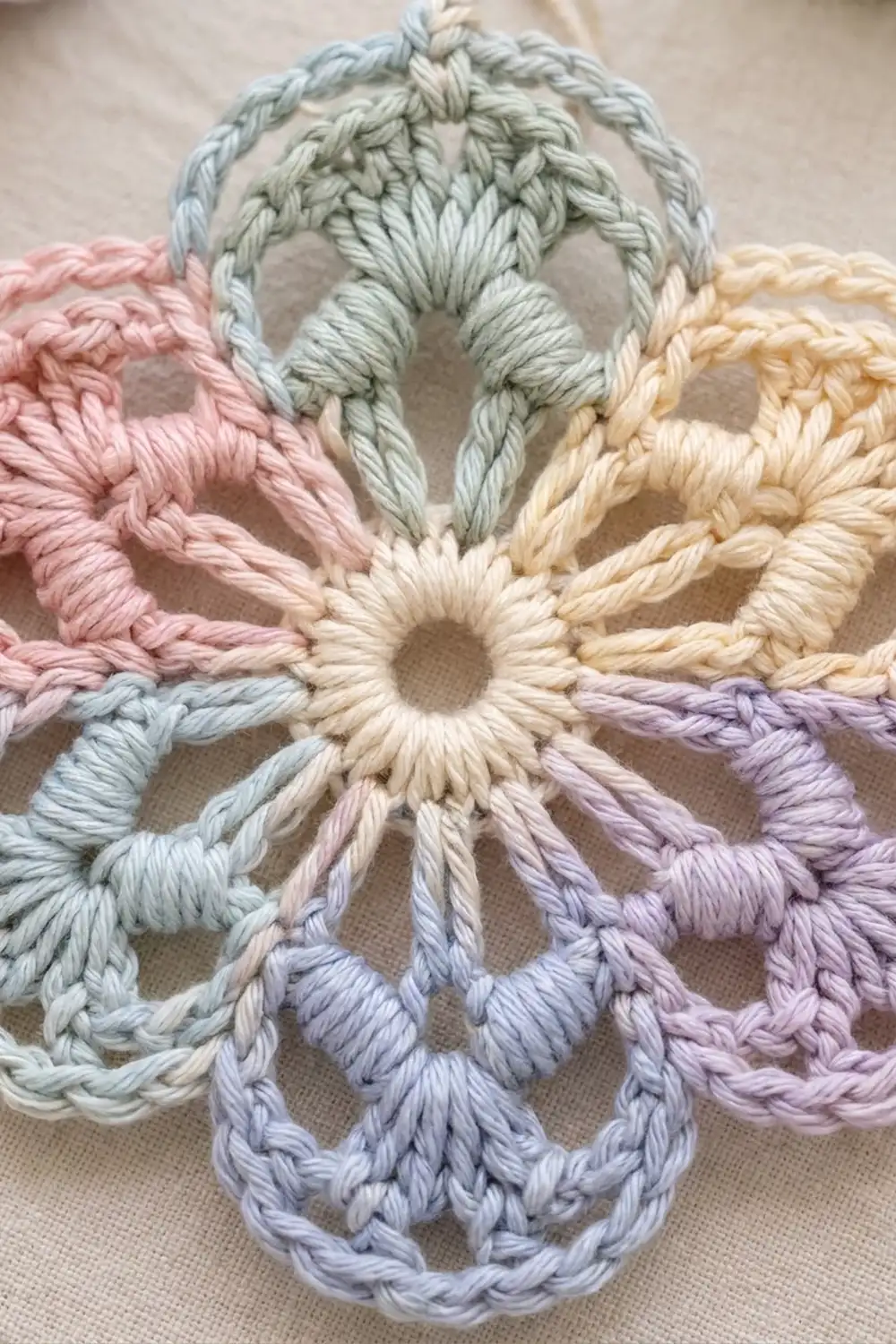
Flower Motif
Center (Color A, Cream)
Rnd 1: Ch 8, sl st in first ch to form a ring. Ch 3 (counts as dc), 23 dc in ring, sl st in 3rd ch of beginning ch-3. (24 dc)
This leaves the open hole in the middle and gives you the solid cream ring.
Rnd 2: Ch 5 (counts as dc + ch 2), skip next dc, dc in next dc, ch 2, skip next dc; rep from * 10 more times, sl st in 3rd ch of beginning ch-5. (12 dc spokes, 12 ch-2 sps)*
Fasten off. The spokes go in pairs: each petal sits on 2 ch-2 sps with one spoke between them. The spoke between two petals stays bare and shows as a thin cream line.
Petals (worked in rows)
Work the petals in this order, moving around the center the same way your rounds went: B Sage (top), C Pink, D Pale Blue, E Periwinkle (bottom), F Lavender, G Butter Yellow. Each petal uses 2 neighboring ch-2 sps. Petal 1 begins in the ch-2 sp made by the beginning ch-5.
Row 1 (RS): Join petal color with a sl st in first ch-2 sp, ch 3 (counts as dc), dc in same sp, ch 2, puff in next dc (the middle spoke), ch 2, 2 dc in next ch-2 sp. Turn. (4 dc, 1 puff, 2 ch-2 sps)
Row 2 (WS): Ch 3 (counts as dc), dc in next dc, ch 2, (puff, ch 3, puff) in top of puff, ch 2, dc in next dc, dc in 3rd ch of tch. Turn. (4 dc, 2 puffs, 2 ch-2 sps, 1 ch-3 sp)
The two puffs open into the V shape near the base of the petal.
Row 3 (RS): Ch 3 (counts as dc), dc in next dc, ch 5, skip ch-2 sp and puff, sc in ch-3 sp, ch 5, skip puff and ch-2 sp, dc in next dc, dc in 3rd ch of tch. Turn. (4 dc, 1 sc, 2 ch-5 sps)
The two ch-5 sps make the arched opening above the puffs.
Row 4 (WS, edging): Ch 1, sc in first 2 dc, in next ch-5 sp work [sc, ch 3] 3 times and then sc, sc in sc (petal tip), rep from * to * in next ch-5 sp, sc in last dc, sc in 3rd ch of tch. Fasten off. (13 sc, 6 ch-3 loops)
The 13 sc break down as 2 + 4 + 1 + 4 + 2. The 6 ch-3 loops make the scalloped edge, and the middle sc is the tip of the petal.
Joining petals as you go: Row 4 ends on the side that touches the petal before it. For Petals 2 to 6, work the last ch-3 loop as ch 1, sl st in first ch-3 loop of previous petal, ch 1. On Petal 6, also work the first ch-3 loop as ch 1, sl st in last ch-3 loop of Petal 1, ch 1. This closes the flower. Each petal still has 6 loops, because a joined loop counts as a loop.
Weave in all ends on the WS, following the color of each petal.
Make All Pieces
Make 192 identical motifs in total, 96 for each panel. Every motif uses all seven colors:
- Color A (Cream): 192 centers
- Colors B to G: 192 petals each, one per motif
Make the centers in batches first, then work petals one color at a time across the batch. This cuts down on how often you switch yarn.
Layout for one panel (M = motif, | = link, U = hanging loop). Each column is one strand:
U   U   U   U   U   U   U   U
M   M   M   M   M   M   M   M    <- motif 1
|   |   |   |   |   |   |   |
M   M   M   M   M   M   M   M    <- motif 2
|   |   |   |   |   |   |   |
... continue to motif 12 ...
M   M   M   M   M   M   M   M    <- motif 12
Each strand has 12 motifs and 11 links. Turn every motif so the sage petal points up and the periwinkle petal points down.
Joining
Block all motifs before you join them (see Final Blocking), so that every link is the same length.
Link method (Color A): With RS facing, join Cream with a sl st in the tip sc of the periwinkle petal on the upper motif. Ch 6. Sl st in the tip sc of the sage petal on the lower motif. Then sl st in the back bump of each of the 6 ch to work back up, and sl st in the starting tip sc. Fasten off. (6 ch + 6 sl sts per link)
Stitch-to-stitch logic: Each link joins exactly 1 tip sc to 1 tip sc. You don’t pick up any other stitches, so the petal counts stay the same. The sl st return makes the link stiff enough that motifs don’t spin or stretch apart.
Tension: Work the 6 ch at your normal tension, but keep the sl sts loose enough to slide your hook in easily. If the link puckers, the sl sts are too tight.
Lay each strand out on the floor as you go. That lets you see that every motif faces the same way before you fasten off each link.
Size checkpoint: Each link is 1 in (2.5 cm) long. That gives one motif plus one link a length of 6.5 in (16.5 cm). For each strand: 12 x 5.5 in + 11 x 1 in = 77 in (195.6 cm).
Border (Hanging Loops)
A strand curtain doesn’t have a border around the edges. The top hanging loop is its border, and it is the only edge finish. The sides and the bottom tips are left as they are.
Border gauge: 8 sc = 1 in (2.5 cm) when worked over a chain loop.
Rnd 1: With RS facing, join Cream with a sl st in the tip sc of the sage petal on motif 1. Ch 24, sl st in same tip sc. (1 ch-24 loop)
Rnd 2: Ch 1, work 32 sc into the ch-24 loop, sl st in same tip sc. Fasten off. (32 sc)
Why the math works: 32 sc at 8 sc per inch cover 4 in (10.2 cm). That matches the length of the 24 ch, so the loop lies smooth with no ruffling or cupping. A loop 4 in around hangs down about 2 in (5.1 cm) and fits a rod up to 1.5 in (3.8 cm) across. That makes 77 in + 2 in = 79 in (200.7 cm) per strand. Each panel has 8 loops. When you space them at 5 in (12.7 cm) centers, the panel is 8 x 5 in = 40 in (101.6 cm) wide, with flowers in neighboring strands just touching.
Final Blocking
- Soak the motifs in cool water for 10 minutes, then press out the water in a towel. Don’t wring them.
- Pin each motif flat with the sage petal at the top. Stretch it to 5.5 in (14.0 cm) tip to tip and 5 in (12.7 cm) side to side.
- Pin the center hole round and line up the six bare spokes evenly.
- Pin out each petal tip and the middle ch-3 loops so the scallops open up.
- Leave to dry completely, then link the motifs.
- After linking, hang each strand and mist it lightly. Its own weight will straighten the links.
Final Quality-Control Checklist
- Every motif has 24 dc in Rnd 1 and 12 spokes in Rnd 2.
- Every petal has 13 sc and 6 ch-3 loops.
- All six petals are joined, and the colors run in the same order on every motif.
- Sage points up and periwinkle points down along each strand.
- Each strand has 12 motifs, 11 links, and 1 hanging loop.
- Each strand measures 79 in (200.7 cm).
- No ends are showing on the RS.
Troubleshooting
- Center cups: Rnd 1 is too tight. Loosen your dc or use ch 9 for the ring.
- Center ruffles: Your spokes are too loose. Go down a hook size for Rnd 2.
- Petals overlap: The Row 3 chains are too long for your tension. Change to ch 4.
- Gaps between petals: You missed a petal join. Add a sl st through the touching loops.
- Strands are different lengths: The links aren’t the same. Re-block, then remake any link that isn’t 1 in (2.5 cm).
- Motifs twist: The link sl sts are too loose. Rework them with a firmer return.
Care
Hand wash in cool water with mild soap, press dry in a towel, and lay flat or rehang to dry. Re-block lightly if the petals lose their shape.
Final Notes
The measurements build on each other. A 2.75 in (7.0 cm) center gives a 5.5 in (14.0 cm) motif. Twelve motifs with eleven 1 in (2.5 cm) links make a 77 in (195.6 cm) strand. The hanging loop brings it to 79 in (200.7 cm), and eight strands at 5 in (12.7 cm) spacing make a 40 in (101.6 cm) panel. Check the first motif carefully, keep your links even, and the rest will follow.
Happy crocheting!