

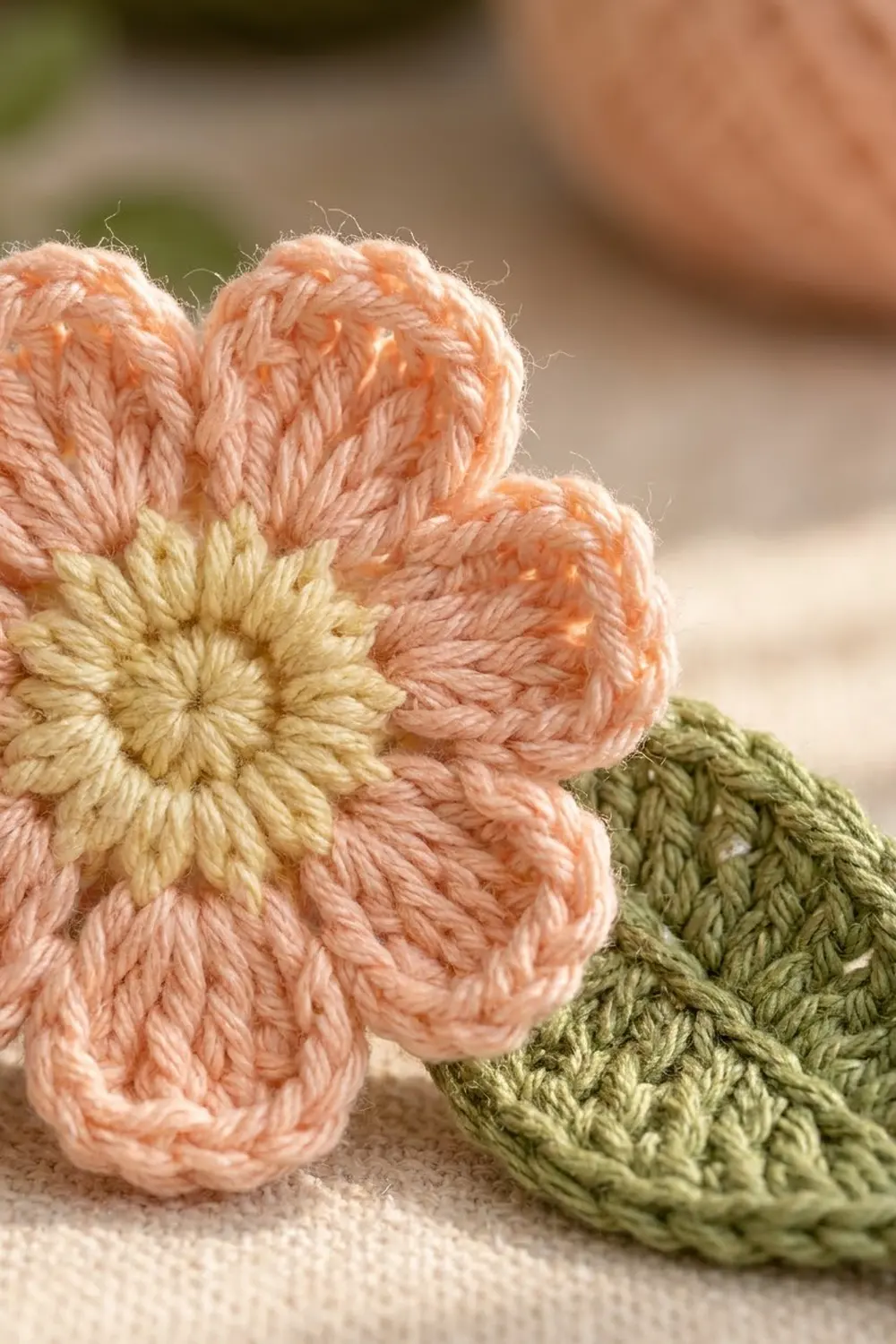
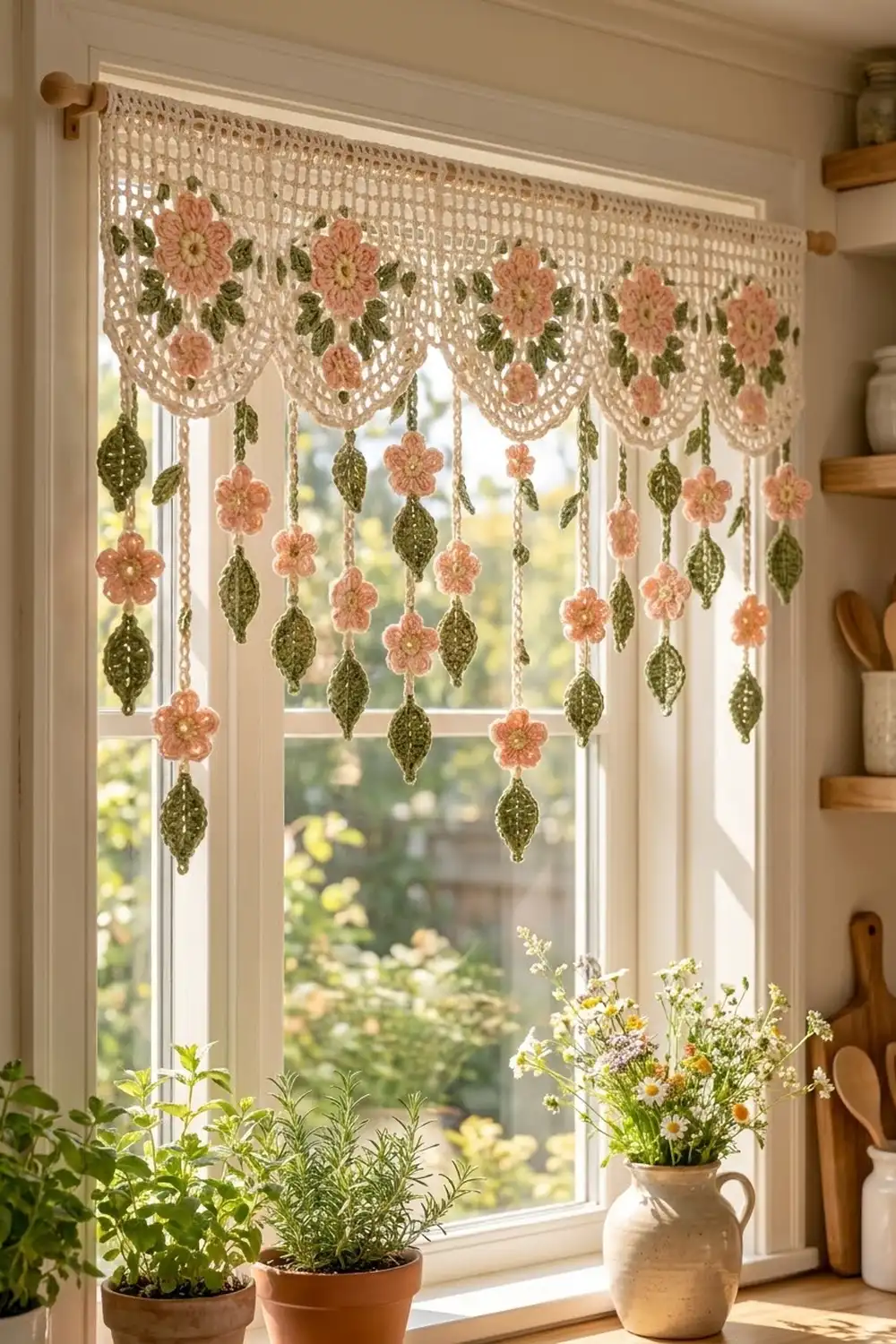
The Peach Blossom Window Valance is a soft, cottage-style piece for a kitchen window. A cream mesh band ends in six rounded lace scallops. Peach flowers with buttery yellow centers and sage-green leaves are sewn onto the band. Below it hang thirteen chain strands of flowers and leaves, which sway when the window is open.
The colors are cream, peach, pale yellow, and sage green. Daylight shows through the mesh, so the solid motifs stand out clearly.
This pattern uses US crochet terms. The valance is 36.5 in (92.7 cm) wide and 8.75 in (22.2 cm) deep through the scallops. The longest strands reach 19.5 in (49.5 cm) from the top edge.
First you crochet a filet mesh band in rows and add one round of single crochet. Then you work six half-circle scallops directly onto the bottom edge. The flowers and leaves are made separately. Some are sewn onto the band, and the rest are joined into hanging chain strands.
Finished Size and Construction
- Finished size: body 36.5 in x 8.75 in (92.7 cm x 22.2 cm); total drop 19.5 in (49.5 cm)
- Skill level: Intermediate
- Terminology: US crochet terms
- Yarn weight: DK (#3) cotton
- Hook: 3.5 mm (E-4)
- Number of pieces: 1 band, 6 large flowers, 26 small flowers, 24 small leaves, 20 large leaves, 13 strands
- Layout: 6 segments side by side, each 6 in (15.2 cm) wide
- Band size before border: 36 in x 5 in (91.4 cm x 12.7 cm), which is 90 mesh x 10 rows
- Size after border round: 36.5 in x 5.5 in (92.7 cm x 14.0 cm)
- Border depth: 0.25 in (0.6 cm) on the top and sides; 3.25 in (8.3 cm) scallops on the bottom
Materials
Use a smooth mercerized or combed DK cotton with about 115 m per 50 g. Cotton keeps the mesh crisp and the motifs well defined.
- Cream: 100 g (230 m) for the band, border, scallops, and strand chains
- Peach: 75 g (173 m) for the petals
- Pale yellow: 25 g (58 m) for the flower centers
- Sage green: 75 g (173 m) for the leaves
These amounts include about 20% extra.
Tools: 3.5 mm (E-4) hook, tapestry needle, 13 stitch markers, scissors, measuring tape, blocking mats, rust-proof pins, spray bottle, and a café rod up to 0.5 in (1.3 cm) thick.
Abbreviations (US Terms)
ch (chain), sl st (slip stitch), sc (single crochet), hdc (half double crochet), dc (double crochet), tr (treble crochet), sk (skip), sp (space), st(s) (stitch/es), RS (right side).
Mesh: One mesh is (dc, ch 1). Ten mesh measure 4 in (10.2 cm).
Fan increase: Work (dc, ch 1, dc) in the same dc. This turns one dc into two and adds one ch-1 sp.
Gauge and Checkpoints
Mesh: 10 mesh and 8 rows = 4 in (10.2 cm). Sc: 5 sc = 1 in (2.5 cm). Chain: 5 ch = 1 in (2.5 cm).
Make a test swatch first. Ch 24, work Row 1, then repeat Row 2 until you have 8 rows. The 10 mesh should measure 4 in (10.2 cm) square. Then make one large flower and one large leaf to check their size.
Checkpoints:
– Large flower: 2.75 in (7.0 cm); small flower: 1.75 in (4.4 cm)
– Large leaf: 2.5 x 1.25 in (6.4 x 3.2 cm); small leaf: 1.5 x 0.75 in (3.8 x 1.9 cm)
– Band after Row 10: 36 x 5 in (91.4 x 12.7 cm)
– After the border round: 36.5 x 5.5 in (92.7 x 14.0 cm)
– Each scallop: 6 in (15.2 cm) wide and 3.25 in (8.3 cm) deep
If your swatch is too big, go down to a 3.25 mm hook. If it’s too small, go up to a 3.75 mm hook. Use the same hook for every part so the motifs stay in scale with the mesh.
Part 1: Mesh Band
Use cream and work in rows. Row 1 is the top edge.
Foundation: Ch 184.
Row 1 (RS): Dc in 6th ch from hook (the skipped 5 ch count as dc and ch-1 sp), ch 1, sk 1 ch, dc in next ch; repeat from * across. Turn. (91 dc, 90 ch-1 sps = 90 mesh)
Rows 2–10: Ch 4 (counts as dc and ch 1), dc in next dc, ch 1, dc in next dc; repeat from * across. Work the last dc in the 3rd ch of the turning ch (on Row 2, in the 3rd ch of the skipped ch-5). Turn. (91 dc, 90 ch-1 sps each row)
Checkpoint: the band measures 36 x 5 in (91.4 x 12.7 cm). Don’t fasten off. Go to Border Round 1 now, then come back for the motifs.
Part 2: Large Flower (make 6)
Rnd 1 (yellow): Magic ring, ch 3 (counts as dc), 11 dc in ring. Sl st to top of ch-3. (12 dc)
Rnd 2 (yellow): Ch 1, sc in next st, 2 sc in next st; repeat from * 5 more times. Sl st to first sc. Fasten off. (18 sc) The center should measure 1.25 in (3.2 cm).
Rnd 3 (peach): Join peach in any sc. Sl st in next sc, (2 dc, 3 tr, 2 dc) in next sc, sl st in next sc; repeat from * 5 more times. Fasten off and leave a long tail. (6 petals: 42 petal sts plus 12 sl sts)
Each petal uses 3 center sts, and 6 x 3 = 18, which matches Rnd 2.
Part 3: Small Flower (make 26)
Rnd 1 (yellow): Magic ring, ch 1, 12 sc in ring. Sl st to first sc. Fasten off. (12 sc)
Rnd 2 (peach): Join peach in any sc. (Hdc, 3 dc, hdc) in next sc, sl st in next sc; repeat from * 5 more times. Fasten off. On 6 of the flowers, leave a 6 in (15.2 cm) tail for sewing. (6 petals: 30 petal sts plus 6 sl sts)
Part 4: Leaves
You work both leaves around both sides of a foundation chain. The chain forms the center vein.
Large Leaf (sage, make 20): Ch 12. Sc in 2nd ch from hook, hdc in next ch, dc in next 2 ch, tr in next 3 ch, dc in next 2 ch, hdc in next ch, 3 sc in last ch. Now work along the other side of the chain: hdc in next ch, dc in next 2 ch, tr in next 3 ch, dc in next 2 ch, hdc in next ch, sc in the same ch as the first sc. (23 sts) For the pointed tip, ch 3, sl st in 2nd and 3rd ch from hook, then sl st in first sc. Fasten off. The end with 3 sc is the stem end.
Small Leaf (sage, make 24): Ch 7. Sc in 2nd ch from hook, hdc in next ch, dc in next 2 ch, hdc in next ch, 3 sc in last ch. Now work along the other side: hdc in next ch, dc in next 2 ch, hdc in next ch, sc in the same ch as the first sc. (13 sts) Ch 2, sl st in 2nd ch from hook, sl st in first sc. Fasten off and leave a 6 in (15.2 cm) tail.
Make All Pieces
- Cream: 1 band with border, 6 scallops, 13 strand chains
- Peach and yellow: 6 large flowers; 26 small flowers (6 for the scallops, 20 for the strands)
- Sage: 24 small leaves (4 per segment); 20 large leaves (for the strands)
BAND:      LF   LF   LF   LF   LF   LF
SCALLOPS:  SF   SF   SF   SF   SF   SF
STRANDS:  L  S  L  S  L  S  L  S  L  S  L  S  L
LF = large flower with 4 small leaves; SF = small flower; L = long strand at a point where two scallops meet; S = short strand at a scallop’s lowest point.
Joining
Finish the Border section first, because the scallop flowers and the strands attach to it.
Appliqué: Center a large flower on the band above each scallop’s center st. Pin 4 small leaves around it at 2, 4, 8, and 10 o’clock, pointing outward. Pin one small flower on Rows 2–3 of the scallop below. Use each motif’s tail to whipstitch it to the dc of the mesh, catching every 2nd or 3rd edge stitch.
How the strands work: Each strand is one continuous cream chain. When you reach a motif in the middle of a strand, sl st into its top, chain behind it, and sl st into its bottom. That way the chain carries the weight and the motif doesn’t stretch.
- Long strand (make 7, at sts 1, 31, 61, 91, 121, 151, 181): Join with sl st in the sc. Ch 12, sl st in a petal tip of a small flower, ch 8 behind the flower, sl st in the opposite petal tip. Ch 5, sl st in the stem end of a large leaf, ch 12 behind the leaf, sl st in its tip. Ch 5 and add a small flower the same way as before. Ch 5, sl st in the stem end of a large leaf. Fasten off. (14 in / 35.6 cm)
- Short strand (make 6): Join between the 24th and 25th sc of a scallop’s Row 7. Ch 5, add a small flower, ch 5, sl st in the stem end of a large leaf. Fasten off. (6.25 in / 15.9 cm)
Tension: Keep your chains even and loose. Tight chains pucker the scallop points, and loose chains twist.
Size checkpoint: The body measures 36.5 x 8.75 in (92.7 x 22.2 cm). Long strands reach 19.5 in (49.5 cm) from the top edge, and short strands reach 15 in (38.1 cm).
Border
Border gauge: 5 sc = 1 in (2.5 cm).
Border Round 1 (cream): Pick up where Row 10 ended and ch 1. Work around all four edges, with ch 1 at each corner. The corner ch-1 sps are not counted as stitches.
– Bottom edge (Row 10): sc in each dc and in each ch-1 sp. (181 sc)
– Each side: work 3 sc around the end post of each odd-numbered row and 2 sc around the end post of each even-numbered row. (5 x 3 + 5 x 2 = 25 sc)
– Top edge (foundation): sc in the base of each dc and in each ch-1 sp. (181 sc)
Sl st to first sc. Fasten off. (412 sc: 181 + 25 + 181 + 25)
Why the math works: Each long edge has 91 dc + 90 sps = 181 sts. At 5 sc per inch, that’s 36.2 in (91.9 cm), within 0.2 in (0.5 cm) of the mesh width. The 25 sc on each side cover 5 in (12.7 cm) at the same gauge, so the corners lie flat. On the bottom edge, 181 = 1 + (6 x 30). Each scallop covers 30 sc, or 6 in (15.2 cm).
Scallop setup: Number the bottom sc from 1 to 181. Scallop 1 uses sts 1–31, Scallop 2 uses sts 31–61, and so on, so neighboring scallops share their end st. Mark the center sts: 16, 46, 76, 106, 136, 166. “Toward A” means toward the lower-numbered end of the scallop. “Toward B” means toward the higher-numbered end.
Scallops (make 6). The stitch numbers below are for Scallop 1. Add 30 to every number for each later scallop.
Row 1: Join cream with sl st in st 16. Ch 4 (counts as dc and ch 1), work (dc, ch 1) 3 times in the same st, then dc in the same st. Sl st in the next 3 band sc toward A (sts 15–13). Turn. (5 dc, 4 sps)
Row 2: Ch 4 (counts as dc and ch 1), dc in first dc, ch 1, fan increase in next dc, ch 1, dc in next dc, ch 1, fan increase in next dc, ch 1, fan increase in 3rd ch of turning ch. Sl st in the next 5 band sc toward B (sts 17–21). Turn. (9 dc, 8 sps)
Row 3: Ch 4 (counts as dc and ch 1), [fan increase in next dc, ch 1, dc in next dc, ch 1] 3 times, fan increase in next dc, ch 1, dc in 3rd ch of turning ch. Sl st in the next 5 sc toward A (sts 12–8). Turn. (13 dc, 12 sps)
Row 4: Ch 4 (counts as dc and ch 1). Work into each dc of the row below. Make a fan increase in the 2nd, 5th, 9th, and 12th dc, and a single dc in every other dc, with ch 1 between each pair of dc. Work the last dc in the turning ch. Sl st in the next 5 sc toward B (sts 22–26). Turn. (17 dc, 16 sps)
Row 5: Work as Row 4, but make the fan increases in the 2nd, 6th, 12th, and 16th dc. Sl st in the next 5 sc toward A (sts 7–3). Turn. (21 dc, 20 sps)
Row 6: Work as Row 4, but make the fan increases in the 3rd, 8th, 14th, and 19th dc. Sl st in the next 5 sc toward B (sts 27–31). Turn. (25 dc, 24 sps)
Row 7 (edge): Ch 1, 2 sc in each ch-1 sp across. Sl st in sts 2 and 1. Fasten off. (48 sc)
Why the scallop math works: For a half-circle, each 0.5 in (1.3 cm) row needs π x 0.5 in = 1.57 in (4.0 cm) more length along the curve. Four mesh at 0.4 in (1.0 cm) each add 1.6 in (4.1 cm), so each row adds 4 sps. Each side of the scallop is anchored over 15 sc (side A: 3 + 5 + 5 + 2; side B: 5 + 5 + 5). That gives a 3 in (7.6 cm) radius and a 6 in (15.2 cm) wide scallop.
Final Blocking
- Weave in all ends except the strand tails.
- Pin the band to 36.5 x 5.5 in (92.7 x 14.0 cm), putting a pin at every 5th mesh.
- Pin each scallop into a smooth half-circle 3.25 in (8.3 cm) deep.
- Pin the petals open and the leaf tips to a point.
- Mist until damp but not soaked, and let it dry completely.
- Unpin it. Weave the rod through every other ch-1 sp of Row 1 and hang the valance. Let the strands hang overnight, then weave in the last tails.
Final Quality-Control Checklist
- 90 mesh across and 10 rows
- Border Round 1: 181 / 25 / 181 / 25 sc
- Every scallop has 24 sps in Row 6 and 48 sc in Row 7
- Neighboring scallops meet in their shared sc with no gaps
- Each segment has 1 large flower and 4 small leaves; each scallop has 1 small flower
- 7 long and 6 short strands, alternating
- Body measures 36.5 x 8.75 in (92.7 x 22.2 cm)
Troubleshooting
Band too wide: Go down a hook size or work the ch-1 sps more tightly.
Scallops ruffle: Check that each row adds exactly 4 sps and that the edge row has 2 sc per sp.
Scallops cup: Work the anchor sl sts more loosely, and use exactly 5 sc per anchor on each side.
Petals curl: Pin every petal tip when blocking.
Strands twist: Mist them lightly and let them dry while hanging.
Care
Hand wash in cool water with mild soap and dry flat to the blocked measurements. Don’t tumble dry, or the strands will tangle.
Final Notes
Each measurement leads to the next. A 10-mesh swatch of 4 in (10.2 cm) gives a 36 x 5 in (91.4 x 12.7 cm) band. The border round brings the band to 36.5 x 5.5 in (92.7 x 14.0 cm). Six 30-st scallops, each 3.25 in (8.3 cm) deep, make the body 8.75 in (22.2 cm) deep. The 14 in (35.6 cm) strands bring the total drop to 19.5 in (49.5 cm). If every checkpoint matches, the valance will hang evenly.
Happy crocheting!