
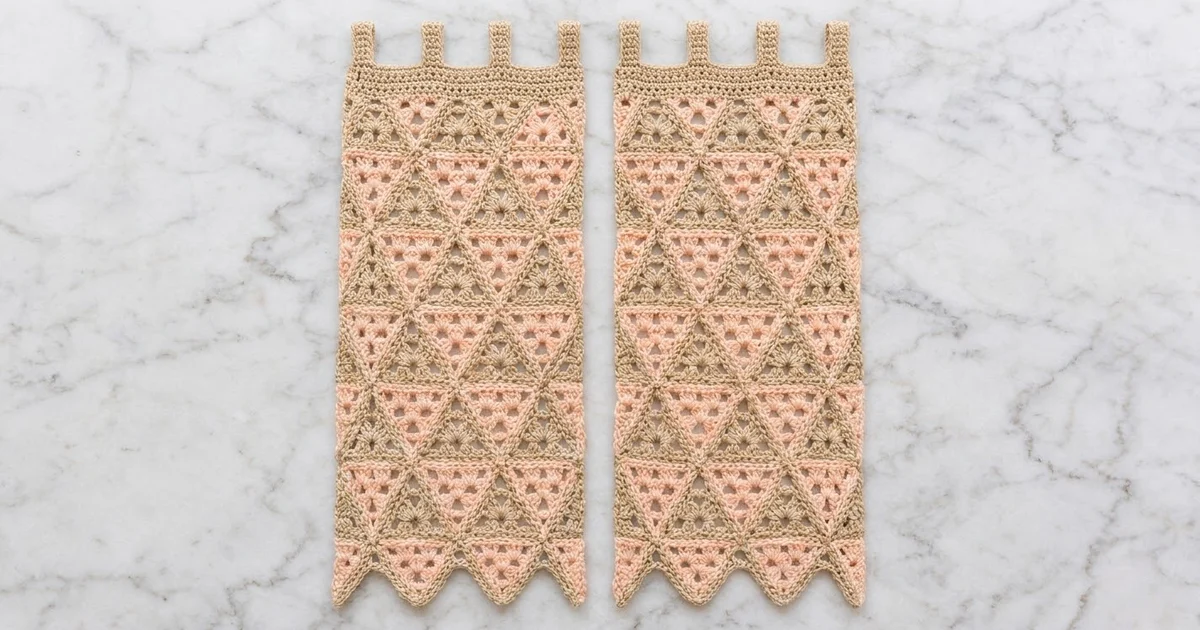
These tab-top curtain panels are made from small granny-style triangles in warm tan and soft peach. The triangles fit together into a lacy geometric surface. The bottom edge ends in a row of pointed peach triangles that form a zigzag hem.
Each triangle has a small center hole circled by three fans of clusters, so light comes through many small openings. Peach triangles point down and tan triangles point up. Tan slip-stitch seams outline every shape with a raised, chain-like ridge.
The pattern uses US crochet terms. Each finished panel is about 21 in (53.3 cm) wide and 62.1 in (157.7 cm) long, measured from the top of the header to the hem points. The tab loops add about 2 in (5.1 cm). The pattern makes a pair of panels.
Here’s the order of work: make full triangles in rounds and half-triangles in rows, then join them into horizontal bands. Join the bands to each other, add a row of point triangles, and finish with a tabbed header and a two-row edging.
Finished Size and Construction
- Finished size (each panel): 21 in (53.3 cm) wide x 62.1 in (157.7 cm) long without tabs; 64.1 in (162.8 cm) to the top of the tab loops
- Skill level: Intermediate
- Terminology: US
- Yarn weight: Chunky (#5)
- Hook: 6.5 mm (US K-10½)
- Number of pieces: 121 per panel (95 full triangles + 26 half-triangles); 242 for the pair
- Layout: 13 horizontal bands of 9 pieces each, plus a row of 4 point triangles
- Piece size: full triangle 5 in (12.7 cm) per side, 4.3 in (10.9 cm) tall
- Size before border: 20 in (50.8 cm) wide x 60.6 in (153.9 cm) long, including points
- Border depth: header about 1 in (2.5 cm); side and hem edging about 0.5 in (1.3 cm)
Materials
Use a smooth chunky cotton or cotton blend of about 120 m per 100 g. Cotton drapes well, shows the stitches clearly, and stretches less than acrylic when it hangs.
- Color A, Tan: 850 g (1,020 m) for up-pointing triangles, tan half-triangles, all seams, the header, tabs, and edging
- Color B, Peach: 700 g (840 m) for down-pointing triangles, point triangles, and peach half-triangles
These amounts are for both panels and include about 15% extra.
Tools: 6.5 mm (US K-10½) hook, tapestry needle, scissors, stitch markers, measuring tape, blocking mats, rust-proof pins, spray bottle, and a curtain rod up to 1 in (2.5 cm) in diameter.
Abbreviations (US Terms)
- ch: chain
- sl st: slip stitch
- sc: single crochet
- dc: double crochet
- tr: treble crochet
- sc2tog / dc2tog: single / double crochet 2 together
- rev sc: reverse single crochet (crab stitch)
- MR: magic ring
- sp: space; st(s): stitch(es); RS / WS: right side / wrong side
Cluster (cl): *Yarn over, insert hook in sp, yarn over and pull up a loop, yarn over and pull through 2 loops; repeat from * 2 more times (4 loops on hook), yarn over and pull through all 4 loops.
Corner group: (sc, ch 2, sc) worked into one corner. Each of the two sc counts toward the side it starts or ends.
Gauge and Checkpoints
Make one full triangle first and block it lightly. Measure each side from corner tip to corner tip.
- After Rnd 1: about 2 in (5.1 cm) per side
- After Rnd 2: about 3.5 in (8.9 cm) per side
- After Rnd 3: about 4.5 in (11.4 cm) per side
- After Rnd 4: 5 in (12.7 cm) per side, 4.3 in (10.9 cm) tall
Try to stay within 0.2 in (0.5 cm) of 5 in (12.7 cm). If the triangle is too big, go down half a hook size. If it is too small, go up half a size. Small errors add up quickly, because each panel is 4 triangles wide and 13 bands long.
A finished half-triangle should measure 4.3 in (10.9 cm) along its straight vertical edge and 5 in (12.7 cm) along its slanted edge.
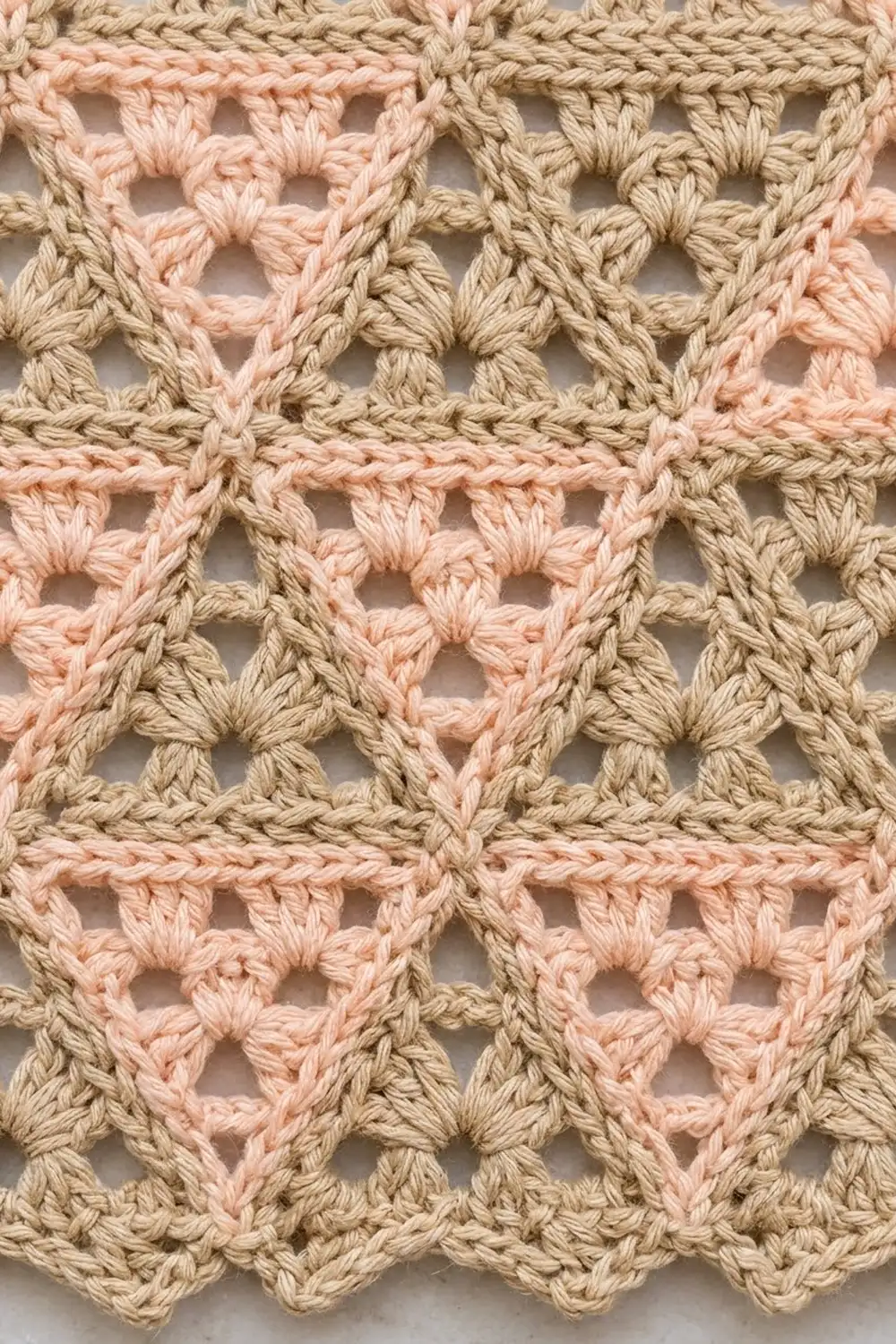
Full Triangle (make 95 per panel)
Work each triangle in one color. Do not turn between rounds.
Rnd 1: MR, ch 3 (counts as dc), 2 dc in ring, ch 4, [3 dc in ring, ch 4] twice, sl st to top of ch-3. Pull the ring closed. (9 dc, 3 ch-4 sps)
Rnd 2: Sl st in next dc (the center dc of the group). Ch 1, sc in same dc. *In next ch-4 sp work (cl, ch 1, cl, ch 3, cl, ch 1, cl), sc in center dc of next 3-dc group; repeat from * twice more, leaving out the last sc. Sl st to first sc. (12 cl, 3 sc, 6 ch-1 sps, 3 ch-3 corner sps)
Each set of 4 clusters fans out toward a corner. This leaves the open center and the small holes between the fans.
Rnd 3: Sl st in next cl, in ch-1 sp, in next cl, and in ch-3 corner sp. Ch 3 (counts as dc), (dc, ch 2, 2 dc) in same sp.
Side sequence: dc in next cl, dc in ch-1 sp, dc in next cl, tr in next sc, dc in next cl, dc in ch-1 sp, dc in next cl.
Work the side sequence, then (2 dc, ch 2, 2 dc) in next corner sp. Repeat once more. Work the side sequence a third time and sl st to top of ch-3. (33 sts: 11 per side between corner ch-2 sps)
The tr in each sc fills the dip between fans, so the sides come out straight.
Rnd 4: Sl st in next dc and in ch-2 sp. Ch 1, *corner group in corner sp, sc in each of next 11 sts; repeat from * twice more. Sl st to first sc. Fasten off, leaving a 4 in (10.2 cm) tail. (39 sc: 13 per side including both corner sc; 3 ch-2 corner sps)
Half-Triangle (make 26 per panel)
A half-triangle is a full triangle cut in half from tip to base. It has a straight vertical edge, a short edge, and a long slanted edge that matches one full triangle side.
Row 1: Ch 8, dc in 4th ch from hook and in each remaining ch, turn. (6 sts)
Row 2: Ch 2 (does not count), dc2tog over first 2 sts, dc in each st to end, turn. (5 sts)
Row 3: Ch 3 (counts as dc), dc in each st to last 2 sts, dc2tog, turn. (4 sts)
Row 4: Repeat Row 2. (3 sts)
Row 5: Repeat Row 3. (2 sts)
Row 6: Ch 2, dc2tog. (1 st) Do not fasten off.
All decreases fall on the same edge, which becomes the slanted edge. The foundation chain is the short edge, and the turning-chain edge is the vertical edge.
Choose the face: For a left half, the side facing you now is the RS. For a right half, turn the piece over before the edging so the other side becomes the RS.
Edging Rnd: Ch 1. Working down the slanted edge: 2 sc in Row 5, 3 sc in each of Rows 4, 3, and 2 (11 sc), then a corner group where Row 1 meets the foundation chain. Across the short edge: sc in next 2 ch, 2 sc in next ch, sc in next ch (5 sc), then a corner group in the last ch. Down the vertical edge: 3 sc in Row 2, 2 sc in each of Rows 3, 4, and 5 (9 sc), then a corner group in the Row 6 point. Sl st to first sc and fasten off.
Edge counts, each including its 2 corner sc: slanted 13, short 7, vertical 11. (31 sc, 3 ch-2 sps)
Make All Pieces
Per panel:
- Tan full triangles (point up): 46
- Peach full triangles (point down): 49 (45 for the bands + 4 point triangles)
- Peach half-triangles: 14 (7 left, 7 right)
- Tan half-triangles: 12 (6 left, 6 right)
Make twice this many for the pair.
Layout (T = tan up, P = peach down, p/t = peach/tan half):
Band 1 (A):  p  T  P  T  P  T  P  T  p
Band 2 (B):  t  P  T  P  T  P  T  P  t
Band 3 (A):  p  T  P  T  P  T  P  T  p
   ... alternate A and B ...
Band 13 (A): p  T  P  T  P  T  P  T  p
Points:         P     P     P     P
A bands (the odd bands) have 4 tan triangles, 3 peach triangles, and peach halves in the top corners. B bands (the even bands) have 4 peach triangles, 3 tan triangles, and tan halves in the bottom corners. Always place the vertical edge of a half on the outside edge of the panel. Use left halves for A-left and B-right; a left half turned 180 degrees fits the B-right position. Use right halves for A-right and B-left.
Joining
Join with tan in slip stitch. Hold two pieces WS together with the RS facing you, and insert the hook through the outer loop of each piece. This makes the raised ridge on the front.
Stitch logic: Sl st through both corner ch-2 sps, through each matching pair of sc, then through the next pair of corner sps. Slanted edges join 13 sc to 13 sc, and half-triangle short edges join 7 sc to 7 sc. Every stitch has a partner, so you never skip or add one.
Order:
- Join the 9 pieces of each band along their slanted sides (8 seams per band).
- Join Band 1 to Band 2. The A-band bottom has 4 x 13 = 52 sc, and the B-band top also has 4 x 13 = 52 sc. The corners line up at every 13th stitch.
- Join Band 2 to Band 3. The B-band bottom has 7 + 13 + 13 + 13 + 7 = 53 sc, and so does the A-band top.
- Keep joining bands in this way through Band 13.
- Join one top side of each point triangle to a tan base at the bottom of Band 13 (4 x 13 = 52 sc). Leave the other sides of the point triangles free.
Tension: Keep the slip stitches as loose as the sc they join. Tight seams pucker the fabric and shorten the panel. If your seams come out tight, use the next larger hook for seams only.
Checkpoint: The panel should be 20 in (50.8 cm) wide. Two bands should measure about 8.7 in (22.1 cm) tall, and 13 bands about 56.3 in (143.0 cm). With the points, the length is 60.6 in (153.9 cm).
Border
Border gauge: about 10 sc per 4 in (10.2 cm), or 2.5 to 2.7 sc per inch. Work 1 sc into each sc of the pieces. Skip the ch-2 sps at the seams, because they are already joined.
Header
Row 1: With the RS facing, join tan at the top right corner. Sc in each sc across: 7 + 13 + 13 + 13 + 7, turn. (53 sc)
Rows 2–3: Ch 1, sc in each st across, turn. (53 sc)
Tabs: Ch 1, sc in first 5 sts, turn. Work 11 more rows of 5 sc (12 rows total, about 4 in / 10.2 cm). Fasten off. *Skip 7 sts and join tan in the next st. Ch 1, sc in same st and next 4 sts, then work 12 rows as before. Repeat from * 3 more times. (5 tabs)
Check: 5 tabs x 5 sts + 4 gaps x 7 sts = 25 + 28 = 53.
Fold each tab to the back and sew its last row along header Row 1 to make a 2 in (5.1 cm) loop.
Side and Hem Edging
Row 1: With the RS facing, join tan at the top left corner of the header. Work 3 sc along the header row-ends, then 1 sc in each sc of the 13 half-triangle vertical edges (13 x 11 = 143). (Left side: 146 sc)
Along the hem, for each point: sc in each of 13 sc down to the tip, (sc, ch 2, sc) in the tip ch-2 sp, then sc in each of 13 sc back up. Between two points, sc2tog over the last sc of one point and the first sc of the next. (Hem: 4 x 26 + 4 x 2 − 3 = 109 sc)
Work up the right side to match the left. (Right side: 146 sc) Do not turn. (Total: 401 sc, 4 ch-2 tips)
Row 2: Ch 1. Working left to right, rev sc in each sc and (rev sc, ch 2, rev sc) in each tip ch-2 sp. (Sides: 146 each; hem: 109 + 8 = 117; total: 409 sts) Fasten off.
Why the math works: Each band gives 11 sts per side, so 13 bands give 143 sts over 56.3 in (143.0 cm), or 2.54 sc per inch. The top has 53 sc over 20 in (50.8 cm), or 2.65 sc per inch. Both numbers match the border gauge, so the edges lie flat. The sc2tog at each valley keeps the zigzag sharp, and the extra stitches at each tip let the points open out without curling.
Final Blocking
- Weave in all ends along the seams, each in a matching color.
- Lay the panel RS up on mats.
- Spray it until damp but not soaked.
- Pin the sides straight, 21 in (53.3 cm) apart.
- Pin the header straight, with the hem tips 62.1 in (157.7 cm) below it.
- Pin each point to a sharp tip, and pin each valley.
- Gently open up the center holes with your fingers.
- Let it dry completely. Block the second panel the same way and compare the two.
Final Quality-Control Checklist
- Each full triangle has 39 sc, 13 per side
- Each half-triangle has 31 sc, with edges of 13, 7, and 11
- Each band has 9 pieces, and the bands alternate A and B
- All seams are on the RS with even tension
- The header has 53 sc and 5 tabs, 7 sts apart
- The edging has 146 sc per side and 109 sc across the hem
- Both panels measure 21 x 62.1 in (53.3 x 157.7 cm)
Troubleshooting
Triangles curl: The Rnd 2 clusters are too tight. Loosen them or go up a hook size.
Triangle sides bow inward: Check that you worked a tr, not a dc, in each Rnd 2 sc.
Slanted edge of a half is too short: Recount; you need 11 sc between the corners.
Panel narrows toward the bottom: The seams are too tight. Redo them with a larger hook.
Points flare: Check that you worked a sc2tog at each valley.
Tabs twist: Sew each tab straight down along a single row.
Care
Hand wash in cool water, or machine wash on a gentle cycle inside a laundry bag. Dry flat and re-block. Don’t hang the panels while wet, because the weight will stretch them.
Final Notes
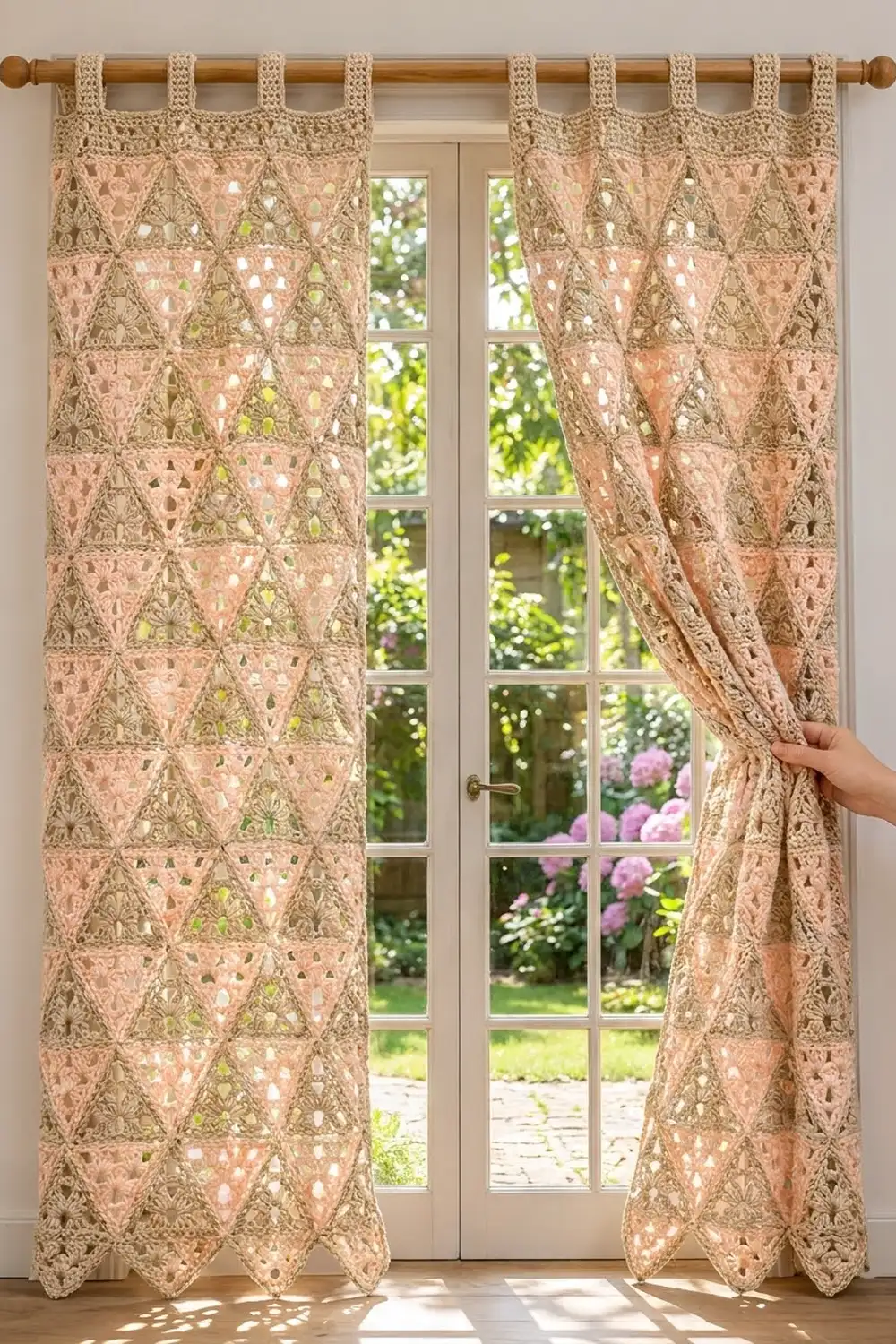
Every measurement starts from one triangle: 5 in (12.7 cm) per side with 13 sc per side. Four triangles make a 20 in (50.8 cm) band. Thirteen bands at 4.3 in (10.9 cm) each make 56.3 in (143.0 cm), and the points bring the length to 60.6 in (153.9 cm). The header and edging finish each panel at 21 x 62.1 in (53.3 x 157.7 cm). Check your measurements at each stage so both panels hang straight and match.
Happy crocheting!