
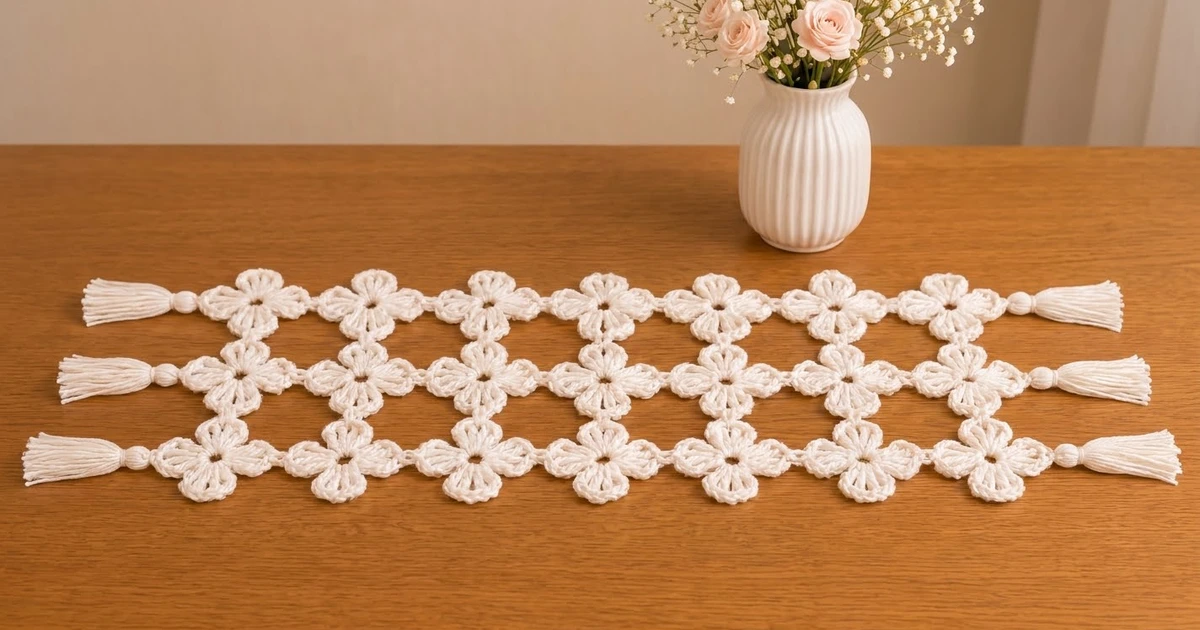
This runner is made from simple five-petal flowers in one creamy white yarn. Each flower has a small open center, five open “spoke” petals and a smooth single crochet outline. The flowers link at their petal tips with short chain bridges, so the finished piece looks like airy lace on the table.
The style is soft and vintage. Using one color makes it easy to match any table, and the wood grain shows through the open centers. A tassel hangs below each column at both short ends, which gives the ends a finished look and a little weight.
The pattern uses US crochet terms. Before tassels, the runner measures about 10.5 in (26.7 cm) wide and 28 in (71.1 cm) long. With tassels it is about 35 in (88.9 cm) long.
Construction is straightforward. You make one flower in three rounds. Then you make 23 more and join each one to its neighbors in the last round (join-as-you-go). The runner is 3 flowers wide and 8 flowers long. Tassels go on last, and then you block the runner.
Finished Size and Construction
- Finished size: about 10.5 x 28 in (26.7 x 71.1 cm) without tassels; 10.5 x 35 in (26.7 x 88.9 cm) with tassels
- Skill level: Easy-intermediate
- Terminology: US crochet terms
- Yarn weight: Worsted (#4), cotton or cotton blend
- Hook: 4.5 mm (US 7)
- Number of pieces: 24 flower motifs joined as you go, plus 6 tassels
- Layout: 3 motifs wide x 8 motifs long
- Piece size: each flower is about 3.5 in (8.9 cm) across, tip to tip
- Size before border: 10.5 x 28 in (26.7 x 71.1 cm)
- Border depth: no stitched border; tassels add 3.5 in (8.9 cm) at each short end
Materials
Choose a smooth, mercerized or combed cotton in worsted weight. Cotton shows each stitch clearly, holds its shape on a table and washes well. Avoid fuzzy or very stretchy yarns, which blur the open petals.
- Main color (cream white): 250 g, about 390 m (427 yd)
Each flower uses about 10 m (10.9 yd), including joins, so 24 flowers use about 240 m. The 6 tassels use about 35 m. The amount listed includes extra yarn for a gauge swatch, tails and small differences in tension.
Tools:
- 4.5 mm (US 7) crochet hook
- Tapestry needle
- Scissors
- Stitch markers (2-3)
- A piece of stiff card, 4 in (10.2 cm) tall, for tassels
- Ruler or tape measure
- Blocking mats and rust-proof pins
- Spray bottle with clean water
Abbreviations (US Terms)
- ch – chain
- sl st – slip stitch
- sc – single crochet
- tr – treble crochet (yo twice, insert hook, yo and pull up a loop, [yo and pull through 2 loops] 3 times)
- sp – space
- st(s) – stitch(es)
- RS / WS – right side / wrong side
Special technique – tip join: When a tip loop has to join a neighbor, work ch 2, sl st into the neighbor’s ch-5 tip loop, ch 2, instead of the usual ch 5. The 2 + sl st + 2 replaces the 5 chains, so the petal stays the same length.
Special technique – valley join: Ch 2, sl st into the second valley sl st of the flower above, ch 2. You use this only on the Top petal of flowers in Rows 2-8.
Gauge and Checkpoints
Make one full flower before you start the runner. Block it lightly and measure it. Every later measurement depends on this one piece.
- After Round 1: the ring is about 1 in (2.5 cm) across, with a center hole of about 0.5 in (1.3 cm).
- After Round 2: the flower is about 3 in (7.6 cm) tip to tip.
- After Round 3: the flower is 3.5 in (8.9 cm) tip to tip.
If your flower is too big (over 3.75 in / 9.5 cm), switch to a 4 mm (US G-6) hook. If it is too small (under 3.25 in / 8.3 cm), switch to a 5 mm (US H-8) hook. A 0.25 in (0.6 cm) difference per flower adds up to 2 in (5.1 cm) over the 8-flower length, so fix it now.
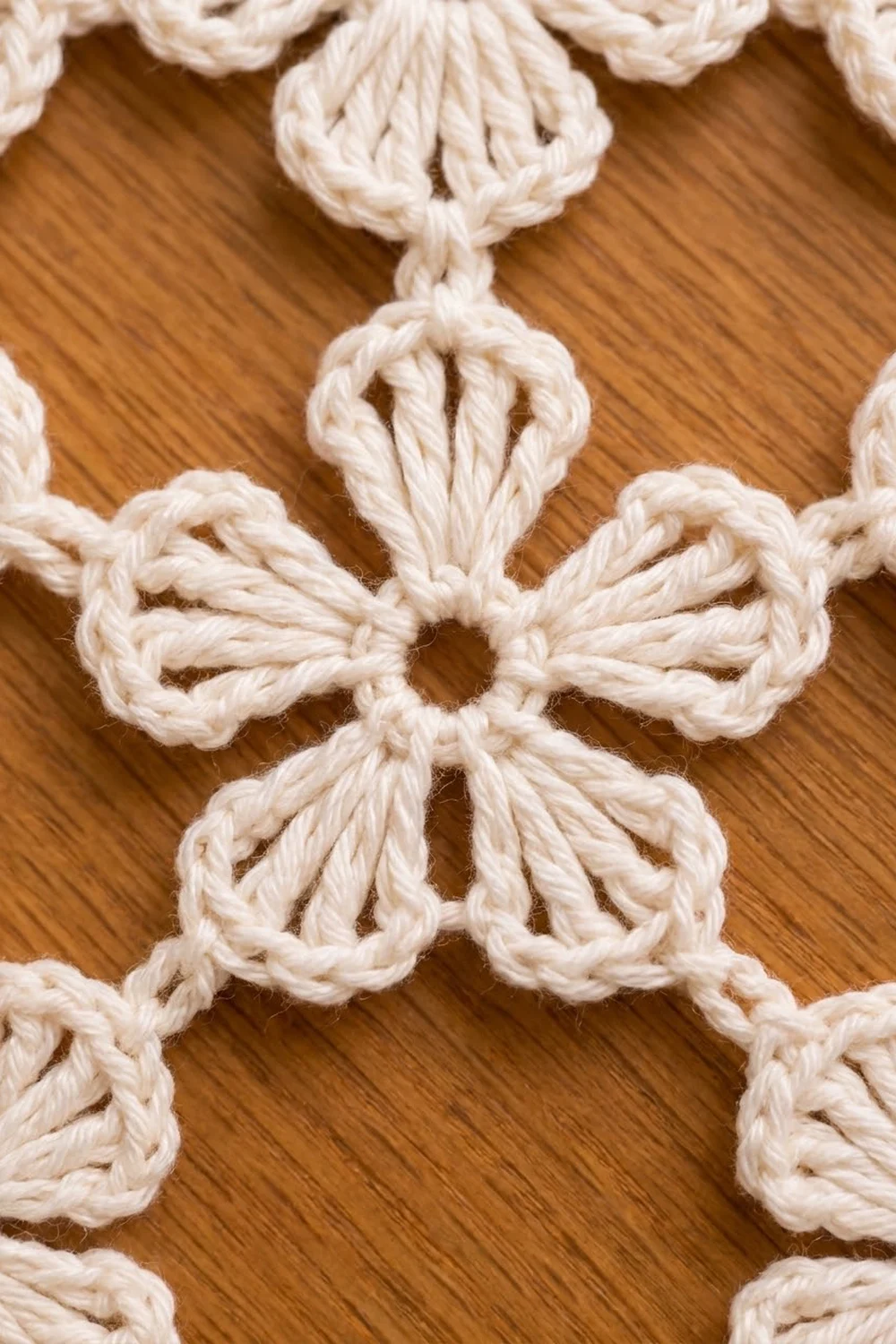
Flower Motif
The petals are named by position, with the flower RS up and the first petal pointing up: Top, Upper Right, Lower Right, Lower Left and Upper Left. The pair of sl sts between two neighboring petals is called the valley. The most important one is the valley between Lower Right and Lower Left, called the bottom valley.
Round 1: Ch 6, sl st in first ch to form a ring. Ch 1, work 15 sc into the ring. Sl st in first sc to join. (15 sc)
Pull the beginning tail gently so the center hole stays about 0.5 in (1.3 cm) wide.
Round 2 (petal spokes): Ch 1, sc in same st as join, ch 3, (tr, ch 3, tr, ch 3, tr) all in next sc, ch 3, sc in next sc. Sc in next sc, ch 3, (tr, ch 3, tr, ch 3, tr) all in next sc, ch 3, sc in next sc. Repeat from * to * 3 more times. Sl st in first sc to join. (10 sc, 15 tr, 20 ch-3 sps; 5 petals)
Each petal uses 3 sc of Round 1. The three tr fan out from one stitch to make the spokes, and the outer ch-3 sps form the open sides. The middle tr of each petal marks the petal tip.
Round 3 (petal outline): Do not turn. 3 sc in next ch-3 sp, 4 sc in next ch-3 sp, ch 5 (tip loop), 4 sc in next ch-3 sp, 3 sc in next ch-3 sp, sl st in each of next 2 sc (valley). Repeat from * to * 4 more times. The last sl st goes into the first sc of Round 2. Fasten off. (70 sc, 5 ch-5 tip loops, 10 sl sts)
Each petal has 3 + 4 + 4 + 3 = 14 sc, plus one tip loop and 2 valley sl sts. The sc outline gives each petal its rounded, rope-like edge, and the ch-5 loop sits right above the middle tr.
Make All Pieces
You need 24 flowers, all in cream white. Make the first flower complete (Rounds 1-3). For each of the other 23, work Rounds 1-2 as written, then work Round 3 with the joins described below.
Layout grid (RS up, Row 1 at the top end):
Row 1:  [ 1] [ 2] [ 3]
Row 2:  [ 4] [ 5] [ 6]
Row 3:  [ 7] [ 8] [ 9]
Row 4:  [10] [11] [12]
Row 5:  [13] [14] [15]
Row 6:  [16] [17] [18]
Row 7:  [19] [20] [21]
Row 8:  [22] [23] [24]
Every flower sits with its Top petal pointing toward Row 1.
Joining
All joins happen in Round 3, when you reach the petal tip that needs joining. Work the flowers in number order.
Horizontal joins (side to side): A flower’s Upper Left tip joins the Upper Right tip of the flower to its left. Work the Upper Left petal as usual up to the tip loop. Work a tip join instead of the loop, then finish the petal. The Upper Left and Upper Right tips sit at the same height, so the rows stay straight.
Vertical joins (row to row): A flower’s Top tip joins the bottom valley of the flower directly above it. At the Top tip, work a valley join, then finish the petal.
Join order:
- Flower 1: no joins.
- Flowers 2 and 3: 1 horizontal join each.
- Flowers 4, 7, 10, 13, 16, 19, 22 (left column): 1 vertical join each.
- All other flowers in Rows 2-8: 1 vertical join and 1 horizontal join.
That makes 2 horizontal joins per row x 8 rows = 16 horizontal joins, plus 7 vertical joins per column x 3 columns = 21 vertical joins, for 37 joins in total.
Stitch-to-stitch logic: No stitches are added or removed. The 2 + 2 chains plus the sl st replace the 5 chains of a free tip loop, so every flower still has 70 sc and 5 tips.
Tension: Keep the bridge chains the same size as your normal chains. Tight bridges pull the petals out of shape, and loose ones make the runner sag. Lay the work flat after each row to check.
Size checkpoint: After Row 2, the runner should be about 10.5 in (26.7 cm) wide and 7 in (17.8 cm) long, with flower centers about 3.5 in (8.9 cm) apart in both directions. After Row 8, it should be about 10.5 x 28 in (26.7 x 71.1 cm).
Border
This design has no stitched border round, because a solid edge would close up the open petal outlines that give the runner its look. Instead, the short ends are finished with tassels.
Border gauge: one tassel per column, centered under (or above) each flower. That spaces the tassels 3.5 in (8.9 cm) apart, the same as the flowers.
Tassels (make 6):
- Wrap yarn 30 times around the 4 in (10.2 cm) card.
- Slide a 12 in (30.5 cm) strand under the wraps at the top edge and tie it tightly. Leave both ends long for attaching.
- Cut the wraps at the bottom edge.
- To form the neck, wrap another strand tightly around the bundle 6-8 times, 0.5 in (1.3 cm) below the top. Tie it off and hide the ends inside the tassel.
- Trim the bottom evenly so the tassel is 3.5 in (8.9 cm) long.
Per side:
- Bottom short end (Row 8): 3 tassels. Tie one to the bottom valley of each of Flowers 22, 23 and 24.
- Top short end (Row 1): 3 tassels. Tie one to the Top tip loop of each of Flowers 1, 2 and 3.
- Long sides: no tassels and no added stitches.
Thread the tie ends through the attachment point, knot them securely on the WS and bury the ends inside the tassel head.
Why the math works: Each short end has 3 columns, and each column ends in exactly one free attachment point. No vertical join uses the bottom valleys of Row 8. The Top tip loops of Row 1 are also free, because there is no row above them. So 3 columns x 1 tassel = 3 tassels per end, 6 in total, and no flower edge is changed.
Final Blocking
- Weave in all remaining tails along the sc outline so they stay hidden.
- Lay the runner RS up on blocking mats.
- Mist it evenly with water until it is damp but not soaked.
- Pin the four corner flowers first so the runner measures 10.5 x 28 in (26.7 x 71.1 cm).
- Pin each petal tip outward so every flower measures 3.5 in (8.9 cm) tip to tip.
- Check that the bridge chains are straight and the rows are parallel.
- Let it dry completely, for at least 12 hours, before unpinning.
- Fluff the tassels with your fingers, steam them lightly and trim again if needed.
Final Quality-Control Checklist
- 24 flowers, arranged 3 wide x 8 long
- Every flower has 5 petals, 70 sc in Round 3 and a 0.5 in (1.3 cm) center hole
- All Top petals point toward Row 1
- 16 horizontal joins and 21 vertical joins, none skipped
- Runner measures about 10.5 x 28 in (26.7 x 71.1 cm) before tassels
- 6 tassels, each 3.5 in (8.9 cm) long, 3 at each short end
- All tails woven in and trimmed
Troubleshooting
Petals cup or ruffle. Make sure you work exactly 3 chains between spokes and that your tr are full height. Then block firmly.
Center hole closes up. Work the 15 sc of Round 1 loosely, and don’t pull the ring tail too hard.
Rows slant. A vertical join probably went into the wrong valley. The Top tip must join the valley between Lower Right and Lower Left.
Runner is too long or too short. Check the size of a single flower again. Small differences add up over 8 rows.
Bridges look uneven. Count the chains on each side of every join sl st. There must be 2 on each side.
Tassels look thin. Add 5-10 more wraps to each tassel, and keep all 6 the same.
Care
Hand wash in cool water with mild soap and roll the runner in a towel to remove water. Dry it flat, reshaping the petals and smoothing the tassels while damp.

Final Notes
The whole runner rests on one chain of measurements. The 15-sc ring is 1 in (2.5 cm) across, the flower is 3 in (7.6 cm) after Round 2, and the finished flower is 3.5 in (8.9 cm). Joined 3 wide and 8 long with even 2-chain bridges, those flowers make a 10.5 x 28 in (26.7 x 71.1 cm) runner. Six 3.5 in (8.9 cm) tassels bring the full length to 35 in (88.9 cm). Check the first flower carefully, and the rest will follow.
Happy crocheting!