

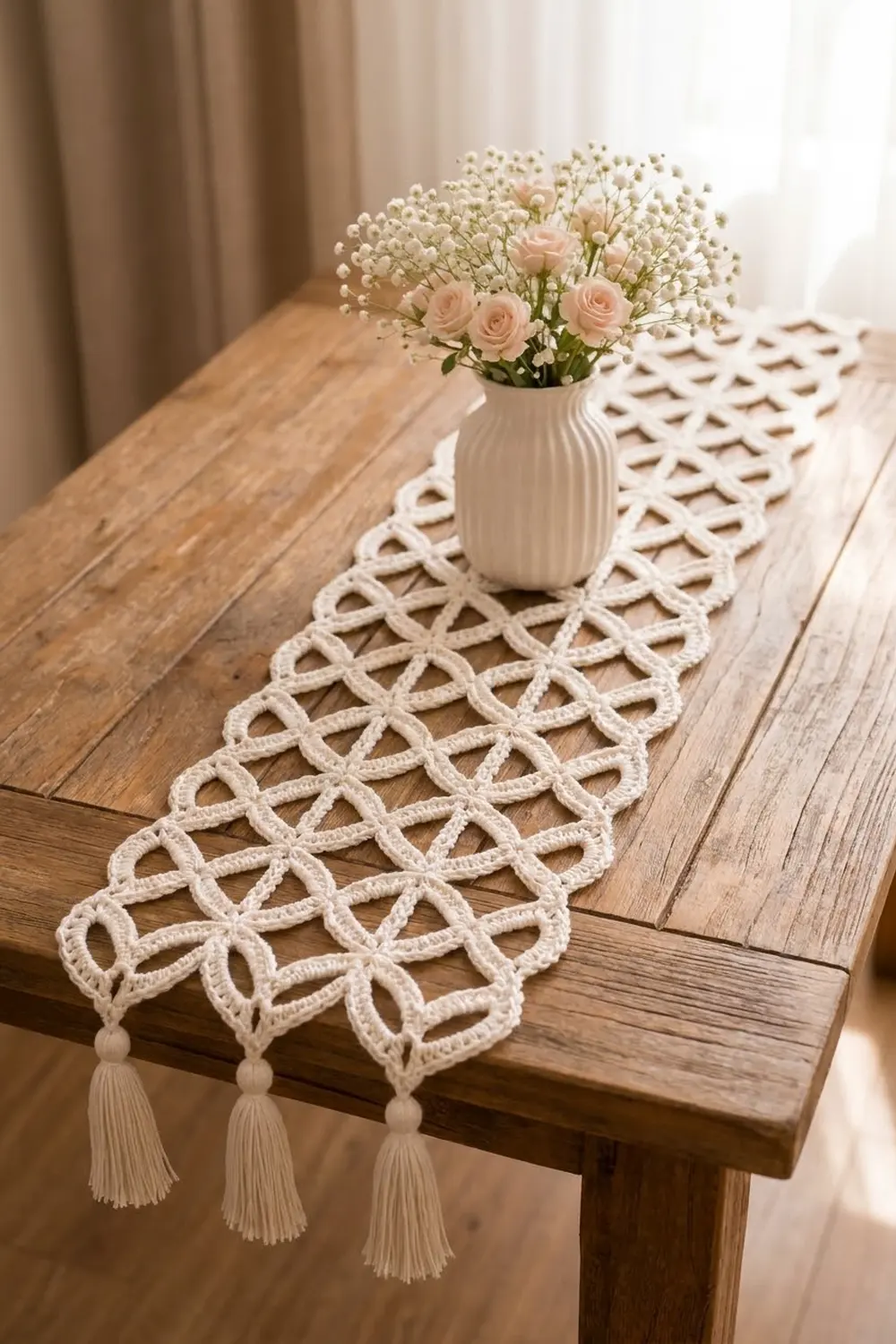
The Petal Lattice Table Runner is an airy, vintage-style lace runner made from simple four-petal flower motifs. Each petal is an open, pointed frame. When you join the motifs tip to tip, the frames form a lattice of interlocking ovals and small diamond windows, so the wood of your table shows through.
The runner is worked in a single ivory cotton, which gives it a clean, heirloom look that suits farmhouse, cottage or minimalist tables. Three round-headed tassels finish each pointed end. This pattern uses US crochet terms throughout.
The finished runner is 15 in (38.1 cm) wide and 55 in (139.7 cm) long without the tassels. With the tassels it is 63 in (160.0 cm) long. It is made of 33 motifs arranged 3 across and 11 long.
Each motif is just three rounds: a small center ring, four chain loops, and one round of stitches worked into each loop to build the petal frames. You join the motifs as you go at the petal tips, then work a slip-stitch firming round around the outside and add six tassels.
Finished Size and Construction
- Finished size: 15 in × 55 in (38.1 cm × 139.7 cm); 63 in (160.0 cm) long with tassels
- Skill level: Intermediate (easy repeats, careful joining)
- Terminology: US crochet terms
- Yarn weight: DK / light worsted (3) cotton
- Hook: 4.0 mm (G-6)
- Number of pieces: 33 identical motifs, joined into one piece
- Layout: 3 motifs wide × 11 motifs long, set on point
- Piece size: 5 in × 5 in (12.7 cm × 12.7 cm), tip to tip
- Size before border: 15 in × 55 in (38.1 cm × 139.7 cm)
- Border depth: less than 1/8 in (0.3 cm); it is a slip-stitch firming round, not a widening border
Materials
Yarn: Use a smooth mercerized or combed cotton in DK weight, about 115 m per 50 g. Cotton holds the pointed petal tips crisply and blocks well. Avoid fuzzy or very stretchy yarns, because they blur the lace.
- Ivory: 150 g / 345 m total
- Motifs: about 75 g / 165 m
- Border: about 7 g / 16 m
- Tassels: about 20 g / 45 m
The quantities include a generous safety margin of about 50%. Buy all the yarn from the same dye lot.
Tools:
– 4.0 mm (G-6) crochet hook
– Tapestry needle
– Scissors
– Stitch markers
– Cardboard strip 4.5 in (11.4 cm) wide, for tassels
– Rust-proof pins and a blocking mat
– Spray bottle
Abbreviations (US Terms)
- ch: chain
- sl st: slip stitch
- sc: single crochet
- hdc: half double crochet
- dc: double crochet
- sk: skip
- st(s): stitch(es)
- sp: space
- rep: repeat
- RS: right side
Special stitch: Tip join. Work this in place of the ch-3 at a petal tip that meets a finished motif. Ch 1, sl st into the neighboring motif’s tip ch-3 sp, ch 1. This still forms a 3-element tip space, so stitch counts don’t change.
Gauge and Checkpoints
Gauge matters here because the runner’s size is simply motif size multiplied by the number of motifs. Make one complete motif first, block it lightly, and measure it before you go on.
- After Rnd 1: the center ring measures 1 in (2.5 cm) across.
- After Rnd 2: each ch-20 loop, laid flat and folded at its tip, is about 2 in (5.1 cm) long.
- After Rnd 3: the motif measures 5 in (12.7 cm) from tip to opposite tip. Each petal is 1.5 in (3.8 cm) wide at its widest point.
If your motif is too large (over 5.25 in / 13.3 cm), go down to a 3.75 mm hook. If it is too small (under 4.75 in / 12.1 cm), go up to a 4.5 mm hook. Don’t change the chain counts, because the stitch math depends on them.
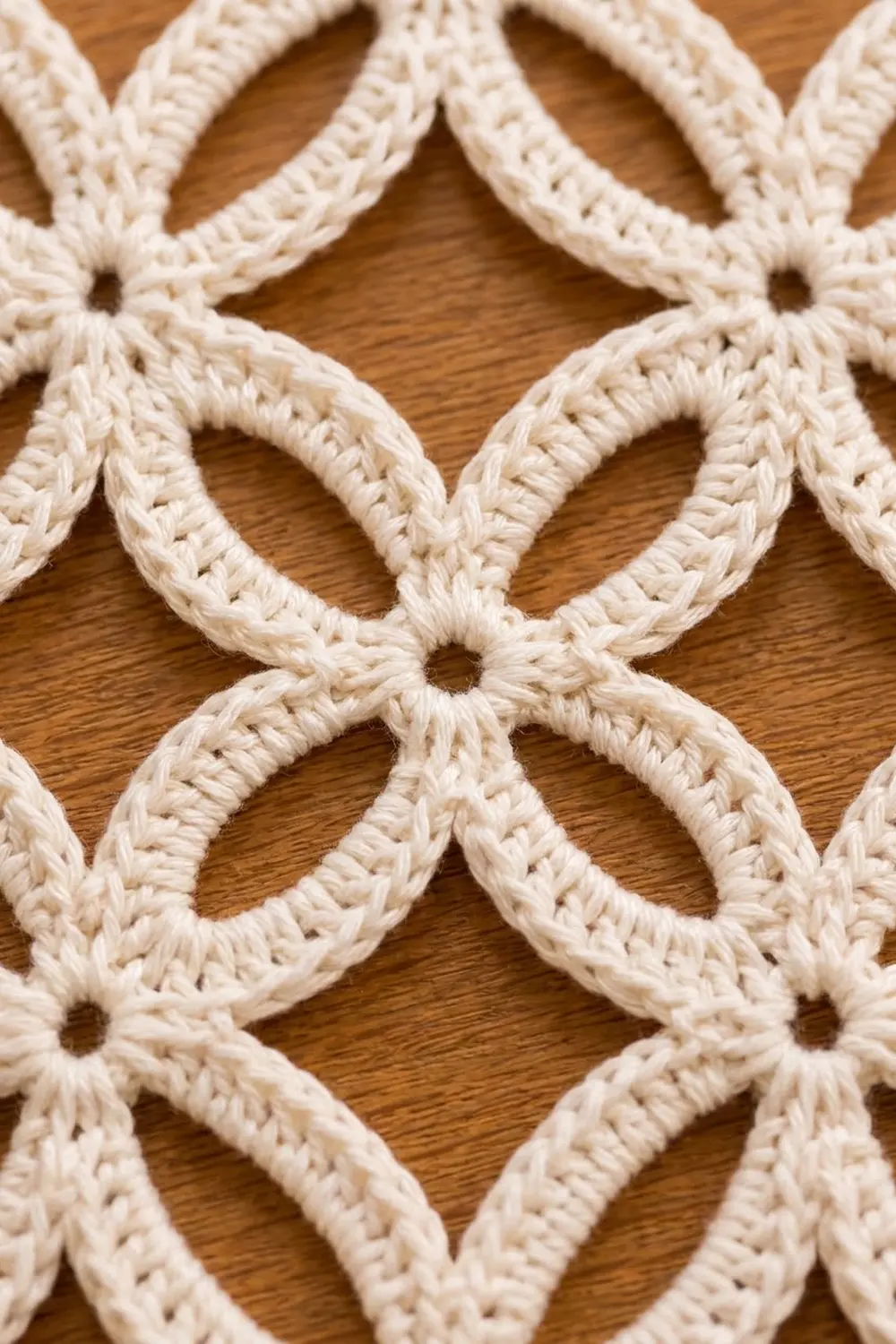
Motif (Make 33)
Make the first motif exactly as written. Make every other motif the same way, but replace the tip ch-3 with a Tip join wherever that tip meets a finished motif (see Joining).
Center ring: Ch 6, sl st in first ch to form a ring.
Rnd 1: Ch 1, 16 sc in ring, sl st in first sc to join. (16 sts)
The 16 stitches divide into 4 groups of 4, with one group per petal.
Rnd 2 (petal loops): Ch 1, sc in next st, ch 20, sk next 2 sts, sc in next st; rep from * 3 more times, sl st in first sc to join. (8 sc + 4 ch-20 loops)*
Each petal now has 2 anchor sc with 2 skipped stitches between them. The skipped stitches leave the small open ring visible at the center. Lay the loops out like a plus sign before you continue so they don’t twist.
Rnd 3 (petal frames): Ch 1. For each petal, work into the individual chains of its loop, not around the loop. Chains 1–10 run out to the tip, and chains 11–20 run back.
*Sc in anchor sc, sc in each of ch 1–2, hdc in each of ch 3–4, dc in each of ch 5–9, dc in ch 10, ch 3 (tip), dc in ch 11, dc in each of ch 12–16, hdc in each of ch 17–18, sc in each of ch 19–20, sc in second anchor sc; rep from * for the remaining 3 petals. Sl st in first sc to join. Fasten off and weave in the ends.
Stitch count per petal: 1 anchor sc + 10 sts on the outgoing chains + ch-3 tip + 10 sts on the returning chains + 1 anchor sc = 22 sts + 1 ch-3 sp.
Round total: 4 × 22 = 88 sts + 4 ch-3 tip sps.
The stitches rise gradually from sc to hdc to dc, so each petal is narrow at the center, widest in the middle and sharply pointed at the ch-3 tip. That gives you the lens-shaped open frame. The inside of each frame stays open because you work into the chain, not around a filled space.
Make All Pieces
You need 33 motifs, all ivory. The runner has 11 rows of 3 motifs, set on point. Each motif’s N, E, S and W petals point up, right, down and left.
Row 1:   [1]  [2]  [3]   <- tassel end (N tips)
Row 2:   [4]  [5]  [6]
Row 3:   [7]  [8]  [9]
 ...      ...  ...  ...
Row 10: [28] [29] [30]
Row 11: [31] [32] [33]   <- tassel end (S tips)
Work the motifs in numerical order, row by row from left to right.
Joining
Method: Join as you go in Rnd 3, using the Tip join at the touching petal tips.
Stitch-to-stitch logic: Each motif touches its neighbors at one tip only:
- Its W tip joins to the E tip of the motif on its left.
- Its N tip joins to the S tip of the motif above it.
So motif 2 makes 1 join (W). Motif 4 makes 1 join (N). Motif 5 makes 2 joins (W and N). The joins never add or remove stitches: ch 1, sl st, ch 1 simply replaces ch 3.
Total joins: 11 rows × 2 horizontal joins = 22, plus 10 row boundaries × 3 vertical joins = 30, for 52 joins.
Tension advice: Keep the ch 1 on each side of the joining sl st relaxed, at the same height as a normal chain. A tight join pinches the tips together and makes the lattice ripple. Before each join, check that the neighboring motif is RS up and not twisted.
Size checkpoint: After Row 1, the strip measures 15 in (38.1 cm) from the outer W tip to the outer E tip (3 × 5 in / 12.7 cm). After Row 4, it measures 20 in (50.8 cm) long. After Row 11, it should be 15 in × 55 in (38.1 cm × 139.7 cm).
Border
This runner has no added lace border. The petal points are the edge. Instead, a slip-stitch firming round runs along every exposed petal edge so the outline keeps its shape and doesn’t stretch.
Border gauge: One sl st in each stitch adds less than 1/8 in (0.3 cm) and leaves the 15 in × 55 in (38.1 cm × 139.7 cm) size unchanged.
Counting the exposed edge: Every petal has 20 stitches on its chains (10 out and 10 back), plus its tip. The anchor sc sit at the motif center and are never part of the edge.
Long side (each):
– 11 outer petals × 20 sts = 220 sts
– 10 notches between vertically joined motifs. Each notch is the outer half of the upper motif’s S petal (10) plus the outer half of the lower motif’s N petal (10) = 20 sts. 10 × 20 = 200 sts.
– Total: 420 sts + 11 free tips
End (each):
– 3 end petals × 20 sts = 60 sts
– 2 notches between horizontally joined motifs × 20 sts = 40 sts
– Total: 100 sts + 3 free tips
Round 1 (firming round): With RS facing, join the yarn with a sl st in the first dc after the free N tip of motif 1. Sl st in every exposed stitch.
- At each free tip: (sl st, ch 3, sl st) in the ch-3 sp.
- At each joined tip in a notch: sl st in the last dc before the join, then go straight to the first dc after the join on the next motif. Don’t work into the join itself.
Continue around the runner and sl st in the first sl st to join. Fasten off.
Round total: 2 × 420 + 2 × 100 = 1,040 sl st + 28 free tips (11 + 11 + 3 + 3).
Why the math works: Each corner motif’s outer E or W petal is counted only on the long side, and its end petal (N or S) only on the end. The half-petals counted in the long-side notches belong to the motifs between rows, not to the end petals. That means no stitch is counted twice. Because you work exactly one sl st per stitch and nothing is added on the straight sections, the edge can’t flare or tighten.
Tassels (make 6):
- Wrap yarn 30 times around the 4.5 in (11.4 cm) cardboard strip.
- Slide a 10 in (25.4 cm) tie strand under the wraps at the top and knot it tightly. Cut the wraps at the bottom.
- Roll a scrap of yarn into a 1/2 in (1.3 cm) ball. Fold the tassel strands down over the ball, centering it under the tie.
- Wrap a separate strand tightly 6 times just below the ball to form the round head, knot it, and hide the ends inside the tassel.
- Trim the tassel to 4 in (10.2 cm).
- Use the tie strand to attach one tassel to each free end tip: N tips of motifs 1–3 and S tips of motifs 31–33.
Final Blocking
- Weave in all the ends before blocking, splitting the plies for security.
- Soak the runner in cool water for 10 minutes, then press out the water in a towel. Don’t wring it.
- Lay it RS up on blocking mats. Measure out a rectangle of 15 in × 55 in (38.1 cm × 139.7 cm).
- Pin every free tip on the long sides and ends to the rectangle outline.
- Pin each internal joined tip so the rows run straight. Check that the diamond windows look even.
- Ease each petal into a smooth, symmetrical lens shape and pin its widest point if needed.
- Leave it to dry completely, which takes 24 hours. Shake out the tassels and trim them evenly while the runner is pinned.
Final Quality-Control Checklist
- 33 motifs, each with 88 sts + 4 tip spaces
- 52 tip joins, none twisted
- All motifs RS up and lined up in straight rows
- Width 15 in (38.1 cm), length 55 in (139.7 cm)
- Firming round has 1,040 sl st + 28 free tips
- 6 tassels, each 4 in (10.2 cm), securely tied
- All ends woven in, with no tails visible in the open spaces
Troubleshooting
- Petals curl or cup: Rnd 3 is too tight. Go up a hook size, or relax your dc.
- Petals are lopsided: You may have worked around the loop instead of into each chain. Redo Rnd 3 into the individual chains.
- The center hole closes up: Make sure you skip 2 stitches under each loop in Rnd 2.
- The lattice ripples: The tip joins are too tight. Loosen the ch 1 on each side of the joining sl st.
- The runner is shorter than 55 in (139.7 cm): Your motifs are under 5 in (12.7 cm). Re-block them, or block more firmly at the tips.
- Tassel heads are flat: The scrap ball is too small, or the head wrap is too loose. Use a firmer 1/2 in (1.3 cm) ball.
Care
Hand wash in cool water with mild soap, roll in a towel, and dry flat, re-pinning the tips if needed. Don’t tumble dry: it will distort the petals and fray the tassels.
Final Notes
The whole runner follows one measurement chain:
- A 1 in (2.5 cm) center ring with 2 in (5.1 cm) loops produces a 5 in (12.7 cm) motif.
- 3 motifs across make 15 in (38.1 cm), and 11 motifs down make 55 in (139.7 cm).
- The slip-stitch firming round holds that size exactly.
- The 4 in (10.2 cm) tassels bring the total length to 63 in (160.0 cm).
If your first motif measures right, the rest of the runner will too.
Happy crocheting!