

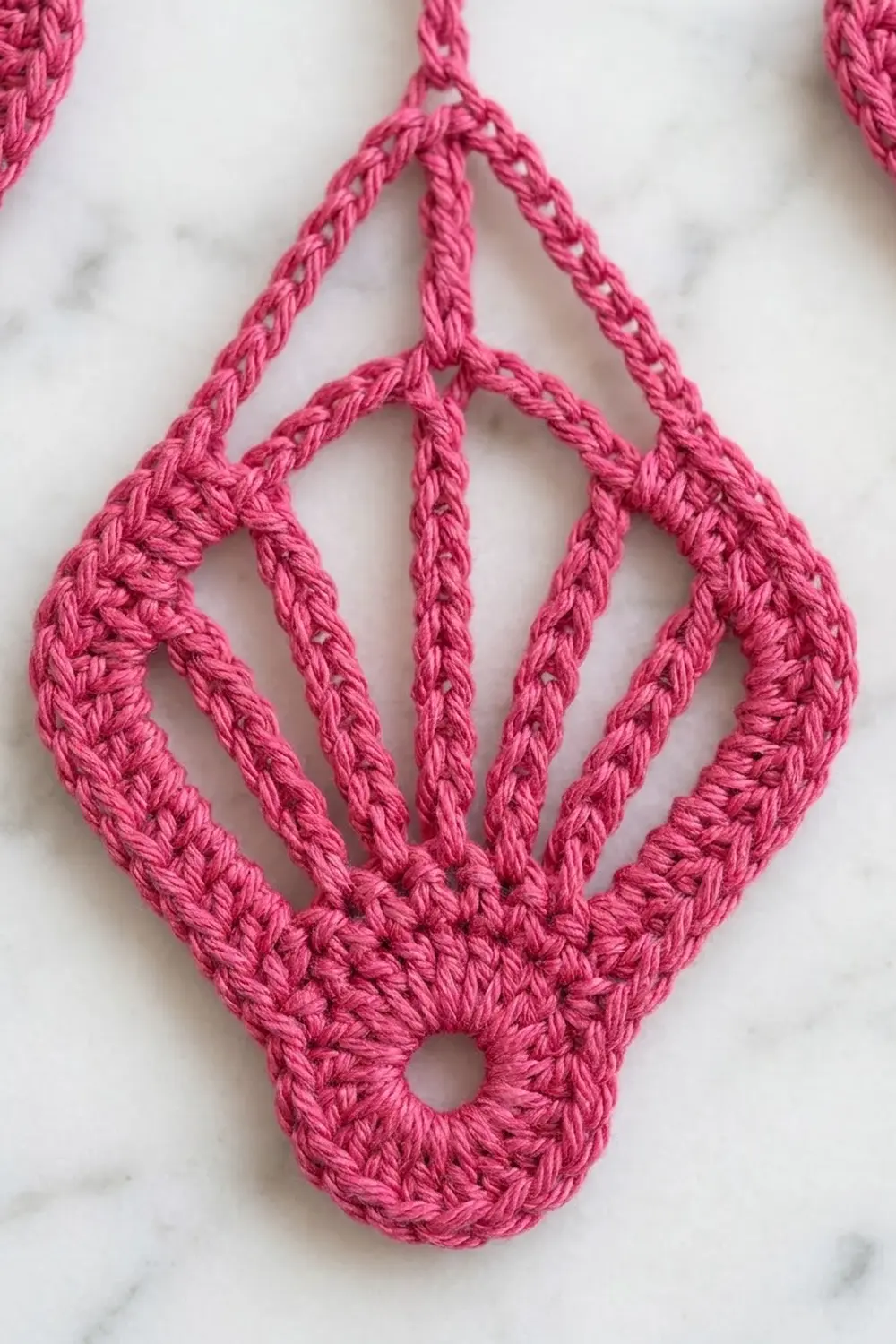
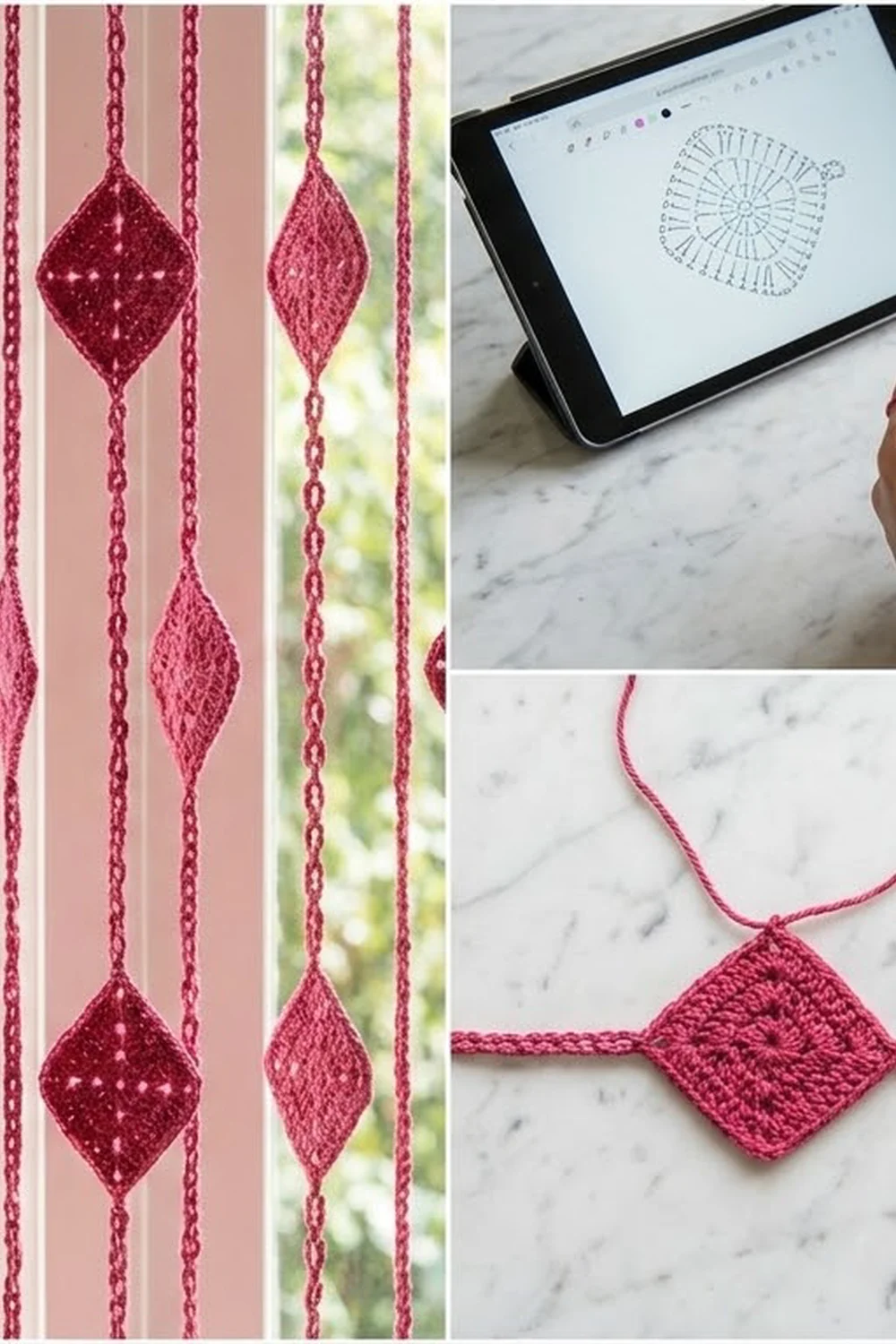
This strand curtain is made of open kite-shaped motifs, each with a fan of tall spokes inside a smooth single-crochet frame. Short doubled chains link the motifs into long vertical strands. Neighboring strands are offset by half a repeat, so the curtain makes a staggered diamond lattice that lets light through while still softening the window.
The sample is worked in one color, a saturated raspberry pink cotton. Cotton gives crisp stitch definition and hangs straight without stretching much. The look is romantic and slightly vintage, and it still works in a modern room.
The pattern uses US crochet terms. Each motif measures 3.5 in (8.9 cm) wide by 4.5 in (11.4 cm) tall. The finished panel has 12 strands of 10 motifs and is about 47.5 in (120.7 cm) wide. Strands hang 60 in (152.4 cm) and 63 in (160.0 cm) long, measured from the rod.
You make each motif separately in four short rows and rounds: a fan of treble spokes, chain arches with a center spine, and a single-crochet outline. Then you join the motifs into strands with doubled chain links. The top motif of each strand has its hanging loop worked in.
Finished Size and Construction
- Finished panel: about 47.5 in (120.7 cm) wide; strands 60 in (152.4 cm) and 63 in (160.0 cm) long
- Skill level: Intermediate
- Terminology: US
- Yarn weight: Worsted (#4) cotton
- Hook: 5.0 mm (H-8)
- Number of pieces: 120 motifs (12 strands x 10 motifs)
- Layout: 12 vertical strands, alternating short and long top stems
- Piece size: 3.5 in (8.9 cm) wide x 4.5 in (11.4 cm) tall
- Size before outline (after Row 3): about 3 in (7.6 cm) wide x 4 in (10.2 cm) tall
- Border depth: one sc outline round, about 0.25 in (0.6 cm)
Materials
Pick a smooth worsted-weight cotton or cotton blend. Mercerized or tightly plied cotton shows the spokes most clearly. Avoid fuzzy or very stretchy yarn, because a long strand will grow under its own weight.
- Raspberry pink: about 620 g / 960 m (1,050 yd), for example seven 100 g balls of about 155 m (170 yd) each
Tools:
- 5.0 mm (H-8) crochet hook
- Tapestry needle
- Scissors
- Stitch markers
- Tape measure
- Blocking mats and rust-proof pins
- Spray bottle
- Curtain rod up to 1.5 in (3.8 cm) in diameter
A single motif with its link uses about 7 m (7.7 yd), or roughly 4.5 g. The quantity above includes about a 10% margin for gauge differences, hanging loops, and weaving in ends.
Abbreviations (US Terms)
- ch – chain
- sl st – slip stitch
- sc – single crochet
- tr – treble crochet
- trtr – triple treble crochet (see below)
- sp – space
- st(s) – stitch(es)
- rep – repeat
Special stitch: triple treble (trtr). Yarn over 4 times, insert hook in stitch, yarn over and pull up a loop (6 loops on hook), [yarn over, draw through 2 loops] 5 times.
Gauge and Checkpoints
Make one complete motif before anything else, and measure it after blocking.
- Chain gauge: 6 ch = 1.5 in (3.8 cm), or 4 ch per inch (2.5 cm)
- After Row 2: top of the fan about 3 in (7.6 cm) across, straight line from first tr to last tr
- After Row 3: bottom of ring to top of trtr about 4 in (10.2 cm)
- After Rnd 4: 3.5 in (8.9 cm) wide x 4.5 in (11.4 cm) tall
If your motif is larger than 3.5 x 4.5 in (8.9 x 11.4 cm), go down to a 4.5 mm hook. If it’s smaller, go up to a 5.5 mm hook. Chain gauge matters as much as stitch gauge here: if your chains are tight, the arches will pull the top point down and the motif will cup.
Motif Pattern
Make 108 standard motifs as written. The 12 top motifs follow the same Rows 1–3, and their top-point variation is given after Rnd 4.
Ring: Ch 5, sl st in first ch to form a ring. This ring is the bottom point of the motif.
Row 1 (fan base): Ch 4 (counts as tr), [ch 2, tr in ring] 4 times. Turn. (5 tr, 4 ch-2 sps)
The five tr sit in the top half of the ring only. Leave the bottom half of the ring free for Rnd 4.
Row 2 (spokes): Ch 4 (counts as tr), [ch 3, tr in next tr] 4 times, working the last tr in the top of the turning ch. Turn. (5 tr, 4 ch-3 sps)
Each tr sits on top of a Row 1 tr, so the five spokes become long columns that fan out with open spaces between them.
Row 3 (arches and spine): Ch 1, sc in first tr, ch 10, trtr in center (3rd) tr, ch 10, sc in last tr (top of turning ch). Do not turn. (2 sc, 1 trtr, 2 ch-10 sps)
The trtr grows straight up from the center spoke to form the center spine. Because the ch-10 ends at the top of the trtr, the first arch runs from the outer spoke up to the top point, and the second arch runs back down. This makes the upper half of the kite.
Rnd 4 (outline): Ch 1, sc in same sc, 10 sc in ch-10 sp, (sc, ch 2, sc) in top of trtr, 10 sc in next ch-10 sp, sc in next sc, 4 sc evenly along the side edge of Row 2, 4 sc evenly along the side edge of Row 1, 3 sc in the free bottom half of ring, 4 sc evenly along the side edge of Row 1, 4 sc evenly along the side edge of Row 2, sl st in first sc. Fasten off. (43 sc and 1 ch-2 top point)
Count check: 1 + 10 + 2 + 10 + 1 + 4 + 4 + 3 + 4 + 4 = 43 sc. The middle sc of the 3-sc group at the bottom is the bottom-point sc, which is used for joining. Mark it.
Top motif variation (make 12): Work Ring through Row 3 as above. In Rnd 4, replace the (sc, ch 2, sc) at the top point as follows:
- Short-stem top motif (make 6): (sc, ch 30, sl st in 24th ch from hook, ch 6, sc) in top of trtr.
- Long-stem top motif (make 6): (sc, ch 42, sl st in 24th ch from hook, ch 18, sc) in top of trtr.
Either way you get a 24-ch hanging loop, about 6 in (15.2 cm) around, on a doubled stem. The short stem (6 ch) is 1.5 in (3.8 cm) long, and the long stem (18 ch) is 4.5 in (11.4 cm). The extra 3 in (7.6 cm) is exactly half of the 6 in (15.2 cm) repeat, which creates the stagger.
Make All Pieces
All pieces are raspberry pink.
- 108 standard motifs
- 6 short-stem top motifs
- 6 long-stem top motifs
- Total: 120 motifs
Layout grid (S = short-stem top motif, L = long-stem top motif, M = standard motif):
Strand:  1  2  3  4  5  6  7  8  9 10 11 12
Top:     S  L  S  L  S  L  S  L  S  L  S  L
2-10:    M  M  M  M  M  M  M  M  M  M  M  M   (9 per strand)
Each strand has 1 top motif + 9 standard motifs = 10 motifs. Odd strands start with S, and even strands start with L.
Block all motifs before joining (see Final Blocking). Joining flat, matching pieces is much easier than straightening a finished strand.
Joining
Each motif is joined to the next with a doubled chain link that runs from the bottom point of the upper motif to the top point of the lower motif.
Link (make 9 per strand, 108 total): With RS facing, join yarn with sl st in the bottom-point sc of the upper motif. Ch 6, sl st in ch-2 top point of the lower motif, ch 6, sl st in the same bottom-point sc of the upper motif. Fasten off and weave in ends along the outline sc.
Stitch-to-stitch logic: Each link attaches to exactly one stitch at each end: the single bottom-point sc above and the single ch-2 sp below. This keeps every motif centered on the strand line so the strands hang straight. Don’t attach to neighboring sc, or the motif will tilt.
Tension: Work the link chains at the same tension as your gauge chain (4 ch per inch). Tight links shorten the strand and stop the motifs from swinging freely. Loose links sag and look uneven next to the stems.
Size checkpoint: Hang each finished strand by its loop and measure from the inside top of the loop to the bottom-point sc.
- Odd strands: 1.5 in stem + (10 x 4.5 in motifs) + (9 x 1.5 in links) = 60 in (152.4 cm)
- Even strands: 4.5 in stem + 45 in + 13.5 in = 63 in (160.0 cm)
Border
A strand curtain has no outer border; the panel stays open on all sides so the strands can move. Each motif’s Rnd 4 sc outline acts as its border, and the counts below are what keep every edge flat.
Border gauge: about 4 sc per inch (2.5 cm) along the outline.
Counts per edge (Rnd 4):
- Upper edges (two): 10 sc each, worked into the ch-10 arch. A 10-ch arch is about 2.5 in (6.4 cm), so 10 sc matches 1 sc per ch at the same gauge.
- Top point: 2 sc with a ch-2 sp between them (stem variation on top motifs).
- Side corners (two): 1 sc each, worked into the Row 3 sc at the widest point.
- Lower edges (two): 8 sc each (4 per tr row). Each tr row end is about 1 in (2.5 cm) tall, so 4 sc per row end keeps the gauge at 4 sc per inch.
- Bottom point: 3 sc in the ring.
Why the math works: 10 + 10 + 2 + 1 + 1 + 8 + 8 + 3 = 43 sc. Every edge gets one sc per quarter inch of length, so the outline lies flat without ruffling or pulling. The 2-sc top and 3-sc bottom groups turn each point without bunching. The sides use a single sc each because the arch and spoke meet there at a wide angle.
Final Blocking
- Weave in all remaining ends along the sc outlines, never across open spaces.
- Lay each strand flat on blocking mats, motif by motif.
- Spray each motif until damp, but not soaked.
- Pin each motif to 3.5 in (8.9 cm) wide x 4.5 in (11.4 cm) tall: one pin at the top point, one at the bottom point, and one at each side corner.
- Straighten the five spokes so they fan evenly. Pull the center spine in line with the top and bottom points.
- Lay the links straight at 1.5 in (3.8 cm) without stretching them.
- Leave everything to dry completely, then unpin.
- Hang the strands on the rod at 4 in (10.2 cm) spacing center to center, alternating S and L strands.
Final Quality-Control Checklist
- 120 motifs total: 108 standard, 6 short-stem tops, 6 long-stem tops
- Every motif has 43 sc in Rnd 4 and measures 3.5 x 4.5 in (8.9 x 11.4 cm)
- All five spokes are straight columns; the trtr spine is centered
- 108 links, each 1.5 in (3.8 cm) long
- Odd strands are 60 in (152.4 cm); even strands are 63 in (160.0 cm)
- The panel is about 47.5 in (120.7 cm) wide with the stagger lined up
- No visible ends and no twisted links
Troubleshooting
Motif cups or curls at the top: The ch-10 arches are too tight. Chain more loosely or go up a hook size for Row 3 only.
Top point is blunt or rounded: Make sure the ch-10 ends exactly at the top of the trtr, and work the (sc, ch 2, sc) into the trtr top, not around its post.
Lower edges ruffle: You’ve worked more than 4 sc per row end. Recount, and spread the 4 sc evenly along each tr post.
Strand twists when hung: A link is attached off-center, or a motif was joined with the WS facing. Redo the link into the bottom-point sc and ch-2 sp with RS facing.
Strands differ in length: The links are at different tensions. Check each link against 1.5 in (3.8 cm) and remake any that are off.
Stagger looks uneven: Check the stem lengths: short stems need 6 ch, long stems need 18 ch.
Care
Hand wash cool and lay flat to dry, then re-pin any motifs that have lost their shape. Don’t tumble dry, because the heat and weight will stretch the strands.
Final Notes
The whole curtain depends on one measurement chain. Gauge is 4 ch or 4 sc per inch, so each motif is 3.5 x 4.5 in (8.9 x 11.4 cm). Each link is 1.5 in (3.8 cm), so the repeat is 6 in (15.2 cm). Ten motifs per strand give 60 in (152.4 cm) and 63 in (160.0 cm) strands. Twelve strands at 4 in (10.2 cm) spacing give a panel about 47.5 in (120.7 cm) wide. Get the first motif right and everything else follows.
Happy crocheting!