

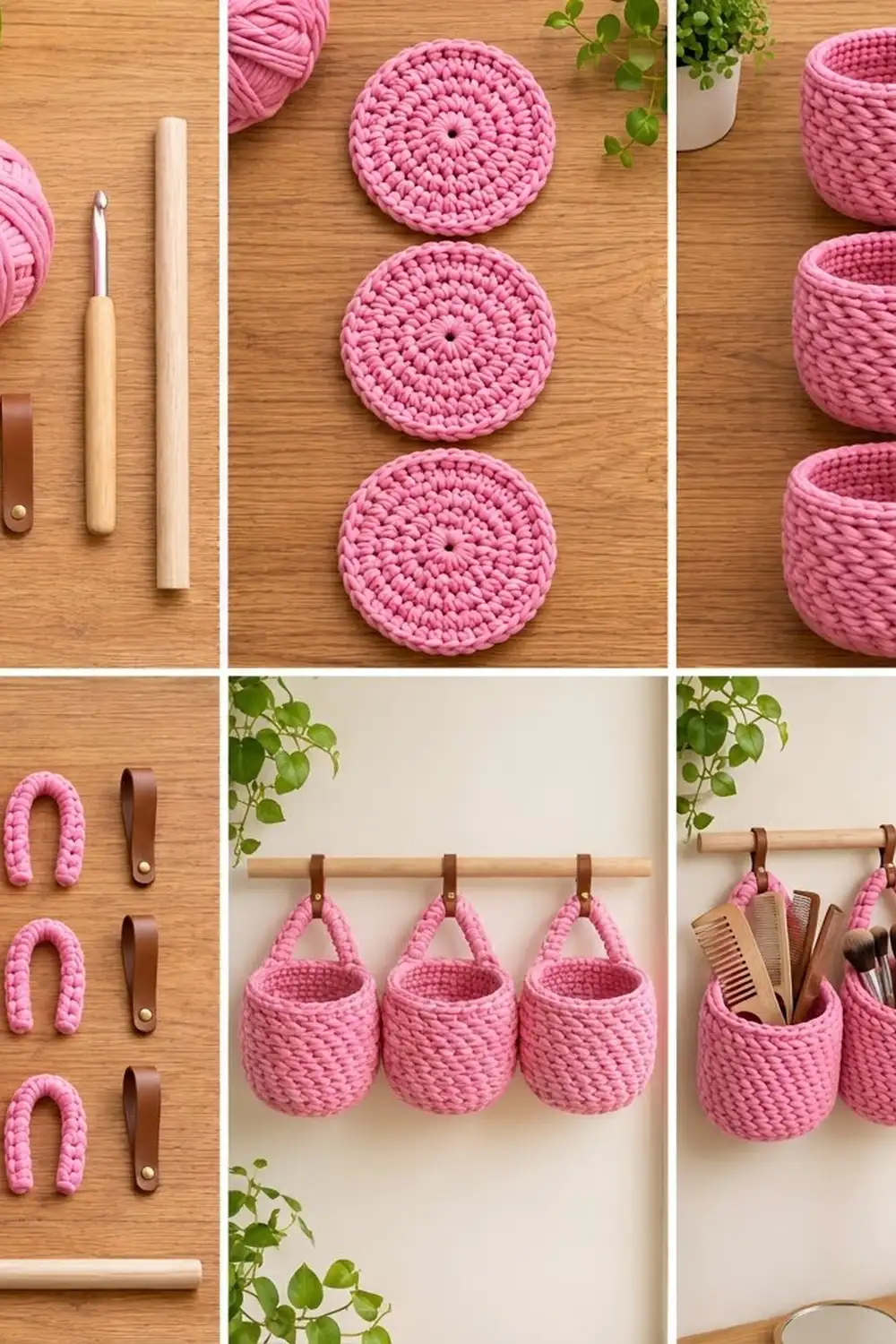
The Rosebud Rail set is three small hanging baskets in a soft bubblegum pink. Each one hangs from its own rope-style handle on a simple wooden rail. They are sized for makeup brushes, combs, small bottles and other bits that normally clutter a vanity or bathroom shelf.
The walls use waistcoat stitch, so they look like chunky knitting. Waistcoat stitch also makes a firm, dense fabric that holds its shape. A plain band of single crochet at the top gives the rim a clean finish. All three baskets use one color, so this is a relaxing, low-fuss make.
The pattern uses US crochet terms. Each finished basket measures about 5 in (12.7 cm) wide and 4½ in (11.4 cm) tall. The handle loop rises about 3 in (7.6 cm) above the rim.
Each basket starts with a flat single crochet circle. One back-loop round turns the edge upward, and then the walls are worked in spiral waistcoat stitch. A decrease round draws the top in slightly. The rim band is two rounds of single crochet and a slip stitch round. A separate handle is worked flat, folded into a rope and sewn inside the rim. A leather tab then hangs each basket from the dowel.
Finished Size and Construction
- Finished size (each basket): 5 in (12.7 cm) wide x 4½ in (11.4 cm) tall, plus a handle loop of about 3 in (7.6 cm)
- Skill level: Easy
- Terminology: US crochet terms
- Yarn weight: Bulky (#5) cotton or cotton blend
- Hook: 6 mm (US J-10)
- Number of pieces: 6 crocheted pieces (3 basket bodies, 3 handles), all separate
- Layout: 3 baskets hanging side by side on one dowel, not joined to each other
- Piece size: body circumference 16 in (40.6 cm) and opening circumference 14 in (35.6 cm); handle 10 in (25.4 cm) long x ½ in (1.3 cm) thick
- Size before rim band: 5 in (12.7 cm) wide x 3¾ in (9.5 cm) tall
- Rim band depth: ¾ in (1.9 cm)
Materials
Yarn: Choose a smooth, firm bulky cotton or cotton blend with good stitch definition. The knit-look V’s show up best in a tightly plied or cord-style yarn. Avoid fuzzy or very loose singles, because they hide the texture and let the walls sag.
- Pink: 300 g / 360 m (394 yd), which is 3 skeins of 100 g / 120 m (131 yd). Each basket uses about 70 g / 84 m for the body and 10 g / 12 m for the handle.
These quantities include a safety margin of about 25%. Waistcoat stitch uses more yarn than plain single crochet, and tension varies from maker to maker.
Tools and hardware:
– 6 mm (US J-10) crochet hook
– Locking stitch marker
– Tapestry needle with a large eye
– Scissors and a measuring tape
– 3 leather straps, each ¾ in (1.9 cm) wide x 7 in (17.8 cm) long, with rivets or snap closures
– 1 wooden dowel, ¾ in (1.9 cm) in diameter x 20 in (50.8 cm) long
– 2 wall hooks or brackets for the dowel
Abbreviations (US Terms)
- MR: magic ring
- ch: chain
- sc: single crochet
- sl st: slip stitch
- inc: 2 sc in the same stitch
- BLO: back loop only
- ws: waistcoat stitch
- ws2tog: waistcoat stitch 2 together
- st(s): stitch(es)
- rnd(s): round(s)
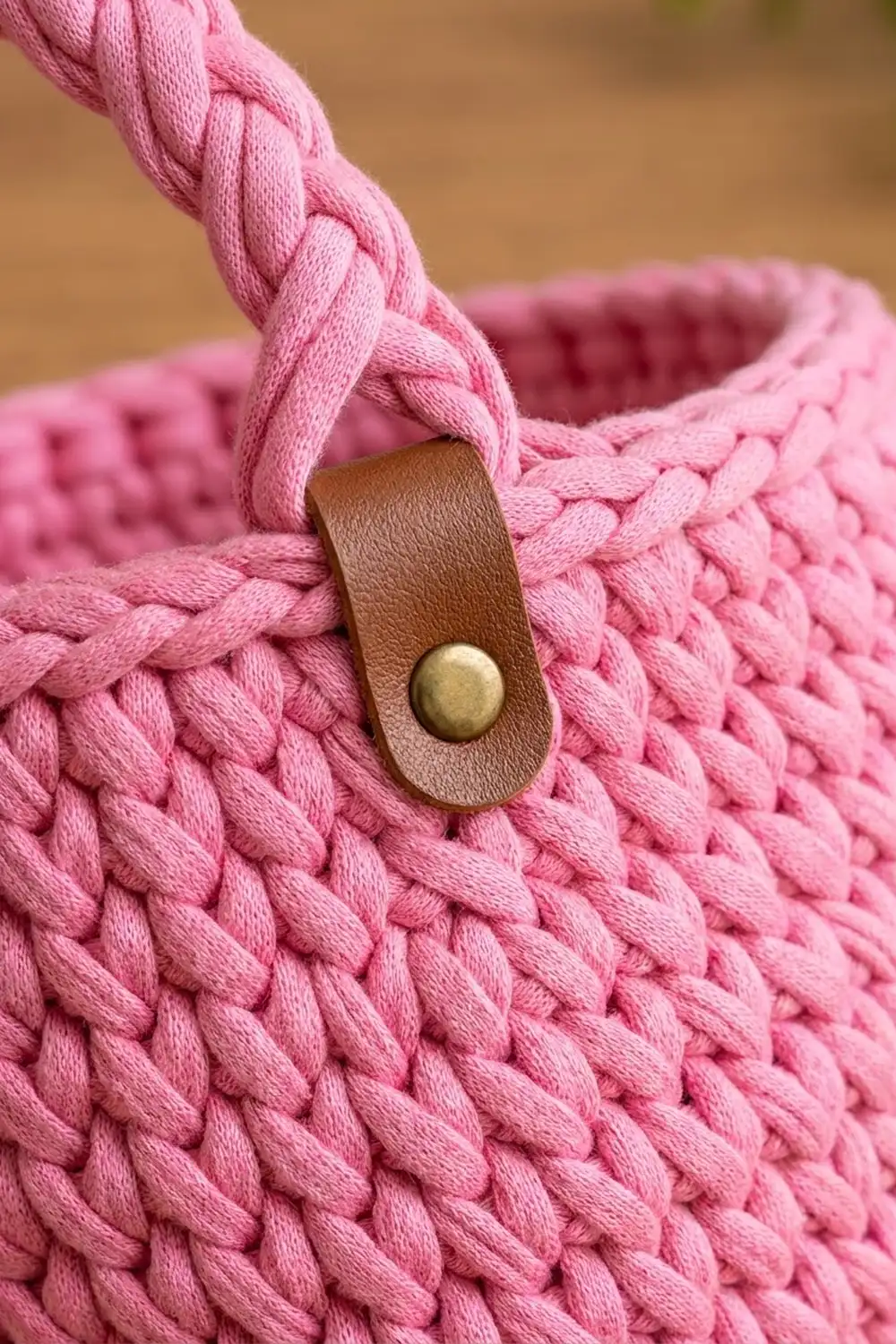
Waistcoat stitch (ws): Look at the sc below from the front. You will see a V on top of two vertical legs. Insert your hook from front to back through the center of that V, between the two legs and below the top loops. Yarn over, pull up a loop, yarn over, and pull through both loops on the hook.
ws2tog: Insert your hook through the center of the next st and pull up a loop. Insert it through the center of the following st and pull up a loop. Yarn over and pull through all 3 loops on the hook.
Waistcoat stitch worked in a spiral leans gently to one side, which gives the walls their slanted, braided look. This is normal and part of the design.
Gauge and Checkpoints
- Sc gauge (base): 12 sts and 12 rnds = 4 in (10.2 cm)
- Waistcoat gauge (walls): 12 sts and 14 rnds = 4 in (10.2 cm)
Make one complete base before you commit to all three baskets. It works as your gauge swatch.
Checkpoints:
– After Rnd 4 (24 sts), the circle measures about 2¾ in (7.0 cm) across.
– After Rnd 8 (48 sts), the base lies flat and measures 5 in (12.7 cm) across.
– After Rnd 21, the walls stand about 3¾ in (9.5 cm) tall, measured from the base fold.
– After Rnd 24, the basket measures 4½ in (11.4 cm) tall, and the opening measures 14 in (35.6 cm) around.
If your base is too big, go down to a 5.5 mm hook. If it is too small, go up to a 6.5 mm hook. If the base ruffles, your tension is loose for this yarn. If it cups, your tension is tight. In either case, change hook size rather than the stitch counts, because all later rounds depend on the 48-st base.
Basket Body (Make 3)
Work in a continuous spiral. Do not join rounds. Place the marker in the first st of each round and move it up as you go.
Base
Rnd 1: Work 6 sc in the MR and pull the ring closed. (6 sts)
Rnd 2: Inc in each st around. (12 sts)
Rnd 3: (Sc in next st, inc) 6 times. (18 sts)
Rnd 4: (Sc in next 2 sts, inc) 6 times. (24 sts)
Rnd 5: (Sc in next 3 sts, inc) 6 times. (30 sts)
Rnd 6: (Sc in next 4 sts, inc) 6 times. (36 sts)
Rnd 7: (Sc in next 5 sts, inc) 6 times. (42 sts)
Rnd 8: (Sc in next 6 sts, inc) 6 times. (48 sts)
Checkpoint: the base is flat, solid and 5 in (12.7 cm) across.
Turning Round
Rnd 9: Working in BLO, sc in each st around. (48 sts)
The unused front loops form a neat ridge. That ridge makes the base turn up into the walls cleanly.
Walls
Rnds 10–20: Ws in each st around. (48 sts per rnd)
Work the first ws of Rnd 10 into the center of the sc from Rnd 9. Keep your tension even. Waistcoat stitch tightens up if you pull each loop short, so pull every loop up to the height of the hook shaft.
Rnd 21 (decrease round): (Ws in next 6 sts, ws2tog) 6 times. (42 sts)
This round uses 48 sts (6 repeats x 8 sts) and makes 42 sts (6 repeats x 7 sts). It draws the top in slightly, so the basket looks rounded instead of flared.
Checkpoint: the walls are 3¾ in (9.5 cm) tall and the body measures 16 in (40.6 cm) around at its widest point.
Handle (Make 3)
The handle is worked flat in rows and then folded into a rope.
Foundation: Ch 31.
Row 1: Sc in the 2nd ch from the hook and in each ch across. (30 sts)
Row 2: Ch 1, turn, sc in each st across. (30 sts)
Row 3: Ch 1, turn, sc in each st across. (30 sts)
Fold seam: Do not fasten off. Fold the strip in half lengthwise so that Row 3 meets the foundation chain. Sl st through each st of Row 3 and the matching foundation chain loop together. (30 sl sts)
Fasten off and leave a 12 in (30.5 cm) tail for sewing. Weave the starting tail into the inside of the rope.
Checkpoint: the handle is 10 in (25.4 cm) long and about ½ in (1.3 cm) thick, with a rounded, rope-like profile.
Make All Pieces
Each basket uses one body and one handle, so you need:
- Pink: 3 basket bodies + 3 handles = 6 pieces
Hanging layout (front view):
   ======================= dowel 20 in (50.8 cm) =======================
        |tab|                 |tab|                 |tab|
       /handle\              /handle\              /handle\
     [ Basket 1 ]   1 in   [ Basket 2 ]   1 in   [ Basket 3 ]
The three baskets are 5 in (12.7 cm) wide each, with 1 in (2.5 cm) gaps between them. That makes the set 17 in (43.2 cm) wide. The remaining 1½ in (3.8 cm) at each end of the dowel leaves room for the wall brackets.
Joining: Attaching Handles and Hanging
The baskets are never joined to each other. In this pattern, “joining” means sewing each handle to its basket and then hanging the baskets on the rail.
Placement: Work this step after the rim band below is complete. Find the first st of Rnd 24 and mark it as Point A. Count 21 sts around and mark st 22 as Point B. The rim has 42 sts, so 21 sts apart puts A and B exactly opposite each other.
Sewing: Hold one handle end inside the basket against Point A. Overlap it by 1 in (2.5 cm), which is about 3 sts of the handle, over Rnds 22–23. Whipstitch around the handle end through the rim stitches, going stitch for stitch along the 3 overlapped sts. Then stitch across the bottom edge of the handle end so it does not flap. Bring the other end over to Point B without twisting the handle, and sew it the same way.
Tension advice: Sew firmly but do not pull hard enough to pucker the rim. The rim stitches should still lie in a smooth, even line. Go through each st at least twice, because the handle carries the full weight of the basket.
Size checkpoint: 10 in (25.4 cm) of handle minus 2 in (5.1 cm) of overlap leaves an 8 in (20.3 cm) arc. That arc stands about 3 in (7.6 cm) above the rim.
Hanging: Thread a leather strap through the top of each handle loop. Fold it over the dowel and fasten it with the rivet or snap, so the folded tab is about 3½ in (8.9 cm) long. Slide the three tabs into place with 1 in (2.5 cm) gaps between the baskets.
Rim Band (the “Border”)
Border gauge: 12 sc and 12 rnds = 4 in (10.2 cm), the same as the base. That works out to 3 sts and 3 rnds per inch (2.5 cm).
Rnd 22: Sc in each st around, working into the top two loops, not the center of the V. (42 sts)
Rnd 23: Sc in each st around. (42 sts)
Rnd 24: Sl st loosely in each st around. (42 sts) Join with a sl st to the first sl st, fasten off and weave in the end.
A round rim has no sides or corners, so every rim round has the same count all the way around: 42 sts.
Why the math works: Rnd 21 leaves 42 sts. Each rim round is worked 1 st per existing st, so all three rounds stay at 42. 42 sts at 3 sts per inch gives 14 in (35.6 cm) around, which is an opening about 4½ in (11.4 cm) across. That sits neatly inside the 16 in (40.6 cm) body circumference. Two sc rounds add about ⅔ in, and the sl st round adds a little more, so the band is about ¾ in (1.9 cm) deep. Added to the 3¾ in (9.5 cm) walls, that gives 4½ in (11.4 cm) total height. Because 42 is an even number, the handle points (st 1 and st 22) land exactly opposite each other.
Final Blocking
- Weave in all remaining ends on the inside of each basket and trim them close.
- Lightly mist each basket with water until it is damp but not wet.
- Stuff each basket firmly with a rolled towel or a 5 in (12.7 cm) jar so the walls stand straight.
- Shape the base by pressing it flat on a table and pushing out the Rnd 9 ridge so the base edge is crisp.
- Smooth the rim band so it lies in an even line. Check that the opening is 14 in (35.6 cm) around.
- Lay each handle flat in a gentle arch and mist it lightly.
- Let everything dry completely, which usually takes 12–24 hours, before you hang the baskets.
Final Quality-Control Checklist
- Each base lies flat and measures 5 in (12.7 cm) across.
- Each body measures 16 in (40.6 cm) around at its widest point.
- Each opening measures 14 in (35.6 cm) around and has 42 sts.
- All three baskets measure 4½ in (11.4 cm) tall, within ¼ in (0.6 cm) of each other.
- Each handle is 10 in (25.4 cm) long and is sewn at sts 1 and 22, directly opposite each other.
- Each handle is not twisted and is secured through at least 3 rim sts on each side.
- Each basket hangs level from its leather tab.
- No ends are visible from the outside.
Troubleshooting
The walls flare outward. Your waistcoat tension is too loose. Go down one hook size for the walls only, or pull each loop up a little shorter.
The walls are too stiff or hard to work into. Your loops are too short. Pull each loop up to the full height of the hook shaft before you finish the stitch.
The base cups upward. Your tension is tight for the base. Redo the base with a hook 0.5 mm larger.
The basket is short. Waistcoat rounds are shorter than sc rounds. Add one more ws round after Rnd 20 and before the decrease round. Keep the count at 48 sts.
The basket tilts when hung. The handle ends are not exactly opposite each other. Count the rim sts again and re-sew one end so the ends are 21 sts apart.
The handle rope is flat instead of round. Your fold seam is too loose. Work the sl sts more firmly, or redo the seam with the next smaller hook.
Care
Hand wash the baskets in cool water and press out the excess water with a towel. Reshape them over a jar and let them dry flat. Do not tumble dry them.
Final Notes
Your measurements build on each other in this order:
- The 48-st base measures 5 in (12.7 cm) across.
- The walls keep the 16 in (40.6 cm) circumference for 3¾ in (9.5 cm).
- The decrease round brings the opening down to 42 sts, or 14 in (35.6 cm).
- The ¾ in (1.9 cm) rim band brings each basket to 4½ in (11.4 cm) tall.
- A 10 in (25.4 cm) handle sewn at opposite points leaves a 3 in (7.6 cm) loop.
- Three baskets with 1 in (2.5 cm) gaps fill 17 in (43.2 cm) of the 20 in (50.8 cm) dowel.
If you check each stage as you go, all three baskets will match. Happy crocheting!