

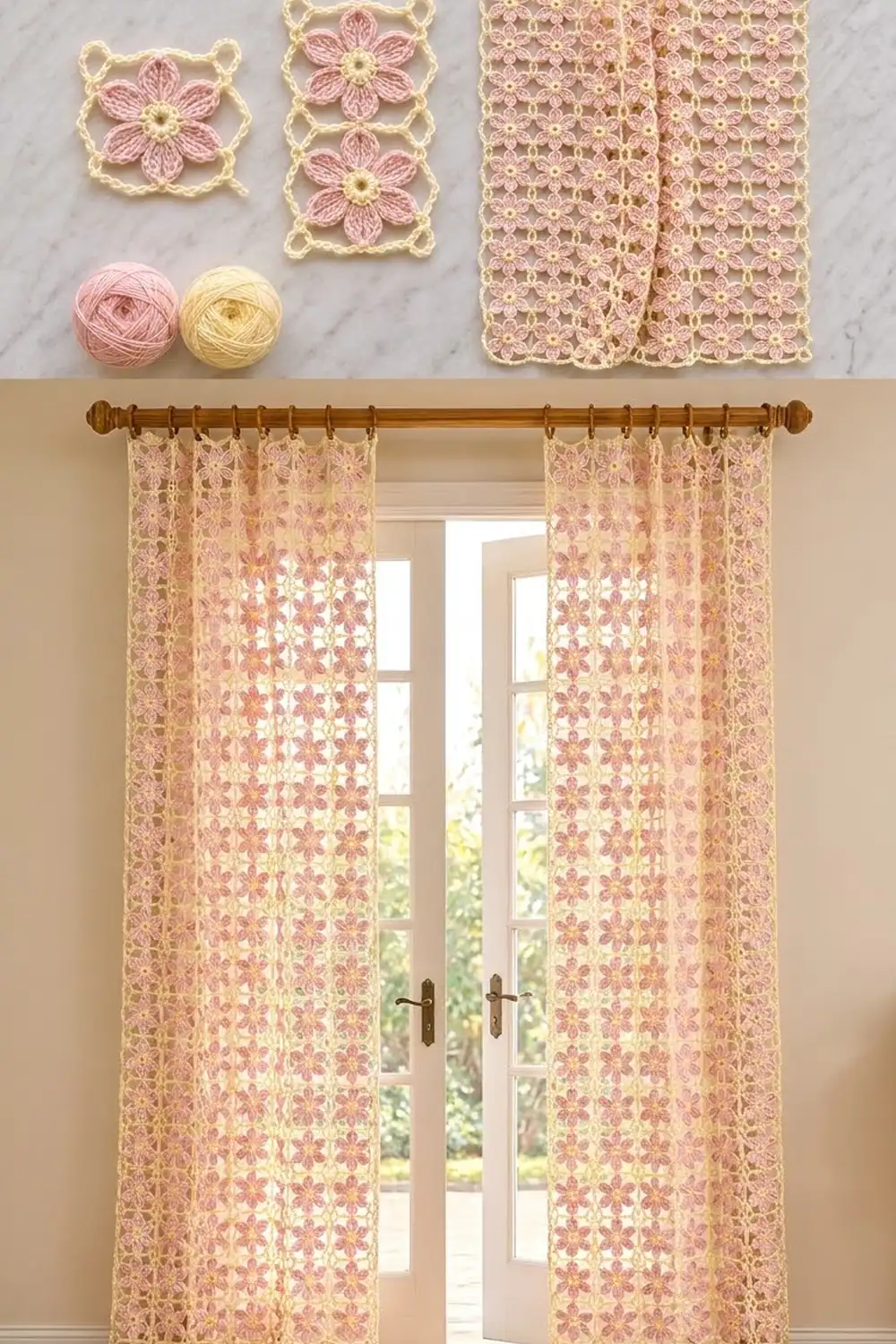
The Rosewater Lattice Curtain is a light, airy lace panel built from small flower squares. Each square has a soft pink six-petal flower with a cream center, set inside a corded cream frame with a tiny loop at every corner. Joined together, the frames form an open grid that lets light through and casts soft flower shadows on the floor.
There are only two colors: pastel pink for the petals and butter cream for the centers, frames, seams and border. The look is cottage-style and gentle, and it works in bedrooms, kitchens or anywhere you want privacy without blocking the light.
This pattern uses US crochet terms. One finished panel measures 36 in × 76 in (91.4 cm × 193.0 cm) after blocking. Make two panels for a pair, like the ones shown.
You’ll crochet each 5 in (12.7 cm) motif in five rounds, then join the motifs with a slip-stitch seam into a grid 7 motifs wide and 15 motifs tall. A two-round lace border finishes the edges.
Finished Size and Construction
- Finished panel size: 36 in × 76 in (91.4 cm × 193.0 cm)
- Skill level: Intermediate
- Terminology: US terms
- Yarn weight: DK (#3), cotton or cotton blend
- Hook: 4.0 mm (G-6)
- Number of pieces: 105 motifs per panel (210 for a pair)
- Layout: 7 motifs wide × 15 motifs tall
- Motif size: 5 in × 5 in (12.7 cm × 12.7 cm), not counting the corner loops
- Size before border: 35 in × 75 in (88.9 cm × 190.5 cm)
- Border depth: 0.5 in (1.3 cm) on each side
Materials
Yarn: Use a smooth DK cotton or cotton blend with about 115 m per 50 g (about 2.3 m per gram). Cotton hangs well, blocks crisply and doesn’t fuzz in sunlight. Avoid splitty yarn, because the petals use tall stitches.
- Color A, pastel pink (petals): 350 g / 805 m per panel; 700 g / 1,610 m for a pair
- Color B, butter cream (centers, frames, seams, border): 650 g / 1,495 m per panel; 1,300 g / 2,990 m for a pair
These amounts include a margin of about 10–15% for gauge differences and swatching.
Tools:
– 4.0 mm (G-6) crochet hook
– 4.5 mm (7) hook, only if your seams pucker
– Tapestry needle
– Stitch markers
– Blocking mats, rust-proof pins and a spray bottle
– Measuring tape
– 16 curtain clip rings for a pair (8 per panel)
Abbreviations (US Terms)
- ch – chain
- sl st – slip stitch
- sc – single crochet
- hdc – half double crochet
- dc – double crochet
- tr – treble crochet (yarn over twice)
- sp – space
- st(s) – stitch(es)
- RS – right side
Special stitch – Petal: In the stated ch-6 loop, work (sc, hdc, 2 dc, 2 tr, ch 2, 2 tr, 2 dc, hdc, sc). That’s 12 stitches and a ch-2 tip. The ch-2 between the pairs of trebles gives the petal its slightly pointed tip and a faint center line.
Gauge and Checkpoints
Gauge: 18 sc = 4 in (10.2 cm) with a 4.0 mm hook.
Make one full motif and block it before you start the batch. Check it against these sizes:
- After Round 1: the center ring measures about 1 in (2.5 cm) across.
- After Round 3: the flower measures 4 in (10.2 cm) from one petal tip to the opposite tip.
- After Round 4: the frame measures about 4.75 in (12.1 cm) across, slightly rounded.
- After Round 5, blocked: each side measures 5 in (12.7 cm). The corner loops stick out about 0.25 in (0.6 cm) beyond that.
Too big (5.25 in / 13.3 cm or more): go down to a 3.75 mm hook.
Too small (4.75 in / 12.1 cm or less): go up to a 4.5 mm hook.
A difference of 0.25 in (0.6 cm) per motif adds up to 1.75 in (4.4 cm) across the width and 3.75 in (9.5 cm) down the length, so it’s worth checking now.
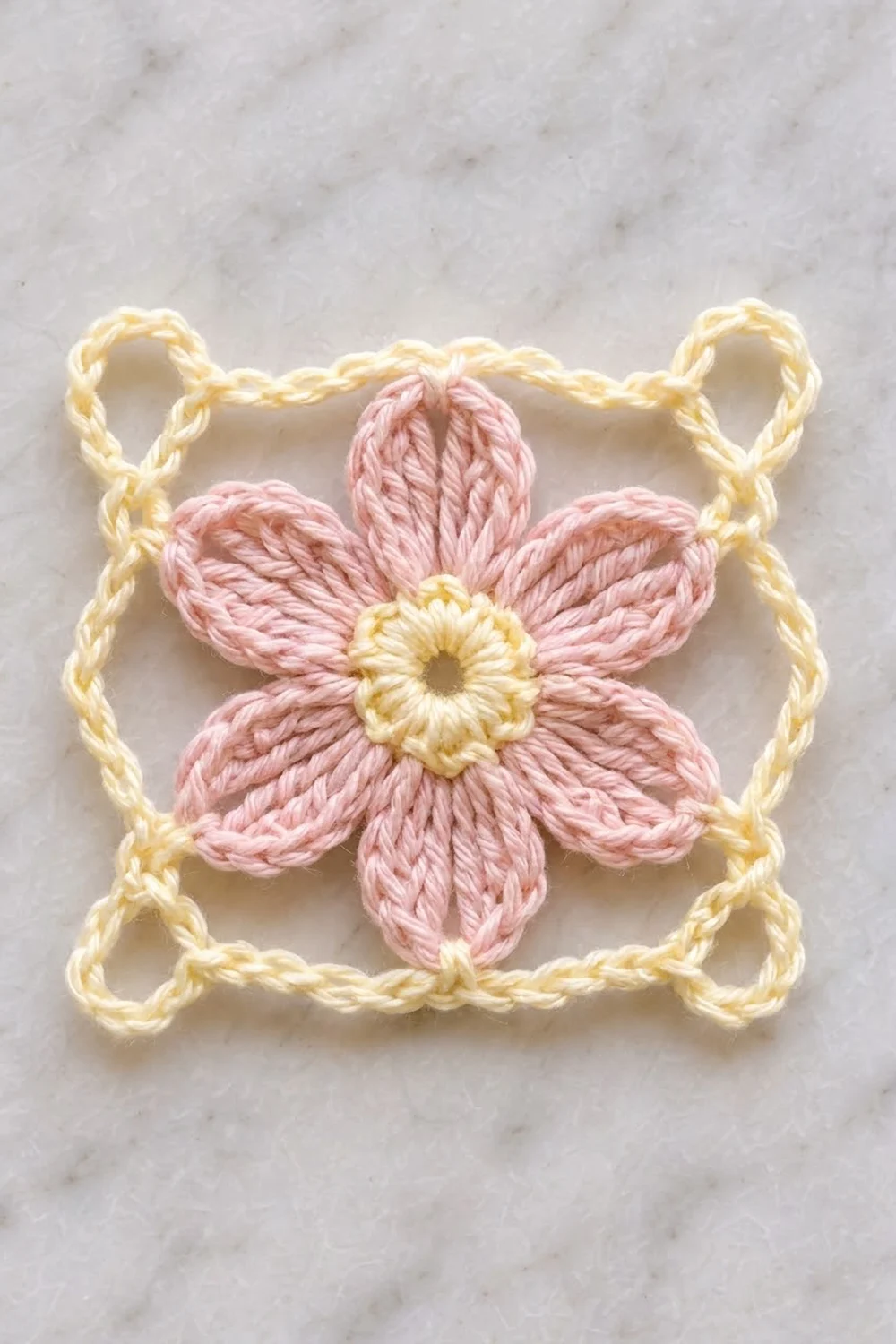
Flower Motif (Make 105 per Panel)
Round 1 (Color B, center)
With cream, ch 5 and sl st in the first ch to form a ring.
Ch 1, work 12 sc in the ring, then sl st to the first sc. (12 sc)
Fasten off. The ring stays open, which gives the flower its visible center hole.
Round 2 (Color A, petal base)
Join pink with a sc in any sc. Ch 6, skip the next sc.
Sc in the next sc, ch 6, skip the next sc. Repeat from * 4 more times, then sl st to the first sc.
(6 sc and 6 ch-6 loops)
Round 3 (Color A, petals)
Work 1 Petal in the next ch-6 loop, then sl st in the next sc. Repeat from * 5 more times. The last sl st goes into the first sc of Round 2.
(6 petals: 72 petal stitches, 6 ch-2 tips and 6 sl sts)
Fasten off pink.
Turn the flower so one petal points straight up. Call it P1. Number the other petals P2 to P6 in your working direction. P1 and P4 point to the middles of the top and bottom edges. P2, P3, P5 and P6 point toward the four corners.
Round 4 (Color B, frame foundation)
- Join cream with a sc in the ch-2 tip of P1. Ch 9.
- Work (tr, ch 5, tr) in the P2 tip (corner). Ch 19.
- Work (tr, ch 5, tr) in the P3 tip (corner). Ch 9.
- Sc in the P4 tip. Ch 9.
- Work (tr, ch 5, tr) in the P5 tip (corner). Ch 19.
- Work (tr, ch 5, tr) in the P6 tip (corner). Ch 9.
- Sl st to the first sc.
Count per side: Every side has 21 stitches between the corner ch-5 spaces, counting the stitch at each end.
– Top and bottom sides: tr + 9 ch + sc + 9 ch + tr = 21
– Left and right sides: tr + 19 ch + tr = 21
Total: 84 sts (8 tr, 2 sc, 74 ch) and 4 corner ch-5 spaces.
The trebles lift the corners away from the diagonal petals. The longer ch-19 sides span the left and right edges, which have no petal tip to anchor them.
Round 5 (Color B, corded frame)
Ch 1. Sc in the same st as the join.
Work 1 sc in each st and each ch around. In each corner ch-5 space, work (sc, ch 4, sc).
Sl st to the first sc and fasten off.
Count: Each side now has 23 sc between the corner ch-4 loops: 21 sc worked into the Round 4 stitches, plus 1 sc from each corner group.
Total: 92 sc and 4 ch-4 corner loops.
Weave in all ends along the back of the frame, not through the petals.
Make All Pieces
- Per panel: 105 motifs, using about 3 g pink and 5 g cream each
- For a pair: 210 motifs
It’s faster to work Rounds 1–3 in batches, then frame them all with cream.
Layout, one panel (M = motif; 7 across × 15 down):
Row 1:  M M M M M M M
Row 2:  M M M M M M M
Row 3:  M M M M M M M
Row 4:  M M M M M M M
Row 5:  M M M M M M M
Row 6:  M M M M M M M
Row 7:  M M M M M M M
Row 8:  M M M M M M M
Row 9:  M M M M M M M
Row 10: M M M M M M M
Row 11: M M M M M M M
Row 12: M M M M M M M
Row 13: M M M M M M M
Row 14: M M M M M M M
Row 15: M M M M M M M
Turn every motif so the P1 petal points to the top of the panel. This keeps the corner loops and the long ch-19 sides lined up throughout the grid.
Joining
Method: slip-stitch seam in cream with the 4.0 mm hook.
- Hold two motifs right sides together with the edges lined up.
- Sl st through both corner ch-4 loops together.
- Work 1 sl st through the outer loops of each matching pair of sc: 23 sl sts.
- Sl st through the next pair of corner loops.
That’s 25 sl sts per seam: 1 + 23 + 1. Because both motifs have exactly 23 sc per side, the seam is a clean 1-to-1 match with no skipped or doubled stitches.
Order: First join the motifs into 15 horizontal strips of 7. Then join the strips along their long edges, matching seam to seam. Where four motifs meet, work the sl st through all four corner loops together so the point lies flat.
Tension: Keep the slip stitches as loose as the sc in the frame. If a seam pulls the edge shorter than the motif beside it, switch to the 4.5 mm hook for seaming only.
Size checkpoints:
– Two joined motifs: 10 in (25.4 cm)
– One finished strip: 35 in (88.9 cm)
– Three strips joined: 15 in (38.1 cm) tall
– Full grid: 35 in × 75 in (88.9 cm × 190.5 cm)
Border
Border gauge: same as the motifs, 18 sc = 4 in (10.2 cm). The two rounds together add 0.5 in (1.3 cm) on each side.
Border Round 1 (Color B)
Join cream with a sc in any panel-corner ch-4 loop.
– In each of the 4 panel-corner loops, work (sc, ch 3, sc).
– Along the edges, work 1 sc in each of the 23 sc of every motif.
– At each seam, work 1 sc through the joined pair of corner loops.
Counts between the corner ch-3 spaces:
– Top and bottom edges: 7 × 23 = 161, plus 6 seam sc = 167, plus 2 corner sc = 169 sc
– Left and right edges: 15 × 23 = 345, plus 14 seam sc = 359, plus 2 corner sc = 361 sc
Sl st to the first sc.
Border Round 2 (Color B, lace edge)
Work along each side:
1. Sc in the first sc of the side.
2. Ch 3, skip the next sc, sc in the next sc. Repeat from * to the last sc of the side.
3. At the corner: ch 3, sc in the corner ch-3 space, ch 3.
Repeat for all four sides, then sl st to the first sc and fasten off.
Counts:
– Top and bottom edges: 85 sc and 84 ch-3 spaces each
– Left and right edges: 181 sc and 180 ch-3 spaces each
– Each corner: 1 sc and 2 ch-3 spaces
– Total: 536 sc and 536 ch-3 spaces
Why the math works: The motif side count (23) is odd. On the short edges, 7 odd sides plus 6 seam sc plus 2 corner sc gives 169, which is odd. On the long edges, 15 odd sides plus 14 seam sc plus 2 corner sc gives 361, which is also odd. The skip-1 pattern uses 2 stitches per repeat after the first sc: 1 + 2 × 84 = 169 and 1 + 2 × 180 = 361. Every edge starts and ends on a sc, with no fudged stitches.
Final Blocking
- Soak the panel in cool water for 15 minutes, then press out the water. Don’t wring it.
- Roll it in towels to remove more moisture.
- Lay it flat on blocking mats. Use a bed or a clean floor with a sheet if your mats don’t cover 36 in × 76 in (91.4 cm × 193.0 cm).
- Pin the four outer corners first, to 36 in × 76 in (91.4 cm × 193.0 cm).
- Pin each seam intersection so every motif is 5 in (12.7 cm) square.
- Open each flower gently with your fingers so the petals lie flat and the centers stay round.
- Let it dry completely, usually 24–48 hours, before you unpin.
Final Quality-Control Checklist
- Every motif has 6 petals, 23 sc per side and 4 corner loops.
- All P1 petals point to the top of the panel.
- Seams lie flat, with no puckers or gaps.
- Every corner where four motifs meet is secured.
- The short edges have 169 sc and the long edges 361 sc in Border Round 1.
- Border Round 2 starts and ends each side on a sc.
- The panel measures 36 in × 76 in (91.4 cm × 193.0 cm).
- All ends are woven in securely and hidden along the frames.
Troubleshooting
- Petals cup or ruffle: Your trebles are too tight against the ch-6 loop. Loosen your tension, or work the Round 2 chains a little looser.
- The frame pulls the flower out of shape: Check that you have 9 and 19 chains. Blocking will square up a little tension, but not a missing chain.
- The motif isn’t square: Recount Round 5. Every side must have 23 sc.
- Seams ripple: Use the 4.5 mm hook for seaming.
- The panel is too short or too long: Add or remove a whole row of 7 motifs. Each row changes the length by 5 in (12.7 cm). Add 46 sc per row (2 × 23) to the Border Round 1 count on the long sides: 23 sc plus 1 seam sc per motif row on each long edge.
- The border flares: You’ve added stitches at the seams. Use exactly 1 sc per seam.
Care
Hand wash in cool water with mild soap, press out the water and dry flat, re-pinning if needed. Don’t tumble dry, and avoid long direct sun if your cotton is prone to fading.
Final Notes
Every measurement in this pattern builds on the one before it:
- 18 sc = 4 in (10.2 cm), which gives a 5 in (12.7 cm) motif with 23 sc per side.
- 7 × 15 motifs make a 35 in × 75 in (88.9 cm × 190.5 cm) grid.
- The 0.5 in (1.3 cm) border brings the panel to 36 in × 76 in (91.4 cm × 193.0 cm).
If your first motif is right, everything after it will be too.
Clip 8 rings evenly along the top edge, one at each panel corner and one at each of the 6 seams, 5 in (12.7 cm) apart. Then hang your panels and enjoy the light.
Happy crocheting!