

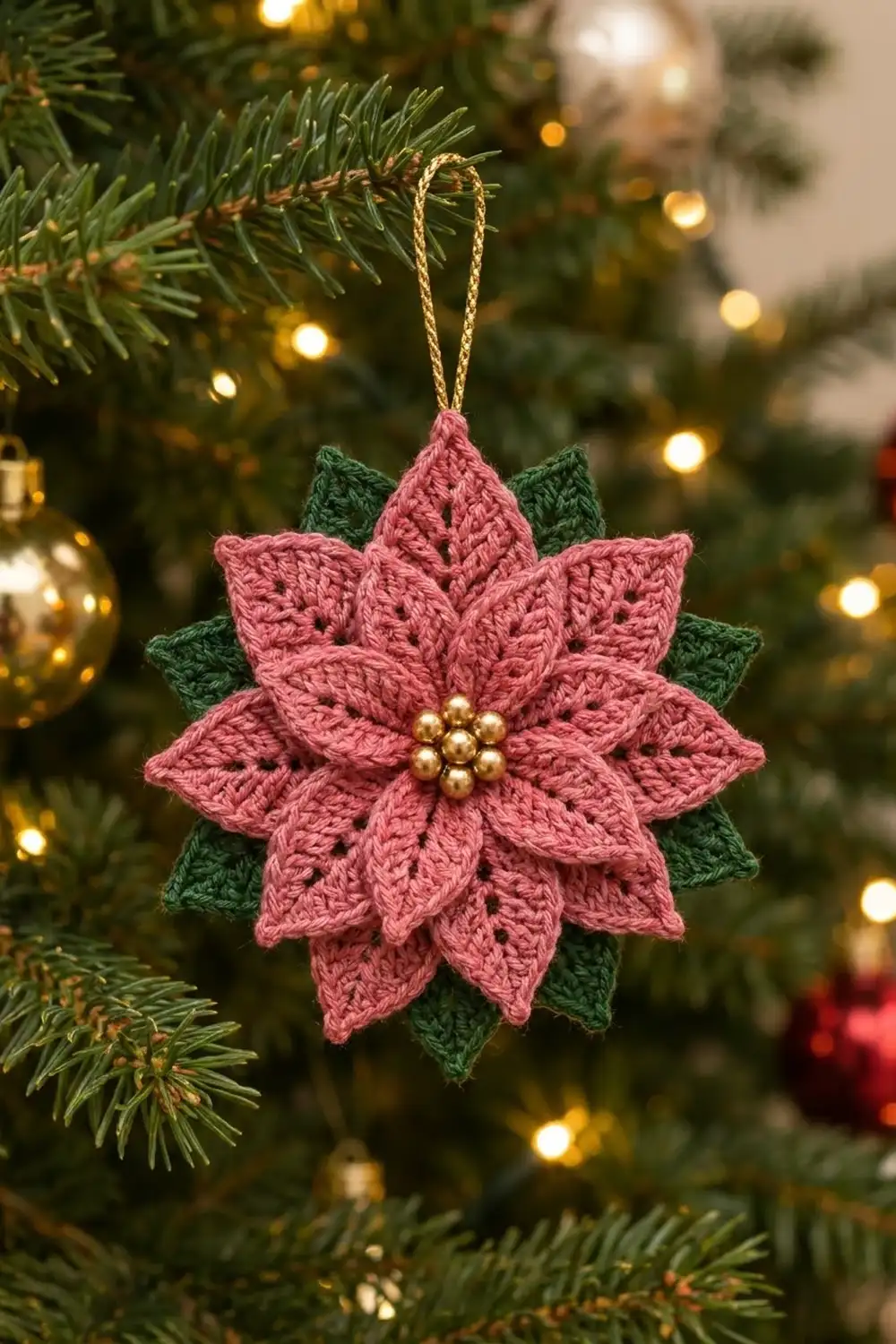
This little poinsettia is a layered, palm-size Christmas ornament. Two rings of dusty rose petals sit on a star of dark forest green leaf points, with a cluster of seven gold beads in the center. A loop of twisted gold cord at the top lets it hang on the tree.
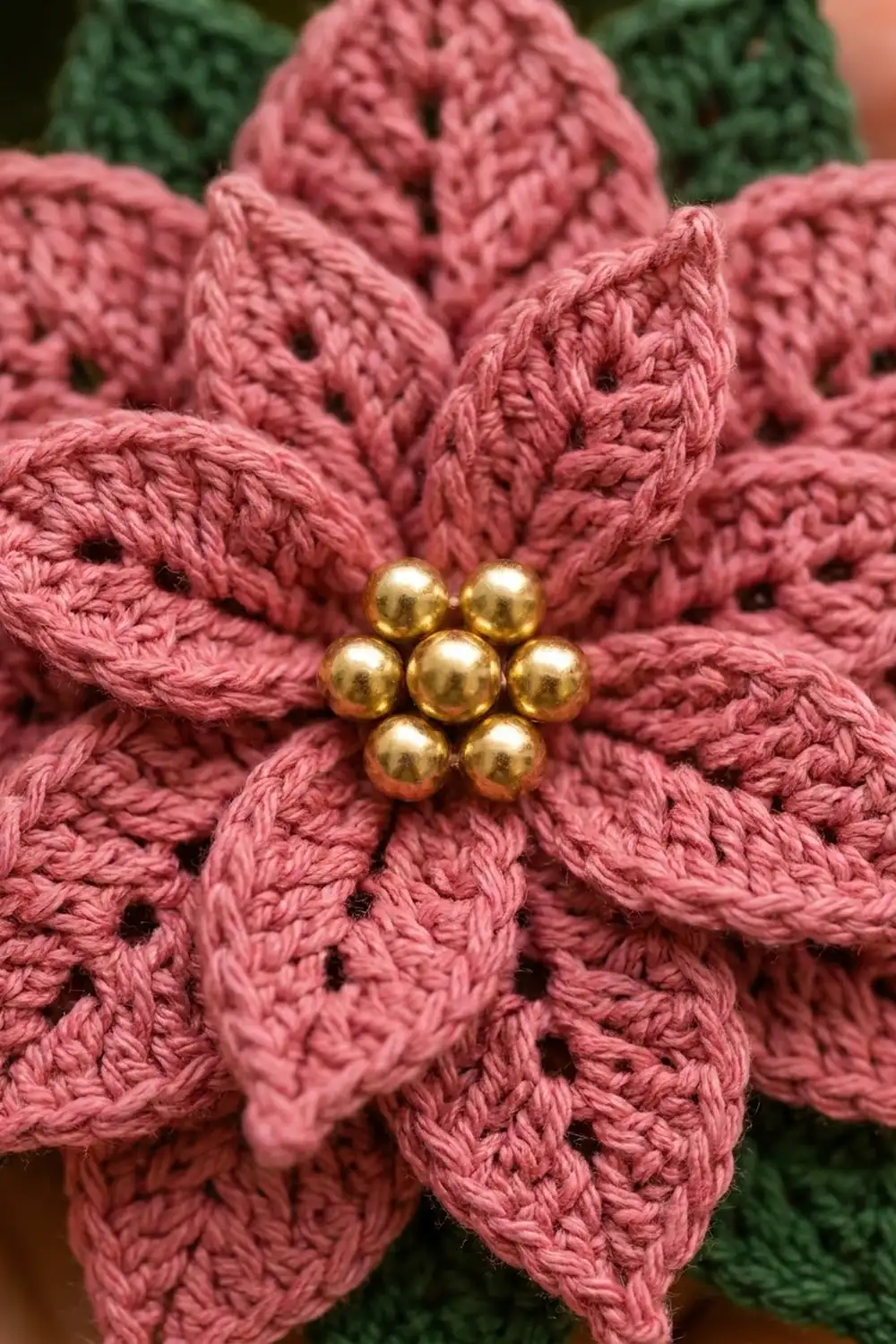
Each rose petal is a pointed oval with a firm, raised single crochet edge. A solid spine runs down the middle with a line of small eyelets on each side, which looks like the veins of a real bract. The colors are soft and a little vintage, and the texture is firm enough to hold its shape on a branch.
The pattern uses US crochet terms. The finished ornament is about 4.5 in (11.4 cm) across from petal tip to petal tip. The green leaf points behind the petals reach about 4.25 in (10.8 cm) across.
Construction is simple. First you crochet a small green disc in rounds. Then you make 8 large petals and 8 small petals, each worked around both sides of a foundation chain. You sew the petals onto the disc in two offset layers and work a border of 8 green leaf points around the disc so they land between the large petals. Last, you add the beads and the hanging loop.
Finished Size and Construction
- Finished size: about 4.5 in (11.4 cm) across, petal tip to petal tip
- Skill level: Easy to intermediate
- Terminology: US crochet terms
- Yarn weight: DK (light worsted, category 3) cotton or cotton blend
- Hook: 3.0 mm (US C/2 or D/3)
- Number of pieces: 17 (1 green disc, 8 large rose petals, 8 small rose petals)
- Layout: green disc at the back, 8 large petals in the middle layer, 8 small petals on top, offset halfway between the large ones
- Piece sizes: large petal 2.25 in (5.7 cm) long x 1.25 in (3.2 cm) wide; small petal 1.75 in (4.4 cm) long x 1 in (2.5 cm) wide
- Size before border: green disc 2 in (5.1 cm) across
- Border depth: each green leaf point is about 1.1 in (2.8 cm) long
Materials
Choose a smooth, tightly plied cotton in DK weight. Mercerized cotton gives the clearest stitch definition and keeps the eyelets open. Avoid fuzzy or very soft acrylics, because the petals will droop.
- Dusty rose (petals): 20 g, about 45 m
- Forest green (leaf disc and border): 9 g, about 20 m
These amounts include about 25 percent extra for a test petal and for weaving in ends.
Tools and notions:
- 3.0 mm crochet hook
- Tapestry needle
- 7 gold beads, 6 mm, with a sewing needle and matching thread
- 8 in (20.3 cm) of gold metallic twisted cord for the hanging loop
- Stitch markers (at least 8)
- Scissors
- Pins and a foam blocking mat
- Optional: spray starch or fabric stiffener
Abbreviations (US Terms)
- ch chain
- sl st slip stitch
- sc single crochet
- hdc half double crochet
- dc double crochet
- tr treble crochet
- sk skip
- sp space
- st(s) stitch(es)
- rep repeat
Special technique, working both sides of the chain: Work the first side into the back bumps of the foundation chain. After the tip, rotate the piece and work the second side into the free front loops of the same chains. The chain becomes the solid center spine of the petal.
Gauge and Checkpoints
Gauge: 22 sc and 24 rows = 4 in (10.2 cm), worked in rows. Gauge matters less here than for a garment, but the petals must be firm.
Make one large petal first and measure it before you make the rest.
- Large petal after Rnd 1: about 2.2 in (5.6 cm) long
- Large petal after Rnd 2: 2.25 in (5.7 cm) long x 1.25 in (3.2 cm) wide
- Small petal after Rnd 2: 1.75 in (4.4 cm) long x 1 in (2.5 cm) wide
- Green disc after Rnd 5: 2 in (5.1 cm) across
If the petal is too big or floppy, go down to a 2.75 mm hook. If it is too small or the eyelets close up, go up to a 3.25 mm hook. Change the hook, not the stitch counts, so the eyelets stay in line.
Green Leaf Disc
With forest green.
Rnd 1: Make a magic ring, ch 1, 8 sc in ring, join with sl st to first sc. (8 sts)
Rnd 2: Ch 1, 2 sc in each st around, join. (16 sts)
Rnd 3: Ch 1, *sc in next st, 2 sc in next st; rep from * 7 more times, join. (24 sts)
Rnd 4: Ch 1, *sc in next 2 sts, 2 sc in next st; rep from * 7 more times, join. (32 sts)
Rnd 5: Ch 1, *sc in next 3 sts, 2 sc in next st; rep from * 7 more times, join. (40 sts)
Checkpoint: the disc lies flat and measures 2 in (5.1 cm) across. Do not fasten off. Pull up a long loop, take the hook out, and put a marker in the loop so it cannot unravel. You will work the border from this loop after assembly.
Large Petals
With dusty rose. Make 8.
Foundation: Ch 13.
Rnd 1 (side A): Working in back bumps, sc in 2nd ch from hook, hdc in next ch, dc in next 2 ch, [ch 1, sk next ch, dc in next ch] 3 times, hdc in next ch. (11 positions: 8 sts and 3 ch-1 sps)
Tip: (sc, ch 2, sc) in last ch.
Side B: Rotate and work in the free loops of the same chains. Hdc in next ch, dc in next ch, [ch 1, sk next ch, dc in next ch] 3 times, dc in next ch, hdc in next ch, sc in last ch. (11 positions: 8 sts and 3 ch-1 sps)
Base: Ch 1, join with sl st to first sc.
Rnd 1 totals: 11 positions on each side, 2 tip sc with a ch-2 sp between them, and 1 base ch-1 sp. The ch-1 spaces line up on both sides of the spine and form the two rows of eyelet veins.
Rnd 2 (edge): Ch 1, sc in each of the 11 positions of side A (work into the ch-1 sps, not the chains), sc in next tip sc, (sc, ch 2, sc) in tip ch-2 sp, sc in next tip sc, sc in each of the 11 positions of side B, sc in base ch-1 sp, join. (27 sc and 1 ch-2 tip sp)
That gives 13 sc per side (11 + 1 tip sc + 1 sc from the tip space), plus 1 base sc: 13 + 13 + 1 = 27. Fasten off and leave a 10 in (25.4 cm) tail for sewing.
Small Petals
With dusty rose. Make 8.
Foundation: Ch 10.
Rnd 1 (side A): Working in back bumps, sc in 2nd ch from hook, hdc in next ch, dc in next ch, [ch 1, sk next ch, dc in next ch] 2 times, hdc in next ch. (8 positions: 6 sts and 2 ch-1 sps)
Tip: (sc, ch 2, sc) in last ch.
Side B: Rotate and work in the free loops. Hdc in next ch, [dc in next ch, ch 1, sk next ch] 2 times, dc in next ch, hdc in next ch, sc in last ch. (8 positions: 6 sts and 2 ch-1 sps)
Base: Ch 1, join with sl st to first sc.
Rnd 2 (edge): Ch 1, sc in each of the 8 positions of side A, sc in next tip sc, (sc, ch 2, sc) in tip ch-2 sp, sc in next tip sc, sc in each of the 8 positions of side B, sc in base ch-1 sp, join. (21 sc and 1 ch-2 tip sp)
That gives 10 sc per side (8 + 1 + 1), plus 1 base sc: 10 + 10 + 1 = 21. Fasten off and leave a 10 in (25.4 cm) tail.
Make All Pieces
- Forest green: 1 leaf disc (loop left live)
- Dusty rose: 8 large petals
- Dusty rose: 8 small petals
Block all 16 petals flat before assembly (see Final Blocking, steps 1 to 3). Flat petals are much easier to place evenly.
Layout, reading clockwise around the center (L = large petal, s = small petal with a green point under it):
        L
     s     s
   L    o    L
     s     s
        L
(full ring: L s L s L s L s L s L s L s L s)
The large petals sit at the 8 compass points (N, NE, E, SE, S, SW, W, NW). The small petals and the green points sit halfway between them.
Joining
Marking the disc: Count the 40 sts of Rnd 5, starting with the st next to the live loop. Place markers in sts 1, 6, 11, 16, 21, 26, 31 and 36. The markers are 5 sts apart, and 8 x 5 = 40, so the spacing is exactly even.
Large petals: Lay a large petal with its base at the center of the disc and its spine running straight out over marker 1. Using whipstitch through the back loops of the petal edge, sew the base sc and the first 3 sc on each side of it to the disc. This holds down about the inner 0.75 in (1.9 cm) of the petal and leaves the outer part free. Repeat at each marker. The petal bases overlap a little at the center, which is fine.
Small petals: Place each small petal halfway between two large petals, with its base at the center. Sew its base sc and the first 2 sc on each side, stitching through the large petals and into the disc.
Tension: Pull each sewing stitch snug but not tight. If the disc starts to cup, your stitches are too tight. Loosen them, or sew through only one layer at a time.
Checkpoint: The flower measures 4.5 in (11.4 cm) from one large petal tip to the opposite tip. All 8 large petals should be the same distance from the center, within 0.125 in (0.3 cm).
Border: Green Leaf Points
Border gauge: each point is worked on a chain of 7, is about 1.1 in (2.8 cm) long, and spans 5 sts of Rnd 5.
Turn the ornament face down. Fold the petals toward the center if they get in the way. Put the live green loop back on the hook. It sits just before st 1, the first marked st.
Rnd 6: Sl st in st 1 (marker), *ch 7, sc in 2nd ch from hook, hdc in next ch, dc in next 2 ch, tr in next 2 ch, sk next 4 sts of Rnd 5, sl st in next st (the next marker); rep from * 7 more times, ending the last rep with sl st in st 1. (8 points)
Why the math works: Each repeat uses 1 sl st plus 4 skipped sts, or 5 sts in all. Eight repeats use 8 x 5 = 40 sts, which is all of Rnd 5. Each point starts and ends on a marker, so its center lands halfway between two large petals, under a small petal. Each point has 6 sts along its length (sc, hdc, 2 dc, 2 tr). The tr end is next to the disc, which gives a broad base and a sharp tip.
Fasten off and weave in the ends. Checkpoint: the green points measure about 4.25 in (10.8 cm) tip to tip. That is the 2 in (5.1 cm) disc plus two 1.1 in (2.8 cm) points, so the points show between the rose petals.
Beads: Sew one 6 mm bead at the exact center. Sew 6 more around it in a tight ring, then pass the thread through the ring twice so the beads sit snugly.
Hanging loop: Fold the 8 in (20.3 cm) gold cord in half. Sew the cut ends to the back of the disc behind one large petal tip, overlapping them by about 1 in (2.5 cm). This leaves a loop of about 3 in (7.6 cm).
Final Blocking
- Wet the petals in cool water and press out the extra water in a towel.
- Pin each petal flat on the mat, with one pin at the tip and one at each widest point.
- Open each eyelet with the tip of a needle so the veins show clearly. Let the petals dry fully.
- After assembly, mist the whole ornament lightly and pin it face up, with one pin at each large petal tip and one at each green point.
- For a stiffer ornament, spray with starch if you like.
- Let it dry for at least 12 hours before you hang it.
Final Quality-Control Checklist
- 8 large petals with 27 sc each, and 8 small petals with 21 sc each
- 3 eyelets per side on each large petal, and 2 per side on each small petal
- Disc Rnd 5 has 40 sts, and the border has 8 evenly spaced points
- Large petals are evenly spaced, 5 sts apart
- Small petals are centered between the large petals
- Ornament measures 4.5 in (11.4 cm) across
- Beads are secure, and the ornament hangs from its loop without tipping
- All ends are woven in on the back
Troubleshooting
Petal twists into a spiral: You worked side B into the back bumps too. Work side B into the free front loops only.
Eyelets are hidden: In Rnd 2, put the sc into the ch-1 space, not into the chain itself. Then open the eyelets during blocking.
Tip is blunt: Make sure you work the ch-2 at the tip in both rounds, and pin the tip sharply when you block.
Disc cups or ruffles: Recount Rnds 3 to 5. Cupping means too few stitches, and ruffling means too many.
Points lean to one side: You skipped 3 or 5 sts instead of 4. Pull out the round and recount from the markers.
Ornament flops on the tree: Starch it, or sew the large petals down a little farther out from the base.
Care
Spot clean with cool water and mild soap, then reshape and dry flat. Store it flat in a box so the petals keep their shape.
Final Notes
The measurements build on each other. At a gauge of 22 sc to 4 in (10.2 cm), a 13-chain foundation makes a 2.25 in (5.7 cm) large petal. Eight of these petals around the center make a 4.5 in (11.4 cm) flower. The 40-stitch disc is 2 in (5.1 cm) across and divides evenly into 8 petal positions and 8 leaf points of about 1.1 in (2.8 cm). If every checkpoint matches, the finished poinsettia will too.
Happy crocheting!