
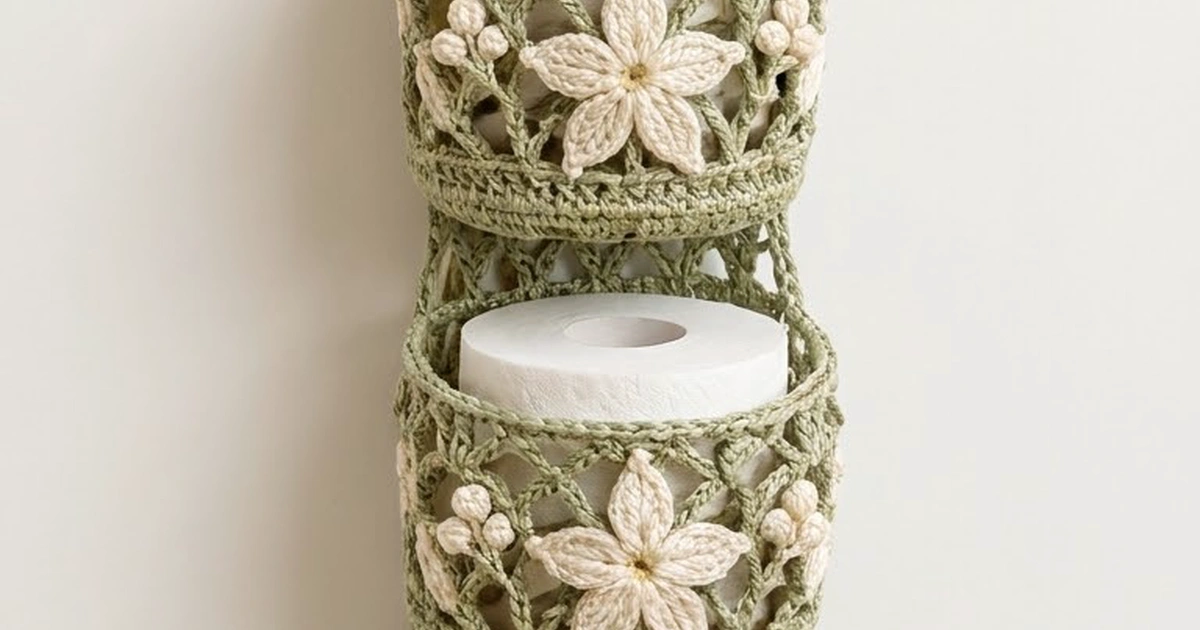
This hanging toilet paper holder brings a soft, cottage-garden feel to the bathroom. Three round pockets stack one above the other, each holding a standard roll. An open lattice cone rises from the top pocket to a natural wooden ring.
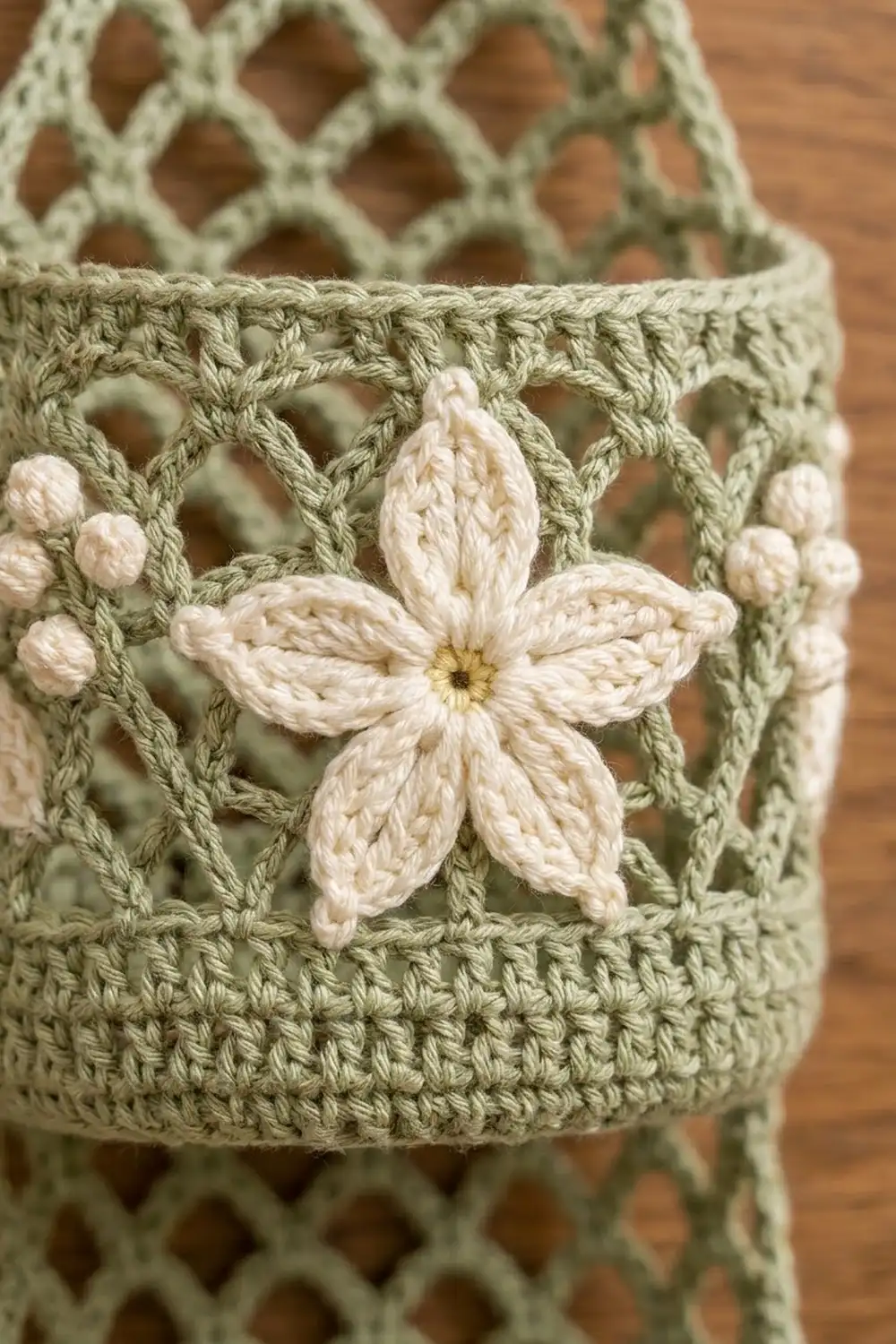
The palette is calm and simple: sage green for the structure, cream for the five-petal flowers and berry sprigs, and a touch of pale yellow at each flower’s heart. The lattice keeps the piece light, while solid bands at the base and rim keep every pocket firm.
This pattern uses US crochet terms. Each pocket measures 5 in (12.7 cm) across and 3.5 in (8.9 cm) tall. The finished hanger is about 18.5 in (47.0 cm) long from the bottom of the lowest pocket to the top of the ring.
You crochet three identical pockets in the round from the base up. Then you work a short connector strap on the back of two of them and work the mesh cone directly onto the top pocket. Flowers and berries are made separately and sewn on, and the pockets are joined stitch to stitch.
Finished Size and Construction
- Finished size: about 5 in (12.7 cm) wide x 18.5 in (47.0 cm) long, including ring
- Skill level: Intermediate
- Terminology: US crochet terms
- Yarn weight: DK / light worsted cotton (weight 3)
- Hook: 3.5 mm (E-4)
- Number of pieces: 3 pockets, 1 hanger cone (worked on the top pocket), 2 connector straps (worked on the lower pockets), 3 flowers, 18 berries
- Layout: 1 column of 3 pockets, with the cone and ring on top
- Piece size (one pocket): 5 in (12.7 cm) diameter x 3.5 in (8.9 cm) tall
- Pocket height before rim border: 3.1 in (7.9 cm)
- Rim border depth: 0.4 in (1.0 cm)
Materials
Choose a smooth mercerized or combed cotton in DK weight. Cotton holds its shape, resists stretching under the weight of a roll, and shows the lattice clearly. Avoid very soft acrylic blends, because the pockets may sag.
- Sage green: 130 g (about 275 m)
- Cream: 25 g (about 55 m)
- Pale yellow: 2 g (about 5 m), or 6-strand embroidery floss
- 3.5 mm (E-4) crochet hook
- 1 wooden ring, 2 in (5.1 cm) outer diameter
- Tapestry needle
- 6 locking stitch markers
- Scissors and a flexible tape measure
- Rust-proof pins and a blocking surface
All quantities include a margin of about 15% for swatching and joining.
Abbreviations (US Terms)
- ch – chain
- sl st – slip stitch
- sc – single crochet
- hdc – half double crochet
- dc – double crochet
- tr – treble crochet
- blo – back loop only
- rsc – reverse single crochet (crab stitch)
- MR – magic ring
- sp – space
- st(s) – stitch(es)
Berry bobble (bb): [yarn over, insert hook in stitch, yarn over, pull up a loop, yarn over, pull through 2 loops] 5 times in the same stitch (6 loops on hook), yarn over, pull through all 6 loops.
Reverse single crochet (rsc): working from left to right (if you crochet right-handed), insert hook in the next stitch to the right, pull up a loop, yarn over, pull through both loops.
Gauge and Checkpoints
Gauge: 20 sc x 22 rounds = 4 in (10.2 cm) in sc worked in the round. That is 5 sc per inch (2.5 cm).
Make one complete pocket before starting the others. It is your real gauge swatch, and every later measurement depends on it.
Checkpoints:
- After Round 7 (42 sts): base diameter about 2.7 in (6.9 cm).
- After Round 13 (78 sts): base diameter 5 in (12.7 cm), circumference 15.6 in (39.6 cm).
- After Round 22: pocket side height 3.1 in (7.9 cm) from the turning ridge.
- After Round 24: pocket height 3.5 in (8.9 cm). A roll 4.5 in (11.4 cm) wide should slide in easily and stand slightly above the rim.
If your base is too big: go down to a 3.25 mm hook. If it is too small or tight: go up to a 3.75 mm hook. Don’t change the stitch counts. The 78-stitch total is what makes the lattice divide evenly.
Pocket (Make 3)
Use sage green, and join every round with a sl st. Each base round has 6 more stitches than the round before.
Base
Round 1: 6 sc in MR, sl st to first sc to join. (6 sts)
Round 2: ch 1, 2 sc in each st around, join. (12 sts)
Round 3: ch 1, sc in next st, 2 sc in next st 6 times, join. (18 sts)
Rounds 4–13: ch 1, sc in next X sts, 2 sc in next st 6 times, join. X is 2 in Round 4 and goes up by 1 each round, ending at 11 in Round 13.
Round totals: Round 4 has 24 sts, Round 5 has 30, Round 6 has 36, Round 7 has 42, Round 8 has 48, Round 9 has 54, Round 10 has 60, Round 11 has 66, Round 12 has 72, and Round 13 has 78.
Place a marker on the joining stitch of Round 13. This is the center back of the base.
Sides
Round 14 (turning round): ch 1, sc blo in each st around, join. (78 sts) The unworked front loops of Round 13 form a ridge that you will use later for joining.
Round 15: ch 3 (counts as dc), dc in each remaining st around, join to top of ch-3. (78 sts)
Round 16: ch 1, sc in each st around, join. (78 sts)
Round 17 (mesh setup): ch 1, sc in first st, ch 5, skip 2 sts, sc in next st 25 times, ch 5, skip last 2 sts, join to first sc. (26 ch-5 loops)
Check: 26 loops x 3 sts = 78 sts, so the mesh divides evenly.
Round 18: sl st in each of the next 3 ch to reach the center of the first loop, ch 1, sc in same loop, ch 5, sc in next loop 25 times, ch 5, join to first sc. (26 loops)
Round 19: repeat Round 18. (26 loops) The offset loops form the diamond lattice.
Round 20 (conversion round): sl st in next ch, ch 1, 3 sc in each ch-5 loop around, join. (26 loops x 3 sc = 78 sts)
Round 21: ch 2 (does not count), hdc in each st around, join to first hdc. (78 sts)
Round 22: repeat Round 21. (78 sts)
The pocket side now measures 3.1 in (7.9 cm). Continue straight into the Rim Border below before you fasten off.
Make All Pieces
- Sage green: 3 pockets with rim border, 1 hanger cone worked on Pocket A, 1 connector strap on each of Pockets B and C, and 6 embroidered stems
- Cream: 3 flowers and 18 berries
- Pale yellow: 3 French-knot centers
Layout (top to bottom):
      [ Wooden ring ]
     [  Mesh cone   ]
  [ Pocket A – top    ]
     [ Connector ]
  [ Pocket B – middle ]
     [ Connector ]
  [ Pocket C – bottom ]
Flower (Make 3)
Round 1: with cream, 10 sc in MR, join. (10 sts)
Round 2: ch 4, skip 1 st, sl st in next st 5 times, working the last sl st into the joining st. (5 ch-4 spaces)
Round 3 (petals): in each ch-4 sp work (sc, hdc, dc, tr, ch 3, sl st in 3rd ch from hook, tr, dc, hdc, sc). Join and fasten off. (5 pointed petals, each with 8 sts plus a picot point)
The flower measures about 2 in (5.1 cm) across. With pale yellow, work one French knot (3 wraps) in the center of the ring.
Berry (Make 18)
With cream, ch 2, work 1 bb in the 2nd ch from hook, ch 1 to close. Fasten off, leaving a 6 in (15.2 cm) tail. Use the tail to sew the berry on.
Rim Border
Work the rim border on each pocket directly after Round 22. The border gauge matches the body: 5 sts per inch (2.5 cm). Lay the pocket flat with the base marker at center back. Each pocket then has a front side of 39 sts and a back side of 39 sts.
Round 23: ch 1, sc in each st around, join. (78 sts: 39 front, 39 back)
Round 24: ch 1, rsc in each st around, join. (78 sts: 39 front, 39 back) Fasten off.
Why the math works: the 78 sts divide into 26 lattice loops of 3 sts each, and the conversion round puts exactly 3 sc back into each loop. The rim adds no stitches, so the circumference stays 15.6 in (39.6 cm). The rsc adds height and a firm corded edge without flaring.
After Round 24, check whether the round join sits at center back, above the base marker. If the mesh rounds have moved it to one side, rotate the pocket until the base marker is at the back again; the 39 + 39 count stays the same. Mark the stitch directly above the base marker as st 78, so st 39 sits at center front.
Joining
Connector Straps (Pockets B and C)
Center 17 sts on the back of Round 24: sts 70–78 and 1–8.
Row 1: join sage in st 70, ch 1, sc in the same st and in the next 16 sts, turn. (17 sts)
Row 2: ch 4 (counts as dc + ch 1), skip 1 st, dc in next st, ch 1, skip 1 st 7 times, dc in last st, turn. (9 dc + 8 ch-1 sps = 17 sts)
Row 3: ch 1, sc in each dc and each ch-1 sp across. (17 sts) Fasten off, leaving a 20 in (50.8 cm) tail.
The strap is 0.8 in (2.0 cm) tall. This gap lets you tilt a roll out of the pocket below.
Hanger Cone (Pocket A)
Center 25 sts on the back of Round 24: sts 66–78 and 1–12.
Row 1: join sage in st 66, ch 1, sc in the same st and in the next 24 sts, turn. (25 sts)
Row 2: ch 1, sc in first st, ch 5, skip 2 sts, sc in next st 8 times, turn. (8 loops)
Row 3: sl st in next 3 ch, ch 1, sc in same loop, ch 5, sc in next loop 7 times, turn. (7 loops)
Rows 4–9: repeat Row 3, working the repeat 1 fewer time each row. Row 4 has 6 loops, Row 5 has 5, Row 6 has 4, Row 7 has 3, Row 8 has 2, and Row 9 has 1.
Row 10: sl st in next 3 ch, ch 1, 5 sc in the loop, turn. (5 sts)
Rows 11–18: ch 1, sc in each st across, turn. (5 sts)
Fold the strap over the wooden ring from front to back and whipstitch Row 18 to Row 11. The cone measures about 4 in (10.2 cm) from the rim to the bottom of the ring.
Stacking the Pockets
The upper pocket is joined by the free front loops of its Round 13, and the lower pocket by Row 3 of its connector.
- Find the 17 front loops of Round 13 centered on the base marker of Pocket A.
- Place Pocket A above Pocket B, with their backs aligned.
- With the connector tail of Pocket B, whipstitch 1 connector stitch to 1 front loop, 17 stitches to 17 loops.
- Repeat to join Pocket B above Pocket C.
Keep the tension firm but not tight. The seam should lie flat at the width of the connector; if it puckers, unpick it and sew it again more loosely. Size check: the hanger should measure about 18.5 in (47.0 cm) including the ring.
Appliqués
Sew a flower at the center front of each pocket over the lattice, centered on st 39 between Rounds 16 and 21. With doubled sage yarn, chain-stitch one stem on each side of the flower. Make each stem about 1.25 in (3.2 cm) long with two short side branches. Sew 3 berries to the tips of each sprig.
Final Blocking
- Weave in all remaining ends.
- Soak the hanger in cool water for 15 minutes, then press the water out in a towel. Don’t wring it.
- Slip a toilet roll into each pocket to shape it.
- Hang it from a hook or lay it flat on a blocking mat.
- Open each lattice diamond with your fingers, and pin the flower petals flat so they point outward.
- Pin the cone so the mesh opens evenly from the rim up to the strap.
- Let it dry completely, then remove the pins.
Final Quality-Control Checklist
- Each base has 78 sts and measures 5 in (12.7 cm) across.
- Each pocket has 26 lattice loops in Rounds 17–19.
- Each rim has 78 sts: 39 front, 39 back.
- Each pocket is 3.5 in (8.9 cm) tall.
- Each connector has 17 sts and is sewn 17 to 17.
- The cone decreases evenly from 8 loops to 1.
- Each flower sits at center front, and the sprigs are symmetrical.
- The ring strap is secure, and the hanger hangs straight.
Troubleshooting
- Base cups or ripples: cupping means your stitches are too tight; ripples mean they are too loose. Change hook size and redo the base.
- Lattice is uneven: recount Round 17. Every loop must skip exactly 2 sts.
- Pocket sags with a roll inside: your gauge is loose. Go down a hook size.
- Rim flares: your rsc is loose. Use a smaller hook for Round 24 only.
- Hanger twists: the cone or connectors are off-center. Recount from st 78.
- Petals curl: pin them flat and steam lightly, or block again.
Care
Hand wash in cool water with mild soap, then lay flat or hang to dry. Unstitch the ring strap before washing, or keep the wooden ring out of the water.

Final Notes
The measurement chain is simple. A gauge of 5 sts per inch gives a 78-stitch base 5 in (12.7 cm) across. Those 78 sts become 26 lattice loops and return to 78 sts at the rim, so each pocket stays 15.6 in (39.6 cm) around and 3.5 in (8.9 cm) tall. Three pockets, two 0.8 in (2.0 cm) connectors, and a 4 in (10.2 cm) cone with a 2 in (5.1 cm) ring give a hanger about 18.5 in (47.0 cm) long.
Check your first pocket carefully, and the rest will follow. Happy crocheting!