
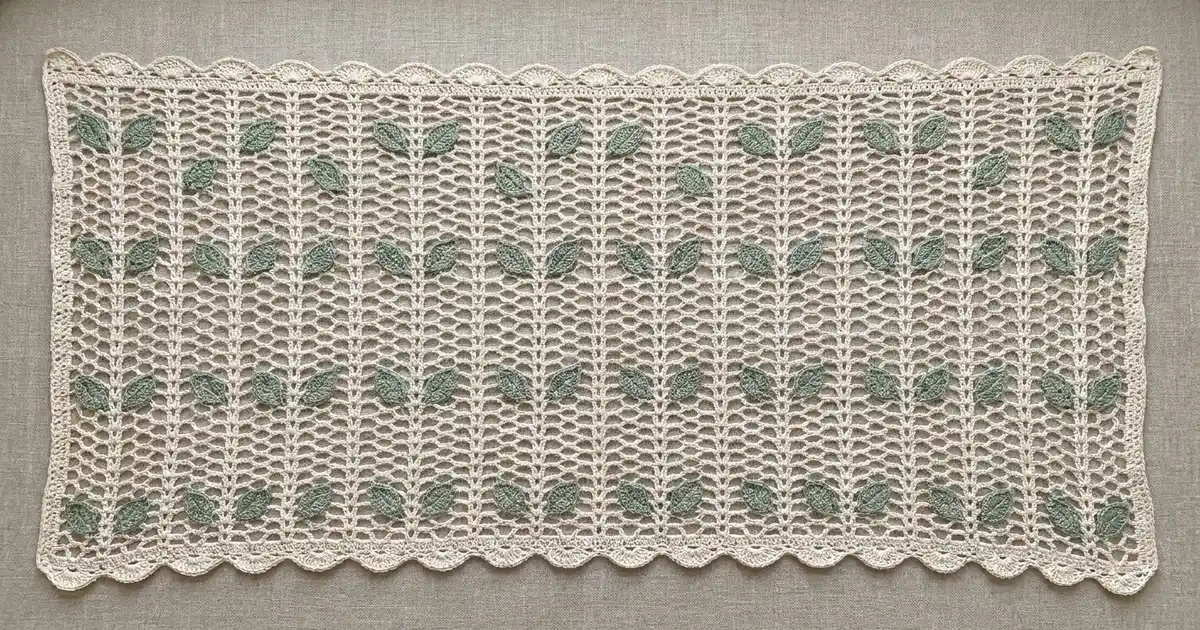
This lace curtain panel has an open arch mesh in soft ivory cotton, with sage-green leaves running up the fabric in straight vertical vines. In daylight the mesh glows and the leaves look like they are climbing toward the rod.
The palette is just two colors: warm ivory for the mesh and a muted sage green for the leaves. The style is calm and botanical and goes well with farmhouse, cottage, or Scandinavian rooms. The pattern uses US crochet terms throughout.
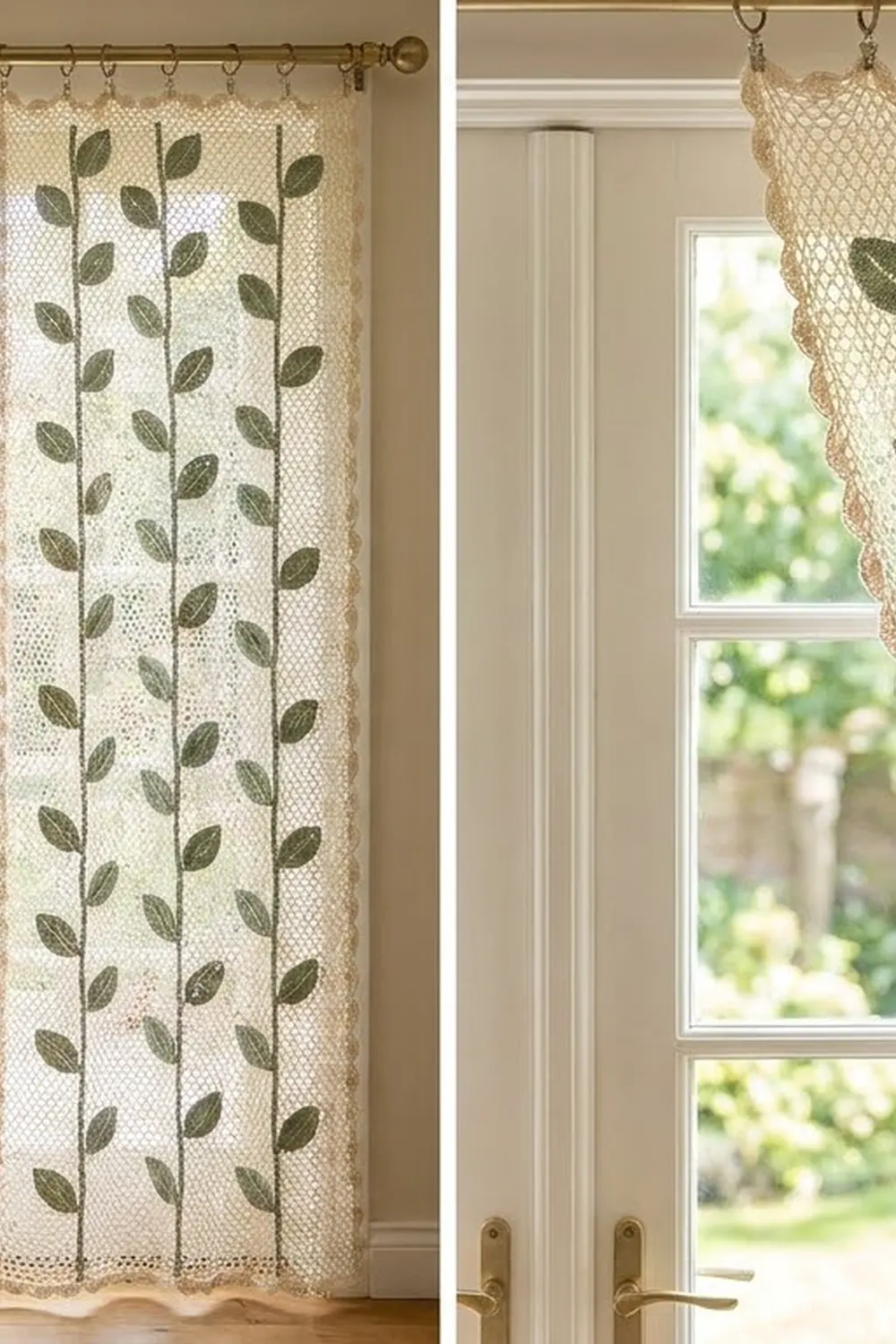
One panel finishes at 41 in wide x 85 in long (104.1 cm x 215.9 cm). The photo shows a matching pair hung from clip rings, so make two panels if you want the same look.
You crochet the mesh flat in rows from the bottom up as one continuous piece. Columns of double crochet form the vine stems, and chain arches fill the spaces between them. The leaves are crocheted separately and sewn onto the stems. A two-round border finishes the edges, with shells along the top and bottom.
Finished Size and Construction
- Finished size (one panel): 41 in x 85 in (104.1 cm x 215.9 cm)
- Skill level: Intermediate
- Terminology: US crochet terms
- Yarn weight: DK (#3) cotton
- Hook: 4.0 mm (G-6) for the mesh, 3.5 mm (E-4) for the leaves
- Number of pieces: 1 continuous mesh panel + 243 leaf appliqués
- Layout: 10 pattern repeats across; 11 stem columns (9 leafy interior vines and 2 plain edge stems)
- Piece size before border: 40 in x 83 in (101.6 cm x 210.8 cm)
- Border depth: 1 in (2.5 cm) at the top and bottom, 0.5 in (1.3 cm) at each side
Materials
Pick a smooth mercerized or combed cotton DK of about 115 m per 50 g. Cotton holds the arches open, drapes well, and stands up to sunlight and washing. Avoid fuzzy yarns, because they blur the mesh.
Yarn (one panel):
- Ivory (mesh and border): 550 g / 1,265 m (11 balls of 50 g)
- Sage green (leaves): 250 g / 575 m (5 balls of 50 g)
These quantities include a margin of about 15% for swatching, sewing tails, and gauge differences. Double them for a pair.
Tools:
- 4.0 mm (G-6) crochet hook
- 3.5 mm (E-4) crochet hook
- Tapestry needle
- Locking stitch markers (at least 20)
- Rust-proof pins and a large blocking surface or a clean floor with towels
- Measuring tape
- Clip rings or a curtain rod with clips for hanging
Abbreviations (US Terms)
- ch – chain
- sl st – slip stitch
- sc – single crochet
- hdc – half double crochet
- dc – double crochet
- sk – skip
- sp – space
- st(s) – stitch(es)
- rep – repeat
- RS / WS – right side / wrong side
Special stitch – Shell: work 5 dc in the same stitch.
Turning chain: In the arch rows, ch 3 at the start counts as the first dc (the first stem).
Gauge and Checkpoints
Mesh gauge (4.0 mm hook): 18 sts (one pattern repeat) = 4 in (10.2 cm) wide. 4 arch rows = 3 in (7.6 cm) tall, so each arch row is 0.75 in (1.9 cm).
Border gauge: 18 sc = 4 in (10.2 cm).
Test swatch first. Ch 38. Work Row 1 (37 sc), then Rows 2–9 as written below, with 2 repeats instead of 10. The swatch should be 8 in (20.3 cm) wide. It should be 6.25 in (15.9 cm) tall: 0.25 in (0.6 cm) for the sc row plus 6 in (15.2 cm) for 8 arch rows. Steam it lightly and let it relax before you measure.
- Swatch too big: go down to a 3.75 mm (F-5) hook.
- Swatch too small: go up to a 4.5 mm (7) hook.
- Width right but rows too short: pull up the dc slightly taller. Don’t change hooks.
Checkpoints during the panel:
- Row 1: 181 sc, 40 in (101.6 cm) wide
- After Row 41: 30.25 in (76.8 cm) tall
- After Row 81: 60.25 in (153.0 cm) tall
- After Row 111: 82.75 in (210.2 cm) tall
- After Row 112: 83 in (210.8 cm) tall
Measure flat, without stretching. Cotton mesh grows a little when it hangs, so being a touch short is safer than being long.
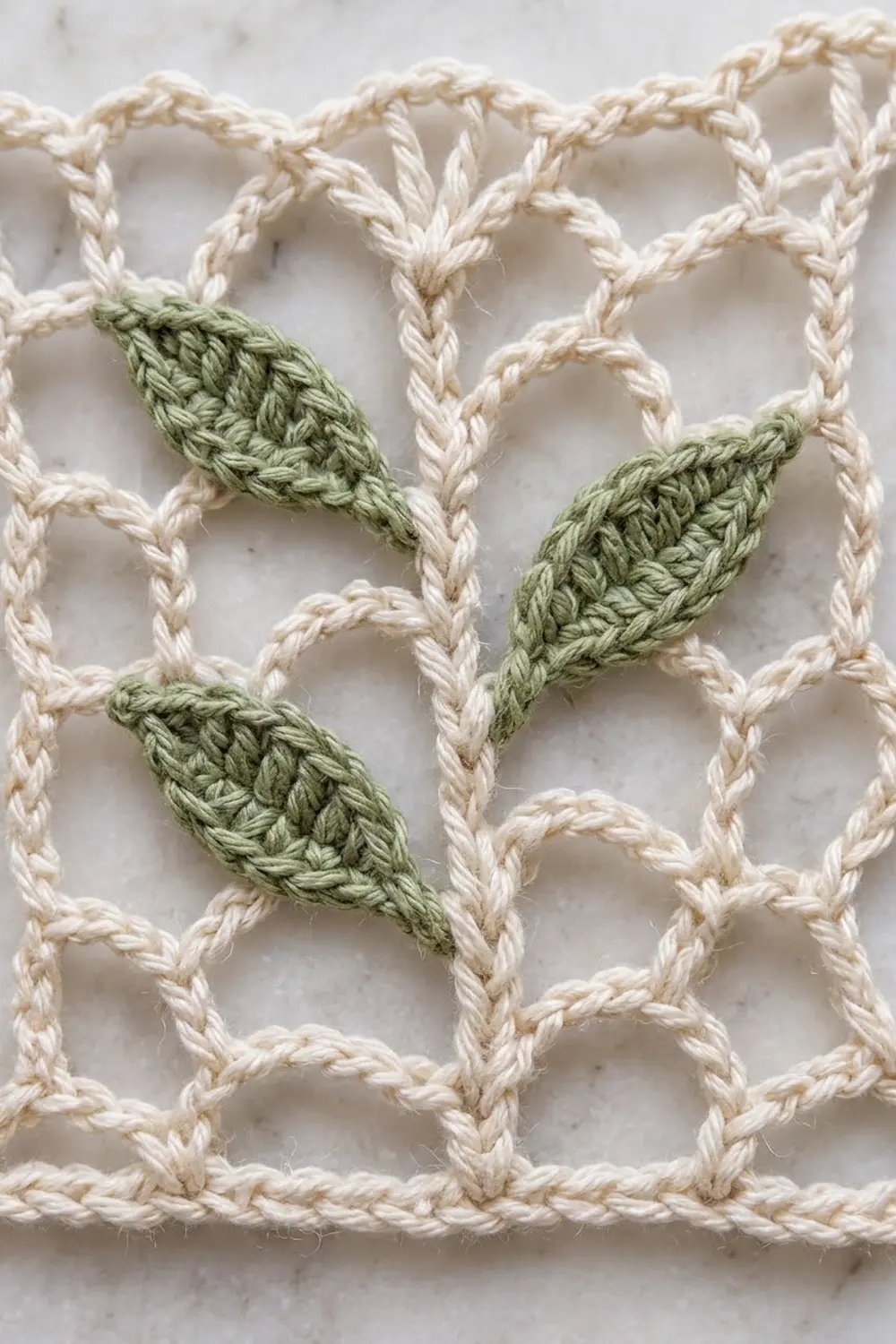
The Mesh Panel
With ivory and the 4.0 mm hook:
Foundation: Ch 182.
Row 1 (RS): Sc in 2nd ch from hook and in each ch across, turn. (181 sc)
Row 2 (set-up arch row, A): Ch 3 (counts as dc). *Ch 5, sk 5 sc, sc in next sc, ch 5, sk 5 sc, sc in next sc, ch 5, sk 5 sc, dc in next sc. Rep from * 9 more times, turn. (11 dc, 20 sc, 30 ch-5 sps)
Each repeat uses exactly 18 sts of Row 1 (5 + 1 + 5 + 1 + 5 + 1). Ten repeats use 180 sts, and the starting ch 3 uses the 181st. The dc land on sts 1, 19, 37, and so on up to st 181. These are your 11 stem positions. Mark stems 2–10. These are the leafy vines.
Row 3 (B): Ch 3 (counts as dc). *Ch 2, sc in next ch-5 sp, ch 5, sc in next ch-5 sp, ch 5, sc in next ch-5 sp, ch 2, dc in next dc. Rep from * 9 more times, working the last dc in the top of the turning ch, turn. (11 dc, 30 sc, 20 ch-5 sps, 20 ch-2 sps)
Row 4 (A): Ch 3 (counts as dc). *Ch 5, sk ch-2 sp, sc in next ch-5 sp, ch 5, sc in next ch-5 sp, ch 5, sk ch-2 sp, dc in next dc. Rep from * 9 more times, working the last dc in the top of the turning ch, turn. (11 dc, 20 sc, 30 ch-5 sps)
Rows 5–111: Rep Rows 3 and 4 alternately. Odd rows are B and even rows are A, and you end after a B row (Row 111). That is 110 arch rows in total (Rows 2–111).
The stems are a dc worked into the dc below in every row. This stacking makes the straight, braided-looking vertical columns. The arches shift half a step every row, which gives the overlapping scallop mesh.
Row 112 (closing row): Ch 1. Sc in first dc. *2 sc in ch-2 sp, sc in sc, 5 sc in ch-5 sp, sc in sc, 5 sc in ch-5 sp, sc in sc, 2 sc in ch-2 sp, sc in next dc. Rep from * 9 more times, working the last sc in the top of the turning ch. Do not fasten off. (181 sc)
Each repeat closes with 2 + 1 + 5 + 1 + 5 + 1 + 2 + 1 = 18 sc. Ten repeats give 180, plus the first sc makes 181. That matches Row 1 exactly, so the top and bottom edges are the same width for the border.
Leaves (Make 243)
With sage green and the 3.5 mm hook:
Foundation: Ch 9.
Round 1: Sl st in 2nd ch from hook. Sc in next ch, hdc in next ch, dc in next 2 ch, hdc in next ch, sc in next ch. Work (sc, ch 2, sc) in last ch for the tip. Rotate and work along the other side of the foundation: sc in next ch, hdc in next ch, dc in next 2 ch, hdc in next ch, sc in next ch, sl st in last ch. (16 sts + 1 ch-2 tip sp)
Round 2: Ch 1. Sc in each of the next 8 sts, (sc, ch 2, sc) in tip sp, sc in each of the next 8 sts. Join with a sl st to the first sc. (18 sc + 1 ch-2 tip sp)
Fasten off, leaving a 12 in (30.5 cm) tail for sewing. The leaf is a pointed oval about 2 in (5.1 cm) long and 1 in (2.5 cm) wide. The center foundation line reads as a vein.
Leaf placement map (each of stems 2–10):
Row 109   ....| LEAF   (right)
Row 105   LEAF |....   (left)
  ...     alternate every 4 rows
Row 13    LEAF |....   (left)
Row 9     ....| LEAF   (right)
Row 5     LEAF |....   (left)
Row 1     ====|====    (no leaves)
On each interior stem, place one leaf at Rows 5, 9, 13, … up to 109. That’s 27 leaves per stem, alternating left and right, with leaves on the same side every 6 in (15.2 cm). 9 stems x 27 leaves = 243 leaves. Stems 1 and 11 at the side edges stay bare.
To attach: With the RS facing, lay the leaf base over the stem dc of that row. Angle the tip upward at about 45° so the leaf lies over the neighboring arch. Whipstitch the base securely to the dc. Then tack the leaf in 2 places along its length to the arch beneath so it can’t flip. Weave the tail through the back of the leaf only, so no green shows through the mesh.
Pin all leaves on one stem before you sew. This lets you check the alternating rhythm.
Border
Border gauge: 18 sc = 4 in (10.2 cm). Work with ivory and the 4.0 mm hook. Continue from Row 112 without fastening off.
Round 1: Ch 1, then work these four sides:
- Top: sc in each st across the top. (181 sc) Ch 2 for the corner.
- Left side: working down the row ends, 1 sc in the end of Row 112, 3 sc in each arch-row end (Rows 111–2), 1 sc in the end of Row 1. (1 + 330 + 1 = 332 sc) Ch 2 for the corner.
- Bottom: sc in each free loop of the foundation ch. (181 sc) Ch 2 for the corner.
- Right side: working up the row ends, 332 sc as before. Ch 2 for the corner.
- Join with a sl st to the first sc.
(1,026 sc + 4 corner ch-2 sps)
The corner ch-2 spaces sit between the sides, so the per-side counts don’t include any corner stitches twice.
Round 2: Ch 1, then work these four sides:
- Top: sc in first sc. *Sk 2 sc, shell in next sc, sk 2 sc, sc in next sc. Rep from * 29 more times. (30 shells, 31 sc) Work (sc, ch 2, sc) in the corner sp.
- Side: sc in each of 332 sc. Work (sc, ch 2, sc) in the corner sp.
- Bottom: work as for the top. (30 shells, 31 sc) Work (sc, ch 2, sc) in the corner sp.
- Side: sc in each of 332 sc. Work (sc, ch 2, sc) in the last corner sp.
- Join with a sl st to the first sc. Fasten off.
Why the math works: Each shell repeat uses 6 sts. 1 + (30 x 6) = 181, so the shells fit the top and bottom exactly, with a sc at both ends.
The sides have 332 sc over 83 in (210.8 cm), which is 4 sc per inch. That’s slightly under the 4.5 sc per inch of the top edge. Hanging cotton stretches lengthwise, and this slightly firmer count keeps the side hems flat instead of rippling.
The border adds 0.5 in (1.3 cm) to each side and 1 in (2.5 cm) at the top and bottom. 40 + 1 = 41 in (104.1 cm) wide, and 83 + 2 = 85 in (215.9 cm) long.
Final Blocking
- Weave in all remaining ivory ends along the stem columns.
- Soak the panel in lukewarm water for 15 minutes, then press out the water. Don’t wring it.
- Roll it in towels to remove more moisture.
- Lay it flat on towels or blocking mats to 41 in x 85 in (104.1 cm x 215.9 cm).
- Pin the side edges straight first, then the top and bottom.
- Pin each top and bottom shell into a rounded scallop.
- Run your fingers up each stem to straighten it, and open any twisted arches.
- Smooth each leaf flat and point its tip up at 45°.
- Let it dry completely, about 24–36 hours.
- Unpin and hang. Let it settle for a day before you judge the length.
Final Quality-Control Checklist
- Row 1 and Row 112 both have 181 sc.
- Every arch row has 11 dc stems in vertical lines.
- A rows have 30 ch-5 sps. B rows have 20 ch-5 sps and 20 ch-2 sps.
- There are 27 leaves on each of stems 2–10, alternating sides.
- Each side has 332 sc. The top and bottom each have 30 shells.
- The blocked size is 41 in x 85 in (104.1 cm x 215.9 cm).
- No green tails show through the mesh.
Troubleshooting
- Stems wander sideways: you missed or doubled a ch-5. Count the arches between stems: 3 in an A row, 2 full plus 2 half arches in a B row.
- Panel narrows as it grows: your chains are tightening. Use a hook one size larger for the ch-5s only.
- Panel will be too long: stop 2 arch rows (1.5 in / 3.8 cm) earlier for each adjustment. Always end on a B row before the closing row, and recount the side border (3 sc per arch row + 2).
- Leaves curl: steam them and pin them flat. Use the 3.5 mm hook, not the larger one.
- Side edges ripple: work 2 sc instead of 3 in every tenth arch-row end, removing the same number on both sides.
- Side edges pull in: work 4 sc instead of 3 in every tenth arch-row end on both sides.
- Shells don’t fit: your top or bottom count isn’t 181. Fix the count first.
Care
Hand wash or machine wash on a delicate cycle in cool water inside a large mesh laundry bag. Reshape the panel while damp and dry it flat or hanging. Avoid hot dryers, which shrink cotton and distort the arches.
Final Notes
The whole curtain comes from one measurement chain. 18 sts make 4 in (10.2 cm), and 10 repeats plus 1 give 181 sts and 40 in (101.6 cm). The first sc row is 0.25 in (0.6 cm) tall and each of the 110 arch rows adds 0.75 in (1.9 cm). With the closing row, that gives 83 in (210.8 cm). The border brings the panel to 41 in x 85 in (104.1 cm x 215.9 cm), and 243 sage leaves climb the nine vines.
Check your swatch, count at each checkpoint, and the panel will hang straight. Happy crocheting!